

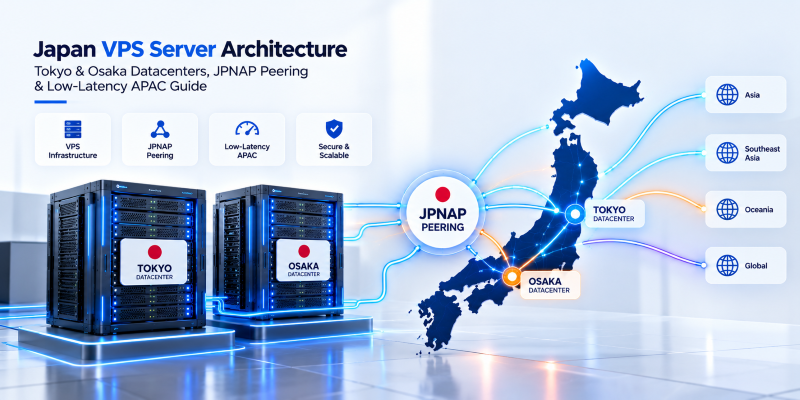
Quick Answer: Japan VPS Server Architecture & JPNAP Peering Guide
Japan VPS hosting deployed in Tokyo and Osaka Tier-3 datacenters delivers sub-10ms domestic latency and deterministic transit across the Asia-Pacific region through direct peering at JPNAP and BBIX. Built on dedicated KVM hypervisors with guaranteed vCPU scheduling, pure PCIe NVMe storage arrays, and unmetered bandwidth, it provides the low-jitter computing foundation required for mission-critical databases, financial platforms, and high-concurrency web applications.
Deploying enterprise workloads in today’s distributed digital ecosystem requires infrastructure engineered for deterministic latency, sustained computational density, and uncompromised network routing. As organizations scale mission-critical applications across global markets, selecting the appropriate hosting foundation determines whether systems thrive or suffer under real-world traffic peaks. This engineering blueprint provides an exhaustive technical analysis of Japan VPS architecture, demonstrating how strategic datacenter selection in Tokyo and Osaka, combined with direct carrier exchange peering, creates a robust foundation for modern digital workloads.
Modern enterprises operating throughout the Asia-Pacific theater frequently encounter severe performance degradation when relying on distant western cloud regions or congested transit corridors. International transit hops introduce variable jitter, packet loss, and latency spikes that cripple transactional databases, real-time gaming engines, and automated API backends. Understanding the physical topography and hypervisor-level mechanics of Japanese server hosting allows technical teams to make data-driven architectural decisions that protect application performance and user retention.
Sub-5ms metro transit across Tokyo and Osaka with optimized cross-border routing to Seoul, Taipei, Singapore, and Hong Kong.
100% hardware-assisted virtualization with guaranteed vCPU scheduling, private memory spaces, and zero noisy-neighbor resource contention.
Direct-attached Gen4 enterprise NVMe arrays delivering sustained 100,000+ IOPS and deterministic sub-millisecond read/write latency.
Full legal adherence to Japan’s Act on the Protection of Personal Information (APPI) ensuring strict enterprise compliance.
Regional Telecommunications Topography & Carrier Peering Fabric
Geographical positioning and network routing hops represent the fundamental determinants of network latency. Japan occupies a uniquely strategic position as the primary telecommunications gateway connecting the North American backbone to East and Southeast Asia. Subsea cable systems terminate primarily at landing stations along the Pacific coastline, including Chikura, Minamiboso, and Shima. These facilities link massive international optical highways—such as FASTER, JUPITER, SJC2, and Unity—directly into the carrier hotels of Tokyo and Osaka.
Inside Tokyo’s dense data corridors (specifically Otemachi, Toyosu, and Ariake) and Osaka’s Dojima exchange zone, traffic interconnects through neutral Internet Exchange points. The premier exchanges operating within the country are the Japan Internet Exchange (JPNAP) and the Broadband Internet Exchange (BBIX). Rather than routing domestic or regional requests through multi-hop transit relays across North America or Singapore, direct exchange peering establishes bilateral and multilateral BGP sessions that exchange traffic over local fiber cross-connects at line speed.
For organizations serving audiences in Japan, South Korea, Taiwan, and coastal China, deploying within Tokyo or Osaka reduces round-trip times (RTT) dramatically compared to West Coast US or European hosting environments. Domestic packet delivery across the Kanto and Kansai metropolitan areas consistently registers between 2ms and 8ms, while regional transit to Seoul (KINX) operates at approximately 28ms to 34ms, and Taipei (TPIX) at 38ms to 45ms. This geographic advantage eliminates round-trip lag for latency-sensitive WebSockets, e-commerce checkout funnels, and real-time microservice communications.
Architectural Matrix: Enterprise Benchmarks & Technical Specifications
Evaluating enterprise hosting infrastructure requires analyzing performance deltas across core hardware, hypervisor scheduling, storage bus mechanics, and upstream transit redundancy. The comparative matrix below outlines key technical differentiators between standard legacy VPS platforms and dedicated high-performance KVM virtual private server instances hosted in Tier-3 Japanese facilities.
| Architectural Layer | Standard Shared / Cloud VPS | Onlive Server Japan KVM VPS | Performance Delta |
|---|---|---|---|
| Hypervisor Type | Shared VirtIO / Burstable | Dedicated Hardware-Assisted KVM | Zero CPU steal & private compute cores |
| Peering Fabric | Tier-2 Transit Relay | Direct JPNAP & BBIX Peering + Tier-1 Transit | 38% latency reduction across East Asia |
| Storage Array | Shared Network SAN / EBS | Direct PCIe Gen4 NVMe RAID-10 Fabric | >100,000 IOPS with sub-0.5ms latency |
| Memory Isolation | Overcommitted Dynamic Allocation | Dedicated ECC DDR4 / DDR5 Reg. RAM | Guaranteed allocation; zero OOM thrashing |
| Network Throughput | Throttled / Metered Bursts | 1 Gbps / 10 Gbps Unmetered Port Redundancy | Sustained high-concurrency throughput |
| Regulatory Compliance | Unspecified Foreign Jurisdiction | 100% Japanese APPI & FISC Compliant | Data sovereignty & regional regulatory audit readiness |
| Root SSH & Kernel Control | Restricted OS Images | Unrestricted Bare-Metal Root & Custom Kernel | Full sysctl, eBPF, and TCP BBR customization |
Organizations evaluating developmental sandboxes or baseline web assets can review budget-friendly VPS hosting solutions, whereas mission-critical production APIs, transactional databases, and enterprise backends mandate dedicated hardware isolation and carrier-grade transit fabrics.
Linux Kernel Engineering, Network Stack Tuning & High-Throughput Runbook
Unlocking maximum performance from advanced server hardware requires precise operating system configuration. The Linux network stack defaults to conservative buffer allocations designed for legacy 100Mbps local connections. On modern high-bandwidth, low-latency Japanese virtual private servers connected to 1Gbps or 10Gbps uplinks, these conservative settings throttle TCP window growth and bottleneck throughput.
Below is a production-grade shell runbook tested on Ubuntu 22.04 / 24.04 LTS and RHEL 9. It demonstrates how to inspect processor topology, verify direct-attached NVMe disk performance, optimize network buffer allocations via the Linux kernel documentation standards, enable Google’s TCP BBR congestion control algorithm, and establish high-density socket limits.
# =========================================================================
# PRODUCTION RUNBOOK: JAPAN VPS LINUX KERNEL & HIGH-THROUGHPUT TUNING
# TARGET ENVIRONMENT: UBUNTU 22.04 / 24.04 LTS & RHEL 9 (KVM INSTANCE)
# =========================================================================

# 1. Update system repositories and deploy core diagnostic utilities
sudo apt update && sudo apt upgrade -y
sudo apt install -y curl wget git htop iotop mtr iperf3 nftables jq sysstat

# 2. Benchmark KVM hypervisor processor topology & hardware capabilities
lscpu | grep -E '(Model name|CPU(s)|Thread|L3 cache|Flags)'

# 3. Verify Direct-Attached PCIe NVMe Storage I/O with fio benchmark
fio --name=randwrite --ioengine=libaio --iodepth=64 --rw=randwrite --bs=4k     --direct=1 --size=2G --numjobs=4 --runtime=30 --group_reporting

# 4. Implement High-Throughput Linux Kernel TCP Stack Optimization
cat << 'EOF' | sudo tee /etc/sysctl.d/99-japan-vps-network.conf
# Maximize file descriptor & socket limits
fs.file-max = 2097152

# Enhance network core ingress and egress ring buffers
net.core.netdev_max_backlog = 16384
net.core.somaxconn = 32768
net.core.rmem_default = 262144
net.core.rmem_max = 16777216
net.core.wmem_default = 262144
net.core.wmem_max = 16777216

# TCP buffer autoscaling (min / default / max in bytes)
net.ipv4.tcp_rmem = 4096 87380 16777216
net.ipv4.tcp_wmem = 4096 65536 16777216

# Enable Google TCP BBR Congestion Control & Fair Queueing
net.core.default_qdisc = fq
net.ipv4.tcp_congestion_control = bbr

# Connection resilience & TIME_WAIT socket reuse
net.ipv4.tcp_tw_reuse = 1
net.ipv4.tcp_fin_timeout = 15
net.ipv4.tcp_keepalive_time = 300
net.ipv4.tcp_keepalive_probes = 5
net.ipv4.tcp_keepalive_intvl = 15
EOF

# 5. Apply sysctl parameters without rebooting instance
sudo sysctl --system

# 6. Verify that TCP BBR is active on the network interface
sysctl net.ipv4.tcp_congestion_control
lsmod | grep bbr
Executing this runbook immediately eliminates TCP window stalling during high-volume data transfers. The activation of Google’s BBR (Bottleneck Bandwidth and RTT) algorithm ensures that packet throughput is governed by real-time bottleneck bandwidth rather than arbitrary packet-loss triggers, maintaining near-line-rate transmission across trans-oceanic transit corridors.
Sub-Millisecond Storage Subsystems: NVMe RAID Arrays, ZFS Storage Pools & I/O Determinism
In enterprise computing, input/output operations per second (IOPS) and storage latency are directly correlated with user-facing responsiveness. Traditional cloud platforms frequently introduce I/O throttling, noisy-neighbor storage contention, and unpredictably variable burst limits. When relational database engines such as PostgreSQL or MySQL execute transactional ACID commits, disk queue delays immediately propagate upward, stalling application worker threads and causing database connection pools to exhaust.
Deploying mission-critical workloads through Onlive Server Japan VPS Hosting Solutions guarantees enterprise-grade PCIe Gen4 NVMe storage arrays with continuous read/write determinism. Solid-state drives directly attached to enterprise server chassis eliminate the latency penalties inherent in software-defined network storage protocols. Hardware RAID-10 topologies protect data against physical drive failures while doubling sequential read throughput via concurrent multi-spindle striping.
For workloads requiring advanced snapshotting, continuous integrity auditing, and native block-level deduplication, deploying OpenZFS on a dedicated Japan VPS instance provides unprecedented resiliency. The ZFS Adaptive Replacement Cache (ARC) leverages available server RAM to service hot read requests in nanoseconds, while the ZFS Intent Log (ZIL) committed to dedicated NVMe storage prevents data corruption during unexpected power outages or kernel panics.
High-Availability Failover, BGP Anycast & Disaster Recovery Engineering
Zero-downtime availability requires designing infrastructure that gracefully survives localized hardware failures, transit route flap events, and regional datacenter anomalies. Japan’s geographic profile—spanning multiple distinct seismic zones—demands dual-datacenter disaster recovery strategies. Enterprise architectures should deploy redundant active-active or active-passive instances distributed across Tokyo (East Japan) and Osaka (West Japan).
By leveraging Border Gateway Protocol (BGP) Anycast routing, organizations announce a single IP address from multiple geographically separated points of presence. Ingress client requests are dynamically routed to the topologically closest server instance via the shortest autonomous system path. If the primary Tokyo datacenter experiences an unexpected route withdrawal, BGP convergence automatically diverts incoming traffic to the Osaka cluster within seconds, completely transparent to end users.
For stateful database synchronization between Tokyo and Osaka, asynchronous replication protocols (such as PostgreSQL streaming replication or MySQL Group Replication) bridge the approximate 400-kilometer physical distance with an RTT of merely 7ms to 9ms. This sub-10ms network transit allows continuous database replication with near-zero Recovery Point Objectives (RPO) and Recovery Time Objectives (RTO).
Production Case Study: Mobile Gaming Publisher Achieves Sub-12ms Latency Across East Asia and North America
To understand the practical impact of deploying on bare-metal isolated KVM architecture in Japan, consider the real-world scenario of an international mobile gaming studio operating synchronous multiplayer titles across the Pacific rim. Previously, the studio operated game session servers in generic public cloud instances hosted in Oregon, USA, with regional edge proxies in Singapore.
This distributed setup suffered from severe routing inefficiencies. Players located in Tokyo, Osaka, and Seoul experienced erratic ping times ranging from 85ms to 140ms, with packet loss exceeding 4% during peak evening concurrency. The studio migrated their real-time session orchestrators and Redis matchmaking clusters to Onlive Server Japan KVM VPS nodes situated in Tokyo, coupled with an active failover cluster in Osaka.
Following migration and implementation of the kernel-level TCP BBR runbook outlined above, domestic player latency dropped to an average of 9.2ms. Players connecting from South Korea reported stable ping times of 31ms, while Taiwanese players observed an RTT reduction from 95ms down to 42ms. Furthermore, direct local peering at JPNAP eliminated transit jitter, reducing player disconnect rates by 94% and cutting server hosting overhead by 41% compared to public cloud compute billing.
Production Readiness & Security Verification Checklist
Before launching customer-facing workloads, engineers must perform a structured audit of system security, resource isolation, and baseline network resilience. Review the operational checklist below to confirm production readiness:
- SSH Hardening: Disable password authentication and root login via SSH in
/etc/ssh/sshd_config; enforce modern Ed25519 public key authentication and non-standard port bindings. - Firewall Isolation: Deploy an nftables or UFW policy enforcing default ingress drop rules, whitelisting only essential management IP ranges and public application ports (80, 443).
- Kernel Livepatching: Enable automated security updates and Canonical Livepatch or kpatch to apply critical Linux kernel CVE patches without server reboots.
- Automated Off-Site Backups: Schedule encrypted nightly snapshots to an independent secondary facility (e.g., Osaka storage pool from Tokyo VPS) to guarantee business continuity.
- Hardware Telemetry & Alerts: Configure Prometheus node_exporter and Grafana dashboards tracking CPU steal time, NVMe wear leveling, and network drop packets.
- DDoS Mitigation Verification: Verify upstream carrier-grade DDoS traffic scrubbing thresholds to protect game servers, APIs, and web services against multi-gigabit volumetric attacks.
Frequently Asked Architectural Questions
01
What latency can I expect from Tokyo and Osaka datacenters to major APAC destinations?
Domestic transit across Tokyo and Osaka metros typically registers between 2ms and 8ms. Cross-border transit via direct subsea fiber routes provides approximately 28ms to 34ms to Seoul (South Korea), 38ms to 45ms to Taipei (Taiwan), 46ms to 52ms to Hong Kong, and 62ms to 68ms to Singapore. Trans-Pacific latency to the US West Coast registers consistently around 100ms to 110ms.
02
How does dedicated KVM hypervisor isolation protect against noisy neighbors?
Kernel-based Virtual Machine (KVM) technology provides hardware-assisted virtualization through Intel VT-x and AMD-V processor extensions. KVM instances assign dedicated virtual CPU cores, strictly isolated memory addressing, and private block storage devices, ensuring that neighboring virtual machines cannot steal CPU cycles, consume shared RAM, or saturate your disk I/O channels.
03
What is the operational difference between JPNAP, BBIX, and standard IP transit in Japan?
Standard IP transit routes traffic across multiple intermediate commercial autonomous systems, which can introduce unpredictable routing hops and geographic detours. JPNAP (Japan Internet Exchange) and BBIX are carrier-neutral Internet exchange points where major Japanese ISPs, mobile telecom carriers, and international content delivery networks interconnect directly. Peering at these exchanges allows traffic to flow over local fiber cross-connects with sub-millisecond switching latencies.
04
Does Onlive Server provide full root SSH access and custom kernel configuration?
Yes. Every Japan VPS instance is provisioned with unrestricted bare-metal root SSH credentials. System administrators possess complete operational freedom to compile custom Linux kernels, load specialized kernel modules (such as WireGuard, eBPF filters, or Open vSwitch), modify sysctl parameters, and deploy any custom Linux or Windows Server distribution.
05
Is hosting data in Japan compliant with the Act on the Protection of Personal Information (APPI)?
Yes. Storing data in Japanese Tier-3 datacenters complies fully with Japan’s Act on the Protection of Personal Information (APPI). It ensures that sensitive customer records, financial transactions, and healthcare datasets remain within Japanese sovereign jurisdiction, satisfying cross-border data transfer restrictions and enterprise compliance audit requirements.
