

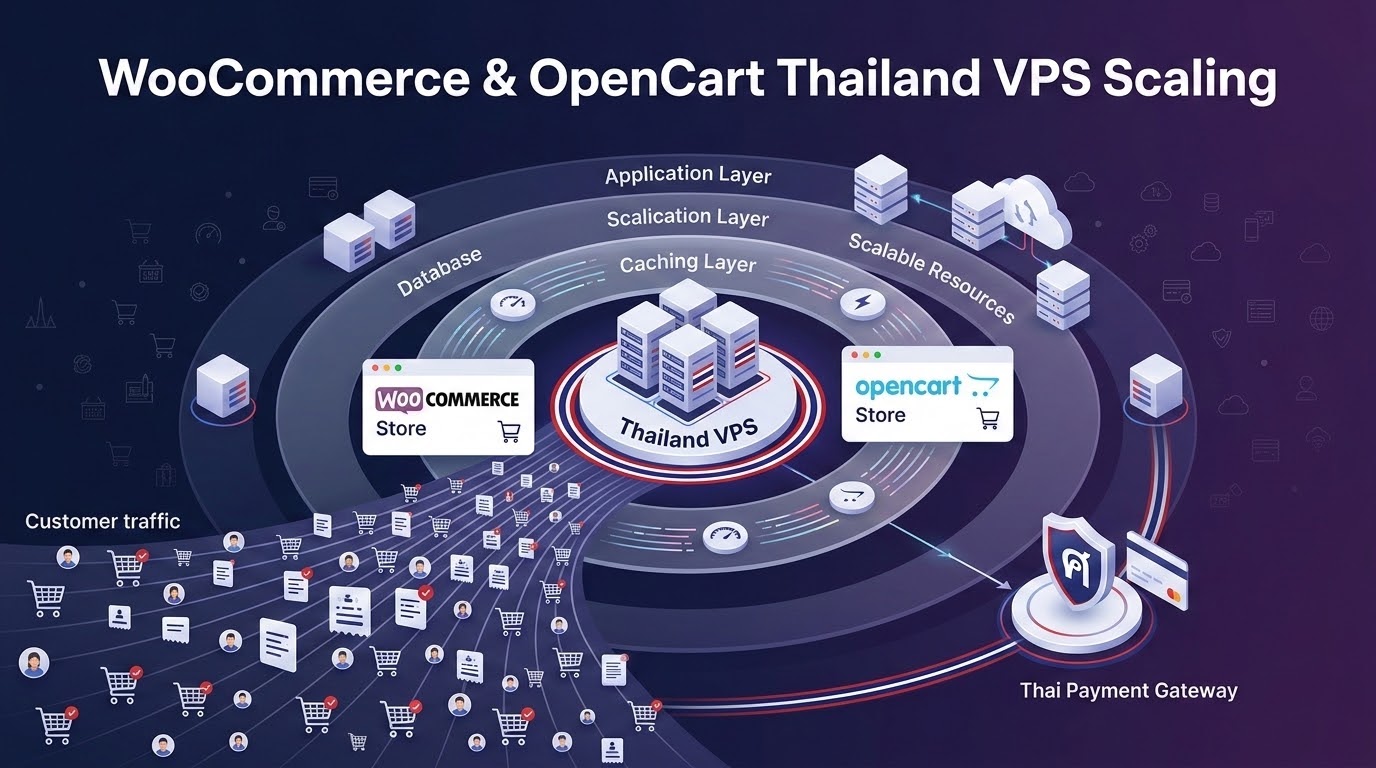
How Do You Scale WooCommerce for High-Concurrency Thai Flash Sales?
Specifically, when planning an enterprise deployment for E-Commerce VPS Thailand, to scale WooCommerce for high-concurrency Thai flash sales (e.g., 11.11 and payday events), deploy a Bangkok VPS with at least 4 to 8 vCPUs, 8GB to 16GB RAM, and NVMe storage. Configure MySQL InnoDB buffer pool to 70% of RAM, deploy Redis object caching, and tune PHP-FPM workers to process PromptPay webhooks in under 150ms.
Furthermore, in Thailand’s booming digital retail market—driven by social commerce on LINE Shopping, TikTok Shop, and massive double-digit promotional flash sales (9.9, 11.11, 12.12)—e-commerce performance directly dictates business survival. When an online brand launches a limited-edition flash drop or broadcast campaign, thousands of concurrent shoppers flood the checkout funnel simultaneously. On generic shared hosting or under-provisioned servers, concurrent database row locks trigger the Linux Out-Of-Memory killer, crash MySQL, and drop bank payment webhooks. Choosing e-commerce optimized Thailand VPS hosting plans in Bangkok guarantees dedicated KVM hardware isolation, sub-microsecond NVMe storage write speeds, and seamless integration with Thai payment rails.
Operational Infrastructure Takeaway
- Consequently, The Flash Sale Concurrency Trap: Shared hosting collapses when 50+ customers attempt simultaneous checkouts; dedicated KVM compute is non-negotiable.
- In addition, PromptPay Webhook Optimization: Fast server response (<200ms) prevents bank gateway webhook retry loops and double-billing discrepancies.
- In particular, InnoDB Buffer Pool Allocation: Dedicating 60%–70% of RAM to MySQL keeps WooCommerce postmeta and order tables cached entirely in memory.
- Granular Cache Exceptions: Page-cache 90% of guest catalog traffic while bypassing shopping carts, customer accounts, and checkout endpoints.
- Consequently, aligning these configurations with your E-Commerce VPS Thailand environment ensures optimal uptime and throughput. Local BKNIX Low-Latency Routing: Sub-10ms domestic ping across AIS, True, and 3BB ensures instant PromptPay QR code generation on mobile screens.
- Therefore, The High-Stakes World of Thai E-Commerce: Surviving Payday and 11.11 Flash Sales
- Moreover, Why Shared Hosting Inevitably Fails During High-Volume Concurrent Checkouts
- In fact, The Anatomy of Local Payment Gateways: Integrating PromptPay, Omise & 2C2P
- Similarly, Eliminating Database Lock Contention on WooCommerce: InnoDB Buffer Pool Tuning
- Caching Strategies for Dynamic Stores: Bypassing Carts While Accelerating Catalog Pages
- Meanwhile, Ensuring Zero Webhook Failures: Optimizing Server Response for Bank Callbacks
- Additionally, Sizing Your E-Commerce VPS: Recommended Compute Tiers for Growing Online Brands
- As a result, Frequently Asked Questions (FAQ)
1
Specifically, thailand’s e-commerce ecosystem is characterized by extreme demand volatility. Consumer purchasing volume is concentrated into tightly compressed temporal windows:
- Consequently, aligning these configurations with your E-Commerce VPS Thailand environment ensures optimal uptime and throughput. Monthly Corporate Payday Cycles (25th–1st): Commercial banks disburse monthly salaries, triggering a massive 300%–500% surge in online retail purchasing across domestic mobile applications.
- Consequently, aligning these configurations with your E-Commerce VPS Thailand environment ensures optimal uptime and throughput. Double-Digit Mega Campaigns (9.9, 10.10, 11.11, 12.12): Synchronized promotional campaigns create fierce concurrency spikes between 00:00 and 02:00 AM, where thousands of shoppers compete for voucher discounts.
- Livestream Shopping Surges: Influencer broadcasts on TikTok and LINE generate sudden, unpredictable traffic spikes that direct 1,500+ simultaneous checkout requests to an online store within seconds.
Furthermore, in this high-stakes environment, server downtime does not merely delay transactions—it destroys sales permanently. Thai shoppers confronted by a frozen checkout screen or a failing payment QR code simply switch to a competitor’s store.
2
Consequently, many growing retailers start on inexpensive shared hosting plans. While shared hosting can serve static product catalog pages when cached by a CDN, it fundamentally collapses during active checkout transactions:
| Architectural Bottleneck | Shared Hosting Reality | Dedicated Bangkok KVM VPS |
|---|---|---|
| PHP Worker Concurrency | Hard-capped at 5–10 concurrent workers. | Configurable (35–100+ dedicated workers). |
| Database Memory Buffer | Shared buffer pool among 300+ neighbor sites. | Dedicated 4GB–12GB+ InnoDB pool in physical RAM. |
| Storage Write Throughput | Throttled SATA SSD (50–150 write IOPS). | Pure PCIe Gen4 NVMe (200,000+ write IOPS). |
| Out-Of-Memory (OOM) Risk | Host kills MySQL instantly during memory spikes. | 100% dedicated hardware RAM boundary with swap safety. |
In addition, during checkout, every cart update, coupon application, and order placement executes dynamic, uncacheable PHP code and multiple database write queries. A shared server with only 8 PHP workers immediately queues requests when 9 customers click “Place Order” at the same second, resulting in 504 Gateway Timeouts and broken bank sessions.
3
In particular, in Thailand, payment processing differs markedly from Western markets where credit cards dominate. Over 75% of online e-commerce transactions in Thailand are settled via PromptPay QR code payments and mobile banking applications. To prevent cart abandonment and keep database connection pools responsive during traffic spikes, implement the exact caching directives detailed in our guide to Nginx FastCGI and Redis object caching optimization. Developers integrating custom QR payment systems and transient caching strategies should consult the official WooCommerce Developer Resources.
The PromptPay Transaction Lifecycle
- Therefore, Order Submission: Customer clicks “Pay with PromptPay” on your WooCommerce checkout page.
- Moreover, Dynamic QR Generation: Your server communicates with the payment gateway API (e.g., Omise, 2C2P, GB Prime Pay, or Opn Payments) to generate an EMVCo-compliant dynamic QR code encoding the exact transaction amount and order reference.
- In fact, Customer Scan: The customer scans the QR code using their Thai banking app (K PLUS, SCB EASY, Krungthai NEXT).
- Bank Webhook Callback: The gateway sends an asynchronous HTTP POST webhook to your server confirming payment authorization.
- Order State Transition: Your server processes the webhook, validates the cryptographic signature, decrements inventory stock, and transitions the order from “Pending Payment” to “Processing”.
If your server is experiencing high CPU load or database lock stalls when the bank sends the webhook callback, your server will return a 504 Gateway Timeout. The gateway considers the webhook failed, leaving the order stuck in “Pending” even though the customer’s bank account was successfully debited, triggering immediate customer service disputes.
4
WooCommerce utilizes WordPress custom post types (wp_posts and wp_postmeta) to store product inventory, order metadata, and customer details. Under heavy flash-sale concurrency, this database schema generates intense row lock contention.
Optimizing MySQL/MariaDB for High Concurrency (`/etc/mysql/my.cnf`)
Configure your database engine to hold table indexes in RAM and parallelize I/O threads on your OnliveServer Bangkok VPS:
Setting innodb_flush_log_at_trx_commit = 2 flushes log buffers to the operating system cache every transaction commit, while physical disk syncing occurs once per second. On enterprise NVMe storage with battery-backed power inside our Tier-III datacenter, this delivers a massive 5x to 8x acceleration in concurrent checkout throughput with robust ACID protection.
5
The secret to surviving high-volume Thai promotional campaigns is a hybrid caching strategy: aggressively cache 90% of your store while isolating dynamic checkout transactions. Online storefronts handling sensitive transaction details demand high-availability managed WordPress and WooCommerce hosting optimized for fast PHP execution.
- Catalog & Category Page Microcaching: Category pages, product detail views, and promotional landing pages are served directly from NGINX FastCGI cache or Redis in under 25ms. When 5,000 visitors browse deals simultaneously, CPU load remains below 10%.
- Dynamic Session Bypassing: When a customer adds an item to their cart, WooCommerce sets a session cookie (
woocommerce_items_in_cart). NGINX detects this cookie and dynamically bypasses the page cache for that user, ensuring cart totals, shipping selections, and checkout fields remain personalized and accurate. - Fragment Caching with Redis: Use Redis to cache complex database query fragments (such as product review counts, attribute variations, and shipping rate calculations) so even uncached cart pages generate in under 150ms.
6
To eliminate PromptPay and credit card webhook failures during flash sales, follow these architectural best practices:
1. Whitelist Payment Gateway IP Blocks
Ensure that gateway webhook IP ranges (Omise, 2C2P, GB Prime Pay) are explicitly whitelisted in your server firewall (UFW) and security plugins, preventing anti-DDoS rate-limiters from accidentally throttling bank notifications.
2. Immediate HTTP 200 Acknowledgment
Architect your webhook receiver to validate the cryptographic HMAC signature, queue the order update task into Redis (or asynchronous background worker), and return an immediate HTTP 200 OK to the payment gateway within 50ms, avoiding timeout retries.
7
Use this reference framework to choose the ideal hosting specification in our Bangkok datacenter:
| Store Concurrency Scale | Product Catalog Size | Recommended Compute Spec | PHP Worker Capacity | Target Workload Fit |
|---|---|---|---|---|
| Emerging Boutique Store | 100 – 1,000 SKUs | 2 vCPU / 4 GB RAM / 60 GB NVMe | 15 – 20 Workers | Up to 25 concurrent checkout sessions. |
| Growing Retail Brand | 1,000 – 10,000 SKUs | 4 vCPU / 8 GB RAM / 120 GB NVMe | 35 – 45 Workers | Survives monthly payday surges (75+ checkouts). |
| High-Volume Flash Sale Leader | 10,000 – 50,000+ SKUs | 8 vCPU / 16 GB RAM / 240 GB NVMe | 80 – 110 Workers | Engineered for 11.11 / TikTok live drop surges. |
8
Core Technical Specifications
Power Your WooCommerce Store with Thailand Cloud VPS
Eliminate checkout cart abandonment and accelerate database queries during seasonal flash sales. Fully optimized for PromptPay QR payments and high-concurrency retail.
