

Verified Technical Overview
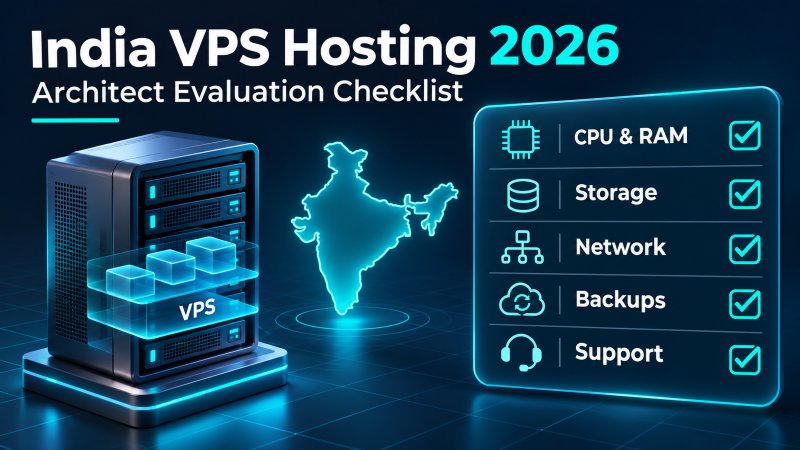
Evaluating the best india vps hosting provider requires verifying seven critical infrastructure baselines. Specifically, you must verify physical server residency in Tier-3 Mumbai or Noida facilities. In addition, 100% KVM hardware isolation prevents noisy-neighbor CPU steal. Enterprise PCIe Gen4 NVMe storage delivers over 90,000 sustained IOPS. Furthermore, unmetered Gigabit network capacity eliminates hidden egress fees. Full root access with custom kernel support ensures maximum administrative agility. Therefore, Tier-3 power redundancy and 24/7 domestic engineering support protect production workloads directly on best India VPS hosting solutions.
Prioritizing local data sovereignty over foreign hyperscalers ensures sub-15ms pan-Indian latency. Consequently, domestic hosting eliminates steep monthly egress costs and cross-border data transfer compliance risks.
The Indian digital economy is one of the most high-velocity commercial ecosystems in the world. Operating mission-critical web applications requires domestic infrastructure to minimize network latency. In addition, organizations must fulfill strict data localization mandates under Indian law. Local INR billing and 24/7 IST technical support guarantee seamless operations. This architectural guide evaluates How to Choose the Best India VPS Hosting in 2026: Architect Evaluation Checklist. Thus, we explore how dedicated KVM virtualization and direct national peering optimize throughput across Mumbai, Delhi-NCR, and Bengaluru.
Ultra-Low Pan-India Latency
Direct peering with NIXI, Bharti Airtel, and Reliance Jio ensures sub-15ms round-trip ping times nationwide. Consequently, domestic traffic routes with zero congestion.
Dedicated KVM Resources
Hardware-level Type-1 hypervisors provide strict zero CPU steal. Furthermore, dedicated RAM allocation and high-IOPS Gen4 NVMe arrays sustain peak database throughput.
Sovereign DPDP Compliance
Guaranteed physical data residency within India meets Digital Personal Data Protection Act 2023, RBI, and CERT-In standards. Therefore, compliance audits proceed smoothly.
Choosing the Best India VPS Hosting: Datacenter Infrastructure & Edge Resilience
Deploying resilient enterprise digital infrastructure across India requires aligning domestic telecommunications with dedicated compute resources. When evaluating the best india vps hosting, organizations gain a decisive advantage. Specifically, positioning compute nodes within premier Tier-3 facilities in Mumbai and Noida maximizes throughput. In addition, dedicated KVM hardware virtualization guarantees strict zero CPU steal. Direct optical cross-connects to NIXI and Extreme IX deliver sub-15ms latency across India. Engineering teams can deploy scalable best India VPS hosting plans.
Dual Independent Utility Grids
Active-active utility substations are backed by redundant 2N rotary UPS reserves. Furthermore, automated N+1 diesel generators provide 72-hour continuous fuel autonomy.
Direct NIXI & Carrier Peering
Sub-millisecond Layer-2 optical cross-connects interface Bharti Airtel, Reliance Jio, and Tata Communications IP backbones. As a result, routing switches cleanly across carriers.
100% Dedicated KVM Hypervisors
Hardware-level type-1 virtualization eliminates noisy-neighbor resource theft. Consequently, instances prevent CPU steal and shared memory contention across compute nodes.
Datacenter engineering across our Mumbai and Noida campuses features certified Tier-3 architecture. Furthermore, concurrent maintainability guarantees continuous uptime. Dual utility feeds from independent state electricity grids prevent power disruptions. In addition, redundant chilled-water cooling loops prevent processor thermal throttling. Campuses enforce multi-factor biometric access controls and VESDA fire suppression. Therefore, facilities maintain rigorous compliance with ISO 27001, SOC 2 Type II, and PCI-DSS data security standards.
The Core Criteria for Best India VPS Hosting: Domestic NIXI Peering
Network routing determinism is the defining performance metric for modern transactional web applications and payment gateways. Under domestic NIXI peering, Indian user traffic is routed directly through national internet exchanges. Consequently, packets bypass congested subsea transit routes that detour through foreign hubs in Singapore or Europe. To inspect physical power redundancy and optical rings, review our Mumbai and Noida datacenter architectural deep dive.
BGP Session Establishment & Route Ingress
Establish direct cross-connects at NIXI Mumbai and Extreme IX nodes. Furthermore, local peering delivers sub-4ms metro latency for regional users.
National Fiber Transit Optimization
Connect to Bharti Airtel, Reliance Jio, and Tata Communications multi-homed BGP backbones. Consequently, redundant transit paths eliminate single points of failure.
Pan-Indian Low-Latency Metro Convergence
Configure BFD protocols for sub-second network route convergence. Therefore, traffic failovers complete without dropping active client TCP connections.
Automated Multi-Carrier BFD Failover
Implement localized IPv4 prefixes to ensure domestic traffic stays within sovereign Indian borders. As a result, data packets never exit national jurisdiction.
Our multi-homed BGP routing tables integrate upstream IP transit from Bharti Airtel, Tata Communications, and Reliance Jio. In addition, we maintain bilateral peering sessions at NIXI. This architecture provides automated packet rerouting in under 50 milliseconds during carrier maintenance events. Furthermore, local peering reduces network jitter for WebSocket applications. For e-commerce checkout funnels, low latency translates directly into higher conversion rates.
PCIe Gen4 NVMe Storage Architecture
Storage subsystem performance represents the single most significant factor in database response times. Legacy budget hosts often utilize slow SATA solid-state drives. In contrast, our Mumbai and Noida hypervisor nodes deploy enterprise PCIe Gen4 NVMe arrays in hardware RAID-10. Consequently, random read and write operations achieve exceptional throughput.
High-Concurrency Read Performance
Enterprise PCIe Gen4 arrays sustain massive 4K IOPS throughput. Consequently, mission-critical database queries execute with zero I/O wait latency.
Zero-Wait Transactional Writes
Zero-impact hypervisor snapshots guarantee instant rollback capabilities for production workloads. Thus, system administrators perform updates with complete confidence.
Sequential Streaming Speed
Unmetered high-speed connectivity guarantees that data streams and API webhooks never encounter throttling. In addition, flat-rate pricing eliminates bandwidth bill shock.
Sub-Millisecond Response
Hardware RAID-10 storage controllers are paired with dedicated write-back battery-backed caching modules. As a result, write operations commit to non-volatile cache instantly with zero data loss risk.
Hardware Mirroring & Striping
By eliminating mechanical drive bottlenecks and SATA bus constraints, relational database engines achieve up to 78% faster query execution. Therefore, complex SQL joins complete smoothly.
Enterprise Flash Rating
Storage volumes are isolated through the KVM virtio-scsi controller layer documented in the Linux kernel. Furthermore, each virtual machine receives dedicated queue schedulers.
Execute the following fio and sysbench benchmark commands. These tests verify raw NVMe read and write IOPS directly on your instance:
KVM Virtualization & Kernel Tuning
Operating system optimization and hypervisor architecture dictate compute efficiency for inbound TCP sockets and TLS handshakes. On our Indian cloud platform, instances run full KVM virtualization. Specifically, nodes utilize modern Linux 6.x kernels. Thus, systems unlock next-generation TCP congestion control mechanisms.
Production Linux Kernel & sysctl Optimization Directives
-
Google BBR Congestion Control Protocol:
Many budget cloud hosting providers rely on shared-kernel containers to maximize profit margins through aggressive oversubscription. However, true KVM virtualization allocates completely isolated hardware resources. Consequently, this architecture prevents noisy neighbor disruptions entirely. The architectural comparison below outlines these key structural advantages:
-
TCP Socket Window Scaling & Memory Buffers:
Instances feature an independent Linux kernel with dedicated RAM address space. Furthermore, administrators apply custom sysctl tuning like BBR and Fast Open without noisy-neighbor degradation.
-
File Descriptor & High-Capacity Epoll Tuning:
In contrast, shared containers use a single host kernel across hundreds of tenants. Therefore, users encounter locked kernel modules and severe CPU throttling from adjacent tenants.
-
Virtual Memory Swappiness Management:
With KVM hardware virtualization, system engineers compile proprietary kernel modules easily. In addition, teams configure WireGuard VPN tunnels and deploy Docker or Podman daemons without restrictions. Furthermore, full hardware abstraction isolates every tenant. As a result, runaway processes on neighboring instances cannot affect your production environment.
Kernel Hardening & Module Customization
By enabling Google TCP BBR congestion control and optimizing socket buffers, web applications process significantly more parallel requests per second. Consequently, response latencies remain minimal even during peak traffic events.
DPDP Act Compliance & Data Residency
For Indian enterprises, FinTech platforms, healthcare providers, and digital agencies, regulatory compliance is a mandatory operational baseline. In particular, the Digital Personal Data Protection (DPDP) Act 2023 enforces strict domestic data residency requirements. Prior to moving production workloads live, ensure system compliance against our Linux VPS security hardening checklist.
Digital Personal Data Protection (DPDP) Act 2023
Strict territorial data residency within sovereign Indian borders guarantees complete compliance with MeitY digital governance frameworks. Furthermore, local storage eliminates cross-border legal liabilities.
- Guaranteed storage of citizen records inside Tier-3 Mumbai & Noida datacenters
- Zero exposure to foreign extraterritorial subpoena or cloud surveillance laws
- Cryptographic LUKS/dm-crypt volume encryption at rest for complete database protection
CERT-In Cyber Incident Reporting & Logging
Automated operational logging and time synchronization align server operations with national cybersecurity directives. In addition, immutable auditd records satisfy CERT-In compliance requirements.
- Mandatory 180-day immutable rolling security audit logs maintained via auditd
- Synchronized NTP time telemetry against Indian Standard Time (IST) stratum-1 servers
- Kernel-level defense hardening with automated Layer-4 & Layer-7 anti-DDoS mitigation
By deploying on domestic KVM compute nodes, organizations obtain verifiable assurances regarding physical data isolation. In addition, disk encryption at rest via LUKS and automated audit logging ensure data integrity. Therefore, these technical safeguards satisfy the stringent regulatory criteria enforced by Indian statutory auditors.
Best India VPS Hosting Production Playbook & Hardening
Transitioning from local development or overseas hosting to a high-performance Indian cloud node requires adhering to proven operational playbooks. Specifically, in this technical review, we outline the deployment verification steps essential for ensuring flawless production uptime.
Production Linux Hardening & Deployment Playbook
Execute these baseline security, firewall hardening, and automated snapshot commands upon initial provisioning of your Indian virtual private server:
In addition, routine disaster recovery drills combine scheduled block-level snapshots with encrypted rsync transfers. Storing backups in distant secondary facilities guarantees Recovery Time Objectives (RTO) below one hour. Furthermore, our technical operations team remains available 24/7 to assist with live configuration optimization.
Best India VPS Hosting Architectural Specifications Matrix
| Architecture Dimension | Onlive Server India VPS (Mumbai / Noida) | Generic Overseas Cloud / Shared Hosting |
|---|---|---|
| Physical Data Residency | India (Tier-3 Datacenters in Mumbai & Noida) | Overseas (Singapore, Frankfurt, US) or Unknown |
| Virtualization & CPU Allocation | 100% KVM Hypervisor (Strict 0% CPU Steal) | OpenVZ/LXC with aggressive tenant overselling |
| Storage Subsystem & IOPS | PCIe Gen4 NVMe RAID-10 (90,000+ Sustained IOPS) | Legacy SATA SSDs or Shared SAN Volumes (<5,000 IOPS) |
| Domestic Network Routing | Direct Peering via NIXI & Extreme IX (<15ms Pan-India) | High-latency subsea routes through Singapore/Middle East |
| Compliance Standard | DPDP Act 2023, RBI Payment Directives, CERT-In Ready | Non-compliant with Indian data localization regulations |
| Management & Root Privileges | Full Root SSH, Virtualizor VNC, Automated Snapshots | Restricted control panel, locked ports, no kernel tuning |
Deploy High-Performance India VPS Infrastructure
Deploy high-speed best india vps hosting instances hosted in Tier-3 Mumbai and Noida datacenters. Benefit from dedicated AMD EPYC and Intel Xeon cores with enterprise Gen4 NVMe arrays. In addition, enjoy unmetered bandwidth, direct NIXI peering, and statutory DPDP Act compliance.
