

• NAPAfrica & JINX BGP Routing
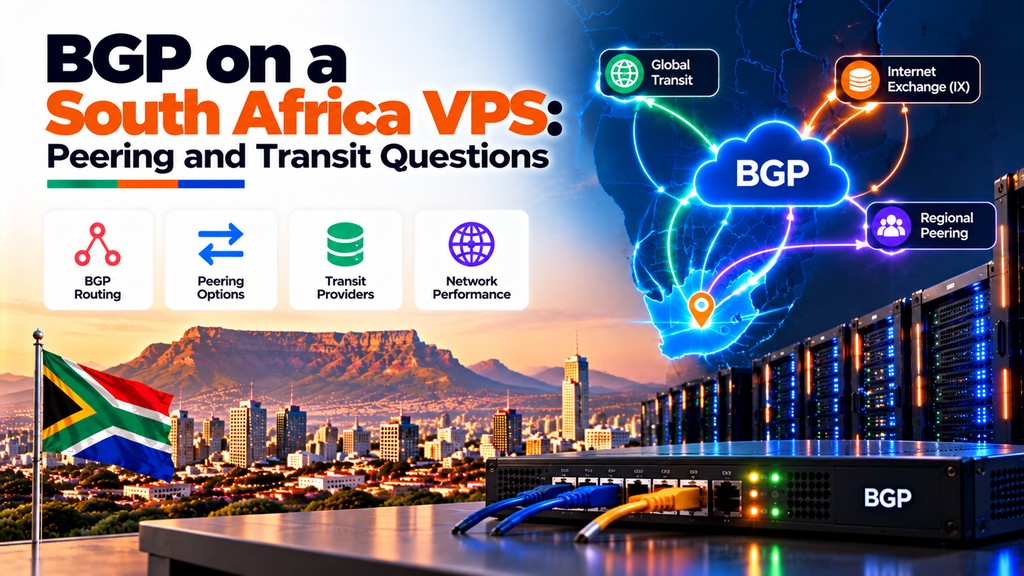
Deploying a BGP VPS South Africa instance enables organizations to establish dynamic peering sessions inside Teraco JB1 Johannesburg. Specifically, by announcing custom Autonomous System Numbers (ASN) and AFRINIC IP prefixes directly to NAPAfrica, traffic stays domestic. Furthermore, pairing BIRD routing daemons with RPKI validation delivers sub-2ms local latency and avoids subsea cable transit disruptions.
To establish custom BGP routing in South Africa, deploy a KVM VPS colocated at Teraco JB1. Specifically, an enterprise BGP VPS South Africa lets you announce your own AFRINIC IPv4 (/24) or IPv6 (/48) prefixes. In addition, it interconnects directly with NAPAfrica and JINX exchange points. Consequently, packets bypass expensive international transit routes, improving uptime and keeping latency under 2ms locally.
Organizations managing fintech platforms, telecom switches, and regional CDNs require complete routing control. In particular, relying on default upstream static routes exposes networks to transit bottlenecks and subsea cable breaks. Therefore, deploying a dedicated BGP VPS South Africa instance provides the dynamic routing autonomy essential for mission-critical infrastructure.
Specifically, Border Gateway Protocol (BGP) enables dynamic path determination across autonomous telecommunication backbones. For instance, hosting your routing engine at Teraco JB1 in Johannesburg places your workloads at Africa’s largest interconnection point. In addition, direct cross-connects to NAPAfrica and JINX exchange points eliminate unnecessary international hops.
Furthermore, pairing BGP peering with Route Origin Authorization (ROA) cryptographically safeguards your network from accidental route leaks. With dedicated KVM compute resources on an OnliveServer South Africa instance, you can announce your own IP space effortlessly.
Sub-2ms NAPAfrica Exchange
Direct Teraco JB1 cross-connects deliver domestic route exchange across major African telecom carriers.
BYOIP & AFRINIC ROA
Announce provider-independent IPv4 /24 and IPv6 /48 subnets with full RPKI cryptographic route validation.
Subsea Redundancy
Multi-homed upstream transit automatically re-routes traffic during WACS, SAT-3, and Equiano cable cuts.
Quick Navigation: South Africa BGP Peering Architecture
- Why Deploy a BGP VPS South Africa Infrastructure Instance
- NAPAfrica and JINX Peering: Sub-2ms Domestic Route Exchange
- BYOIP and AFRINIC IP Announcement on a BGP VPS South Africa
- Production BIRD Configuration Runbook for BGP VPS South Africa
- RPKI and ROA Validation: Preventing BGP Route Hijacking
- BGP Session Comparison Matrix: Full Tables vs IXP Peering
- Frequently Asked Questions
Why Deploy a BGP VPS South Africa Infrastructure Instance
Specifically, standard cloud instances rely on static default gateway routing provided by their hosting provider. While suitable for simple websites, this approach restricts larger organizations. Consequently, enterprises managing high-volume transaction networks require independent routing capabilities.
In contrast, operating a BGP VPS South Africa deployment gives you direct control over your Autonomous System Number (ASN). For example, you can dynamically balance inbound and outbound traffic flows. For details on dual-stack routing, read our technical breakdown on routing dual-stack IPv4 and IPv6 subnets in South Africa.
Under the IETF BGP-4 specification (RFC 4271), routers establish peer relationships to exchange reachability data. In South Africa, this architecture prevents traffic from hair-pinning through Europe when communicating between domestic endpoints.
NAPAfrica and JINX Peering: Sub-2ms Domestic Route Exchange
Consequently, interconnecting directly with Internet Exchange Points (IXPs) is critical for low-latency delivery. NAPAfrica, located inside Teraco JB1, represents the largest Internet exchange on the African continent.
Therefore, peering at NAPAfrica allows your VPS to exchange routes directly with over 600 connected members. These members include major domestic ISPs, Content Delivery Networks, and enterprise cloud providers. Furthermore, the Johannesburg Internet Exchange (JINX) provides secondary domestic redundancy.
Sub-2ms Domestic Hops
Direct IXP peering reduces round-trip times between Johannesburg, Pretoria, and regional endpoints to under 2ms.
Zero IP Transit Charges
Settlement-free peering through NAPAfrica route servers drastically lowers outbound data transfer expenses.
Subsea Outage Immunity
Domestic traffic continues flowing uninterrupted even when international undersea cables experience physical cuts.
Consequently, to mitigate cable disruptions, review our guide on multi-homing across redundant subsea fiber routes in South Africa.
BYOIP and AFRINIC IP Announcement on a BGP VPS South Africa
In addition, Bring Your Own IP (BYOIP) allows enterprises to announce their own IP space through our network. When migrating infrastructure to an OnliveServer BGP VPS South Africa, your public IP addresses remain unchanged.
Specifically, to establish a successful BYOIP announcement, ensure your network meets these prerequisites:
- Allocated Prefix: Clean, unflagged IPv4 /24 or IPv6 /48 IP space registered to your organization.
- AFRINIC Registration: Verified object in the AFRINIC Whois database reflecting your organization’s administrative handle.
- Letter of Authorization (LOA): Formal document granting OnliveServer authorization to announce your prefix via AS37195.
- Route Origin Authorization (ROA): Signed RPKI cryptographic object linking your prefix to your designated ASN.
Production BIRD Configuration Runbook for BGP VPS South Africa
Moreover, BIRD is the gold standard for software-based BGP routing on Linux servers. Below is our production-tested BIRD 2 configuration for an OnliveServer BGP VPS South Africa deployment:
After applying this configuration, reload BIRD using birdc configure. Then, verify the BGP session status by executing birdc show protocols all upstream_jnb.
RPKI and ROA Validation: Preventing BGP Route Hijacking
Furthermore, Resource Public Key Infrastructure (RPKI) is an indispensable security framework for contemporary telecommunications. Without RPKI validation, malicious actors can hijack IP addresses through rogue BGP route announcements.
In fact, Route Origin Authorizations (ROA) cryptographically bind your IP prefixes to your authorized ASN. When upstream transit carriers receive BGP updates, they validate announcements against the global RPKI database. Consequently, invalid or unauthorized announcements are rejected automatically.
Strategic BGP Routing & Peering Best Practices
- Verify that your AFRINIC ROA matches the exact prefix length announced in your BIRD configuration.
- Utilize BGP community tagging to selectively control route propagation to international upstream transits.
- Configure redundant BGP sessions across separate hypervisors to ensure seamless carrier failover.
BGP Session Comparison Matrix: Full Tables vs IXP Peering
Specifically, the following comparison table outlines hardware specifications and routing capacities for different BGP deployment tiers:
| BGP Feed Type | Approximate Route Count | Minimum Recommended VPS Specs | Primary Use Case |
|---|---|---|---|
| Default Route Only (0.0.0.0/0) | 1 – 2 Routes | 2 vCPU / 4 GB RAM / 50 GB NVMe | Simple BYOIP prefix announcement |
| Domestic IXP Peering Routes | 1,500 – 3,500 Routes | 4 vCPU / 8 GB RAM / 100 GB NVMe | Optimized low-latency South African transit |
| Single Full Internet BGP Table | 950,000+ IPv4 & IPv6 Routes | 8 vCPU / 16 GB RAM / 200 GB NVMe | Multi-homed border gateway path selection |
| Dual Full Internet Tables | 1,900,000+ Routes | 16 vCPU / 32 GB RAM / 400 GB NVMe | Tier-1 transit operator edge routing |
Frequently Asked Questions
Core BGP Architecture & Interconnect Specifications
What is BGP peering on a South Africa VPS?🇿🇦
Can I bring my own AFRINIC IP address space to an Onlive Server VPS?🇿🇦
Which BGP routing software daemons are supported on Linux VPS?🇿🇦
What is the difference between receiving a full BGP routing table vs a default route?🇿🇦
Deployment, Protocol Hardening & Operational Resilience
How does BGP multi-homing handle subsea fiber cable outages?🇿🇦
What is an Autonomous System Number (ASN) and do I need one for BGP peering?🇿🇦
How does BGP community tagging influence traffic routing across South Africa?🇿🇦
How does RPKI Route Origin Authorization (ROA) protect my BGP VPS South Africa prefixes from route hijacking?🇿🇦
NAPAfrica & JINX Peering • 24/7 BGP NOC Support
Announce Your IP Prefixes on South Africa BGP VPS Today
Deploy custom BGP routing sessions with full carrier redundancy at Teraco JB1. Benefit from sub-2ms domestic peering, dedicated hardware resources, and automated RPKI route protection.
✓ Instant Provisioning • ✓ Full Root Access • ✓ 24/7/365 Tech Support