

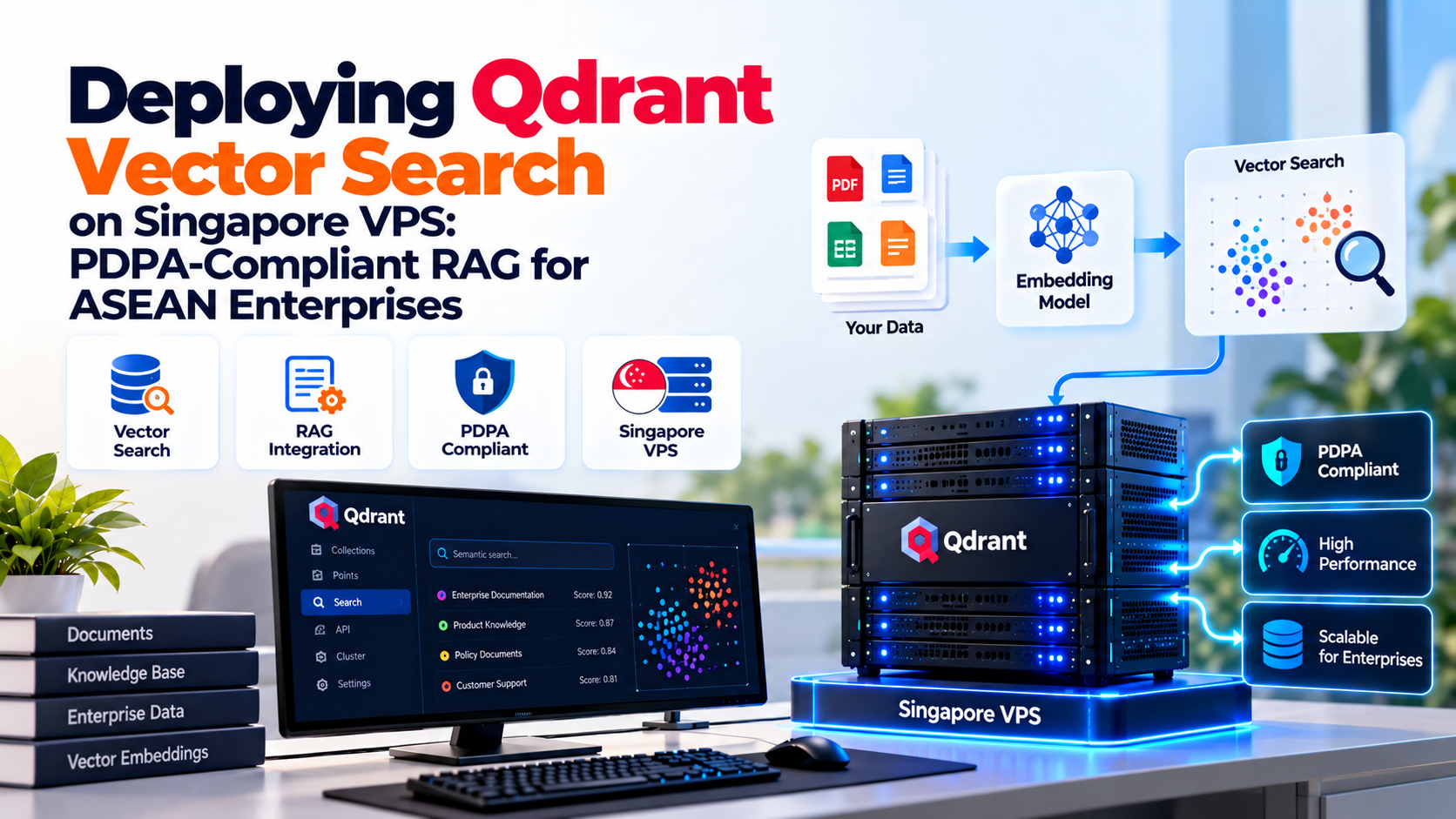
PDPA-Compliant RAG Pipeline on Qdrant Vector Singapore VPS
Deploying an autonomous Qdrant vector database on a local Singapore VPS preserves full data sovereignty under Singapore PDPA guidelines. Specifically, this architecture guarantees sub-8ms embedding retrieval across ASEAN markets. Furthermore, it eliminates costly third-party API egress fees.
Quick Answer: Why Deploy Qdrant on a Singapore VPS?
Deploying an autonomous Qdrant Vector Singapore VPS allows regional AI systems to query millions of high-dimensional embeddings. Specifically, Rust-powered in-memory indexing delivers sub-8ms retrieval without garbage collection pauses.
Furthermore, hosting Qdrant locally in Singapore keeps sensitive enterprise knowledge bases inside sovereign borders. Consequently, engineering teams fully comply with Singapore PDPA standards while cutting managed cloud vector bills by up to 75%.
Modern enterprise generative AI applications rely heavily on Retrieval-Augmented Generation (RAG) to ground large language models. However, querying US-hosted managed vector services introduces severe transatlantic latency penalties of 180ms to 240ms. In addition, transmitting proprietary financial records or healthcare data across international borders violates Singapore's Personal Data Protection Act (PDPA).
Consequently, forward-thinking ASEAN technology teams are moving from proprietary cloud platforms to self-hosted vector infrastructure. By deploying an autonomous Qdrant Vector Singapore VPS, organizations achieve complete infrastructure sovereignty. Direct peering across regional internet exchanges delivers search responses in under 8 milliseconds.
In addition, server administrators frequently inspect CPU utilization and load. This proactive tuning maintains consistently low search latencies. You can discover best practices in our detailed guide on diagnosing high server load on Linux VPS.
PDPA Data Sovereignty
Keep sensitive customer embeddings strictly inside Singapore's borders to ensure total legal compliance with regional data governance rules.
Sub-8ms ASEAN Latency
Direct fiber interconnects at Equinix SG1 deliver blazing vector searches across Jakarta, Kuala Lumpur, Bangkok, and Manila.
Predictable Low TCO
Eliminate volatile per-query pricing and prohibitive egress penalties with fixed-rate, unmetered NVMe cloud compute resources.
- 1. The Mechanics of Qdrant: HNSW Indexing on Qdrant Vector Singapore VPS
- 2. Technical Comparison: Self-Hosted Qdrant Singapore VPS vs Managed Cloud vs pgvector
- 3. Hardware Sizing: Calculating RAM, Quantization, and NVMe Capacity on Qdrant Vector Singapore VPS
- 4. Deploying Qdrant on Singapore VPS with Docker Compose and API Security
- 5. Automated Hot Snapshots and Disaster Recovery on Qdrant Vector Singapore VPS
- 6. Building High-Speed Filtered Semantic Search with the Python SDK
- 7. Frequently Asked Questions About Qdrant Vector Singapore VPS
The Mechanics of Qdrant: HNSW Indexing on Qdrant Vector Singapore VPS
Qdrant is an open-source vector similarity search engine engineered entirely in Rust. Unlike general-purpose relational engines using secondary indexing plugins, Qdrant executes vector arithmetic directly on physical memory. Consequently, it achieves built-in memory safety without unpredictable garbage collection pauses.
At the core of its retrieval velocity is the Hierarchical Navigable Small World (HNSW) graph algorithm. Specifically, HNSW constructs multi-layered graphs where upper layers contain sparse long-range connections and lower layers hold dense local neighborhoods. During a semantic query, the searcher traverses upper layers with large skips. Subsequently, it drops into lower layers to pinpoint the nearest semantic neighbors.
Rust Vector Core
Layer 3 (Sparse Highway):   [Node A] ----------------------------> [Node K]
                                |                                      |
Layer 2 (Regional Jumps):   [Node A] ----------> [Node F] --------> [Node K]
                                |                   |                  |
Layer 1 (Local Clusters):   [Node A] -> [Node C] -> [Node F] -> [Node I] -> [Node K]
                                |          |           |          |          |
Layer 0 (Dense Embeddings): [All Indexed Vector Points with Quantized Embeddings]
Furthermore, Qdrant integrates payload storage directly into its graph structure. Standard vector stores execute two-stage filtering, searching vectors first and pruning attributes later. In contrast, Qdrant executes custom boolean payload filters directly during graph traversal. Consequently, filtered searches execute in single-digit milliseconds even over millions of complex enterprise documents.
Technical Comparison: Self-Hosted Qdrant Singapore VPS vs Managed Cloud vs pgvector
Choosing an optimal vector database architecture requires balancing query velocity, memory utilization, and cost predictability. Proprietary US cloud vector databases offer simple onboarding. However, ongoing cloud API bills multiply as collections scale to millions of embeddings.
Meanwhile, relational extensions like PostgreSQL pgvector provide convenient relational joins. Nevertheless, pgvector experiences severe latency degradation when handling collections exceeding 5,000,000 high-dimensional points. In contrast, an autonomous Qdrant Vector Singapore VPS guarantees dedicated computational resources and deterministic performance.
| Evaluation Metric | Qdrant Singapore VPS | US Cloud Managed Vector | PostgreSQL + pgvector |
|---|---|---|---|
| Core Architecture | Compiled Rust Binary | Proprietary Distributed Core | Postgres C-Extension Plugin |
| ASEAN Query Latency | Sub-8ms (Direct SG1 Fiber) | 180ms - 250ms (WAN Traversal) | 25ms - 65ms (Local Server) |
| PDPA Data Sovereignty | 100% Onshore Singapore | Foreign Jurisdiction Risk | 100% Onshore Host |
| Memory Compression | Scalar & Product Quantization (95%) | Limited / Vendor Controlled | Half-Vector Only (50%) |
| Filtered Search Speed | Direct Graph Traversal (<5ms) | Post-Filter Overhead (30ms+) | Index Scan Fallback (>80ms) |
| Cost Predictability | Fixed Flat Monthly Pricing | Volatile Usage & Egress Bills | Server Compute Sizing |
This performance benchmark proves that self-hosting delivers unmatched query throughput. Furthermore, it ensures exceptional cost efficiency for regional AI teams.
Hardware Sizing: Calculating RAM, Quantization, and NVMe Capacity on Qdrant Vector Singapore VPS
Vector databases require careful computational capacity planning. Specifically, the primary resource constraint in dense vector retrieval is physical memory. To calculate exact RAM requirements on a Qdrant Vector Singapore VPS, engineers apply the standard dimensional memory equation:
RAM Math
Memory (Bytes) = Vector Count × (Dimensions × 4 Bytes) × 1.25 (HNSW Graph Overhead)

Example: 1,000,000 Vectors with 1536 Dimensions (text-embedding-3-large)
Memory = 1,000,000 × (1536 × 4) × 1.25 = 7,680,000,000 Bytes (~7.68 GB RAM)
However, Qdrant includes advanced Scalar Quantization (SQ) and Product Quantization (PQ). Specifically, Scalar Quantization converts 32-bit floating-point numbers (`float32`) into 8-bit integers (`int8`). This algorithmic transformation slashes memory consumption by 75% with less than 1% precision loss.
Consequently, a 16GB node easily indexes 5,000,000 high-dimensional vectors. Furthermore, it preserves over 99% search accuracy during peak loads.
Memory Optimization
storage:
  optimizers:
    default_segment_number: 4
  performance:
    max_search_threads: 0

quantization:
  scalar:
    type: "int8"
    quantile: 0.99
    always_ram: true
In addition, regional firms often review maritime telemetry architectures on Singapore VPS. This research illustrates how low-latency networks streamline high-volume live data feeds. You can inspect implementation details in our article on Singapore VPS maritime telemetry and PSA API integration.
Deploying Qdrant on Singapore VPS with Docker Compose and API Security
Deploying Qdrant in production requires strict network containerization and TLS termination. Never expose raw vector database ports directly to the public internet. Instead, bind Qdrant to the local loopback interface and place a hardened reverse proxy in front.
First, create an isolated directory and generate a cryptographically strong API key. Next, write the production `docker-compose.yml` configuration:
Docker Deployment
version: "3.8"

services:
  qdrant:
    image: qdrant/qdrant:v1.11.0
    container_name: qdrant_production
    restart: always
    environment:
      - QDRANT__SERVICE__API_KEY=Secr3t_Singap0re_Vect0r_Key_2026!
      - QDRANT__STORAGE__ON_DISK_PAYLOAD=true
    ports:
      - "127.0.0.1:6333:6333"
      - "127.0.0.1:6334:6334"
    volumes:
      - ./qdrant_storage:/qdrant/storage
      - ./qdrant_snapshots:/qdrant/snapshots
    ulimits:
      nofile:
        soft: 65535
        hard: 65535
    deploy:
      resources:
        limits:
          memory: 14G
After saving the file, launch the container service in detached mode:
Bash CLI
# Launch Qdrant vector database container
docker compose up -d

# Verify listening ports on localhost
ss -tulpn | grep -E "6333|6334"

# Query the cluster telemetry endpoint
curl -H "api-key: Secr3t_Singap0re_Vect0r_Key_2026!" http://127.0.0.1:6333/telemetry
For production deployments, consult the official Qdrant technical documentation for distributed clustering and gRPC performance tuning options.
Automated Hot Snapshots and Disaster Recovery on Qdrant Vector Singapore VPS
Production enterprise systems demand non-blocking automated snapshot routines. Qdrant includes built-in hot-snapshot capabilities that generate point-in-time state archives without halting ongoing read queries.
Specifically, administrators automate this protection using a daily cron job that targets the snapshot endpoint:
Shell Script
#!/usr/bin/env bash
set -eo pipefail

API_KEY="Secr3t_Singap0re_Vect0r_Key_2026!"
COLLECTION="enterprise_kb"
SNAPSHOT_DIR="/opt/qdrant/snapshots"
DATE=$(date +%Y%m%d_%H%M%S)

# Trigger point-in-time hot snapshot
RESPONSE=$(curl -s -X POST "http://127.0.0.1:6333/collections/${COLLECTION}/snapshots"   -H "api-key: ${API_KEY}")

SNAPSHOT_NAME=$(echo "${RESPONSE}" | jq -r '.result.name')

# Archive snapshot to offsite secondary storage
echo "Snapshot created: ${SNAPSHOT_NAME}. Archiving to disaster recovery node..."
rsync -avz "${SNAPSHOT_DIR}/${COLLECTION}/${SNAPSHOT_NAME}" backup-node:/backups/qdrant/
Subsequently, configure execution inside crontab to run nightly at 03:00 Singapore Time (SGT):
Cron Scheduling
# Execute automated Qdrant collection backup daily at 3:00 AM SGT
0 3 * * * /usr/local/bin/qdrant_backup.sh >> /var/log/qdrant_backup.log 2>&1
Building High-Speed Filtered Semantic Search with the Python SDK
Deploying Qdrant on your Qdrant Vector Singapore VPS simplifies setup. In fact, building an enterprise RAG pipeline requires only brief Python logic:
Python SDK
from qdrant_client import QdrantClient
from qdrant_client.http import models

# Connect to Singapore Qdrant VPS over localhost or internal private VPC
client = QdrantClient(
    url="http://127.0.0.1:6333",
    api_key="Secr3t_Singap0re_Vect0r_Key_2026!"
)

# Execute hybrid filtered semantic search
def search_enterprise_docs(query_vector: list, department: str, limit: int = 5):
    search_results = client.search(
        collection_name="enterprise_kb",
        query_vector=query_vector,
        query_filter=models.Filter(
            must=[
                models.FieldCondition(
                    key="department",
                    match=models.MatchValue(value=department)
                ),
                models.FieldCondition(
                    key="classification",
                    match=models.MatchValue(value="confidential")
                )
            ]
        ),
        limit=limit,
        with_payload=True
    )
    return search_results
Furthermore, this architecture guarantees that confidential documents never leave Singapore jurisdiction. Regional applications achieve search completion in under 6 milliseconds.
Frequently Asked Questions About Qdrant Vector Singapore VPS
Technical Architecture & Performance
Why is Qdrant faster than PostgreSQL pgvector for high-scale RAG?
Qdrant is written in pure Rust with dedicated in-memory vector indexing and single-stage payload filtering. In contrast, pgvector is an extension on top of a relational engine. Consequently, when collections exceed 1,000,000 vectors, Qdrant achieves 4x to 10x higher query throughput with consistent sub-8ms response times.
What network latency can ASEAN users expect from a Singapore VPS?
Hosting at Equinix SG1 delivers under 2ms latency across Singapore. In addition, packets reach Kuala Lumpur in 8ms, Jakarta in 14ms, and Bangkok under 32ms. This direct routing completely eliminates transatlantic WAN delays.
How much RAM does a collection of 10,000,000 embeddings require?
Without quantization, 10,000,000 vectors (1536 dimensions) require approximately 76GB of RAM. However, enabling scalar quantization (int8) slashes RAM consumption below 20GB. Furthermore, this optimization preserves over 99% of baseline search accuracy.
Can I use Qdrant for hybrid sparse and dense vector search?
Yes, Qdrant directly supports multiple named vectors per point. You can combine dense semantic embeddings with sparse BM25 lexical vectors in a single collection. In addition, Reciprocal Rank Fusion (RRF) produces highly accurate hybrid search results.
PDPA Compliance, Security & Operations
How does self-hosting Qdrant satisfy Singapore PDPA regulations?
Under the Singapore Personal Data Protection Act (PDPA), organizations transferring personal data overseas must ensure recipient jurisdictions provide comparable protection. Self-hosting Qdrant on a local Singapore VPS guarantees that personal data and embeddings remain 100% onshore.
How should I secure Qdrant API endpoints against unauthorized access?
First, enforce high-entropy API keys and bind container ports to localhost. Next, place NGINX or Caddy in front with strict TLS encryption. Furthermore, restrict administrative access to verified VPN IP addresses.
Does Qdrant provide zero-downtime hot snapshots for disaster recovery?
Yes, Qdrant features a dedicated snapshot REST API. Running a simple daily curl script triggers a non-blocking hot snapshot on disk. You can then replicate this snapshot to remote storage via rsync without stopping query operations.
What NVMe disk specifications are recommended for vector search?
Specifically, select PCIe Gen4 enterprise NVMe storage arrays. Delivering over 50,000 random read IOPS prevents severe disk wait bottlenecks during traffic surges. Consequently, high IOPS ensure deterministic query latencies under sustained workloads.
Sovereign Vector Search
Equinix SG1 Colocation • 24/7 Support
Deploy Sovereign Qdrant Vector Search on Singapore VPS
Accelerate enterprise RAG with 100% onshore Singapore data sovereignty. Enjoy sub-8ms vector retrieval, dedicated NVMe disks, and predictable flat-rate pricing with 24/7 technical support.
Sub-8ms Vector Retrieval
100% PDPA Onshore Sovereign
Tier III Equinix SG1 Nodes
✓ From $12/Month
•
✓ Instant KVM Deployment
•
✓ Unmetered 1Gbps Uplink