

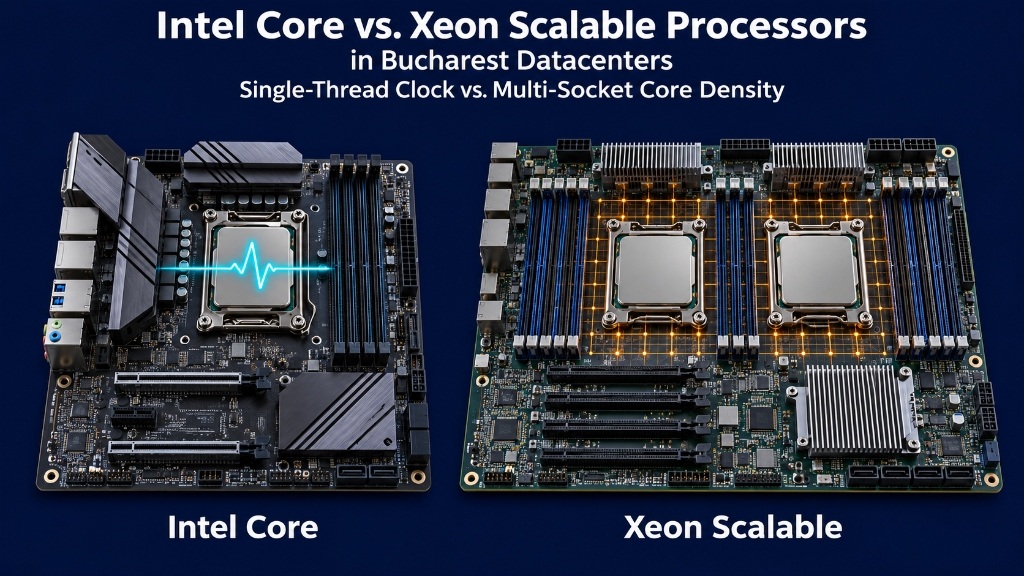
Choosing between Intel Core (e.g. i7/i9 14th Gen) and Intel Xeon Scalable (4th/5th Gen) dedicated servers in Bucharest depends on whether your workload is bottlenecked by single-thread clock frequency or multi-socket memory channel bandwidth. Intel Core delivers blisteringly fast 5.4GHz to 5.8GHz single-core turbo clocks, making it the premier choice for low-latency algorithmic trading, forex matching engines, CS2/Rust gaming nodes, and CAD/compilation pipelines. Conversely, Intel Xeon Scalable provides 8-channel Registered ECC DDR5 memory per socket, up to 64 cores per CPU, multi-socket NUMA scalability, and enterprise IPMI/BMC remote telemetry, making it essential for heavy virtualization (Proxmox/VMware), enterprise databases (PostgreSQL/SQL Server), and big data analytics.
Select your dedicated server CPU architecture based on execution thread parallelism and memory integrity requirements:
- Choose Intel Core (High-Clock Frequency) if: Your application relies heavily on single-threaded performance (tick-by-tick forex trading, dedicated game servers, build automation, Python/Node.js microservices) and requires maximum clock speed (>5.0GHz) at an affordable price point.
- Choose Intel Xeon Scalable (Multi-Socket Density) if: You operate multi-tenant virtualization clusters, mission-critical ERP databases requiring >128GB Registered ECC RAM to prevent silent memory corruption, or multi-socket compute platforms with massive PCIe Gen5 lane expansions.
In the datacenter landscape of Bucharest, Romania, computing hardware specifications have evolved to accommodate distinctly specialized computing workloads. Enterprise architects and systems engineers selecting dedicated bare-metal servers must navigate a fundamental microarchitecture divide: deploying high-frequency desktop-derived enterprise processors (such as the Intel Core i7-14700K or i9-14900K) versus deploying server-grade Intel Xeon Scalable processors (such as the Xeon Silver 4410Y or Xeon Gold 6430/6530).
For years, conventional wisdom dictated that enterprise datacenter racks should house only Xeon processors. However, software architectural realities have disrupted this dogma. Many modern application runtimes—including Node.js, Python ASGI workers, Redis single-threaded event loops, high-frequency trading matching algorithms, and multiplayer game server simulation ticks—are strictly constrained by the performance of a single CPU core. On these single-threaded tasks, a 5.8GHz Intel Core processor can outperform a multi-thousand-dollar 2.4GHz Xeon processor by more than 80%.
Yet, pure clock speed is only half of the architectural equation. Enterprise workloads involving multi-terabyte transactional databases, heavy virtualization hypervisors (Proxmox VE, ESXi), and distributed analytics depend on massive memory bus bandwidth, error-correcting code (ECC) memory reliability, multi-socket NUMA topologies, and continuous 24/7 thermal stability. This comprehensive engineering comparison examines the silicon microarchitecture, memory buses, PCIe lanes, remote management capabilities, and economic trade-offs of Intel Core versus Xeon Scalable servers deployed in Bucharest facilities.
Intel Core delivers the world’s highest single-thread instruction throughput for latency-critical event loops and simulation engines.
Intel Xeon Scalable provides up to 307.2 GB/s memory bandwidth per socket with multi-bit error correction preventing bit-flip crashes.
Direct high-speed bus connectivity on Xeon for multi-GPU arrays, dual 100GbE Mellanox NICs, and multi-drive NVMe backplanes.
Dedicated out-of-band management chips providing virtual KVM, ISO mounting, and hardware sensor telemetry in Bucharest racks.
- 1. The Microarchitecture Divide: Desktop High-Clock Core vs Multi-Socket Enterprise Xeon
- 2. Single-Thread Clock Speed (5.8GHz) vs Multi-Thread Core Density (64+ Cores)
- 3. Memory Subsystems: Dual-Channel Unbuffered vs 8-Channel Registered ECC DDR5
- 4. Workload Performance Matrix: Matching Applications to CPU Architectures
- 5. Thermal Management & Sustained Power Tuning in Bucharest Datacenter Racks
- 6. Linux Kernel CPU Governor Tuning & Core Pinning Runbook (`performance` & `taskset`)
- 7. Remote Out-of-Band Hardware Management: Consumer vPro vs Enterprise ASPEED AST2600
- 8. Total Cost of Ownership: When High-Clock Core Delivers 3x Better Price-to-Performance
- 9. Frequently Asked Questions (Intel Core vs Xeon Romania Dedicated Server FAQ)
1. The Microarchitecture Divide: Desktop High-Clock Core vs Multi-Socket Enterprise Xeon
Intel designs its Core and Xeon processor lines with fundamentally divergent engineering goals:
- Intel Core Architecture (Raptor Lake Refresh): Intel Core utilizes a hybrid architecture featuring Performance-cores (P-cores) and Efficient-cores (E-cores). Engineered for rapid burst execution, P-cores feature aggressive instruction reordering pipelines, enormous L2 caches per core (2MB per P-core), and aggressive dynamic clock multipliers that push single-core frequencies up to 5.6GHz – 5.8GHz. However, memory bus width is limited to dual-channel (128-bit), and maximum addressable RAM is capped at 192GB unbuffered non-ECC or basic ECC.
- Intel Xeon Scalable Architecture (Emerald Rapids / Sapphire Rapids): Xeon Scalable processors feature exclusively symmetric Performance-cores (up to 32 to 64 cores per socket, and up to 2 to 4 sockets per motherboard). Xeon is engineered for relentless, continuous throughput across massive datasets. Each CPU socket integrates an 8-channel DDR5 memory controller (512-bit bus width), 80 lanes of PCIe Gen5, and built-in hardware accelerators including Intel Advanced Matrix Extensions (AMX), QuickAssist Technology (QAT), and In-Memory Analytics Accelerator (IAA).
2. Single-Thread Clock Speed (5.8GHz) vs Multi-Thread Core Density (64+ Cores)
The primary criterion for CPU selection is the degree of parallelism exhibited by your primary software application:
| Architectural Parameter | Intel Core i9-14900K Dedicated | Dual Intel Xeon Gold 6430 Dedicated |
|---|---|---|
| Base & Maximum Boost Clock | 3.2 GHz Base / 5.8 GHz Turbo Boost | 2.1 GHz Base / 3.4 GHz All-Core Turbo |
| Physical Cores & Threads | 24 Cores (8P + 16E) / 32 Threads | 64 Cores / 128 Threads (Dual Socket) |
| Geekbench 6 Single-Core Score | ~3,150 (Unmatched execution speed) | ~1,780 (43% slower per single thread) |
| Geekbench 6 Multi-Core Score | ~21,500 | ~44,800 (108% higher parallel throughput) |
| Memory Controller Bus Width | Dual-Channel (128-bit, ~89.6 GB/s) | 16-Channel Aggregate (1,024-bit, ~614 GB/s) |
| PCIe Gen5 Lane Expansion | 20 Total Lanes (Direct from CPU) | 160 Total Lanes (80 Lanes per Socket) |
3. Memory Subsystems: Dual-Channel Unbuffered vs 8-Channel Registered ECC DDR5
The memory architecture represents one of the most critical engineering differentiators between Core and Xeon platforms:
- Dual-Channel Unbuffered Memory (Intel Core): Intel Core motherboards feature 2 memory channels supporting up to 4 DIMM slots. While DDR5-5600/6000 speeds provide rapid transfer rates, the total memory bus width is limited to 128 bits. If hundreds of concurrent worker processes saturate the memory controller, memory bandwidth becomes a severe choke point. Furthermore, most Core platforms utilize unbuffered non-ECC RAM, which cannot detect or correct cosmic-ray-induced bit flips.
- 8-Channel Registered ECC Memory (Intel Xeon): Xeon Scalable processors feature an 8-channel memory controller per socket (512-bit aggregate bus width). Running DDR5-4800 Registered ECC modules, a single socket delivers over 307 GB/s of sustained memory bandwidth. Registered ECC (RDIMM) features dedicated register chips on each module to buffer command and address signals, allowing servers to reliably support up to 4TB of RAM per node with multi-bit error correction preventing operating system kernel panics.
4. Workload Performance Matrix: Matching Applications to CPU Architectures
Deploying the right CPU architecture for specific software profiles dramatically optimizes infrastructure expenditure and system responsiveness:
- High-Frequency Trading & Forex Execution (Intel Core): Bucharest datacenters provide ultra-low latency optical transit to Frankfurt (Eurex) and London (LSE). Forex matching engines and automated trading bots operate as sequential event loops where a single core must parse market feeds and execute orders in microseconds. Intel Core’s 5.8GHz boost clock reduces tick-to-trade latency by up to 40% compared to Xeon.
- Dedicated Multiplayer Gaming Nodes (Intel Core): Game engines (Counter-Strike 2, Rust, Minecraft, Unreal Engine 5 dedicated servers) execute tick physics, player positioning, and hit registration on a primary thread. High-frequency Core i7/i9 servers prevent “server tick drop” and maintain stable 128-tick rates under intense match gameplay.
- Enterprise Database Clusters (Intel Xeon): High-concurrency PostgreSQL, Oracle, and Microsoft SQL Server databases serving thousands of concurrent client connections require massive parallel query workers, huge buffer pools (>256GB RAM), and extensive PCIe Gen5 NVMe arrays. Dual Xeon Scalable processors deliver unmatched parallel throughput without memory bus saturation.
- Hypervisor Virtualization (Proxmox VE / VMware ESXi) (Intel Xeon): Partitioning a dedicated server into dozens of independent virtual machines requires dense core counts, multi-socket NUMA management, and Registered ECC memory stability to guarantee that one failing guest VM cannot compromise the entire host.
5. Thermal Management & Sustained Power Tuning in Bucharest Datacenter Racks
Running desktop-class processors (such as the i9-14900K) at full 5.8GHz clock speeds inside high-density $1U$ and $2U$ datacenter rack chassis requires specialized thermal engineering:
- Power Limit (PL1 / PL2) Calibration: Desktop motherboards often ship with unlocked power profiles that push CPU draw past 300 Watts, triggering thermal throttling in rack environments. Onlive Server engineers calibrate Long Duration Power Limits (PL1 = 125W to 150W) and Short Duration Power Limits (PL2 = 253W) with custom vapor chamber copper heatsinks and high-CFM counter-rotating chassis fans, sustaining 5.0GHz+ all-core clocks without thermal degradation.
- Xeon Thermal Determinism: Xeon Scalable processors feature conservative Thermal Design Power (TDP) envelopes (typically 150W to 250W per socket) engineered specifically for front-to-back datacenter cold-aisle airflow. Xeon processors maintain flat, unwavering all-core clock rates under 100% continuous multi-day compute loads.
6. Linux Kernel CPU Governor Tuning & Core Pinning Runbook (`performance` & `taskset`)
By default, Linux enterprise distributions (Ubuntu, Debian, AlmaLinux) utilize the `powersave` CPU frequency scaling governor, which dynamically lowers clock speeds to conserve electricity. For latency-sensitive trading, gaming, and real-time APIs, dynamic clock ramp-up adds microsecond jitter.
Configure the static `performance` governor and pin critical worker threads to dedicated high-frequency Performance-cores:
7. Remote Out-of-Band Hardware Management: Consumer vPro vs Enterprise ASPEED AST2600
Managing dedicated servers deployed in remote Bucharest datacenters requires robust out-of-band management:
- Enterprise Server IPMI / BMC (ASPEED AST2600): All Onlive Server enterprise bare-metal machines (both Xeon and enterprise-grade Intel Core builds on Supermicro/ASRock Rack motherboards) feature dedicated ASPEED Baseboard Management Controllers (BMC). This provides a dedicated physical Ethernet port with isolated out-of-band network access, HTML5 virtual KVM console, remote virtual ISO mounting for OS installations, and real-time hardware sensor logging (temperatures, voltages, fan speeds).
- Consumer vPro / AMT Limitations: Consumer desktop boards rely on Intel vPro / Active Management Technology (AMT), which shares the primary network interface, lacks hardware-level power rail telemetry, and cannot reliably survive network interface reconfiguration. Onlive Server avoids consumer desktop motherboards, utilizing specialized enterprise server boards for all Intel Core deployments.
8. Total Cost of Ownership: When High-Clock Core Delivers 3x Better Price-to-Performance
From a financial perspective, deploying high-frequency Intel Core servers yields massive capital and operating savings when matched to appropriate software architectures:
- Core-Based Licensing Savings: Many commercial software packages (database engines, trading platforms, rendering tools) license their software on a per-core basis (e.g. $500 to $2,500 per CPU core). Running a 24-core Intel Core processor at 5.8GHz provides identical or superior throughput to a 48-core low-clock Xeon, cutting commercial software licensing fees by 50%.
- Monthly Server Rental Savings: An enterprise dedicated server equipped with an Intel Core i9, 128GB DDR5 RAM, and dual enterprise NVMe drives typically rents for 40% to 60% less per month than a multi-socket Xeon Scalable node, unlocking superior return on investment (ROI) for startups, trading firms, and game publishers.
9. Frequently Asked Questions (Intel Core vs Xeon Romania Dedicated Server FAQ)
High-clock Intel Core chips excel at serial jobs up to 5.8 GHz, whereas Xeon Scalable builds deliver 8-channel registered ECC memory and massive core counts. Choosing the right Bucharest chassis prevents memory bandwidth starvation or wasted parallel threads. Compare Romania Core and Xeon server specifications.
