

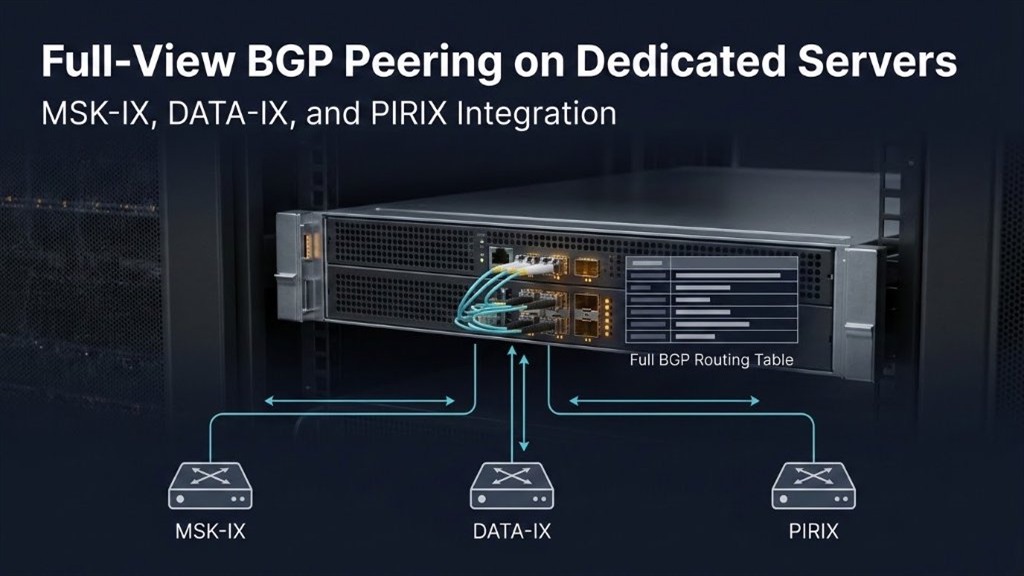
Deploying full-view BGP on dedicated servers in Russia requires running high-performance routing daemons (such as BIRD 2 or FRRouting) receiving complete IPv4 (~960,000 routes) and IPv6 (~210,000 routes) routing tables across dual multi-gigabit uplinks. Integrating with Russia’s top three internet exchanges—MSK-IX (Moscow), DATA-IX (National), and PIRIX (St. Petersburg/Northwest)—via dedicated VLANs and BGP route servers optimizes traffic paths, bypasses Tier-1 commercial transit hops, reduces intra-Russian round-trip latency to under 12ms, and prevents route hijacking through strict RPKI ROA origin validation.
Choose the optimal routing policy based on hardware memory allocations and traffic distribution requirements:
- Choose Full-View Multi-Carrier BGP if: You operate your own Autonomous System (ASN), manage your own IP address blocks (/24 IPv4 or /48 IPv6), require granular outbound path selection using BGP local-preference, and possess at least 64GB ECC RAM to maintain dual in-memory FIB tables without swapping.
- Choose Default Route (0.0.0.0/0) with IXP Peering if: You want optimal direct latency to Russian domestic eyeballs via MSK-IX and DATA-IX route servers but wish to offload international and transit path computation to the hosting provider’s upstream edge core routers.
Border Gateway Protocol (BGP) is the fundamental routing protocol that stitches together the global internet. Within the Russian Federation, the topology of Autonomous Systems (ASNs) presents unique operational dynamics. Russia spans eleven time zones and contains one of the world’s most dense domestic peering landscapes. Navigating this ecosystem efficiently requires an enterprise infrastructure strategy that transcends simple static default routing.
Deploying dedicated bare-metal servers equipped with hardware-assisted network interface controllers (such as Mellanox ConnectX-4/5 10G/25G SFP28) enables systems engineers to run full-view BGP daemons directly within the Linux kernel or hardware routing tables. By concurrently establishing peering sessions with MSK-IX (Moscow), DATA-IX (Federal footprint), and PIRIX (St. Petersburg/Northwest), server administrators achieve optimal path selection, dynamic multi-homing failover, and comprehensive traffic engineering through BGP community tagging.
Receive complete global IPv4 (>960k routes) and IPv6 (>210k routes) routing tables directly on your bare-metal server, enabling per-prefix best-path selection.
Simultaneous BGP route-server sessions with MSK-IX, DATA-IX, and PIRIX provide access to over 1,200 unique peering networks across Russia and the CIS.
Apply RFC1997 standard and extended BGP communities to control route propagation across Rostelecom, MegaFon, MTS, and regional transit carriers.
Integrate Routinator / Cloudflare GoRTR to validate Route Origin Authorizations (ROAs), cryptographically dropping invalid announcements and preventing BGP hijack attacks.
- 1. The Russian Internet Exchange Landscape: MSK-IX vs DATA-IX vs PIRIX
- 2. Bare-Metal Hardware & Memory Sizing for Dual Full-View BGP Tables
- 3. Major Russian Carrier BGP Communities (Rostelecom, MegaFon, MTS)
- 4. Production Configuration: BIRD 2 Multi-Homed Peering & RPKI Validation
- 5. Sub-Second Convergence via BFD (Bidirectional Forwarding Detection)
- 6. Outbound Traffic Engineering & AS-Path Prepending Best Practices
- 7. Frequently Asked Questions (Russian Dedicated Server BGP FAQ)
1. The Russian Internet Exchange Landscape: MSK-IX vs DATA-IX vs PIRIX
Unlike smaller geographic zones where a single dominant internet exchange handles all local peering, Russia features three major national and inter-regional internet exchange platforms that complement one another:
| Internet Exchange | Primary Hub / PoPs | ASN / Peering Type | Peak Traffic Volume | Key Peering Advantage |
|---|---|---|---|---|
| MSK-IX | Moscow (MMTS-9, NORD, IXcellerate) + 9 regional nodes | AS8631 (Route Servers + Bilateral) | 5.8+ Tbps | Direct peering with Yandex, VK, Sber, and major Moscow CDNs |
| DATA-IX | Distributed across 38 cities (Moscow, SPb, Novosibirsk, etc.) | AS25478 (Multilateral Peering) | 6.5+ Tbps | Widest geographic reach covering Urals, Siberia, and Kazakhstan |
| PIRIX | St. Petersburg (MMTS-10) and Northwest Russia | AS34305 (Route Server Exchange) | 1.2+ Tbps | Low-latency regional peering across Northwest federal district |
When you configure an Onlive Server bare-metal server with multi-IX connectivity, traffic destined for Yandex or VK services peers directly via MSK-IX route servers in Moscow, while traffic directed toward regional users in Siberia or Central Asia peers via DATA-IX routes. This eliminates unnecessary trombone routing across transit carriers and delivers non-blocking bandwidth at line rate.
2. Bare-Metal Hardware & Memory Sizing for Dual Full-View BGP Tables
Holding full internet routing tables from multiple upstream transit providers (e.g., Rostelecom, MegaFon, Level3/Lumen) requires substantial physical RAM and CPU processing power. As of 2026, the global IPv4 routing table exceeds 960,000 prefixes, while IPv6 contains over 210,000 prefixes.
Empirical Memory Footprint per BGP Full Table
- Single IPv4 + IPv6 Full View (RIB): Approximately 1.8GB to 2.4GB of RAM per upstream peer in BIRD 2 / FRR memory structures.
- Dual Upstream Transits + 3 IXPs (RIB): Maintaining 2 full transit peers plus MSK-IX and DATA-IX route servers consumes approximately 6.5GB to 8.2GB of active RAM solely for BGP path attributes, AS-path trees, and community lists.
- FIB (Linux Kernel Routing Table): The filtered best-path Forwarding Information Base installed into the Linux kernel requires approximately 650MB to 950MB of non-swappable kernel slab memory.
To prevent out-of-memory (OOM) kernel panics during routing convergence spikes (e.g. when an upstream transit peer resets and re-announces 1 million routes simultaneously), production bare-metal servers must be provisioned with at least 64GB of DDR4/DDR5 ECC RAM. Virtual cloud instances with 8GB or 16GB of RAM frequently crash or suffer high CPU steal during massive BGP table recalculations.
3. Major Russian Carrier BGP Communities (Rostelecom, MegaFon, MTS)
BGP communities allow network engineers to control how upstream carriers propagate your IP prefixes. By tagging your outgoing prefix announcements with specific RFC1997 communities, you can adjust local preference, execute selective AS-path prepending, or suppress prefix announcement to specific geographic regions or competitor ASNs.
| Carrier / Network | ASN | BGP Community | Functional Routing Action |
|---|---|---|---|
| Rostelecom | AS12389 | 12389:100 | Set Local Preference to 100 (Default) |
| Rostelecom | AS12389 | 12389:80 | Lower Local Preference to 80 (Backup Path) |
| Rostelecom | AS12389 | 0:12389 | Do not announce prefix to international peers |
| MegaFon | AS31133 | 31133:90 | Set MegaFon backbone Local Preference to 90 |
| MTS | AS8359 | 8359:1x | Prepend AS 1 time towards external peers |
| MSK-IX Route Server | AS8631 | 0:peer-as | Block route propagation to specific peer ASN at IXP |
4. Production Configuration: BIRD 2 Multi-Homed Peering & RPKI Validation
The following production configuration demonstrates setting up BIRD 2 on a dedicated server with dual transit uplinks, MSK-IX peering, and RPKI Route Origin Authorization (ROA) validation:
5. Sub-Second Convergence via BFD (Bidirectional Forwarding Detection)
Standard BGP hold timers operate on a default interval of 90 to 180 seconds. If an upstream optical fiber link drops without an immediate physical interface down event (such as a silent laser transceiver failure or an intermediary DWDM optical switch freeze), standard BGP can take up to 3 minutes to detect the failure and reconverge, causing severe customer downtime.
Enabling BFD (Bidirectional Forwarding Detection, RFC 5880) alongside BGP solves this problem completely. BFD transmits lightweight micro-heartbeat packets across the optical link every 100 to 300 milliseconds. If three consecutive heartbeat packets fail to return, BFD immediately signals the BIRD or FRR routing daemon to withdraw the inactive peer’s routes:
With this configuration, link failures trigger route convergence in under 900 milliseconds, ensuring active database streams, VPN tunnels, and API transactions remain uninterrupted without noticeable user impact.
6. Outbound Traffic Engineering & AS-Path Prepending Best Practices
When managing multi-homed BGP servers in Russia, asymmetric routing is common. While you can precisely steer outbound traffic using BGP `preference` (local preference), inbound traffic is dictated by external autonomous systems choosing the shortest AS-path to reach your prefixes. To balance inbound traffic evenly across carriers:
- AS-Path Prepending: Artificially lengthen the AS-path announced to secondary transit providers by prepending your ASN two or three times (`bgp_path.prepend(MY_ASN); bgp_path.prepend(MY_ASN);`). External networks will favor the shorter path via your primary carrier unless that circuit fails.
- More-Specific Subnet Announcements: For critical database endpoints, announcing two /25 prefixes alongside an aggregate /24 prefix directs specific traffic chunks to designated network cards while preserving global route reachability.
- Flowspec DDoS Scrubbing Integration: Utilize BGP Flowspec (RFC 5575) to signal upstream scrubbing centers to drop volumetric UDP amplification attacks at the carrier boundary before traffic saturates your physical server port.
7. Frequently Asked Questions (Russian Dedicated Server BGP FAQ)
Carrying dual full-view routing tables demands enough RAM, fast control-plane CPUs, and clean RPKI filtering before peering goes live. Combine MSK-IX, DATA-IX, and PIRIX sessions with BIRD 2, BFD timers, and carrier community tuning on dedicated Russian hardware built for autonomous routing.
