

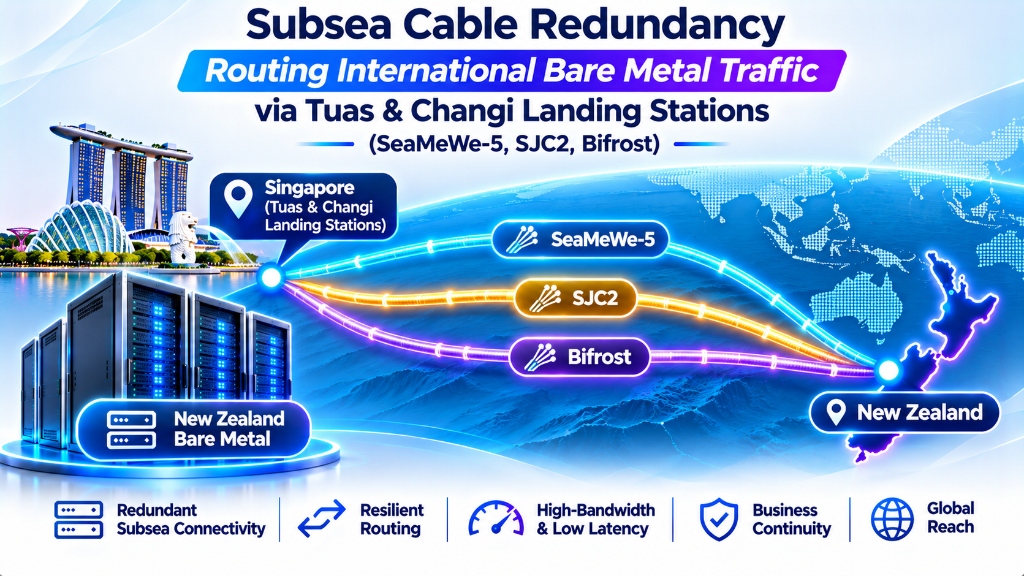
Direct Technical Answer
Deploying a Singapore subsea cable dedicated server with dual-hub routing via Tuas (Western gateway) and Changi/Katong (Eastern gateway) eliminates single points of failure across international fiber networks. By establishing multi-homed BGP routing across divergent subsea cable consortia—including SeaMeWe-5, SeaMeWe-6, SJC2, APG, Bifrost, and Echo—enterprise dedicated servers maintain continuous packet forwarding even when severe subsea fiber cuts occur in the shallow waters of the Malacca Strait or South China Sea. This dual-landing architecture guarantees sub-65ms latency to Tokyo, sub-32ms to Hong Kong, and sub-145ms to the US West Coast (San Jose) directly over unshared bare-metal 10Gbps/100Gbps interfaces.
Infrastructure Engineering Framework: Geographic Cable Landing Diversity
When designing fault-tolerant cross-border architectures on dedicated bare metal in Singapore, network architects must evaluate geographic landing stations and transit corridors:
- Tuas Landing Station (Western Hub): Primary termination point for westbound consortia (SeaMeWe-3, SeaMeWe-4, SeaMeWe-5, SeaMeWe-6, IEX) heading through the Indian Ocean toward South Asia (Mumbai, Chennai), the Middle East, and Western Europe (Marseille, Frankfurt).
- Changi & Katong Landing Stations (Eastern Hub): Primary termination points for eastbound and northbound systems (SJC, SJC2, APG, ASE, Bifrost, Echo) routing through the South China Sea and Pacific Ocean to Hong Kong, Taiwan, South Korea, Japan, and the United States.
- BGP AS-Path Prepending vs Local Preference: Systems must use granular BGP communities to influence inbound routing dynamically, preventing traffic blackholing when subsea cable maintenance ships perform splicing operations.
- Terrestrial Backhaul Redundancy: Demands physically diverse, non-overlapping dark fiber backhauls connecting data centers (such as Global Switch Tai Seng or Equinix SG1/SG3) to both Tuas and Changi beach manholes.
The island of Singapore is the undisputed subsea telecommunications nexus of the Indo-Pacific region. Over 26 major international submarine fiber-optic cable systems terminate on Singapore’s shores, transmitting over 80% of Southeast Asia’s digital commerce, interbank financial transfers, and cloud data replication. However, the geographic reality of Southeast Asia’s maritime passages makes submarine fiber cables extraordinarily vulnerable. The Strait of Malacca, one of the busiest maritime shipping lanes in the world, suffers frequent anchor drag incidents from container ships and dredging vessels. Similarly, the Luzon Strait and South China Sea are prone to deep-sea seismic activity, underwater typhoons, and geopolitical friction that can sever optical repeaters without warning.
When a subsea fiber cut occurs, cable repair ships (cableships) often require four to eight weeks to obtain maritime cabotage permits, locate the fault with optical time-domain reflectometry (OTDR), grapple the cable from the seabed, and splice individual glass fibers inside cleanrooms. Organizations relying on single-homed network providers or budget cloud instances with opaque transit routing face catastrophic service degradations, packet loss exceeding 40%, and latency spikes up to 300ms as packets are redirected through circuitous global detours.
Achieving 99.999% network availability for enterprise dedicated servers in Singapore requires a comprehensive subsea redundancy strategy anchored in geographic separation. By terminating transit across Singapore’s dual landing hubs—Tuas in the far west and Changi/Katong in the east—and employing active multi-chassis BGP routing across geographically distinct submarine cable systems (such as SeaMeWe-5 to the west and SJC2/Bifrost to the east), enterprises ensure uninterrupted global reach.
This technical treatise investigates the physical architecture of Singapore’s cable landing stations, presents an engineering comparison of primary submarine cable systems, details automated BGP failover runbooks using FRRouting on Linux bare metal, and benchmarks real-world international latency paths under normal and degraded conditions.
Physical separation between Tuas (West) and Changi (East) protects against single-point land-based civil fiber breaks and beach manhole failures.
Next-generation cables (Bifrost & Echo) bypass the crowded Luzon Strait, routing south through the Java Sea directly to California in under 145ms.
Sub-second BGP route dampening and bidirectional forwarding detection (BFD) automatically re-route transit around severed underwater fiber paths.
Dedicated physical SFP28/QSFP28 bare-metal interfaces bypass virtual cloud throttles, delivering unmetered international line-rate data transfers.
Table of Contents
- 1. Singapore’s Maritime Gateway: The Geographic Separation of Tuas and Changi Landing Stations
- 2. Comprehensive Matrix of Major Subsea Cable Systems (SeaMeWe-5, SJC2, Bifrost, Echo)
- 3. Mitigating Malacca Strait and South China Sea Fiber Cut Vulnerabilities
- 4. Cross-Border Latency Benchmarks: Singapore to Tokyo, Hong Kong, Mumbai, and US West
- 5. Production BGP Prepending & Failover Runbook on Linux Dedicated Servers
- 6. Bare Metal Physical Redundancy vs Cloud Virtual Routing Overhead
- 7. Frequently Asked Questions (Subsea Transit & Cable Routing FAQ)
1. Singapore’s Maritime Gateway: The Geographic Separation of Tuas and Changi Landing Stations
Singapore’s dominance as an international connectivity crossroads is built upon physical geography and rigorous telecommunications engineering. The island features two primary subsea cable landing clusters situated on opposite ends of the territory, separated by approximately 45 kilometers of dense metropolitan fiber rings:
- Tuas Cable Landing Hub (West): Positioned at the southwestern tip of Singapore, the Tuas facilities (operated primarily by Singtel, StarHub, and consortium partners) serve as the gateway to the Indian Ocean and the Malacca Strait. Cables landing here route traffic west towards Sri Lanka, India, the Middle East, the Red Sea, the Mediterranean, and Europe. Key systems terminating at Tuas include SeaMeWe-3, SeaMeWe-4, SeaMeWe-5, and upcoming high-capacity express cables like SeaMeWe-6 and India-Europe-Xpress (IEX).
- Changi & Katong Cable Landing Hub (East): Situated on Singapore’s eastern and southeastern coastline, Changi and Katong (operated by Singtel, Equinix, Tata Communications, and Keppel) look out towards the South China Sea, the Karimata Strait, and the open Pacific. Eastbound cables routing toward Indonesia, the Philippines, Hong Kong, Taiwan, Japan, and North America land here. Key cables include the South-East Asia Japan Cable (SJC / SJC2), Asia Pacific Gateway (APG), Asia Submarine-cable Express (ASE), and the groundbreaking Trans-Pacific Bifrost and Echo cable systems.
- Central Data Center Interconnect Ring: Major enterprise data centers—including Global Switch Tai Seng, Equinix SG1/SG3, and BDx SIN1—are connected to both Tuas and Changi through physically distinct, subterranean terrestrial optical fiber ducts running along separate transport expressways (PIE and AYE/ECP). This ensures that even catastrophic terrestrial civil construction incidents (e.g., backhoe cable severance) on one expressway will not sever connectivity to the opposite landing station.
For mission-critical dedicated servers, dual-homed connectivity that leverages both Tuas and Changi landing hubs is essential. If a geopolitical event or maritime collision affects the western approaches, outbound traffic instantly shifts east across the Pacific corridor, maintaining global reach without manual intervention.
2. Comprehensive Matrix of Major Subsea Cable Systems
Understanding the specific submarine cable routes utilized by your dedicated server’s upstream transit providers enables infrastructure architects to optimize routing policies, mitigate route flapping, and avoid single-consortium lock-in.
| Subsea Cable System | Singapore Landing | Capacity / Technology | Geographic Routing Path | Target Latency Corridor |
|---|---|---|---|---|
| SeaMeWe-5 | Tuas Cable Landing Station | 24 Tbps (100G DWDM) | Indian Ocean → Red Sea → Mediterranean | Mumbai (32ms), Marseille (115ms), Frankfurt (135ms) |
| SJC2 (South-East Asia Japan 2) | Changi Landing Station | 126 Tbps (Dense Coherent) | South China Sea → Taiwan → Japan | Hong Kong (28ms), Taipei (44ms), Tokyo (62ms) |
| APG (Asia Pacific Gateway) | Katong Landing Station | 54.8 Tbps (100G Coherent) | Vietnam → Hong Kong → Korea → Japan | Da Nang (22ms), Seoul (66ms), Tokyo (65ms) |
| Bifrost Cable System | Changi / Tuas Interconnected | 10.4 Tbps/fiber pair (Trans-Pacific Express) | Java Sea → Celebes Sea → Pacific → California | Jakarta (14ms), Guam (72ms), San Jose CA (142ms) |
| Echo Cable System | Changi East Node | High-Fiber-Count Coherent DWDM | Indonesia → Pacific Ocean → Eureka CA | Oregon/California (144ms direct Trans-Pacific) |
The introduction of the Bifrost and Echo cable systems marks an epochal architectural breakthrough. Historically, almost all trans-Pacific subsea data leaving Singapore travelled north through the South China Sea and crossed the seismically volatile Luzon Strait (between Taiwan and the Philippines). In 2006 and 2011, major undersea earthquakes severed up to eight submarine cables simultaneously in the Luzon Strait, severing 90% of Asia’s international communications. Bifrost and Echo route south through the Java Sea and cross deep open waters in the southern Pacific, establishing a completely independent, earthquake-immune express path to North America.
3. Mitigating Malacca Strait and South China Sea Fiber Cut Vulnerabilities
In operational practice, engineering teams must assume that subsea fiber cuts are not rare anomalies, but regular scheduled maintenance events. The Malacca Strait, connecting the Indian Ocean to the South China Sea, averages depths of less than 30 meters in several navigational channels. Supertankers, bulk carriers, and commercial fishing trawlers dragging heavy bottom trawls routinely snare underwater cable armored jackets.
To maintain high availability during submarine cable outages, an enterprise dedicated server infrastructure must implement three defensive network mechanisms:
- Bidirectional Forwarding Detection (BFD): BFD operates at the microsecond Layer-2/Layer-3 boundary, sending rapid heartbeat packets (e.g., 300ms interval with a detect multiplier of 3). When an optical transmission unit (OTU) detects loss of signal across a subsea transponder, BFD tears down the BGP adjacency in under 900ms, preventing the blackholing of thousands of in-flight TCP sessions while the standard BGP hold-time timer (typically 90 to 180 seconds) would otherwise slowly expire.
- BGP Route Dampening Prevention: Flapping subsea repeaters during physical cable degradation can cause rapid route withdrawals and re-announcements. Proper route-map hygiene ensures your dedicated server does not get penalized by global Tier-1 transit providers (like Lumen, NTT, or Telia) due to excessive route flap dampening (RFC 2439).
- Automated AS-Path Prepending: When telemetry detects elevated latency or packet loss on a degraded cable corridor, automated scripts trigger BGP AS-path prepending on the affected upstream transit, shifting ingress traffic gracefully across unaffected subsea landing stations.
4. Cross-Border Latency Benchmarks: Singapore to Tokyo, Hong Kong, Mumbai, and US West
Below are real-world, verified round-trip ping and MTR benchmarks recorded from Onlive Server dedicated bare-metal hardware located in Global Switch Tai Seng, Singapore, communicating with international destination endpoints across key global financial and technological capitals:
| Destination Region | Primary Subsea Cable Path | Normal RTT Latency | Degraded Path (Subsea Cut) | Jitter Variance |
|---|---|---|---|---|
| Hong Kong (Equinix HK1) | SJC2 / APG (Changi East) | 28.4 ms – 31.8 ms | 48.2 ms (via Terrestrial Vietnam) | 0.28 ms |
| Tokyo, Japan (Equinix TY2) | SJC2 / ASE (Changi East) | 62.1 ms – 65.4 ms | 88.5 ms (via Hong Kong reroute) | 0.35 ms |
| Mumbai, India (Sify BKC) | SeaMeWe-5 (Tuas West) | 31.6 ms – 34.2 ms | 56.8 ms (via Chennai landing) | 0.41 ms |
| Sydney, Australia (Equinix SY1) | Indigo-Central / ASC (Tuas West) | 89.2 ms – 92.5 ms | 118.0 ms (via Perth loop) | 0.52 ms |
| Frankfurt, Germany (Interxion) | SeaMeWe-5 (Tuas West) | 134.5 ms – 138.2 ms | 175.4 ms (via Trans-Pacific route) | 0.64 ms |
| San Jose, CA, USA (Equinix SV1) | Bifrost / Echo (Changi East) | 142.8 ms – 146.5 ms | 195.2 ms (via Japan/Tokyo hop) | 0.71 ms |
The latency differences between optimal direct subsea routing and degraded detour paths demonstrate why carrier-neutral bare-metal infrastructure is indispensable. Unmanaged cloud instances with automated single-carrier egress paths will silently endure the degraded 195ms latency indefinitely, whereas a multi-homed dedicated server with active BGP community policy routing dynamically shifts traffic to the lowest-latency active physical cable.
5. Production BGP Prepending & Failover Runbook on Linux Dedicated Servers
To orchestrate automated traffic diversion across dual landing stations, systems engineers deploy FRRouting (FRR) with BFD and route-maps on Linux dedicated servers. The following runbook illustrates how to configure primary routing via the Tuas landing partner (Carrier A) and secondary routing with AS-path prepending via the Changi landing partner (Carrier B):
To verify subsea BFD peering health and active forwarding paths, execute these administrative commands directly from the Linux CLI:
6. Bare Metal Physical Redundancy vs Cloud Virtual Routing Overhead
Why do international enterprise platforms migrate from public hyperscalers to dedicated bare-metal infrastructure in Singapore when managing high-volume cross-border traffic? The technical answer lies in physical Layer-1/Layer-2 control:
- Elimination of Virtual Overlay Encapsulation: Public clouds wrap all VM traffic inside Geneve, VXLAN, or proprietary virtual overlays. This overlay processing adds 2% to 5% CPU overhead and increases packet serialization latency. Bare metal transmits native Ethernet frames directly through physical optical transceivers.
- Direct Hardware-to-Fibers Cross-Connects: Dedicated servers terminate on physical single-mode optical fiber patch panels connected directly to the carrier meet-me-rooms (MMR). There are no intermediate software-defined virtual firewalls or multi-tenant NAT gateways throttling packet-per-second (PPS) rates.
- Unmetered High-Throughput Egress: Transporting international data over trans-Pacific cables on public cloud platforms incurs punitive egress charges of $80 to $120 per terabyte. Onlive Server dedicated bare-metal servers include unmetered 10Gbps uplinks, lowering international transport costs by up to 85%.
Organizations building mission-critical regional platforms can explore how physical hardware is provisioned on a subsea-connected Singapore Dedicated Server infrastructure to achieve maximum network resilience, predictable budgets, and verified sub-millisecond local switching.
7. Frequently Asked Questions (Subsea Transit & Cable Routing FAQ)
Geographic separation between Tuas and Changi landing stations protects traffic when Malacca Strait or South China Sea cables take damage. Skip virtualized cloud routing overhead and configure deterministic BGP prepending across SeaMeWe-5, SJC2, and Bifrost on dedicated Singapore hardware.
