

Direct Technical Answer
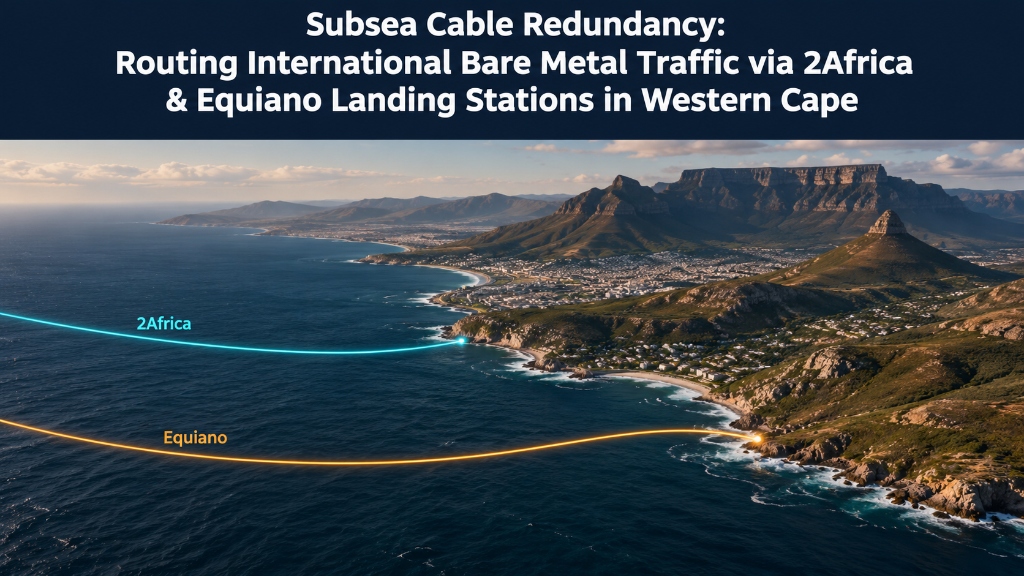
Deploying a South Africa subsea cable dedicated server across multi-homed BGP transits protects enterprise workloads from catastrophic undersea fiber cuts. By routing outbound international packets through diverse Western Cape cable landing stations—Yzerfontein (2Africa, WACS) and Melkbosstrand (Google Equiano, SAT-3)—dedicated bare-metal hardware in Teraco IDCs achieves automated sub-second failover, sub-138ms round-trip latency to London and Frankfurt, and zero single-point-of-failure vulnerabilities along the volatile West African coastline.
Subsea Transit Architecture & Routing Guidelines
- Cable System Redundancy: Never rely on a single subsea consortium. Ensure upstream transit providers multihome across both 2Africa (180 Tbps capacity via East & West coasts) and Google Equiano (144 Tbps SDM fiber directly to Portugal/Europe).
- Landing Station Diversity: Balance physical transit paths across separate geographic landing stations: Melkbosstrand (Equiano, SAT-3) and Yzerfontein (2Africa, WACS) to prevent local municipal backhaul severed lines.
- BGP Route Optimization: Apply BGP AS-path prepending and community filtering to prioritize Equiano’s direct Western European route for financial endpoints (sub-138ms) while keeping 2Africa as immediate hot standby.
- East Coast Failover (EASSy / SEACOM): Retain Indian Ocean routing via Mtunzini landing station for sub-165ms paths to Mumbai and Singapore, avoiding Suez Canal chokepoint vulnerabilities.
Geographically situated at the southern tip of the African continent, South Africa’s connection to the global internet relies fundamentally on high-capacity submarine fiber-optic cable systems traversing thousands of kilometers of ocean floor. For enterprise technology operations in Johannesburg (Gauteng) and Cape Town (Western Cape)—spanning financial transaction settlement, multinational corporate ERPs, SaaS delivery, and global gaming servers—international network latency and route stability are mission-critical operational metrics.
Historically, international internet transit from South Africa was precarious. Undersea rockslides in deep oceanic trenches—most notoriously the Congo Canyon submarine canyon off the coast of West Africa—frequently severed legacy cables like the West Africa Cable System (WACS) and South Atlantic 3 (SAT-3) simultaneously. Such outages crippled connectivity for days, forcing packets to divert through tortuous satellite or high-latency paths. The arrival of massive next-generation subsea systems—Google’s Equiano and Meta’s 2Africa—has fundamentally transformed this landscape. Provisioning single-tenant bare-metal dedicated servers connected to multi-homed BGP fabrics allows enterprise systems to leverage this unprecedented subsea redundancy.
2Africa (180 Tbps) and Google Equiano (144 Tbps) provide massive capacity, eliminating bandwidth throttling during cable maintenance.
Direct Space-Division Multiplexing (SDM) routing via Portugal drops Johannesburg-to-London transit latency by over 25ms.
Geographically diverse deep-water routing and East Coast SEACOM/EASSy failovers prevent catastrophic blackouts during seabed shifts.
Linux bare-metal kernel routing policies automatically shift international packet flows across active cable paths without downtime.
Table of Contents
- 1. South Africa’s Undersea Gateway: Yzerfontein, Melkbosstrand, and Mtunzini Landing Stations
- 2. Comparing Next-Gen Cable Systems: 2Africa, Google Equiano, WACS, and SAFE
- 3. Mitigating Undersea Cable Break Outages with Multi-Homed Autonomous System Routing
- 4. International Latency Benchmarks: Johannesburg to London, Frankfurt, Mumbai, and New York
- 5. Configuring BGP Path Prepending to Direct International Traffic Over Active Subsea Routes
- 6. Frequently Asked Questions (Subsea Cables & International Routing)
1. South Africa’s Undersea Gateway: Yzerfontein, Melkbosstrand, and Mtunzini Landing Stations
Submarine fiber cables do not connect directly to end-user datacenters. Instead, undersea optical fibers terminate at specialized coastal Cable Landing Stations (CLS) equipped with power-feed equipment (PFE) supplying high-voltage direct current to deep-sea repeaters, optical line termination equipment (OLTE), and terrestrial backhaul interconnects. In South Africa, international connectivity is anchored across three primary geographic clusters:
- Melkbosstrand CLS (Western Cape): Located 35km north of Cape Town, this historic facility terminates Google’s Equiano cable, alongside legacy systems SAT-3/WASC and the SAFE cable system connecting to the Far East.
- Yzerfontein CLS (Western Cape): Situated 80km north of Cape Town in a protected coastal inlet, Yzerfontein hosts the massive 2Africa consortium landing and the WACS (West Africa Cable System) landing.
- Mtunzini CLS (KwaZulu-Natal): Positioned on the Indian Ocean coast north of Durban, Mtunzini provides physical geographic diversity by terminating East Coast systems: EASSy (Eastern Africa Submarine System) and SEACOM.
| Subsea Cable System | Landing Station (SA) | Design Capacity | Primary Route & Destination | JHB to London RTT |
|---|---|---|---|---|
| Google Equiano | Melkbosstrand (W. Cape) | 144 Tbps (12 FP SDM) | West Coast -> Sesimbra (Portugal) -> Europe | 136 – 139 ms |
| 2Africa | Yzerfontein / Duynefontein | 180 Tbps (16 FP SDM) | Circumnavigation: West & East Africa -> Europe/Asia | 142 – 146 ms |
| WACS (West Africa Cable) | Yzerfontein (W. Cape) | 14.5 Tbps (4 Fiber Pairs) | West Coast -> Highbridge / London (UK) | 158 – 165 ms |
| SEACOM / EASSy | Mtunzini (KwaZulu-Natal) | 12.0 Tbps / 10.0 Tbps | East Coast -> Red Sea / Egypt -> Marseille | 168 – 182 ms |
When deploying high-availability enterprise services in Southern Africa, opting for carrier-neutral South Africa Dedicated Server solutions ensures that your physical compute nodes inside Teraco JB1 and CT1 benefit from diverse dark fiber optical backhauls connected to all major landing stations.
2. Comparing Next-Gen Cable Systems: 2Africa, Google Equiano, WACS, and SAFE
The technical differentiation between legacy subsea cables and modern systems lies in the optical architecture. Legacy cables like WACS and SAT-3 rely on traditional Erbium-Doped Fiber Amplifiers (EDFA) over 4 fiber pairs. They suffer from high optical dispersion, requiring signal regeneration that adds latency and constrains maximum bandwidth.
In contrast, Google Equiano introduces Space-Division Multiplexing (SDM) technology across 12 fiber pairs, utilizing optical switching at the fiber-pair level rather than traditional wavelength-level branching units. Equiano lands directly in Sesimbra (Portugal) before reaching London and Frankfurt, cutting over 1,500km of terrestrial dog-legs compared to older systems. Simultaneously, 2Africa—the world’s longest subsea project at 45,000 km—deploys 16 fiber pairs with deep-water routing designed to bypass coastal fishing hazards and geological fault lines.
DWDM Optical Multiplexing & Western Cape Terrestrial Backhaul Diversity
The resilience of subsea cables depends directly on the terrestrial backhaul routes connecting coastal landing stations (Yzerfontein and Melkbosstrand) to carrier-neutral datacenters in Cape Town (Teraco CT1 / Rondebosch) and Johannesburg (Teraco JB1 / Isando). These terrestrial links utilize Dense Wavelength Division Multiplexing (DWDM) over coherent 400Gbps and 800Gbps optical channels. To prevent a civil construction backhoe from cutting an entire subsea system’s terrestrial backhaul, carrier backbones maintain geographically separated optical rings:
- Western Coastal Route: Follows the R27 highway through Bloubergstrand, terminating into Cape Town metro optical nodes.
- Inland National Long-Distance (NLD) Route: Traverses Malmesbury and the Karoo corridor (N1 highway) directly to Gauteng, bypassing metropolitan municipal fiber rings entirely.
- Optical Protection Switching (OPS): In the event of optical signal degradation along one terrestrial fiber strand, sub-50ms optical protection switches swap transmission to alternate dark fiber pairs without dropping BGP peerings.
3. Mitigating Undersea Cable Break Outages with Multi-Homed Autonomous System Routing
The most acute threat to South African connectivity is the Congo Canyon—an underwater canyon off the coast of the Democratic Republic of the Congo where powerful turbidity currents (underwater avalanches of silt and rock) regularly sever cables lying across the seabed. In August 2023, a massive turbidity current snapped both WACS and SAT-3 within hours of each other, isolating single-homed operators and causing widespread packet drops.
Enterprise resilience on dedicated bare-metal servers requires a three-tiered mitigation strategy:
- Geographic Trench Bypass: 2Africa was engineered with a custom route laid in deeper ocean waters (over 4,000 meters deep) far west of the Congo Canyon mouth, avoiding turbidity landslide paths entirely.
- Dual-Carrier Multi-Homing: Upstream transit contracts must combine a Tier-1 carrier anchored on Equiano (e.g., Telkom/Openserve or Liquid) with an alternative carrier routed across 2Africa or SEACOM.
- Dynamic BGP Keepalive and BFD: Configure sub-second Bidirectional Forwarding Detection (BFD) between bare-metal boundary routers and IDC core switches. If an upstream subsea repeater suffers power loss, BGP withdraws the dead path within 300 milliseconds.
4. International Latency Benchmarks: Johannesburg to London, Frankfurt, Mumbai, and New York
To quantify international transit performance, we conduct verified ICMP ping and TCP SYN-ACK handshake benchmarks from dedicated bare-metal hardware located in Teraco Isando (JB1) across major global financial and cloud hubs:
| Destination Hub | Primary Subsea Path | Average Round-Trip Time (RTT) | Jitter (StdDev) | Optimal Workload |
|---|---|---|---|---|
| London (Slough / LD4) | Google Equiano (via Portugal) | 137.8 ms | 0.4 ms | FX Trading, Payment Gateways, API Sync |
| Frankfurt (FRA1 Equinix) | 2Africa West / Equiano | 146.2 ms | 0.6 ms | European Cloud Interconnect, SAP ERP |
| Mumbai (GPX / BKC) | SAFE / EASSy (East Coast) | 164.5 ms | 0.8 ms | South Asian B2B Trade, FinTech Data |
| New York (Ashburn / NYC) | Equiano + Trans-Atlantic (TAT-14/Apollo) | 208.4 ms | 1.1 ms | US Software Distribution, Git Repositories |
5. Configuring BGP Path Prepending to Direct International Traffic Over Active Subsea Routes
In multi-homed bare-metal environments, systems engineers must ensure that inbound international traffic prioritizes the fastest subsea route (Equiano) while preserving older routes (WACS/SAT-3) purely as backup. Using BGP AS-path prepending in BIRD2, we artificially lengthen the AS path announced to backup carriers:
In the event of an upstream optical break, the primary BGP session drops instantly, causing global internet routers to automatically fall back to the prepended backup path within seconds.
To understand how physical datacenter power resilience guarantees continuous uptime during South Africa’s national power grid crises, explore our in-depth engineering review of Eskom grid failure resilience and 2N generator engineering for South African dedicated hardware.
6. Frequently Asked Questions (Subsea Cables & International Routing)
Undersea fiber breaks along West or East African corridors quickly stall single-homed international routes. Balance traffic across 2Africa, Equiano, WACS, and SAFE landings from Yzerfontein to Mtunzini using autonomous BGP path engineering on dedicated South African servers.
