

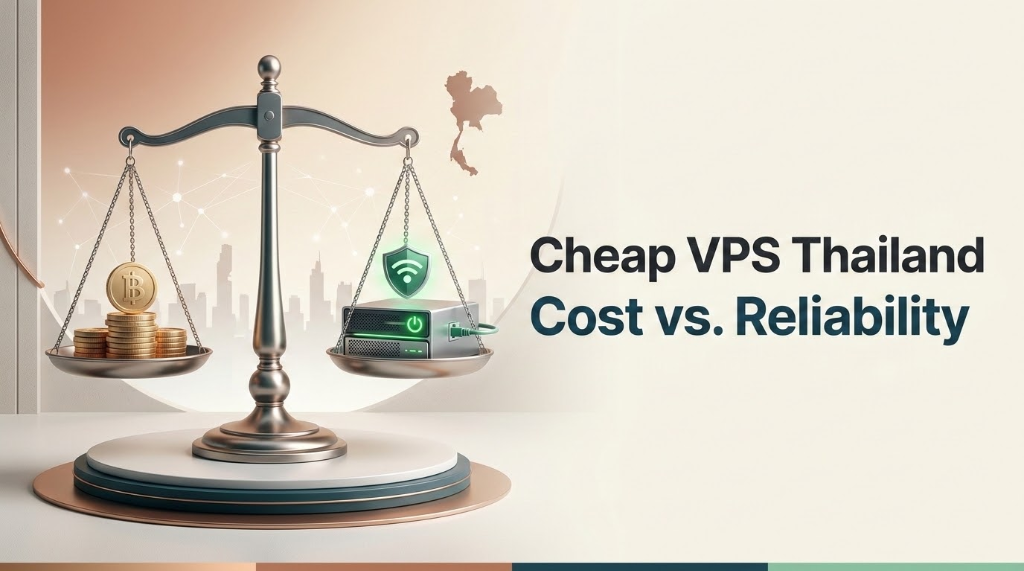
How to Evaluate a Cheap VPS in Thailand Without Sacrificing Performance?
Specifically, when planning an enterprise deployment for Cheap VPS Thailand, to safely evaluate a cheap Thailand VPS, verify that low pricing does not stem from CPU overselling or SATA storage throttling. Choose providers offering true KVM virtualization, genuine enterprise NVMe storage arrays, transparent bandwidth caps, and proven local network peering at BKNIX to ensure budget hosting maintains enterprise stability.
Furthermore, in the competitive hosting landscape of Bangkok, the lure of ultra-cheap cloud servers is powerful for bootstrapped founders, indie developers, and digital marketing agencies. Advertisements offering “Thailand VPS for 99 THB” frequently flood local technical forums. However, operating physical enterprise infrastructure in Bangkok carries fixed capital expenses: datacenter floor space, precision tropical cooling, and carrier transit fees. Navigating between predatory budget traps and genuine value when selecting affordable, reliable Thailand VPS hosting requires an objective technical audit of hardware overcommitment, disk I/O bottlenecks, and network routing policies.
✔ Key Budget Evaluation Takeaways
- Consequently, Datacenter Unit Economics: Quality Tier-III rack space, MEA electricity, and BKNIX fiber transit in Bangkok have real base costs; sub-$4 plans inevitably cut corners on hardware density or support.
- In addition, The Container Ballooning Trap: Cut-rate hosts deploy OpenVZ/LXC container architectures to oversell memory by 300%, triggering silent OOM database terminations during peak traffic.
- Hidden Bandwidth Throttling: Cheap plans often advertise 1Gbps domestic port speeds while secretly capping international transit to a crippling 10Mbps, breaking foreign API integrations.
- In particular, Storage Technology Discrepancy: Budget hosts frequently recycle slow mechanical SATA hard drives or budget consumer SSDs that choke under sustained MySQL indexing operations.
- Therefore, The Sustainable Budget Benchmark: Investing 350 to 650 THB ($10–$18/mo) provides dedicated KVM RAM, enterprise NVMe storage, and responsive 24/7 engineering support in Bangkok.
Table of Contents
- Moreover, The Economics of Budget VPS Hosting in Bangkok
- In fact, Where Ultra-Cheap Hosting Providers Cut Corners in Thailand
- Similarly, RAM Overcommitment and the Ghost of Container Overcommit
- Meanwhile, The Bandwidth Trap: Domestic Speed vs. Throttled International Transit
- Additionally, Five Essential Features You Must Never Compromise on a Budget VPS
- As a result, How to Benchmark a Cheap Thai VPS During Your Trial Period
- Specifically, The Sustainable Budget Sweet Spot: Getting Real Value on Thailand VPS
- Furthermore, Frequently Asked Questions (FAQ)
1
Consequently, every business seeks to minimize operating expenses. In cloud computing, however, price is directly anchored to physical engineering realities. To understand why a 99 THB ($3 USD) server often ends in operational disaster, one must examine the cost structure of running servers in central Bangkok.
In addition, operating an enterprise cloud cluster in a premier Bangkok telehouse (such as CAT Tower Bangrak, True IDC, or NTT Bangkok 2) entails non-negotiable monthly expenses:
- In particular, Carrier-Grade Rack Colocation: Standard 42U rack colocation space with dual power feeds and biometric security in Bangkok averages 25,000 to 45,000 THB per month.
- Therefore, High-Density Power & Precision Cooling: High-performance server processors (AMD EPYC or Intel Xeon) demand substantial kilowatt allocations. In Bangkok’s tropical climate, precision computer room air handling (CRAH) must work continuously to combat ambient heat and humidity, resulting in substantial electricity bills from the Metropolitan Electricity Authority (MEA).
- Moreover, Optical Fiber Transit & BKNIX Peering: Connecting to the Bangkok Neutral Internet Exchange (BKNIX) and securing multi-carrier upstream transit across AIS, True, and National Telecom (NT) requires dedicated cross-connect fees and commercial bandwidth commits.
- In fact, Hardware Capital Amortization: Enterprise server nodes featuring registered ECC DDR4/DDR5 RAM, enterprise PCIe NVMe storage arrays, and hardware RAID controllers cost upwards of $6,000 to $12,000 USD per node.
Similarly, when an ultra-cheap provider sells a VPS for $2 to $4 per month, the only mathematical way they can turn a profit is by packing hundreds of virtual machines onto underpowered, aging hardware. Knowing how providers cut these corners allows you to identify deceptive marketing before placing an order.
2
Meanwhile, cut-rate VPS providers operating in the Thai market rely on four primary compromise mechanisms that directly threaten your website’s availability:
1. Decommissioned Legacy Server Hardware
Instead of deploying modern enterprise hardware, ultra-cheap hosts often buy decommissioned second-hand desktop-grade components or outdated multi-socket servers from 2014. These systems lack modern CPU instructions (like AVX-512) and rely on power-hungry, slow memory channels that bottleneck database performance.
2. Low-Grade Mechanical Drives and Consumer SSDs
Additionally, enterprise NVMe drives are built with high write endurance (DWPD – Drive Writes Per Day) and power-loss protection (PLP) capacitors. Cheap hosts often deploy consumer-grade SATA SSDs or legacy mechanical hard drives. Under multi-tenant database write loads, consumer drives quickly exhaust their cache, causing disk I/O wait times (%wa) to spike over 40%, freezing web servers across the entire physical node.
3. Non-Existent or Outsourced Technical Support
As a result, hiring qualified Linux systems administrators in Bangkok commands professional salaries. To maintain rock-bottom pricing, cheap hosts eliminate technical support desks. Support queries submitted via email or contact forms often go unanswered for 48 to 72 hours, leaving your business stranded during critical operational outages.
4. Single-Homed Network Connectivity
Specifically, rather than investing in multi-homed BGP network routing across diverse telecom carriers, budget hosts connect their servers to a single, cheap upstream bandwidth line. If that single carrier experiences fiber cuts or upstream maintenance, all hosted virtual servers lose connectivity simultaneously.
3
Furthermore, the single greatest operational hazard on ultra-cheap Thai cloud servers is memory overcommitment. Cut-rate hosts frequently deploy legacy container architectures (such as OpenVZ or unmanaged shared LXC nodes) where every tenant shares the host operating system kernel. To ensure your low introductory rate does not double on renewal, verify transparent Thailand VPS renewal pricing before locking your business into an extended contract. Regional pricing dynamics and cross-border connectivity benchmarks are tracked globally via the ITU ICT telecommunications benchmark indicators.
Because container hosting does not enforce hardware memory boundaries, the host can advertise 4 GB of RAM to twenty different customers on a physical machine that only possesses 16 GB of physical RAM. The host relies on dynamic memory ballooning, reclaiming memory pages from idle containers. However, during high-traffic Thai business hours (11:00 to 14:00 and 20:00 to 23:00 ICT), multiple tenants experience traffic surges simultaneously. When aggregate memory demand exceeds physical RAM, the Linux Out-Of-Memory (OOM) killer abruptly terminates high-consuming processes:
In contrast, an OnliveServer KVM cloud VPS guarantees that 100% of your allocated memory is locked into physical ECC RAM pages. Dynamic ballooning is strictly prohibited on our production clusters, ensuring that your MySQL buffer pools, Redis caches, and PHP worker processes remain completely insulated from adjacent workloads.
4
In addition, a classic marketing trap in the cheap Thai VPS market involves asymmetric bandwidth advertising. A host’s sales page may prominently boast “1 Gbps Port Speed Unmetered Bandwidth.” Non-technical buyers assume they are receiving an unthrottled global 1 Gbps internet connection.
In particular, in reality, bandwidth within Thailand is divided into two distinct routing paths:
- Therefore, Domestic Thai Traffic: Routes locally through BKNIX or private peering links. Because domestic transit is low-cost, the provider genuinely delivers fast speeds (up to 1 Gbps) for visitors residing within Thailand.
- Moreover, International Upstream Transit: Routes across international submarine cables landing in southern Thailand (such as AAG, APG, and SJC2). International transit carries high wholesale transit costs. Cheap hosts aggressively cap international throughput on sub-$5 plans—often limiting outgoing and incoming overseas speeds to a mere 10 Mbps or 20 Mbps.
If your web application relies on international third-party APIs (such as Stripe payments, Google Cloud services, AWS S3 storage buckets, or GitHub CI/CD webhooks), this severe international bottleneck causes API connection timeouts and sluggish backend data synchronization.
| Pricing & Tier Category | Virtualization & Hardware | Bandwidth Allocation | Production Viability |
|---|---|---|---|
| Ultra-Cheap (Sub-150 THB / <$4) | OpenVZ / Shared LXC / HDD | 10Mbps International / Shared Port | Testing & Experimental Only |
| Sustainable Budget (350–650 THB) | Full KVM / Dedicated RAM / NVMe | 1Gbps Domestic / 50-100Mbps Global | Production Business & E-Commerce |
| Enterprise Cloud (900–1,800+ THB) | AMD EPYC KVM / RAID 10 NVMe | Unmetered BKNIX / High Global Cap | High-Concurrency Databases & FinTech |
5
In fact, when selecting an economical cloud hosting solution in Thailand, compromising on certain features is acceptable (e.g., using a free control panel like FastPanel or aaPanel instead of an expensive commercial cPanel license). However, you must never compromise on the following five technical pillars: Finding cost-effective hosting without sacrificing uptime requires evaluating budget-friendly cloud VPS servers built on unthrottled enterprise hardware.
The Non-Negotiable Infrastructure Baseline
- 1. KVM Hardware Virtualization: Never accept containerized hosting (OpenVZ/LXC). Full KVM virtualization guarantees dedicated RAM, zero memory ballooning, and an independent Linux kernel.
- 2. Pure PCIe NVMe Storage: Insist on solid-state NVMe drives. Avoid legacy spinning hard drives (HDD) and budget SATA SSDs that fail under concurrent database transactions.
- 3. Dedicated Static IPv4 Address: Ensure your plan includes a dedicated, clean IPv4 address with self-service Reverse DNS (PTR) management, protecting your email deliverability.
- 4. Tier-III Bangkok Datacenter Colocation: Verify that servers are physically housed inside certified facilities (CAT Bangrak, True IDC) with dual utility power feeds and backup diesel generators.
- 5. Automated Snapshot Capabilities: Ensure the management portal supports on-demand or automated system snapshots, allowing instant rollback in the event of configuration errors.
6
When onboarding a new budget server in Bangkok, take advantage of money-back guarantee or trial windows by executing a comprehensive diagnostic benchmark runbook. This allows you to verify hardware claims empirically before deploying production customer data.
Execute the industry-standard Yet-Another-Bench-Script (YABS) to evaluate CPU performance, disk IOPS, and network transit speeds:
If the 4K write IOPS metric is below 10,000, the host is using slow storage. If the CPU steal column (st) shows sustained values above 3%, physical CPU cores are severely oversold across adjacent tenants.
7
True economy in cloud infrastructure is not about finding the lowest possible invoice number; it is about maximizing uptime, page loading velocity, and data security per baht spent. A server that saves you 200 THB a month is extraordinarily expensive if an unannounced outage during an evening marketing campaign costs you 20,000 THB in lost e-commerce sales.
The sustainable budget sweet spot in Thailand sits firmly between 350 and 650 THB ($10 to $18 USD) per month. In this tier, OnliveServer provides an uncompromised entry-level production cloud instance:
- 2 Dedicated vCPU cores on enterprise AMD EPYC or Intel Xeon hardware.
- 4 GB of guaranteed physical ECC RAM (100% dedicated, zero ballooning).
- 60 GB to 80 GB of enterprise PCIe NVMe storage in hardware RAID 10.
- Unmetered 1 Gbps domestic transit directly connected to BKNIX in Bangkok.
- A dedicated, clean static IPv4 address with full automated Reverse DNS support.
- Bilingual 24/7 technical support and seamless PromptPay QR payment options.
This entry configuration comfortably handles production corporate WordPress websites, high-conversion WooCommerce stores, API microservices, and regional database clusters with rock-solid stability.
8
Core Technical Specifications
Get Affordable Thailand VPS Hosting with Enterprise Hardware
Enjoy budget-friendly monthly pricing without sacrificing performance. Run your web applications on enterprise AMD EPYC processors and high-speed NVMe arrays backed by unmetered bandwidth.
