

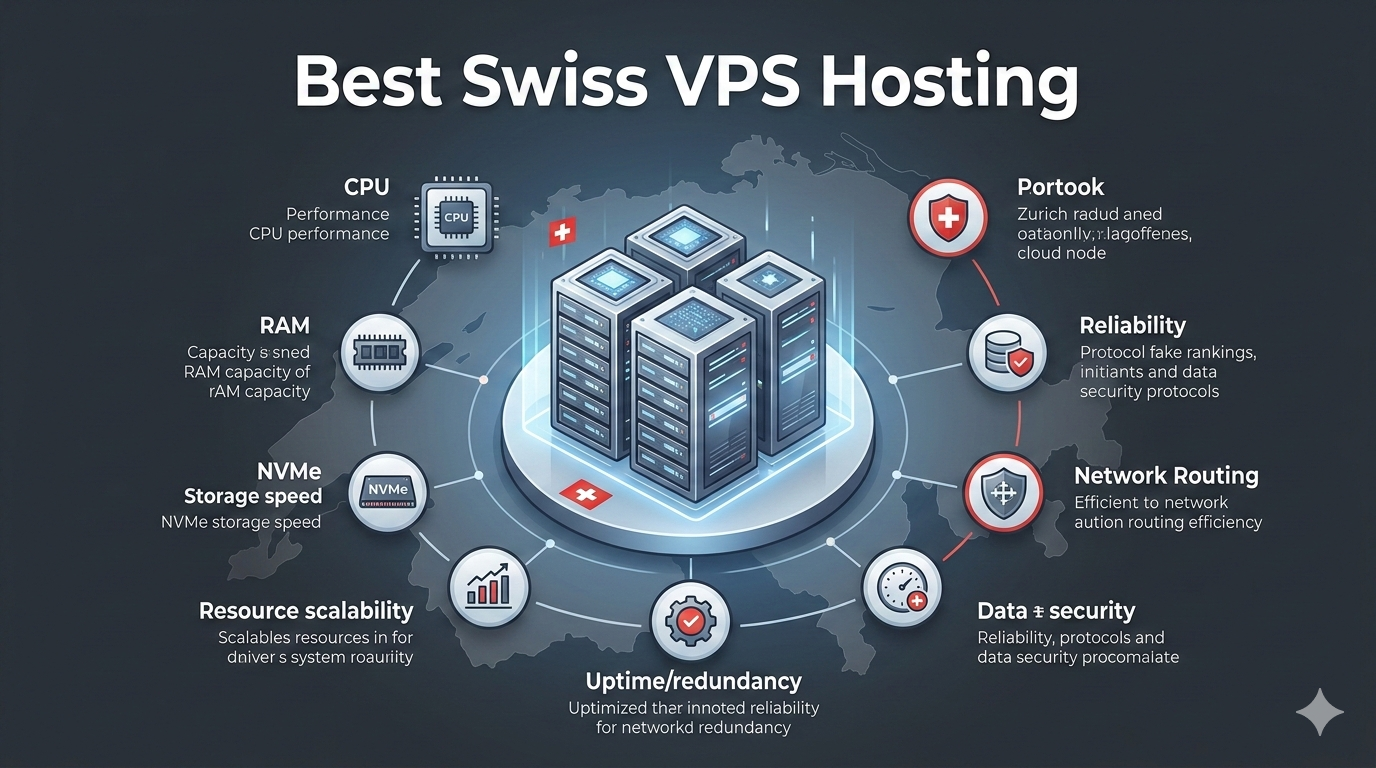
Specifically, the best Swiss VPS hosting providers distinguish themselves through certified Tier III carrier-neutral Zurich datacenter placement, pure KVM hypervisor virtualization, and enterprise PCIe 4.0 NVMe storage subsystems. Top-tier providers guarantee compliance with the revised Swiss Federal Act on Data Protection (revDSG), maintain direct SwissIX peering, and deliver 24/7 root-level sysadmin technical assistance.
Furthermore, selecting the best Swiss VPS hosting provider requires looking far beyond marketing slogans and superficial pricing tiers. For organizations managing sensitive financial records, intellectual property, and high-concurrency production platforms, your cloud hosting provider represents the foundational bedrock of your security perimeter. While Switzerland offers an inherently superior legal and geographical framework for digital hosting, individual provider implementations vary drastically in hypervisor isolation, storage bus designs, upstream network peering, and technical support responsiveness. This comprehensive evaluation guide establishes rigorous technical benchmarks—encompassing compute virtualization, fio storage profiling, network jitter across European peering hubs, and revDSG regulatory compliance—to help systems architects and IT managers select the premier Swiss VPS for their mission-critical workloads.
Key Technical Takeaways
- Consequently, Hypervisor Architecture Priority: The best providers exclusively deploy Kernel-based Virtual Machine (KVM) virtualization, eliminating noisy-neighbor resource theft common to shared-kernel container platforms.
- Enterprise PCIe 4.0 NVMe Storage: Top Swiss hosts implement hardware RAID 10 NVMe storage subsystems delivering over 600,000 IOPS and sub-20 microsecond random read/write latency.
- In addition, Direct SwissIX Peering: Premier Zurich facilities connect directly to the Swiss Internet Exchange, ensuring sub-5ms domestic latency and deterministic transit routing into Frankfurt and Milan.
- In particular, Full Compliance with Swiss revDSG: Hosting in certified Swiss datacenters guarantees sovereign data protection, recognized as adequate by the European Commission without requiring complex Standard Contractual Clauses.
- Therefore, Unrestricted Root Access & Modern OS Freedom: True enterprise hosting provides unhindered root SSH access, custom ISO installation, and seamless support for modern Linux distributions and Windows Server.
- Moreover, The State of Swiss Cloud Infrastructure: Navigating Modern Hosting Options
- In fact, Core Technical Evaluation Pillars: Compute, Storage, Network, and Support
- Similarly, Benchmarking Methodologies: YABS, Geekbench 6, and Fio IOPS Testing
- Meanwhile, Storage Architecture: Why Pure Enterprise NVMe Outperforms Standard SSD
- Additionally, Technical Support Standards: Direct Sysadmin Assistance vs. Ticket Queues
- As a result, Compliance, Security, and Physical Datacenter Tier Certifications
- Specifically, Frequently Asked Questions About the Best Swiss VPS Hosting Providers
- Furthermore, Deploy the Best Swiss VPS Hosting for Your Workload
The State of Swiss Cloud Infrastructure: Navigating Modern Hosting Options
Consequently, switzerland’s hosting ecosystem is characterized by an exceptional standard of physical infrastructure, driven by the nation’s stringent industrial building codes and world-leading electrical grid reliability. However, this high baseline sometimes creates a false sense of security among technical buyers.
In the modern market, hosting providers operating under a Swiss banner broadly fall into three categories:
– Legacy Colocation Resellers: Traditional hosts that evolved from physical server leasing. While they offer robust physical facilities, their management panels are often archaic, provisioning is manual, and pricing reflects outdated cost structures.
– Budget Container Brokers: Low-cost hosting brands that leverage OpenVZ or LXC containers to cram hundreds of virtual tenants onto aging hardware. They offer attractive sticker prices but suffer from severe resource contention, high I/O wait times, and zero kernel customizability.
– Modern Hyper-Converged Cloud Providers: Progressive hosts such as OnliveServer that deploy enterprise KVM nodes backed by PCIe 4.0 NVMe arrays, automated cloud deployment APIs, and direct multi-homed BGP peering inside carrier-neutral Zurich facilities.
To identify the best Swiss VPS hosting provider, evaluators must evaluate performance across objective, reproducible technical metrics rather than brand longevity alone.
Core Technical Evaluation Pillars: Compute, Storage, Network, and Support
In addition, when conducting an architectural audit of prospective Swiss cloud hosts, technical teams should structure their assessment across four foundational pillars:
Compute Hypervisor Isolation
In particular, the foundational requirement of enterprise virtualization is guaranteed hardware isolation. Top providers implement Kernel-based Virtual Machine (KVM) virtualization paired with dedicated vCPU execution threads (utilizing Intel VT-x or AMD-V virtualization extensions). In this model, physical CPU cycles and registered ECC RAM addresses are allocated exclusively to your virtual machine, ensuring consistent processing power during high-concurrency production spikes.
Storage Bus Architecture and IOPS Delivery
Therefore, web applications and databases spend the vast majority of execution time waiting on storage I/O. Providers relying on legacy SATA solid-state drives or mechanical storage arrays create massive performance bottlenecks. Top providers deploy enterprise Non-Volatile Memory Express (NVMe) solid-state storage operating over PCIe 4.0 buses in hardware RAID 10 configurations, delivering sustained throughput exceeding 5,000 MB/s and random read/write latency under 20 microseconds.
Network Topology and Peering Interconnects
Moreover, a top-tier Swiss server must possess redundant network connectivity. Evaluate whether the provider operates under an autonomous system number (ASN) registered with the RIPE Network Coordination Centre (RIPE NCC) and maintains direct peering on the Swiss Internet Exchange (SwissIX). Multi-homed BGP routing with Tier-1 carriers ensures deterministic sub-10ms transit times across Central Europe. For detailed network routing benchmarks, consult our analysis of Zurich VPS datacenter peering.
Direct Technical Support Capability
In fact, when production systems experience anomalies, tiered support ticket systems with 24-hour response SLAs are unacceptable. The best providers maintain 24/7 technical operations centers staffed by experienced Linux and Windows systems administrators capable of addressing kernel panics, firewall issues, and routing anomalies immediately.
Benchmarking Methodologies: YABS, Geekbench 6, and Fio IOPS Testing
Similarly, prudent infrastructure architects validate hosting claims through standardized, objective benchmarking suites. Before migrating production workloads to a Swiss VPS, execute the following diagnostic tests:
Yet Another Benchmark Script (YABS)
Meanwhile, yABS represents the industry-standard benchmarking tool for virtual private servers, testing CPU performance via Geekbench 6, disk read/write throughput using fio, and network transit speeds across international iPerf3 endpoints: “bash curl -sL yabs.sh | bash `
Evaluating Fio Storage Performance
Additionally, to isolate disk I/O capabilities, execute direct fio commands targeting 4KB random read/write operations with a queue depth of 32—the exact profile generated by high-concurrency relational databases (PostgreSQL and MySQL): `bash fio --name=random-write --ioengine=libaio --rw=randwrite --bs=4k --size=4G --numjobs=1 --iodepth=32 --runtime=60 --time_based --group_reporting “ An enterprise-grade Swiss VPS backed by PCIe 4.0 NVMe storage should achieve at least 80,000 to 120,000 random write IOPS with an average completion latency under 0.3 milliseconds. If a provider’s test results reveal IOPS below 10,000 or latency exceeding 2.0 milliseconds, the host is utilizing SATA SSDs or oversubscribing shared storage pools.
Storage Architecture: Why Pure Enterprise NVMe Outperforms Standard SSD
As a result, the architectural disparity between legacy SATA storage and modern enterprise NVMe PCIe 4.0 arrays directly determines web application concurrency and database throughput. The table below outlines verified technical differences:
Specifically, these empirical metrics demonstrate why the best Swiss VPS providers strictly deploy enterprise NVMe storage. For database transactions and API endpoints, PCIe 4.0 NVMe reduces disk wait times by over 85%, allowing virtual machines to process substantially higher concurrency on equivalent vCPU and RAM allocations. For budget-conscious procurement strategies, review our guide to cheap Swiss VPS hosting.
Technical Support Standards: Direct Sysadmin Assistance vs. Ticket Queues
Furthermore, in production hosting environments, the quality and responsiveness of technical support often matter more than hardware specifications. When an unannounced kernel update causes a bootloop or an upstream BGP route flap disrupts traffic, delays in support response translate directly into financial loss.
When evaluating the best Swiss VPS hosting providers, test support capabilities against three strict criteria:
– Direct Engineer Access: Avoid providers where frontline customer service representatives act as gatekeepers, requiring two to three ticket escalations before a qualified Linux or Windows systems administrator investigates the issue.
– Round-the-Clock (24/7/365) Availability: Datacenter incidents do not adhere to standard business hours. The best providers maintain active technical operations shifts throughout nights, weekends, and national holidays.
– Root-Level Troubleshooting Capability: Leading hosts assist with out-of-band console access, network routing diagnostics, reverse DNS management, and kernel rescue mode configuration, ensuring rapid recovery from administrative misconfigurations.
Compliance, Security, and Physical Datacenter Tier Certifications
Consequently, the ultimate differentiator for Swiss cloud infrastructure is data sovereignty and physical security compliance. A provider operating out of an uncertified facility cannot guarantee the legal and physical protection required for enterprise deployments.
In addition, ensure your selected Swiss host satisfies the following compliance standards:
Swiss revDSG and GDPR Adequacy
Physical server deployment within Switzerland ensures that all hosted personal data is governed exclusively by the revised Swiss Federal Act on Data Protection (revDSG) and the Swiss Federal Constitution. Because the European Commission has formally recognized Swiss privacy laws as offering full adequacy, organizations can store and process European customer records without executing cumbersome Standard Contractual Clauses (SCCs).
Certified Tier III / Tier IV Datacenter Standards
Ensure hosting infrastructure resides inside certified carrier-neutral Zurich facilities engineered to Tier III or Tier IV specifications. These standards guarantee redundant 2N electrical distribution, N+1 rotary diesel generator reserves, precision climate control, and comprehensive physical security including biometric mantraps and 24/7 closed-circuit television monitoring. By synthesizing enterprise KVM virtualization, PCIe 4.0 NVMe storage, and certified Tier III Swiss datacenter engineering, OnliveServer delivers the premier Swiss VPS hosting experience for organizations demanding peak performance and unassailable data privacy.
Frequently Asked Questions About the Best Swiss VPS Hosting Providers
Core Technical Specifications
Deploy the Best Swiss VPS Hosting for Your Workload
Experience the pinnacle of Swiss cloud hosting inside Zurich’s premier Tier III datacenter ecosystem. Benefit from pure KVM virtualization, ultra-fast PCIe 4.0 NVMe storage, direct SwissIX peering, and unassailable revDSG privacy.
