

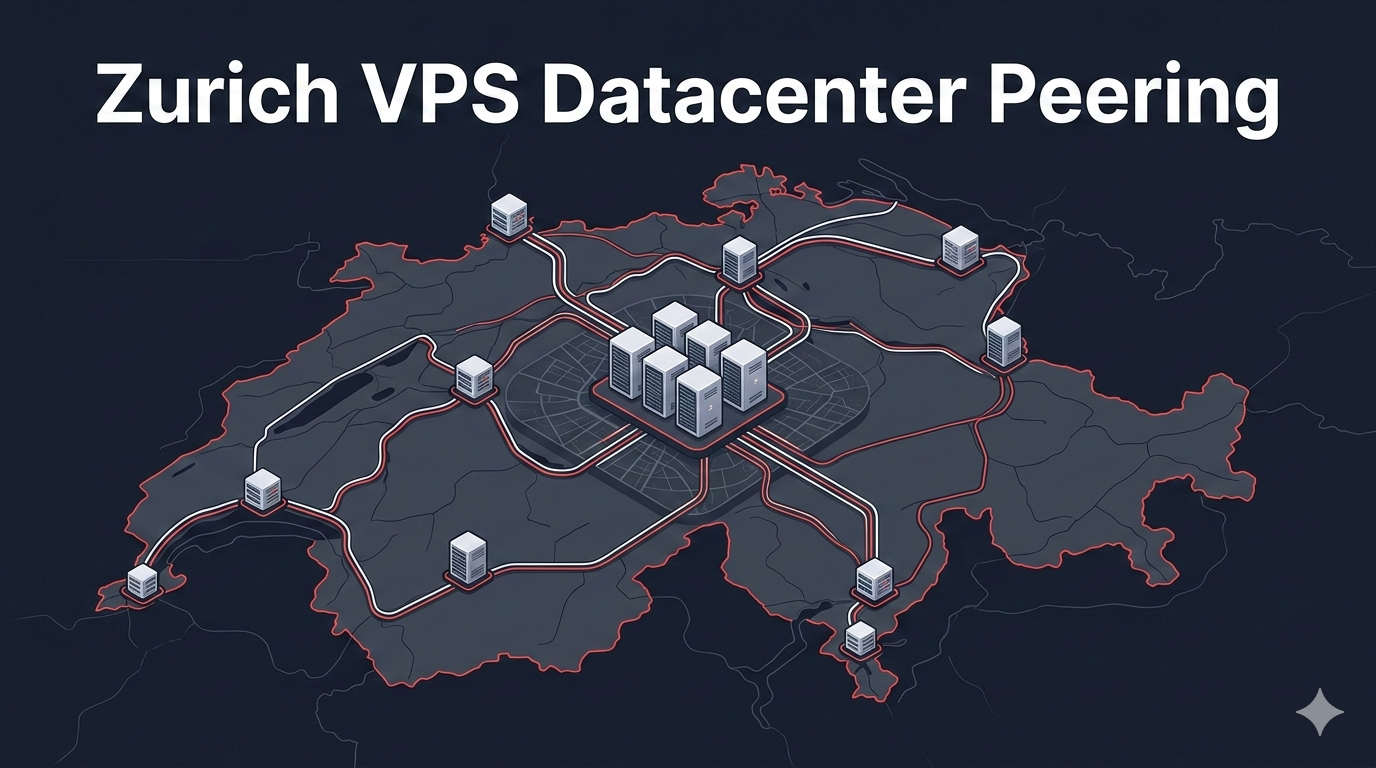
Zurich VPS datacenter peering leverages Switzerland’s geographic position and carrier-neutral fiber hubs to deliver sub-10ms latency across Central Europe. By interconnecting directly through the Swiss Internet Exchange (SwissIX) and trans-Alpine dark-fiber corridors, virtual machines deployed in Zurich bypass congested international transit backbones, achieving sub-5ms domestic latency, 7ms to Frankfurt, and 8ms to Milan with enterprise DDoS mitigation.
In modern cloud computing, geographical placement and physical network topology dictate application throughput far more than raw clock cycles. For latency-critical deployments—such as automated algorithmic trading desks, microservices clusters, real-time telemetry ingestion, and distributed database synchronization—server placement within a carrier-neutral Zurich datacenter provides decisive structural advantages. Zurich functions as the primary telecommunications clearinghouse of the Swiss Confederation, anchoring high-capacity trans-Alpine fiber corridors that link Northern Europe, the Mediterranean, and Central Europe. This technical guide examines how direct Zurich VPS datacenter peering through the Swiss Internet Exchange (SwissIX), multi-homed BGP routing, and hardware-accelerated hypervisors deliver deterministic, sub-10ms transit performance across European financial corridors.
Key Technical Takeaways
- Strategic Central European Crossroads: Zurich sits at the nexus of trans-Alpine optical dark-fiber trunks, delivering sub-10ms round-trip times (RTT) to Frankfurt, Milan, Paris, and Vienna.
- Direct SwissIX Fabric Integration: Direct peering over the Swiss Internet Exchange interconnects with 200+ global carriers, Swiss ISPs (Swisscom, Sunrise, Salt), and cloud CDNs without traversing third-party transit backbones.
- Autonomous System (AS) Multi-Homing: Enterprise BGP routing policies utilize diverse Tier-1 upstreams (Lumen, Telia/Arelion, Cogent) with automated failover and zero packet loss during path disruptions.
- Sub-5ms Domestic Swiss Traversal: Local cantonal traffic remains confined within sovereign Swiss optical borders, fully satisfying revDSG data localization and confidentiality standards.
- Hardware-Accelerated Virtual Switching: KVM hypervisors utilizing SR-IOV and DPDK bypass host kernel networking overhead, processing millions of packets per second (Mpps) with sub-15 microsecond internal hypervisor jitter.
- The Strategic Centrality of Zurich in European Fiber Architecture
- Architecture of the Swiss Internet Exchange (SwissIX)
- BGP Multi-Homing and Tier-1 Upstream Transit Routing
- Trans-Alpine Optical Corridors: European Latency Benchmarks
- Hardware and Virtualization Layer: KVM Acceleration with SR-IOV
- Benchmarking Zurich Peering Against Frankfurt, Amsterdam, and Paris
- Frequently Asked Questions About Zurich VPS Datacenter Peering
- Deploy Low-Latency Zurich VPS Infrastructure Today
The Strategic Centrality of Zurich in European Fiber Architecture
Switzerland’s central geography in Western Europe has historically established it as a continental trade junction. In the digital economy, this physical geometry translates directly into optical fiber topology. Fiber-optic trunks laid through Swiss rail tunnels, Alpine passes, and Rhine Valley river corridors converge directly in the metropolitan district of Zurich.
When evaluating hosting infrastructure for high-throughput applications, physical route miles represent the hard physical limit of latency. Fiber-optic pulses travel through silica glass at approximately 200,000 kilometers per second (two-thirds the speed of light in a vacuum), creating an immutable baseline of roughly 1 millisecond of round-trip latency for every 100 kilometers of fiber distance.
Because Zurich is located approximately equidistant between Frankfurt (DE-CIX), Milan (MIX), Paris (France-IX), and Vienna (VIX), deploying inside a Zurich facility eliminates the asymmetrical latency penalties typical of perimeter European hosting hubs such as Dublin, Stockholm, or Madrid. Rather than routing traffic north to Frankfurt only to hair-pin south back toward Italy, a Zurich-based server can distribute data symmetrically across Northern and Southern Europe via dedicated trans-Alpine conduits.
Furthermore, Zurich hosts the most dense concentration of carrier-neutral colocation facilities in Switzerland. These facilities provide direct physical meet-me-rooms (MMRs) where international backbone providers, domestic tier-2 network operators, and regional enterprise networks terminate dark-fiber pairs. This density prevents single-point-of-failure vulnerabilities and provides the raw bandwidth necessary to absorb massive traffic surges without packet drops.
Architecture of the Swiss Internet Exchange (SwissIX)
At the heart of Zurich’s digital networking ecosystem operates the Swiss Internet Exchange (SwissIX). Established as an association-driven, carrier-neutral layer-2 exchange fabric, SwissIX provides an open peering platform where internet service providers, enterprise networks, content delivery networks (CDNs), and cloud providers exchange internet traffic directly.
In a conventional hosting setup without local IX peering, a request initiated by a user in Zurich destined for a local server must be routed through international transit providers. In inefficient routing scenarios, this packet might travel across international borders to a transit exchange in Frankfurt or London before returning to Switzerland, introducing unnecessary latency hops and exposing data packets to foreign jurisdiction surveillance.
Connecting directly to SwissIX completely eliminates these inefficiencies:
– Single-Hop Regional Delivery: Traffic between your Zurich VPS and domestic Swiss carriers—including Swisscom, Sunrise, Salt, Init7, and SWITCH (the Swiss educational and research network)—exchanges over local 100Gbps optical switching ports. Round-trip ping times remain consistently under 3 to 5 milliseconds across Swiss cantons.
– Traffic Localization and Sovereignty: Keeping domestic packets within Swiss borders is a fundamental requirement under the revised Swiss Federal Act on Data Protection (revDSG). Peering on SwissIX ensures that domestic corporate data does not cross international borders where it could be intercepted under foreign surveillance regimes.
– Bypassing Public Transit Congestion: By offloading domestic and regional European traffic to direct peering VLANs, your server’s primary IP transit bandwidth remains completely clear for long-haul international visitors, preventing packet loss during peak global traffic hours.
BGP Multi-Homing and Tier-1 Upstream Transit Routing
While local internet exchange peering handles regional traffic efficiently, global reachability requires an enterprise-grade Border Gateway Protocol (BGP4) routing architecture. A budget hosting provider typically relies on a single budget IP transit provider; if that provider experiences a fiber cut, route flap, or DDoS attack, the hosted virtual machines immediately become unreachable.
High-availability Zurich cloud infrastructure implements full multi-homed BGP4 routing utilizing Autonomous System Numbers (ASNs) with multiple upstream Tier-1 global transit carriers.
Our Zurich routing infrastructure blends Tier-1 carriers including:
– Lumen (CenturyLink): Providing massive transatlantic and pan-European backbones with high-capacity intercontinental routing.
– Arelion (formerly Telia Carrier): Consistently ranked as the world’s number one global internet backbone, providing deterministic routing across Scandinavia, Eastern Europe, and the Americas.
– Cogent Communications: Delivering dense, high-volume peering across global enterprise networks with low-latency metropolitan rings.
– SwissIX & CIXP Peering Fabrics: Offloading domestic Swiss and French-speaking Romandie traffic directly at layer-2.
Through automated BGP route optimization, edge routers continuously measure latency, packet jitter, and path length across millions of global prefixes. If an optical fiber disruption occurs along the Rhine Valley corridor toward Frankfurt, the BGP engine instantly recalculates paths, rerouting traffic across alternate Alpine trunks via Zurich to Milan within milliseconds. This redundant architecture guarantees 99.99% network uptime and insulates mission-critical applications from regional carrier outages.
Trans-Alpine Optical Corridors: European Latency Benchmarks
For organizations operating cross-border digital platforms, understanding the exact latency profile of Zurich datacenter peering is critical. The table below details verified average round-trip ping times (RTT), typical network jitter, and primary optical routing paths from our Zurich facility to major European commercial capitals:
These benchmarks demonstrate Zurich’s decisive role as a Central European communications hub. Applications requiring bi-directional data synchronization between German manufacturing systems, Italian logistics networks, and Swiss private banking portals achieve deterministic, sub-10ms response times without incurring the substantial latency penalties of hosting in single-region outer hubs.
Hardware and Virtualization Layer: KVM Acceleration with SR-IOV
Raw optical fiber speed is meaningless if the virtualization layer introduces internal latency bottlenecks. Many budget hosting providers configure shared-kernel containers (such as OpenVZ or LXC) or oversubscribe virtual CPU scheduling threads, causing packet queuing delays within the host node’s software network stack.
Enterprise Zurich VPS deployments utilize hardware-assisted Kernel-based Virtual Machine (KVM) virtualization paired with advanced network acceleration techniques:
Single Root I/O Virtualization (SR-IOV)
In standard virtualized environments, network packets directed toward a virtual machine must traverse the host hypervisor’s virtual bridge (such as Linux Bridge or Open vSwitch). This introduces CPU interrupts, context switching overhead, and packet queuing jitter. With SR-IOV enabled on enterprise Intel and Mellanox 10Gbps/25Gbps network interface cards (NICs), a physical network adapter partitions into multiple virtual functions (VFs). Each KVM virtual server is assigned a direct virtual function, bypassing the hypervisor software bridge entirely. This hardware-level passthrough slashes hypervisor packet latency to under 15 microseconds.
Data Plane Development Kit (DPDK) Acceleration
For high-frequency trading workloads, VoIP communications, and real-time gaming engines, our Zurich infrastructure supports DPDK-accelerated packet processing. By executing packet processing routines in user space rather than kernel space, DPDK eliminates expensive kernel system calls and context switches, enabling virtual machines to process over 10 million packets per second (Mpps) with zero packet drops during burst traffic events.
Hardware Enterprise NVMe Storage Pairing
Low-latency networking must be paired with ultra-low-latency storage to prevent I/O wait states. Deploying on Zurich KVM nodes backed by enterprise PCIe 4.0 NVMe storage in hardware RAID 10 ensures that database read/write queries complete in microseconds, perfectly matching the speed of incoming network requests. For detailed guidelines on selecting enterprise storage architectures, review our Swiss VPS hosting selection guide and our analysis of Swiss VPS hosting architecture benefits.
Benchmarking Zurich Peering Against Frankfurt, Amsterdam, and Paris
A frequent question asked by enterprise infrastructure evaluators is whether to place Central European workloads in Zurich, Frankfurt, Amsterdam, or Paris.
While Frankfurt and Amsterdam boast higher aggregate commercial data exchange volumes, Zurich provides several distinct technical and legal advantages:
– Energy and Network Independence: Germany and the Netherlands have faced acute electrical grid constraints, resulting in moratoriums on new datacenter construction and volatile power surcharges. Switzerland generates over 60% of its power from domestic hydroelectric installations, guaranteeing stable power tariffs and continuous 99.99% grid availability.
– Geopolitical Neutrality & Sovereign Jurisdiction: Data stored in Frankfurt, Amsterdam, or Paris is subject to centralized European Union surveillance regulations, cross-border discovery directives, and potential mutual intelligence-sharing pacts. Zurich infrastructure is governed exclusively by the Swiss Federal Constitution and the revised Federal Act on Data Protection (revDSG), remaining immune to extraterritorial discovery warrants like the US CLOUD Act.
– Alpine Transit Geometry: For businesses requiring symmetric low-latency access across both Southern Europe (Italy, Switzerland, Southern France) and Northern Europe (Germany, Austria), Zurich provides superior round-trip times compared to Amsterdam, which is located substantially further north.
By combining Tier III facility standards, direct SwissIX layer-2 fabric peering, and independent Swiss sovereignty, Zurich VPS hosting represents the premier deployment target for organizations demanding uncompromising network velocity and absolute data confidentiality.
Frequently Asked Questions About Zurich VPS Datacenter Peering
Accelerate Your Infrastructure with Zurich VPS Peering
Deploy high-throughput KVM compute inside Zurich’s premier carrier-neutral datacenters. Enjoy direct SwissIX peering, sub-10ms European latency, enterprise NVMe storage, and bulletproof revDSG data privacy.
