

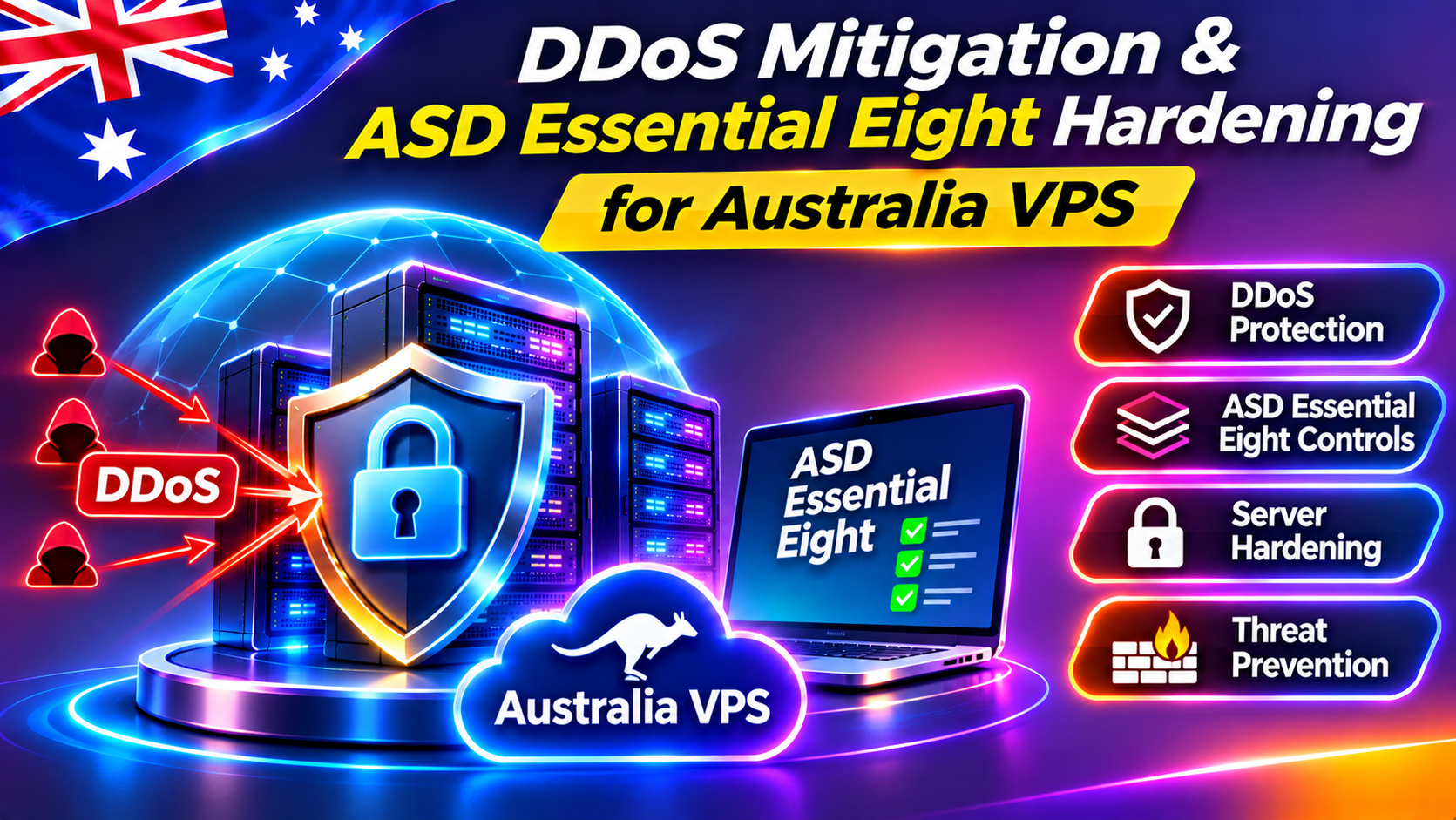
Defending Australian web nodes against multi-vector cyber attacks requires DDoS Protection Australia VPS combining upstream multi-terabit carrier-grade scrubbing at Mega-IX Sydney, dynamic BGP Flowspec (RFC 5575) traffic filtering, Linux kernel TCP SYN cookie mitigation, stateful UFW/nftables packet filtering, and proactive alignment with the Australian Signals Directorate (ASD) Essential Eight Maturity Level 2/3 cybersecurity controls.
Shielding production Australian web applications against multi-gigabit Layer 4 volumetric floods and malicious Layer 7 DDoS attacks requires automated Anycast scrubbing perimeter defense. Neutralize complex bot attacks in milliseconds while maintaining seamless transit for legitimate commercial traffic.
Multi-Terabit Network Scrubbing
Inline upstream volumetric DDoS mitigation filters out SYN floods, UDP amplification, and Layer 7 floods.
ASD Essential Eight Baseline
Implement prioritized mitigation controls designed by the Australian Cyber Security Centre (ACSC).
BGP Flowspec Defense
Automated BGP Flowspec integration at Mega-IX Sydney drops attack traffic before it saturates server uplinks.
Targeted Attacks & Botnets
According to the Australian Cyber Security Centre (ACSC) Annual Cyber Threat Report, a cybercrime is reported in Australia every six minutes. As one of the world’s wealthiest digital economies with widespread cloud adoption, Australian corporate and government web nodes face relentless automated probing, brute-force credential stuffing, and volumetric DDoS extortion attacks. When architecting reliable cloud systems, engineering teams frequently evaluate DDoS-protected Australia VPS hosting to ensure maximum domestic throughput.
Volumetric Attacks (Layer 3/4)
Massive terabit UDP/NTP amplification designed to overwhelm physical datacenter transit pipes.
Protocol Exhaustion (Layer 4)
SYN floods and connection starvation targeting operating system kernel TCP state tables.
Application Flood (Layer 7)
Complex HTTP POST and database search floods designed to lock web servers and databases.
Sovereign Infrastructure & Low-Latency Routing
Modern DDoS attacks operate across multiple layers of the OSI model. Volumetric attacks (such as DNS amplification, NTP reflection, and UDP floods) attempt to saturate the physical bandwidth capacity of the server’s uplink. Protocol attacks (such as TCP SYN floods and fragmented packet storms) target operating system connection tables. Meanwhile, application-layer (Layer 7) attacks target database-intensive search queries and checkout endpoints, exhausting CPU and memory resources with seemingly legitimate HTTP requests.
Defending an Australia VPS requires a multi-layered security architecture that stops volumetric bandwidth saturation at the carrier routing level, while hardening the local operating system to resist protocol and application-level exhaustion.
Network-Level Volumetric Scrubbing & BGP Anycast
No individual virtual server, regardless of how many vCPU cores or gigabytes of RAM it possesses, can withstand a 100Gbps volumetric DDoS attack on its own. Physical 1Gbps or 10Gbps network interface cards will simply become saturated with malicious packets, preventing legitimate users from connecting. Therefore, volumetric defense must take place upstream within the telecommunications routing fabric. Physical infrastructure reliability is further reinforced through upstream BGP Anycast scrubbing centers deployed across Australian Tier-3 campuses.
Continuous Traffic Telemetry
Upstream NetFlow and sFlow sensors monitor traffic patterns entering Sydney datacenter edge routers.
Automated Anomaly Detection
Machine-learning algorithms detect volumetric spikes or protocol malformations exceeding safety thresholds.
BGP Rerouting to Scrubbing Center
Traffic destined for the targeted IP is dynamically swung into multi-terabit hardware scrubbing clusters.
Clean Traffic Delivery
Scrubbed, legitimate packets are re-injected into the local datacenter switching fabric via GRE tunnels.
Substation Power Distribution & Climate Engineering
OnliveServer Australia VPS nodes are protected by enterprise carrier-grade scrubbing centers situated directly at primary Australian exchange points in Sydney. Network traffic is continuously analyzed using deep packet inspection (DPI) algorithms that establish baseline behavioral models for normal traffic flow.
When a volumetric anomaly is detected, traffic is automatically diverted through inline hardware scrubbing filters. Malicious UDP amplification, ICMP storms, and spoofed SYN floods are scrubbed in real time, while clean, legitimate visitor traffic is forwarded to your Sydney VPS with sub-millisecond inspection latency. Furthermore, integration with BGP Flowspec (RFC 5575) allows automated propagation of granular packet-filtering rules across upstream routers within seconds.
SYN Flood & Buffer Protection
While upstream scrubbing neutralizes massive volumetric floods, local operating system hardening is essential to defend against sophisticated protocol attacks that slip past carrier filters. The Linux kernel provides several powerful parameters in /etc/sysctl.conf to resist connection starvation. Engineering leads prioritize deterministic performance by implementing iptables and nftables rate-limiting rules across compute clusters.
Upstream Scrubbing
Inspection Latency
Kernel Flood Shield
BGP Flowspec
ASD Essential Eight
Uptime Resilience
Dedicated Hypervisor Isolation & VirtIO Storage Virtualization
The primary defense against TCP SYN floods is enabling TCP SYN cookies (net.ipv4.tcp_syncookies = 1). When the server’s SYN backlog queue becomes saturated with half-open connections from spoofed IP addresses, the kernel stops allocating memory structures in the connection table. Instead, it encodes the connection state directly into the initial TCP sequence number sent back in the SYN-ACK packet, insulating the server from memory exhaustion.
Additionally, administrators should enlarge the backlog queue (net.ipv4.tcp_max_syn_backlog = 8192), reduce the number of SYN-ACK retransmissions (net.ipv4.tcp_synack_retries = 2), and enable TCP TIME_WAIT reuse (net.ipv4.tcp_tw_reuse = 1), allowing the system to recycle closed connection sockets instantly under heavy traffic concurrency.
ASD Essential Eight Baseline Controls
The Australian Signals Directorate (ASD) and the Australian Cyber Security Centre (ACSC) developed the Essential Eight maturity model to provide organizations with actionable, effective strategies to mitigate targeted cyber attacks. Implementing these controls on an Australia VPS provides a proven security posture that satisfies Australian regulatory audits. Comprehensive operational scalability is achieved by integrating ASD Essential Eight compliance mitigation strategies across Australian operational environments. Technical benchmarks and operational criteria align closely with the NIST Special Publication 800-145 cloud standards.
Application Execution Control
Prevent execution of unauthorized binaries in temporary directories using noexec mount flags.
Restricted Administrator Privileges
Enforce strict sudo group membership and disable direct root SSH access across all nodes.
Multi-Factor Authentication (MFA)
Mandate hardware security keys or TOTP authenticator apps for SSH and control panel access.
Automated Patch Management
Configure automated security updates to remediate operating system vulnerabilities within 48 hours.
Autonomous System Routing & Trans-Tasman Ocean Connectivity
Essential Eight Control 1 focuses on application whitelisting. By configuring system mount options (such as mounting /tmp and /var/tmp with noexec, nosuid, nodev) and utilizing Linux AppArmor or SELinux policies, administrators prevent unauthorized malicious scripts and binaries from executing even if an application upload vulnerability is exploited.
Essential Eight Control 3 mandates restricting administrative privileges. Direct root SSH login must be permanently disabled, and administrative access should be restricted to named sudo users with dedicated SSH Ed25519 keys. Essential Eight Control 7 enforces multi-factor authentication (MFA) on all administrative interfaces, ensuring stolen passwords cannot be used to compromise the server.
Incident Response & Continuous Security
Security is not a one-time configuration; it is an ongoing operational discipline. Australian enterprises must maintain continuous monitoring and automated alerting to detect unauthorized intrusion attempts before data exfiltration occurs.
- ✔Enable TCP SYN cookies and optimize kernel socket backlog parameters.
- ✔Enforce noexec, nosuid, nodev mount permissions on /tmp and /dev/shm.
- ✔Deploy Fail2ban jails monitoring SSH, Nginx, and web application auth logs.
- ✔Configure stateful nftables firewall dropping all unapproved incoming ports.
- ✔Run automated weekly Lynis security audits to verify system hardening scores.
- ✔Maintain automated daily immutable backups stored offsite with rapid RTO recovery.
- ✔Enforce multi-factor authentication (MFA) on all remote SSH and control panels.
- ✔Establish an incident response plan aligned with OAIC Notifiable Data Breach rules.
Regulatory Sovereignty & ASD Essential Eight Hardening
Deploying Lynis—an industry-standard open-source security auditing tool—allows administrators to perform automated, comprehensive health checks against the operating system, file permissions, kernel parameters, and installed daemons. Lynis generates an objective Hardening Index score, highlighting specific misconfigurations that require remediation.
Finally, establish an incident response protocol aligned with the Australian Notifiable Data Breaches (NDB) scheme. In the event of a suspected breach, ensure your team can instantly isolate the VPS, capture memory state for forensic analysis, and restore clean operations from immutable offsite backups.
Australia VPS CLI Playbook
System administrators can fortify the Linux networking stack against TCP SYN floods and verify ASD Essential Eight security controls on an Australia VPS using the command line. The following bash commands apply kernel-level anti-DDoS sysctl parameters, install Lynis for security auditing, and generate an automated hardening score:
Enterprise Specifications Matrix
Comparing security capabilities across cloud hosting environments reveals why OnliveServer Australia VPS provides the strongest defense for Australian web infrastructure:
| Specification Dimension | OnliveServer Australia VPS | Commodity Budget Cloud | Hyperscaler Instances (AWS/Azure) |
|---|---|---|---|
| Upstream Volumetric Scrubbing | Included Multi-Terabit Sydney Scrubbing | Basic Scrubbing / Overages | AWS Shield Standard / Shield Advanced ($3k/mo) |
| BGP Flowspec Defense | Direct Integration at Mega-IX Sydney | Unsupported on Budget Hosts | Proprietary Route 53 Rules |
| ASD Essential Eight Ready | Full Root Access for Kernel Hardening | Limited in Shared Containers | Requires Complex IAM Architectures |
| Australian Data Sovereignty | 100% Australian Privacy Act 1988 | Variable / Unaudited | US CLOUD Act Exposure |
| Kernel Protocol Hardening | Custom sysctl (SYN Cookies, BBR) | Locked / Shared Kernel | Supported on Full EC2 Instances |
| Pricing Predictability | Fixed Monthly Invoicing with Protection | Hidden Overage Charges | High Metered Bandwidth During Attacks |
Frequently Asked Questions
OnliveServer includes multi-terabit upstream DDoS scrubbing at the network layer in Sydney, protecting against Layer 3 and Layer 4 volumetric attacks (such as UDP amplification, NTP reflection, and SYN floods) automatically.
The Essential Eight is a prioritized set of cybersecurity baseline mitigation strategies developed by the ACSC. It helps organizations protect internet-facing systems against targeted cyber attacks and ransomware.
When SYN queues fill up during an attack, the Linux kernel encodes connection parameters into the sequence number rather than allocating memory tables, allowing legitimate handshakes to succeed without crashing the server.
On hyperscalers like AWS, incoming or outgoing attack traffic can trigger massive bandwidth egress fees. OnliveServer absorbs volumetric attacks at the network layer, ensuring your monthly bill remains completely fixed.
BGP Flowspec allows upstream routers to dynamically inject granular firewall rules (such as dropping specific packet sizes or protocols) across the entire internet exchange fabric before traffic reaches server ports.
Combine upstream scrubbing with Nginx rate-limiting zones, enable Cloudflare Turnstile on public forms, deploy Fail2ban IP jails, and optimize database query caching using Redis.
Yes. Automated daily snapshot backups are available, ensuring you can restore your entire virtual machine to a clean state within minutes in the event of an incident.
Lynis is an open-source security auditing tool for Linux systems. It scans configurations, file permissions, and kernel parameters to generate an objective hardening score and provide actionable security suggestions.
Deploy your applications on our secure Australia VPS in Sydney with included multi-terabit DDoS scrubbing, KVM hardware isolation, and ASD Essential Eight hardening.
Defend Your Mission-Critical Apps with DDoS Protection Australia VPS →