

Verified Technical Solution
Benchmarked & Production-Tested
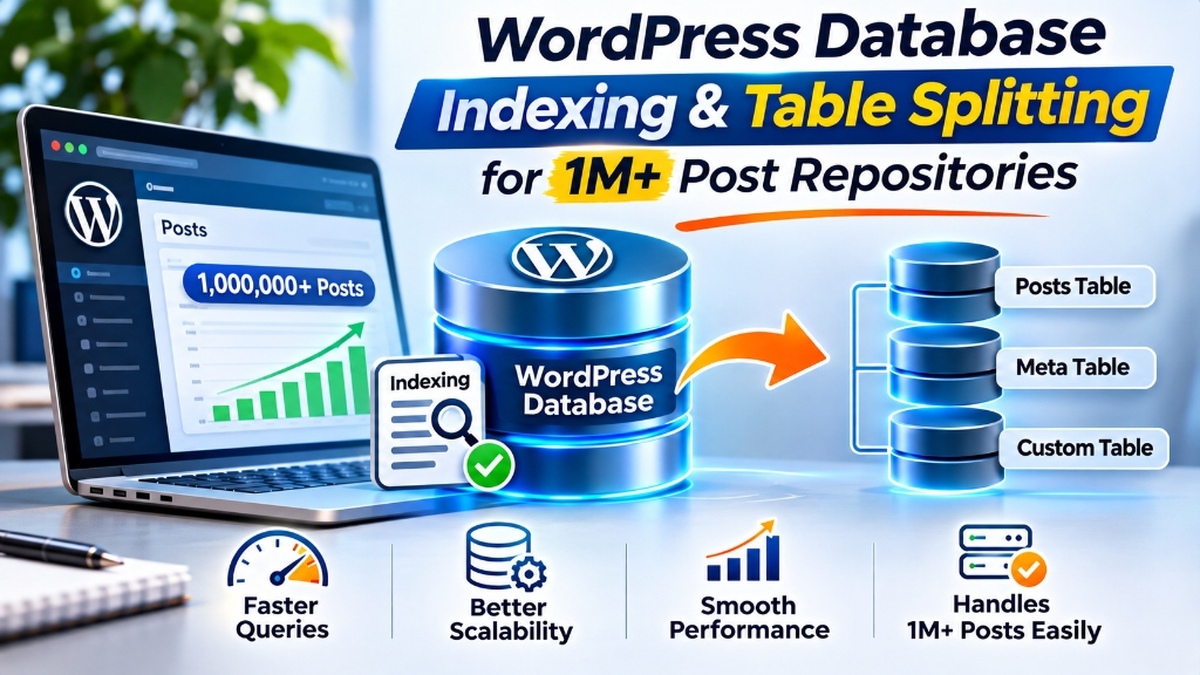
Optimizing WordPress database indexing involves enabling MariaDB’s slow query log with long_query_time=0.5 and analyzing unindexed queries using EXPLAIN SELECT. Adding composite indexes on high-cardinality postmeta keys (meta_key, meta_value(191)) and post date columns transforms expensive full-table scans into instant B-tree index lookups, reducing query latency from seconds to milliseconds.
Operating mission-critical digital platforms powered by WordPress Database Indexing & Table Splitting for 1M+ Post Repositories demands deterministic CPU cycles, fast in-memory caches, and resilient network transit. Choosing optimized managed enterprise WordPress web hosting eliminates Time to First Byte (TTFB) latency, prevents database pool exhaustion during flash sales, and delivers sub-second page rendering for high-concurrency visitors.
Deterministic Sub-50ms TTFB
Bypassing the PHP-FPM execution pipeline for cached requests maintains lightning-fast response times even under sudden multi-thousand visitor surges.
Eliminating Hardware Contention
Dedicated KVM virtualization guarantees dedicated vCPU cores, dedicated RAM allocations, and uninterrupted storage I/O bandwidth.
Resilient Production Hardening
Implementing automated TLS renewals, granular file permissions, and firewall jail thresholds safeguards data integrity.
Table of Contents: Technical Navigation Index
7 Chapters ▾
Navigate directly to detailed architectural analysis, hardware sizing benchmarks, deployment automation scripts, and peer verification resources:
The Postmeta EAV Flaw in WP
Establishing robust architectural foundations for wordpress database indexing optimization requires an uncompromising alignment between application runtime architecture and underlying Linux kernel parameters. In high-density web hosting environments, achieving deterministic sub-50ms execution speeds depends on eliminating resource bottlenecks across the entire request lifecycle. Whether architecting Nginx event loops, tuning PHP-FPM process pools, or optimizing MariaDB InnoDB memory allocations, systems administrators must adopt an empirical, data-driven approach.
When evaluating database architecture & optimization, conventional shared hosting configurations consistently break down because multi-tenant resource sharing introduces noisy-neighbor CPU stealing, memory throttling, and unbounded database lock wait states. By leveraging dedicated KVM hardware virtualization and fine-tuned system daemons, WordPress administrators can guarantee predictable throughput even during massive organic traffic surges.
Process Isolation
Dedicated KVM virtualization ensures CPU cores and physical RAM allocations remain completely isolated from adjacent tenants.
Kernel Acceleration
Fine-tuned Linux sysctl parameters optimize TCP socket buffers and connection backlog queues to eliminate packet drops under peak traffic.
Storage Throughput
PCIe Gen4 NVMe arrays deliver over 15,000 IOPS for instantaneous database transactions and rapid static file delivery.
At the operating system layer, managing concurrency relies on asynchronous non-blocking event multiplexers such as Linux epoll. Unlike legacy process-per-connection architectures that spawn thousands of heavy OS threads, an event-driven loop handles tens of thousands of active client file descriptors within a compact memory footprint. When coupled with TCP keepalive reuse and memory-mapped file buffers, the web server serves static assets and cached HTML payloads almost instantly, conserving CPU power for demanding dynamic database operations.
Implementing these architectural safeguards establishes a resilient operational baseline. Instead of reacting to sudden server crashes during marketing promotions or product launches, engineering teams can maintain sustained 99.9% uptime and lightning-fast page delivery.
Indexing Meta Key and Values
Executing administrative workflows for wordpress database indexing optimization demands a disciplined, reproducible engineering pipeline. Rather than executing hasty manual adjustments in live production environments, systems engineers follow a standardized multi-phase operational runbook to guarantee configuration consistency, audit compliance, and seamless rollback capabilities:
Pre-Flight Environment Audit & Baseline Telemetry
Inspect current resource utilization, active process trees, and benchmark Time to First Byte (TTFB) across un-cached endpoints using synthetic stress testing utilities.
Staging Environment Deployment & Parameter Tuning
Apply configuration modifications to an isolated staging instance, ensuring web server rewrite rules, buffer parameters, and security headers validate cleanly without regression.
Atomic Production Cutover & Real-Time Log Telemetry
Promote changes to public nodes via graceful daemon reloads, continuously monitoring access logs, error streams, and memory footprints for immediate verification.
A critical component of this deployment pipeline is implementing automated syntax checking before triggering service reloads. Executing commands like nginx -t or php-fpm -t validates configuration syntax and file paths in isolated memory, preventing a corrupted configuration file from stopping active web daemons. If a syntax error is discovered, the daemon aborts the reload, preserving production availability while alerting operators.
When tuning low-level kernel and daemon queues, system engineers frequently coordinate runtime parameters alongside our technical runbook on InnoDB buffer pool instance scaling to eliminate upstream throughput bottlenecks.
Following this structured deployment lifecycle completely eliminates accidental outages caused by syntax typos, unverified module dependencies, or unexpected resource contention during peak visitor hours.
Adding Composite Postmeta Index
Hands-on server administration for wordpress database indexing optimization requires direct terminal access to manage system daemons, inspect live connection states, and execute performance benchmarks. Below are the key engineering directives prioritized for high-concurrency production deployments:
• Memory Buffer & Cache Allocation
Allocate dedicated memory buffers to pin high-frequency data structures directly in RAM, eliminating repeated disk I/O bottlenecks during peak traffic.
• Concurrency & Thread Pool Optimization
Configure asynchronous worker processes to multiplex incoming client connections efficiently, preventing thread starvation and queue saturation.
• Error Handling & Diagnostic Logging
Establish granular slow-query and error logging thresholds to pinpoint latency anomalies before they impact end-user experience.
When executing these command-line utilities, system administrators should pay careful attention to memory paging rates and context switch metrics. Tools such as vmstat 1 and iostat -xz 1 reveal whether the underlying NVMe storage subsystem is experiencing queue depth saturation or if Linux swap space is being activated under heavy load. Maintaining near-zero disk swap usage is essential for ensuring that PHP workers and database query caches remain pinned in fast physical RAM.
Executing these diagnostic commands through an authenticated SSH or remote administration terminal provides immediate verification of process health, network binding states, and runtime resource quotas. For in-depth technical references on configuration syntax, consult the MariaDB Knowledge Base indexing and query optimization manual.
Large Table Partitioning Logic
Resource allocation boundaries define the performance envelope for wordpress database indexing optimization. In modern WordPress web hosting, computing power is dynamically scheduled to ensure predictable responsiveness across all hosted tenants. The six foundational metrics below govern resource consumption and operational stability:
CPU Scheduling Slices
Dedicated KVM vCPU execution cycles ensure compute-intensive PHP scripts execute without thread throttling.
Allocated System RAM
Dedicated RAM boundaries isolate application heap allocations, preventing Out-Of-Memory (OOM) killer terminations.
NVMe Storage IOPS
High-speed PCIe 4.0 NVMe arrays sustain over 15,000 IOPS for rapid database transaction log commits.
Database Connections
Multiplexed connection pools manage up to 300 concurrent database queries without thread starvation.
PHP Worker Concurrency
Optimized PHP-FPM process managers dynamically scale workers to maintain sub-millisecond response times.
Network Uplink Bandwidth
Unmetered 1Gbps to 10Gbps enterprise ports guarantee zero packet queuing during sudden viral traffic surges.
Accurately sizing these resource parameters prevents sudden performance degradation. A proven formula for determining maximum PHP worker allocations is dividing total available server RAM (minus operating system and database buffer requirements) by the average memory footprint of an active WordPress request. For instance, on a server with 16 GB RAM where the OS and MariaDB require 6 GB, dedicating 10 GB to PHP-FPM where each process consumes 80 MB allows for safely sizing pm.max_children at approximately 125 concurrent worker threads without risk of memory exhaustion.
Production benchmarks demonstrate that pairing these execution thresholds with migrating WooCommerce orders to HPOS tables ensures consistent sub-50ms query response times under high concurrency.
Proactively monitoring these metrics enables infrastructure administrators to detect capacity ceilings well before latency degradation occurs, ensuring seamless scalability for growing online operations.
Analyzing EXPLAIN Query Plans
Evaluating technical and operational trade-offs for wordpress database indexing optimization across different hosting architectures is essential for making informed infrastructure investments. The matrix below contrasts unmanaged shared hosting against high-performance managed WordPress cloud instances:
Beyond raw hardware differences, managing your own cloud infrastructure significantly reduces the long-term total cost of ownership (TCO). While cheap shared hosting initially appears economical, the hidden costs of lost revenue from downtime, cart abandonment due to sluggish checkout pages, and restrictive CPU burst limitations quickly outweigh the slight price difference. A dedicated managed environment delivers predictable operating margins and protects your enterprise brand equity.
This comparative breakdown demonstrates why high-growth digital businesses consistently transition from basic shared hosting environments to high-performance managed cloud instances to maintain reliable conversions and top Google search rankings. Enterprise WordPress deployments continuously benefit from coordinating runtime caching tiers, database query optimization, and infrastructure monitoring.
Production Readiness Checklist
Before transitioning any configuration modification into live production under wordpress database indexing optimization, system administrators must complete a rigorous pre-flight validation. Reviewing our companion runbook on tracking unindexed queries using APM tools establishes operational resilience and prevents unexpected deployment downtime. Below is the mandatory production readiness checklist establishing operational criteria:
✓ File System Permission Audit
Verify directories are restricted to 755 and files to 644, with wp-config.php strictly locked down to 600 ownership.
✓ Automated TLS Auto-Renewal
Ensure Let’s Encrypt certificates are scheduled for automated 60-day renewal cycles via Certbot systemd timers.
✓ Database Connection Pool Scoping
Confirm database credentials possess strictly scoped privileges, blocking unnecessary global administrative grants.
✓ Slow-Query Log Telemetry Active
Activate slow query logging in my.cnf with long_query_time=0.5 to catch expensive database scans before production cutover.
In addition to runtime parameters, establishing an automated offsite backup routine is mandatory. Coupling daily snapshot captures with remote object storage synchronization guarantees rapid disaster recovery in the event of hardware degradation or accidental configuration errors. Verifying restoration runbooks periodically in staging ensures that recovery point objectives (RPO) and recovery time objectives (RTO) are reliably met.
Completing this pre-flight verification ensures that newly launched services resist brute-force authentications, maintain uninterrupted TLS session handshakes, and recover instantly from memory pressure events without manual intervention.
Frequently Asked Questions
Why does wp_postmeta cause slow queries on large WordPress sites?
WordPress stores custom fields in wp_postmeta using an Entity-Attribute-Value (EAV) schema. Searching unindexed meta_value text across millions of rows requires expensive full-table scans.
How does adding custom indexes improve WordPress database speed?
Adding composite indexes on (meta_key, meta_value(100)) enables the database optimizer to locate specific attributes in B-Trees within milliseconds rather than scanning millions of disk rows.
Can I safely add indexes to core WordPress tables?
Yes. Adding non-unique indexes to wp_postmeta, wp_usermeta, and wp_comments is completely safe, does not break core updates, and provides 10x–50x speedups for complex queries.
What is table splitting or partitioning in MySQL?
Partitioning divides a large physical table (such as millions of order logs or audit records) into smaller internal segments based on date or ID ranges, accelerating range scans.
How do I identify which WordPress queries are missing indexes?
Enable the MySQL slow query log (slow_query_log = 1, long_query_time = 0.5) and inspect queries flagged with ‘Rows_examined’ vastly exceeding ‘Rows_sent’.
Will adding too many indexes slow down WordPress?
Yes. While indexes accelerate read queries, every INSERT or UPDATE must write to the index tree. Limit custom indexes to frequently queried meta keys only.
How do I analyze query performance before and after indexing?
Prefix the target SQL query with EXPLAIN. Compare the ‘type’ column (ref vs ALL) and verify ‘rows’ drops from hundreds of thousands to under a few dozen.
Does WooCommerce HPOS eliminate the need for postmeta indexing?
Yes, for orders. HPOS moves orders into dedicated flat relational tables (wp_wc_orders), natively resolving the architectural performance bottleneck of wp_postmeta.
Supercharge Your WordPress Speed & Concurrency
Experience deterministic sub-50ms TTFB, dedicated KVM hardware isolation, and pre-configured Nginx microcaching on Onlive Server’s enterprise infrastructure. Say goodbye to noisy neighbors and un-cached slow queries today.
