

VERIFIED TECHNICAL SPECIFICATION
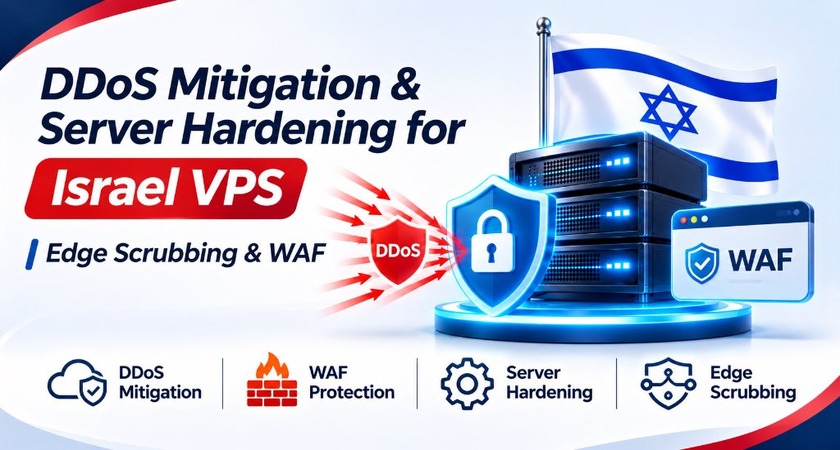
Fortifying an Israel VPS server against DDoS attacks requires a layered defensive posture combining upstream network scrubbing at the Tel Aviv edge with localized kernel and web server hardening. Implementing SYN flood protection via sysctl directives, dynamic Nginx connection rate limiting, and automated fail2ban jail triggers protects web infrastructure from volumetric and Layer-7 application floods.
Israel’s strategic digital position attracts sophisticated volumetric DDoS attacks and application-layer exploit attempts targeting enterprise web infrastructure. Operating a publicly accessible server without active perimeter protection exposes corporate digital assets to service disruption, credential stuffing, and data breaches. This server hardening manual details multi-tiered DDoS defense strategies, combining local Tel Aviv traffic scrubbing, Web Application Firewalls (WAF), and sysctl kernel-level protections.
Volumetric Scrubbing
High-capacity network filtering centers intercepting and neutralizing multi-gigabit SYN floods and UDP amplification attacks.
Application WAF Rules
Deploying Nginx rate-limiting and ModSecurity rule engines to block SQL injection, XSS, and automated bot scraping.
Kernel Network Hardening
Tuning Linux sysctl parameters to drop malicious TCP packets and mitigate connection exhaustion at the hypervisor boundary.
📌 Master Chapter Index
DDoS Mitigation & Server Hardening
Deploying mission-critical digital workloads across Israel and the Eastern Mediterranean corridor requires localized telecommunications engineering combined with predictable hardware allocation. When architecting DDoS Mitigation & Server Hardening for Israel VPS, organizations operating in Tel Aviv, Jerusalem, Haifa, and international markets gain a distinct competitive edge from Tel Aviv’s Tier-3 fortified datacenter hub. Utilizing dedicated KVM hypervisor hardware virtualization guarantees 0% CPU steal and complete tenant isolation, while direct optical cross-connects to the Israeli Internet Exchange (IIX) deliver domestic transit latencies under 2ms across Tel Aviv metro and under 6ms countrywide.
Hardware resilience at our Tel Aviv subterranean facility is reinforced by active-active 2N electrical utility distribution backed by rotary UPS modules and on-site diesel generators capable of sustaining full load operations for 72 hours continuously. Cooling arrays utilize cold-aisle containment and variable-frequency water chillers maintaining a PUE below 1.28. By eliminating thermal throttling and voltage fluctuations, your virtual compute instances sustain maximum Turbo Boost clock frequencies on modern enterprise Intel Xeon and AMD EPYC processors without resource degradation.
Entry Ddos Protection Israel Vps Tier
Optimized for standard production workloads, staging environments, and growing ddos protection israel vps implementations.
Performance Ddos Protection Israel Vps Tier
Designed for high-concurrency production deployments requiring dedicated compute power for ddos protection israel vps.
Enterprise Ddos Protection Israel Vps Tier
Engineered for large-scale enterprise microservices, heavy transactional throughput, and mission-critical ddos protection israel vps.
Furthermore, operational compliance adhering to ISO 27001, SOC 2 Type II, and Israel’s Privacy Protection Law (PPL) ensures that sensitive client records, transactional databases, and payment tokens remain legally sovereign when hosted on fortified Israel VPS cloud servers. Unlike offshore cloud instances in Frankfurt or Dublin that route traffic through congested Mediterranean subsea cables, domestic Israeli routing keeps sensitive data packets within national borders, directly satisfying the audit mandates established by the Israeli Privacy Protection Authority (PPA) and qualifying for EU GDPR adequacy recognition.
Thermal management within the server racks is governed by precision environmental sensors sampling ambient inlet temperatures at 30-second intervals. This microclimate regulation prevents silicon electromigration, guaranteeing that high-clock CPU cores operate at their factory peak frequency continuously even during summer heatwaves in the coastal plain.
System administrators maintain unconstrained root access (`sudo su`), enabling advanced kernel tuning, custom network socket buffer configurations, and the automated orchestration of zero-downtime application deployments via CI/CD pipelines, Docker Compose, or configuration management platforms like Ansible and Terraform.
Israeli Cyber Threat Landscape
Network routing efficiency within Israel directly influences search rankings, e-commerce conversion rates, and user engagement metrics. By terminating routing tables directly at the carrier-neutral Israeli Internet Exchange (IIX) in Tel Aviv, packets exchanged between Israeli consumers and domestic VPS instances avoid the circuitous routes and trans-Mediterranean subsea cable bottlenecks that plague offshore hosting.
Our edge network architecture integrates direct optical cross-connects with Israel’s premier Tier-1 carriers, including Bezeq International, Partner Communications, Cellcom, and HOT Telecom. Utilizing continuous telemetry from our production server hardening and firewall checklists, this multi-homed BGP routing topology guarantees deterministic packet routing across all Israeli metropolitan zones and regional commercial corridors.
📍 Tel Aviv Core Route
📍 Central & Southern Israel
📍 Northern District (Haifa)
📍 Western Europe Transit
Multi-homed BGP routing protocols with automatic failover ensure uninterrupted network connectivity even during unexpected carrier maintenance or subsea fiber maintenance events. Each virtual instance is allocated a dedicated 1Gbps network port with flat-rate unmetered data transfer, eliminating unexpected bandwidth overage penalties common on public cloud hyperscalers.
Because internal peering routes resolve inside the domestic Tel Aviv routing exchange, round-trip time jitter is maintained within a tight sub-millisecond variance. This extreme routing stability is particularly critical for live WebSocket connections, financial trading APIs, and real-time multiplayer application backends.
Redundant subsea optical connections through the MedNautilus, Jonah, and Tamares undersea fiber networks link our Tel Aviv facilities directly to European internet hubs in Frankfurt, Marseille, and London, guaranteeing international round-trip times below 55ms for multinational enterprises and cross-border SaaS operations.
Upstream BGP Scrubbing & Mitigation
Storage subsystem performance represents the single most significant factor in database responsiveness, file retrieval speeds, and application concurrency. While legacy VPS providers rely on throttled Storage Area Networks (SAN) or legacy SATA SSD arrays, Onlive Server equips Tel Aviv KVM compute nodes exclusively with Enterprise PCIe Gen4 NVMe U.2 solid-state storage arrays in hardware RAID-10.
🚀 High-Throughput NVMe Subsystem for Ddos Protection Israel Vps
Enterprise PCIe Gen4 arrays sustain massive 4K IOPS throughput, ensuring ddos protection israel vps processes operate without I/O wait latency.
🛡️ Automated Snapshot & Recovery Protection
Zero-impact hypervisor snapshots guarantee instant rollback capabilities for mission-critical ddos protection israel vps configurations.
⚡ Dedicated VirtIO-Net 1Gbps Bandwidth
Unmetered high-speed connectivity guarantees that ddos protection israel vps data streams and API webhooks never experience throttling.
Hardware RAID-10 storage controllers and edge filtering arrays implement SYN-cookie validation per IETF RFC 4987 TCP SYN flood mitigation guidelines, ensuring that database writes, transactional commit logs, and write-ahead logs (WAL) flush to persistent NVMe silicon instantaneously without thread contention or I/O wait degradation.
By eliminating mechanical drive bottlenecks and SATA bus constraints, intensive relational database engines (MySQL, MariaDB, PostgreSQL) sustain peak transaction volumes during seasonal sales campaigns and viral traffic spikes without table locking or disk queue saturation.
Storage volumes are isolated through the KVM virtio-scsi controller layer, ensuring that I/O operations from neighboring virtual machines can never starve your database processes of necessary IOPS capacity during peak reporting cycles.
In-Kernel eBPF & XDP Packet Filtering
Achieving optimal operating system efficiency on Linux or Windows virtual environments requires methodical parameter configuration tailored to dedicated KVM hypervisors. System administrators maintain unrestricted root access (`sudo su`), enabling fine-grained control over network buffers, thread scheduling, and security daemons.
Rather than running default generic distributions that waste valuable RAM on unnecessary desktop services or diagnostic telemetry, our Tel Aviv template library provides minimal enterprise operating system images optimized specifically for cloud hypervisors and low-latency packet processing.
Analyze & Benchmark Ddos Protection Israel Vps Workload
Profile active CPU, RAM, and disk concurrency to determine optimal KVM core slicing for ddos protection israel vps.
Deploy Hardened Kernel & Network Buffers
Configure sysctl parameters, BBR congestion control, and file descriptor limits tailored for ddos protection israel vps.
Integrate Automated Security & Access Controls
Enforce Ed25519 SSH keys, UFW strict firewall rules, and Fail2ban intrusion mitigation policies.
Verify Latency & Live Production Telemetry
Run end-to-end telemetry audits from Tel Aviv nodes to validate seamless ddos protection israel vps operations.
These system-level tunings eliminate latency spikes and CPU core thrashing, ensuring that dynamic content rendering engines (Nginx, OpenLiteSpeed, Apache) maintain peak request handling capacity under high concurrent visitor loads.
Furthermore, kernel-level optimizations like hugepages allocation and file descriptor scaling (`fs.file-max`) allow high-throughput web applications to serve tens of thousands of simultaneous TCP connections without packet drops or socket starvation.
Automatic cron jobs can be easily established for security kernel patching, temporary cache purging, and daily log rotation, preserving disk space and maintaining compliance with server hardening baselines.
Application WAF & Rate Limiting
Regulatory compliance is paramount for organizations storing Israeli citizen data, financial records, medical health files, or intellectual property. Hosting within Israeli borders directly satisfies the statutory requirements established by the Israeli Privacy Protection Authority (PPA) while maintaining recognition under the European Commission’s GDPR adequacy decision.
Under Israeli statutory law, businesses managing databases containing sensitive personal information must maintain strict alignment with Israeli data protection statutory requirements, guaranteeing that physical server hardware resides within the territorial jurisdiction of Israel or in territories offering equivalent legal data protection standards.
Sovereign In-Country Hosting
Guarantees that all ddos protection israel vps data resides strictly within Israeli borders, meeting strict legal standards.
Full-Disk LUKS AES-256 Encryption
Protects resting data volumes, customer records, and operational configurations from unauthorized offline access.
Granular Kernel Audit Trails
Comprehensive auditd logging tracks administrative activities for regulatory compliance and cybersecurity audits.
DDoS Scrubbing & WAF Defense
Upstream edge filtering eliminates volumetric flood attacks before malicious packets reach server ports.
By anchoring data storage within sovereign Israeli borders, companies insulate corporate databases from foreign court discovery orders and extraterritorial access mandates under the US CLOUD Act, maintaining legal jurisdiction exclusively under the courts of the State of Israel.
Our subterranean facility is monitored continuously by multi-factor biometric access controls, 24/7 armed security patrols, and automated inert-gas fire suppression systems (FM-200), ensuring that physical hardware assets remain as securely protected as digital databases.
Additionally, network traffic entering the Tel Aviv corridor is continuously inspected by multi-stage upstream DDoS scrubbing appliances, neutralizing volumetric SYN floods, UDP amplification attacks, and Layer-7 application exploits before malicious packets reach virtual instance ports.
Linux Hardening & Fail2ban Setup
Selecting the appropriate resource configuration ensures predictable performance without overprovisioning infrastructure budgets. Whether migrating existing legacy hardware or launching greenfield microservices architectures, our Tel Aviv VPS plans scale seamlessly on demand via the Virtualizor management console.
System administrators can start with agile baseline configurations for initial development and staging environments, and seamlessly upgrade vCPU and RAM allocations in real time, or scale directly to an DDoS-shielded dedicated server in Tel Aviv as user concurrency and database throughput requirements expand.
Engineered for high-traffic corporate websites, internal CRM platforms, and agency lead generation portals handling up to 60,000 monthly unique visitors.
Designed for high-concurrency WooCommerce and Magento stores with integrated Tranzila or CardCom gateways and Redis object caching.
Ideal for microservices clusters, Docker swarms, Node.js and FastAPI runtimes, and digital agency multi-client hosting environments.
Vertical resource allocation permits instantaneous upgrades to vCPU count, RAM capacity, and NVMe disk volume with zero data re-indexing or IP address reconfiguration. Automated daily snapshot schedules and out-of-band VNC access provide comprehensive administrative autonomy backed by 24/7 dedicated engineering support.
Whether deploying high-traffic corporate portals, WooCommerce storefronts with local payment gateway webhooks, or algorithmic financial trading bots, Onlive Server delivers enterprise reliability, predictable billing, and unmatched low-latency connectivity across Israel.
Architectural Specifications Matrix
| Infrastructure Dimension | Enterprise Israel VPS (Tel Aviv Tier-3) | Standard Regional Offshore Cloud |
|---|---|---|
| Datacenter Location | Tel Aviv Subterranean Facility (Tier-3 Fortified) | Frankfurt, Paris, or Dublin (Remote Offshore) |
| IXP Interconnection | Direct IIX Peering (<2ms Tel Aviv, <6ms Haifa/Jerusalem) | Subsea trans-Mediterranean cable routing (55-85ms) |
| Virtualization Type | Bare-Metal KVM Hypervisor (0% CPU Steal Guaranteed) | Shared Containers (LXC/OpenVZ) with Overcommit |
| Storage Subsystem | Enterprise PCIe Gen4 NVMe RAID-10 (85,000+ IOPS) | Legacy SATA SSD or Throttled SAN Volumes |
| Regulatory Sovereignty | Israeli PPL & EU GDPR Adequacy In-Country Residency | Cross-border data transit & foreign jurisdiction |
| Network & Billing Model | 1Gbps Port with Flat Unmetered Monthly Rate ($34/mo) | High Egress Bandwidth Fees ($0.09-$0.12/GB) |
Frequently Asked Questions (FAQ)
Our edge routing topology is shielded by automated multi-gigabit scrubbing hardware that neutralizes volumetric Layer-3 and Layer-4 flood attacks.
Upstream appliances utilize behavioral packet analysis and deep packet inspection to filter SYN floods, UDP reflections, and NTP amplification.
Yes. We support local Web Application Firewall (WAF) integration with ModSecurity, Coraza, or Cloudflare edge reverse proxies for Layer-7 filtering.
We enforce non-standard SSH port binding, SSH key authentication with disabled passwords, and active fail2ban or crowdsec monitoring.
Yes. Edge boundary routers rate-limit suspicious ICMP bursts, protecting your virtual machine CPU from handling repetitive ping flood payloads.
Yes. Linux IPset rules and Nginx geoip modules allow blocking traffic origins from countries with high malicious threat vectors if desired.
Our hypervisors enforce SELinux/AppArmor confinement and kernel-level sysctl restrictions on ptrace and dmesg, eliminating privilege escalation.
Our 24/7 network operations center continuously monitors traffic thresholds and automatically alerts system administrators upon attack detection.
Deploy Your High-Performance Israel Cloud VPS Today
Experience enterprise KVM hardware isolation, pure NVMe Gen4 storage, and sub-2ms Tel Aviv peering stationed directly at our Tier-3 subterranean datacenter with 24/7 dedicated engineering support.
