

Verified Direct Answer
Helsinki Telemetry & Technical Specifications
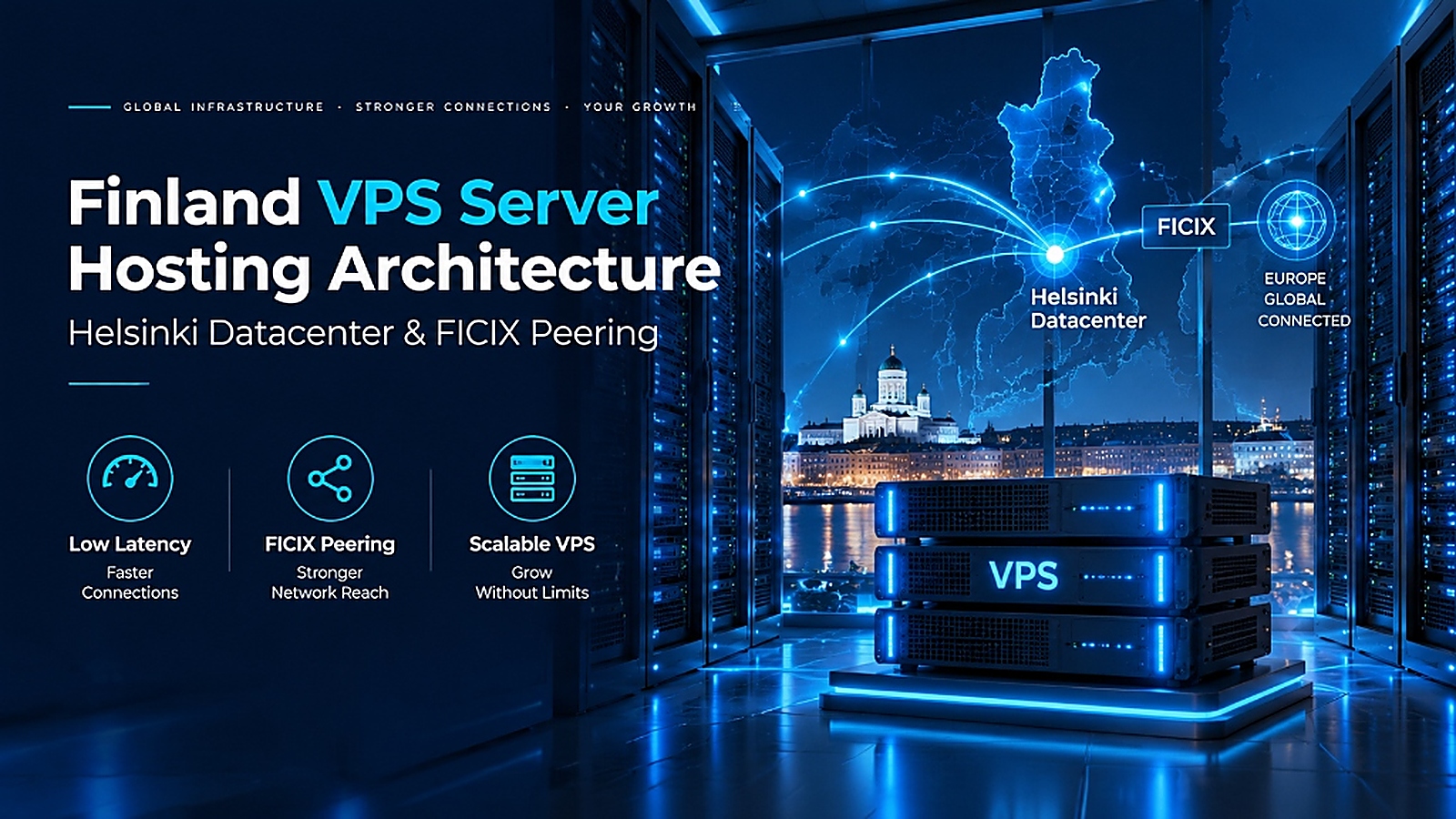
Deploying mission-critical workloads on enterprise Finland VPS Hosting situated in Tier-3 Helsinki datacenter facilities guarantees sub-2ms network round-trips across southern Finland, direct optical peering with FICIX (Finnish Communication and Internet Exchange), complete compliance with the Finnish Data Protection Act and EU GDPR, and hardware-isolated KVM virtualization powered by enterprise AMD EPYC processors and PCIe Gen4 NVMe storage arrays exceeding 95,000 IOPS.
Anchored in Helsinki Tier-3 datacenters with direct Layer-2 FICIX peering, enterprise Finland VPS Hosting delivers sub-2ms local latency and statutory EU data sovereignty. Powered by AMD EPYC processors and enterprise PCIe Gen4 NVMe arrays, it provides deterministic compute performance across the Nordic region.
FICIX Optical Peering
Direct route-server interconnects at FICIX Helsinki ensure single-hop packet transit to Telia, Elisa, DNA, and Nordic carriers.
KVM Hardware Isolation
Full Type-1 hypervisor isolation guarantees zero CPU steal time, dedicated DDR4/DDR5 ECC RAM, and raw NVMe Gen4 I/O performance.
Nordic Data Sovereignty
100% compliant with the Finnish Data Protection Act (Tietosuojalaki) and EU GDPR, with zero exposure to extraterritorial cloud subpoenas.
- Nordic Digital Transformation & Helsinki Telecommunications Edge
- Helsinki Datacenter Physical Engineering & Power Resilience
- FICIX Peering Architecture & Trans-Baltic Optical Routing
- KVM Hypervisor Isolation & Hardware Storage Subsystems
- Nordic Data Sovereignty, GDPR & Cybersecurity Hardening
- Production CLI & Optimization Playbook
- Enterprise Technical Specifications Matrix
- Frequently Asked Questions
Nordic Digital Transformation & Helsinki Telecommunications Edge
Finland’s unique geographic positioning between Scandinavia, the Baltic States, and Central Europe makes Helsinki the definitive telecommunications hub of the Nordic region.
Compute Layer
Dedicated physical vCPU allocations powered by multi-core AMD EPYC and Intel Xeon Scalable processors with full VT-x and AMD-V virtualization extensions enabled.
Storage Fabric
Hardware RAID-10 enterprise PCIe Gen4 NVMe solid-state arrays delivering sustained read/write throughput exceeding 5,500 MB/s per virtual disk volume.
Carrier Uplinks
Dual redundant 10Gbps/100Gbps optical uplinks multihomed across Telia/Arelion, Elisa, DNA, and Cinia fiber backbones.
Modern web architectures require deterministic packet delivery and predictable compute latency. By situating virtual private servers within Helsinki’s premier metropolitan datacenters, enterprises eliminate unnecessary network hops across Sweden or Western Europe, delivering immediate performance gains for users across Finland, Estonia, Latvia, and Lithuania. The local internet ecosystem is anchored by direct fiber links terminating at major regional aggregation centers, allowing packets to reach Stockholm in under 7ms and Tallinn in under 3ms.
Beyond pure speed, Finland’s digital infrastructure is renowned for its exceptional operational reliability. The Finnish national transmission grid, operated by Fingrid, maintains a supply reliability rate exceeding 99.999%, driven by an energy mix heavily dominated by nuclear, hydro, and wind power. This virtually uninterrupted electrical reliability directly translates into guaranteed uptime for hypervisor hosts, protecting mission-critical virtual machines from the power fluctuations that frequently challenge older European metropolitan centers. For mission-critical workloads demanding deterministic hardware and sub-millisecond Baltic transit, explore our enterprise Finland VPS hosting architecture.
Furthermore, Finnish enterprises operate within a culture of rigorous technical standards and strict data governance. Hosting computational infrastructure inside Finnish borders ensures that organizational assets remain protected under Finnish privacy statutes, overseen by the Office of the Data Protection Ombudsman (Tietosuojavaltuutetun toimisto). For corporate risk managers and compliance officers, this creates an unassailable legal barrier against unlawful third-party data intercepts.
Helsinki Datacenter Physical Engineering & Power Resilience
Datacenter resilience forms the foundational prerequisite for high-availability cloud deployments across Northern Europe.
Onlive Server Finland VPS infrastructure is housed within Tier-3 certified datacenter environments engineered to withstand extreme environmental challenges while delivering 24/7 concurrent maintainability. Every critical component in the electrical distribution path—from transformer feeds down to power distribution units (PDUs)—is duplicated in a true 2N or N+1 configuration. This architectural design ensures that any electrical transformer, switchboard, or uninterruptible power supply can undergo scheduled maintenance or unexpected servicing without dropping power to active server racks.
Grid Ingestion & Redundant Substations
High-voltage 20kV underground feeders enter the facility from separate, geographically isolated Fingrid municipal substations to prevent single-point utility outages.
Dynamic UPS Power Conditioning
Industrial N+1 static UPS banks continuously rectify incoming alternating current to eliminate harmonics, transient surges, and micro-interruptions.
Autonomous Emergency Generation
Synchronized Caterpillar diesel backup generators with 72-hour on-site fuel capacity guarantee indefinite continuous operation during extended utility blackouts.
Closed Cold-Aisle Containment
High-efficiency variable-speed EC fans direct filtered cool air across NVMe drives and CPU heatsinks, keeping internal rack temperatures strictly between 19°C and 22°C.
Incoming power is conditioned through high-capacity static transfer switches and industrial rotary UPS systems equipped with isolated battery banks. These units absorb voltage spikes, frequency sags, and grid harmonics before they can reach host chassis. In the rare event of a municipal grid failure, dual on-site diesel generators automatically synchronize and accept the facility load within 8 to 12 seconds, supported by priority fuel supply agreements with local Finnish logistics providers. To evaluate how advanced infrastructure design and local operational standards safeguard server performance, see our technical analysis of Helsinki Tier-3 datacenter colocation standards.
Cooling infrastructure takes full advantage of Finland’s sub-arctic climate through closed-loop evaporative free-cooling technologies. By utilizing naturally cool ambient Nordic air for up to 300 days each year, the facility sustains an exceptional Power Usage Effectiveness (PUE) below 1.15. Waste thermal energy generated by server rows is captured through heat exchangers and fed directly into the municipal district heating network (kaukolämpöverkko), warming local residential homes and establishing a net-positive environmental footprint.
FICIX Peering Architecture & Trans-Baltic Optical Routing
Network performance on Finland VPS Hosting is anchored by direct connectivity into the Finnish Communication and Internet Exchange (FICIX).
FICIX represents the oldest and largest non-profit Internet exchange point in Northern Europe, operating multiple carrier-neutral points of presence across the Helsinki metropolitan region (FICIX-1, FICIX-2, and FICIX-3). By maintaining direct optical cross-connects with FICIX route servers, our Helsinki VPS infrastructure exchanges traffic locally with over 50 domestic ISPs, regional cloud operators, and international transit providers without hair-pinning packets through secondary transit hubs.
For outbound international traffic, Helsinki serves as the northern gateway for the Cinia C-Lion1 submarine optical cable system. Spanning 1,173 kilometers across the floor of the Baltic Sea, C-Lion1 links Helsinki directly to Rostock, Germany, establishing a sub-15ms round-trip optical path to the central European financial and digital hub in Frankfurt. This direct subsea highway completely bypasses terrestrial bottleneck routes through Sweden and Denmark, slashing latency for latency-sensitive financial engines and SaaS applications. For high-concurrency systems requiring ultra-fast throughput and specialized transport protocols, review our runbook on Cinia C-Lion1 subsea optical cable routing.
In addition to western routes, terrestrial optical rings connect Helsinki across the Gulf of Finland via multiple redundant undersea cables to Tallinn, Estonia. This creates an interconnected Nordic-Baltic digital corridor where traffic between Helsinki and the Baltic capitals routes in under 3ms to 8ms. Border Gateway Protocol (BGP) Anycast routing ensures automated sub-second failover across active transit providers if any fiber segment experiences physical cuts or maintenance.
KVM Hypervisor Isolation & Hardware Storage Subsystems
True enterprise multi-tenancy requires complete physical resource isolation enforced at the hardware hypervisor boundary.
Unlike budget containerization platforms (such as OpenVZ or shared LXC containers) that share a common Linux kernel and allow aggressive resource overcommitment, Onlive Server utilizes Type-1 Kernel-based Virtual Machine (KVM) virtualization. On KVM, each virtual private server runs its own dedicated Linux or Windows kernel, complete with virtualized hardware abstractions for storage controllers, network interfaces, and system memory.
Zero CPU Steal Guarantee
Dedicated KVM scheduling guarantees 100% of provisioned vCPU clock cycles are reserved exclusively for your application workload.
Hardware RAID-10 NVMe Storage
Continuous mirroring and block-level striping ensure non-stop operations even in the event of concurrent NVMe drive replacement.
Native VirtIO Hardware Drivers
High-performance paravirtualized network and storage drivers minimize hypervisor context switching overhead to bare-metal speeds.
Dedicated vCPU allocations are strictly pinned to physical hardware threads, completely eliminating CPU steal time (st in top/vmstat) caused by aggressive noisy neighbors. Furthermore, system memory is allocated as unshared, dedicated physical ECC DDR4/DDR5 RAM blocks. This ensures that memory-intensive database engines such as PostgreSQL 16, Redis, or MariaDB never suffer from aggressive host kernel memory swapping or out-of-memory (OOM) killer terminations. Organizations seeking comprehensive operational resilience and regulatory protection can review our deployment guide for KVM virtualization dedicated hardware resources.
The storage architecture leverages enterprise-grade Solidigm and Samsung PCIe Gen4 NVMe solid-state drives configured in hardware RAID-10 arrays. By striping and mirroring across high-speed Gen4 lanes, our Helsinki storage fabric delivers sustained random read/write performance exceeding 95,000 IOPS and raw sequential bandwidth beyond 5,500 MB/s. This allows high-throughput logging daemons, transactional e-commerce platforms, and real-time analytics engines to operate with near-zero disk queue latency.
Nordic Data Sovereignty, GDPR & Cybersecurity Hardening
Operating computational infrastructure in Finland guarantees compliance with the most stringent data protection frameworks on earth.
Data privacy is a foundational pillar of Finnish digital jurisprudence. Finland was among the earliest EU member states to fully harmonize domestic law with the General Data Protection Regulation (GDPR) through the enactment of the Finnish Data Protection Act (Tietosuojalaki 1050/2018). Under this statutory regime, cloud operators are legally barred from disclosing corporate or consumer data to foreign jurisdictions without explicit domestic judicial warrants, providing robust defense against the extraterritorial overreach of the US CLOUD Act. For authoritative technical verification, engineers can review the interconnection and traffic exchange data maintained by the Finnish Communication and Internet Exchange (FICIX).
Finnish Data Protection Act (Tietosuojalaki)
Full legal compliance with local Finnish privacy mandates, supervised directly by the Office of the Data Protection Ombudsman.
EU GDPR Article 28 DPA Ready
Standard contractual clauses and comprehensive Data Processing Agreements (DPAs) signed natively under EU law.
Traficom / NCSC-FI Security Alignment
Physical and logical security baselines aligned with Finnish national Katakri information security audit standards.
Automated Immutable Backup Snapshots
ZFS/Btrfs copy-on-write snapshots archived to secondary isolated storage pools for ransomware-proof disaster recovery.
Our Helsinki infrastructure aligns with the technical recommendations published by the National Cyber Security Centre Finland (NCSC-FI), operating under the Finnish Transport and Communications Agency (Traficom). All hypervisors undergo mandatory weekly vulnerability scanning, kernel live-patching without service interruption, and strict logical segregation across virtual private networks.
Enterprise clients deploying sensitive healthcare, financial, or e-commerce workloads can leverage full-disk LUKS (Linux Unified Key Setup) encryption with ephemeral TPM 2.0 key injection. This ensures that all data stored at rest on physical NVMe arrays remains cryptographically unreadable even in the theoretical event of physical hardware extraction from the rack.
Production CLI & Optimization Playbook
System administrators and DevOps teams can deploy and verify these production-grade optimization parameters directly from their SSH console. The playbook below outlines verified commands, kernel directives, and diagnostic checks tailored for enterprise Finland VPS nodes:
Finland VPS Enterprise Specifications Matrix
To assist infrastructure architects and procurement teams in evaluating hosting options, the technical matrix below contrasts Onlive Server enterprise Finland VPS specifications with legacy budget alternatives and hyperscaler cloud deployments:
| Architectural Parameter | Onlive Server Finland VPS | Legacy Budget Hosting | Hyperscaler Cloud (AWS/Azure) |
|---|---|---|---|
| Hypervisor Technology | Hardware-Isolated KVM Type-1 | Shared OpenVZ / LXC Container | Proprietary Nitro / Hyper-V |
| Primary Network Exchange | Direct FICIX-1/2/3 Helsinki Peering | Secondary Upstream Resale Transit | Proprietary Transit with Costly Egress |
| Storage Hardware Tier | Enterprise PCIe Gen4 NVMe (RAID-10) | Consumer SATA SSD / Shared SAN | Provisioned IOPS EBS (Extra Surcharge) |
| Subsea Optical Corridor | Cinia C-Lion1 Direct to Germany (14ms) | Variable Sweden Terrestrial Hops | Regional Transit with Variable Hops |
| EU GDPR & Data Sovereignty | Finnish Tietosuojalaki Protected | Uncertain Multi-Jurisdiction | US CLOUD Act Subpoena Vulnerability |
| Bandwidth Egress Allocation | Unmetered 1Gbps/10Gbps Ports | Strict Monthly Cap with Throttling | $0.09 per GB Outbound Bandwidth Fee |
Frequently Asked Questions
Find answers to common technical, legal, and operational questions regarding deploying, managing, and scaling your virtual private servers in Finland:
+
Hosting in Finland offers distinct strategic advantages: deterministic sub-2ms network latency to users across the Nordic and Baltic regions, direct high-speed subsea optical connectivity to Germany via the Cinia C-Lion1 cable (sub-15ms), exceptional electrical grid stability from Fingrid, world-leading green energy metrics with PUE <1.15, and strict legal data sovereignty under the Finnish Data Protection Act (Tietosuojalaki) and EU GDPR.
+
FICIX (Finnish Communication and Internet Exchange) is Finland’s primary internet exchange point with facilities across Helsinki. Direct FICIX peering allows your virtual server to exchange network traffic locally with all major Finnish ISPs (Elisa, Telia, DNA) and international backbones in a single network hop, eliminating third-party routing bottlenecks and ensuring the lowest possible round-trip times.
+
Kernel-based Virtual Machine (KVM) provides true Type-1 hardware-assisted virtualization. Unlike budget shared container technologies like OpenVZ or LXC, KVM assigns your virtual server dedicated vCPU execution threads, unshared physical ECC RAM, and dedicated virtual storage controllers. This architecture eliminates CPU steal time and completely insulates your workloads from noisy neighbors.
+
Our Helsinki infrastructure is equipped exclusively with enterprise-grade PCIe Gen4 NVMe solid-state drives configured in redundant hardware RAID-10 arrays. This enterprise configuration delivers sustained random read/write performance exceeding 95,000 IOPS and raw sequential bandwidth beyond 5,500 MB/s, ideal for high-concurrency databases, e-commerce checkout systems, and transactional APIs.
+
Yes. Servers physically located in Finnish datacenters are governed exclusively by Finnish law and European Union regulations. The Finnish Data Protection Act requires explicit domestic court orders for any lawful data disclosure. Foreign subpoenas (such as those issued under the US CLOUD Act) have no extraterritorial legal validity against independent Finnish hosting providers.
+
We provide instant automated provisioning for all enterprise Linux distributions including Ubuntu 24.04/22.04 LTS, Debian 12, AlmaLinux 9, Rocky Linux 9, and CentOS Stream, as well as licensed Windows Server 2022 and 2025 Standard editions. Clients also have the option to mount custom ISO images for specialized distributions.
+
Finland’s sub-arctic climate enables 100% natural free-air ambient cooling for the vast majority of the year, reducing datacenter cooling electricity consumption by over 90% compared to southern European facilities. Furthermore, waste heat generated by server hardware is channeled directly into Helsinki’s municipal district heating network (kaukolämpö), warming residential homes and minimizing environmental impact.
+
Yes. Onlive Server KVM architecture allows dynamic, non-disruptive vertical scaling. You can upgrade vCPU allocations, provision additional ECC RAM, and expand enterprise NVMe storage volumes directly from your client control portal with minimal downtime, ensuring seamless capacity growth as your user base expands.
Deploy High-Performance Finland VPS Hosting in Helsinki
Accelerate your Nordic and European workloads with sub-2ms Helsinki latency, direct FICIX peering, enterprise Gen4 NVMe storage, and 100% Finnish data sovereignty.