

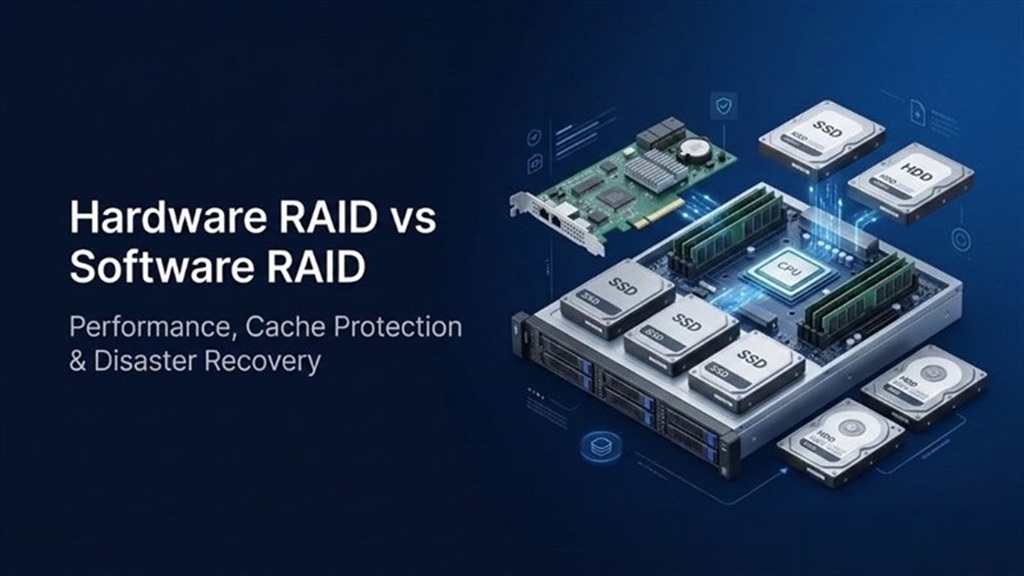
When choosing hardware raid vs software raid server architectures, hardware RAID utilizes a dedicated physical RAID controller card with onboard cache and battery backup (BBU/CacheVault) to offload array processing from the host CPU. Software RAID (such as Linux mdadm or ZFS) executes parity calculations directly on host processor cores. For modern multi-core bare-metal servers equipped with high-speed PCIe NVMe drives, software RAID and ZFS deliver superior throughput and flexibility, while hardware RAID remains preferred for legacy SAS/SATA drive arrays.
For enterprise infrastructure architects and systems administrators, evaluating Hardware RAID vs Software RAID (ZFS/mdadm) is critical for high-throughput transactional applications. Deploying on USA bare metal dedicated server infrastructure eliminates hypervisor scheduling contention, delivers unthrottled PCIe Gen4 NVMe throughput, and ensures deterministic instruction execution under peak loads.
Hardware Isolation
Single-tenant bare-metal cores with zero noisy-neighbor CPU steal and dedicated DDR5 ECC memory channels.
Ultra-Low Latency
Unmetered 1Gbps to 10Gbps transit with direct coastal peering and sub-millisecond optical backbone routes.
PCIe NVMe Storage
Enterprise NVMe RAID arrays delivering sustained 700K+ random read IOPS for mission-critical database operations.
Table of Contents: Technical Navigation Index 8 Chapters ▾
Navigate directly to detailed architectural analysis, hardware sizing benchmarks, deployment automation scripts, and peer verification resources:
Hardware RAID Architecture: Controller Caches and BBU
Traditional hardware RAID architecture is anchored around a dedicated PCIe expansion card—such as a Broadcom / LSI MegaRAID controller—equipped with an onboard RAID-on-Chip (RoC) processor and dedicated volatile DDR3/DDR4 cache memory (typically 1GB to 8GB). The controller acts as an autonomous computing subsystem, handling all XOR parity calculations, disk striping algorithms, and sector verification without consuming host CPU cycles.
The paramount operational advantage of hardware RAID is its hardware write-back cache. To prevent data corruption during sudden datacenter power interruptions, enterprise hardware RAID controllers incorporate a Battery Backup Unit (BBU) or flash-based CacheVault supercapacitor. When power fails, the capacitor provides sufficient electrical current to copy dirty cache data to permanent flash memory, guaranteeing zero data loss for transactional database commits. For foundational architecture context, systems engineers frequently reference our technical analysis on comparing RAID 1, RAID 10, and RAID 5 storage levels to establish baseline compute sizing requirements.
Protects unwritten dirty write-back cache data against sudden server power outages without battery degradation.
Dedicated RoC processor executes parity calculations, leaving all server CPU cores dedicated to application workloads.
Integrated controller BIOS/UEFI firmware manages drive hot-swapping and background rebuilds automatically.
Operating on unvirtualized silicon ensures deterministic instruction execution cycles, eliminates noisy neighbor memory bus congestion, and delivers guaranteed throughput for demanding enterprise workloads.
Software RAID and ZFS: The NVMe Revolution
Despite the historical dominance of hardware RAID controllers, the advent of ultra-high-speed PCIe NVMe solid-state drives exposed severe architectural bottlenecks in traditional RAID cards. Traditional SAS/SATA hardware RAID controllers operate over a limited PCIe x8 interface and process I/O through legacy SCSI translation layers, effectively bottlenecking high-speed NVMe drives capable of delivering millions of IOPS.
Software RAID—implemented via the Linux kernel Multiple Device (mdadm) driver or the OpenZFS filesystem—connects drives directly to the processor’s PCIe lanes. With modern AMD EPYC and Intel Xeon processors boasting 16 to 64 cores, the CPU overhead of software RAID calculations is negligible (typically under 1% CPU utilization), while delivering raw, unthrottled NVMe throughput. Contrasting storage mediums across dedicated tiers, as detailed in our analysis of When evaluating hardware isolation and throughput constraints, engineering teams examine enterprise NVMe drive latency and IOPS benchmarks to verify sustained production performance.
Comparative Architectural Assessment
Evaluating virtualization overhead against dedicated bare metal involves quantifying hypervisor CPU cycle interception, memory bus saturation, and I/O wait latency across real-world enterprise workloads:
Physical RAID controller cards introduce single points of failure, battery backup degradation risks, and throughput ceilings that artificially bottleneck high-speed NVMe storage.
Direct software RAID 10 and ZFS mirror configurations leverage native CPU compute and PCIe lanes to deliver line-rate NVMe performance with built-in cryptographic data integrity.
Disaster Recovery and Hardware Portability Trade-Offs
A critical operational consideration when comparing hardware and software RAID is disaster recovery portability. If a hardware RAID controller experiences a hardware failure, the storage array cannot be accessed until an identical or compatible controller model is installed and configured with matching firmware. This creates a proprietary hardware dependency that can extend downtime during catastrophic hardware events.
In contrast, software RAID arrays created with Linux mdadm or ZFS storage pools are 100% portable. If a motherboard or CPU fails on a dedicated server, the physical storage drives can be moved to any server running a standard Linux kernel, where mdadm --assemble --scan or zpool import will instantly recognize and mount the array with zero data loss. Infrastructure capacity planners systematically evaluate deployment sizing through our guide on integrating local RAID redundancy with 3-2-1 backup archives before finalizing dedicated server hardware configurations.
Hardware Architecture Specifications & Core Sizing Matrix
Key hardware infrastructure sizing parameters must be systematically evaluated across the following production architectural components:
- • Universal Hardware Portability: Software RAID arrays can be mounted on any Linux server without proprietary controller card requirements.
- • ZFS Checksumming and Self-Healing: ZFS detects silent data corruption (bit-rot) and automatically repairs corrupted blocks using parity data.
- • Drive Health Telemetry Access: Direct OS access to raw SMART and NVMe health telemetry without intermediate controller translation.
- • Flexible Volume Resizing: Dynamically expand software RAID arrays and create thin-provisioned snapshots directly from the Linux CLI.
RAID Management and Telemetry Inspection Runbook
To monitor the operational health, rebuild status, and disk parity integrity of your storage array, administrators can deploy the diagnostic runbook below, which supports both Linux mdadm software RAID and MegaRAID hardware controllers:
Production Implementation & Verification Runbook
Executing automation or configuration changes in a production enterprise environment requires a structured protocol to ensure system continuity, audit logging, and zero unplanned service interruptions:
Confirm active root privileges (whoami), verify available filesystem storage on /tmp and /var/log, and inspect active kernel modules with lsmod before applying configuration deltas.
Deploy changes during scheduled low-traffic windows. Capture real-time diagnostic output using standard redirection (tee -a /var/log/audit-runbook.log) to preserve execution timestamps and return codes for compliance auditing.
Execute immediate regression testing by verifying active service sockets (ss -tulpn), inspecting system error logs (journalctl -xe --since "10 minutes ago"), and checking hardware health sensor telemetry via IPMI.
Maintain validated configuration snapshots (e.g. cp /etc/sysctl.conf /etc/sysctl.conf.bak) and scripted recovery triggers to instantly revert parameters if latency or error rates exceed established SLA thresholds.
Always configure automated email notifications in /etc/mdadm/mdadm.conf or MegaRAID Storage Manager to receive instantaneous alerts upon drive failure or degraded array state. When deploying automation and kernel parameters in enterprise production, sysadmins should cross-reference technical requirements against the Linux Kernel mdadm software RAID documentation.
Selecting the Right RAID Configuration for Your Workload
Choosing between hardware and software RAID requires evaluating your specific drive types and application redundancy requirements. Reviewing our comprehensive breakdown for monitoring disk array health via IPMI sensors ensures that usable capacity, disk rebuild times, and unrecoverable read error (URE) risks are perfectly balanced across your dedicated server storage subsystem.
Deploy MegaRAID cards with CacheVault for high-capacity SATA HDD arrays requiring write-back caching.
Deploy Linux mdadm or ZFS RAID-1/10 for pure NVMe solid-state storage to achieve maximum IOPS and throughput.
Schedule monthly background RAID scrubs to verify data integrity and detect failing drive sectors proactively.
Production Resilience & Failure Domain Hardening
To eliminate single points of failure across bare-metal server infrastructure, systems engineering teams must implement defense-in-depth architectural safeguards:
Maintain independent network routing for IPMI / BMC management interfaces to preserve administrative control during core network saturation or OS kernel panics.
Configure Linux kdump with reserved memory allocations to capture crash dumps (vmcore) for root-cause post-mortem diagnostics following critical system halts.
Configure daemonized SMART and software/hardware RAID monitoring to instantly alert NOC engineers upon drive read retry rate anomalies.
Leverage redundant upstream carrier paths to dynamically route around regional fiber cuts and upstream Autonomous System (AS) routing anomalies.
Hardware Telemetry & Architectural Comparison
Onlive Server offers both enterprise hardware RAID controllers (Broadcom/LSI MegaRAID with CacheVault) and high-performance software RAID / ZFS configurations across our USA dedicated servers in Missouri, New York, California, and Ohio. Experience unthrottled storage resilience starting at just $44/month.
| Feature / Metric | Hardware RAID Controller | Linux mdadm Software RAID | ZFS Storage Pool (Software) |
|---|---|---|---|
| Host CPU Utilization | 0% (Offloaded to controller chip) | < 1% on modern multi-core CPUs | 1% – 3% (Includes compression & checksums) |
| Write-Back Cache Safety | Protected via BBU / CacheVault | Requires battery/UPS backed RAM | Protected via ZFS ZIL / SLOG on NVMe |
| NVMe Gen4 Throughput | Bottlenecked by PCIe x8 controller | Uncapped direct PCIe lane throughput | Uncapped direct PCIe lane throughput |
| Silent Data Corruption | Undetected (Relies on drive) | Undetected (No checksumming) | 100% Detected and Self-Healed via Parity |
| Hardware Portability | Locked to controller vendor/model | 100% Portable across any Linux host | 100% Portable across any ZFS system |
All Onlive Server USA dedicated hosting nodes include dedicated IPMI 2.0 remote out-of-band management, 24/7 proactive hardware replacement guarantees, and unmetered Tier-1 network uplinks to ensure uncompromising enterprise operational continuity.
Related Technical Deep-Dives
Expand your systems engineering expertise across our interconnected dedicated hosting architecture series:
In-depth hardware analysis, telemetry comparisons, and production benchmarks.
Technical deployment runbook, automated scripts, and system hardening guidelines.
High-performance dedicated server plans across Tier-3 data centers in the United States.
Frequently Asked Questions
Is hardware RAID better than software RAID for servers? +
Hardware RAID is traditionally better for spinning HDDs and enterprise SATA SSDs because its dedicated processor offloads parity calculations and its onboard battery backup (BBU/CacheVault) protects unwritten cache data. However, for modern NVMe solid-state drives, software RAID (Linux mdadm or ZFS) is superior because it connects directly to CPU PCIe lanes without controller bottlenecking.
Does software RAID slow down the server CPU? +
On modern multi-core processors (such as Intel Xeon or AMD EPYC), software RAID overhead is negligible, typically consuming less than 1% of CPU cycles for RAID 1 mirroring and RAID 10 striping. The massive compute power of modern processors renders dedicated RAID chips unnecessary for flash storage.
What is a Battery Backup Unit (BBU) on a RAID controller? +
A BBU (or modern flash CacheVault capacitor) is a hardware backup power supply attached to a hardware RAID controller. If the server loses power unexpectedly, the BBU maintains power to the controller’s write-back cache or copies dirty data to flash memory, preventing database and filesystem corruption.
What happens if a hardware RAID card fails? +
If a hardware RAID controller fails, your storage array becomes completely inaccessible until you replace the card with an identical or compatible controller model running matching firmware. This proprietary lock-in is a primary reason many sysadmins prefer software RAID.
Can I use ZFS as software RAID on a dedicated server? +
Yes. ZFS is an advanced enterprise filesystem and logical volume manager that provides software RAID (mirror, RAID-Z1, RAID-Z2). ZFS includes native cryptographic checksums, automatic bit-rot self-healing, snapshot replication, and inline data compression.
Can I hot-swap drives with software RAID? +
Yes. Provided the server chassis includes hot-swap drive bays and the SATA/NVMe controller supports hot-plugging, you can replace a failed drive in a software RAID array and rebuild it online using mdadm or zpool commands without rebooting.
Which RAID level is recommended for databases on software RAID? +
RAID 10 (mirrored striping) is strongly recommended for high-transaction databases. RAID 10 provides maximum random write performance, eliminates parity calculation overhead, and offers fast rebuild times without degrading database response latency.
Does Onlive Server support hardware and software RAID? +
Yes, Onlive Server supports both dedicated hardware RAID controllers (with write-back cache and BBU) and native Linux mdadm/ZFS software RAID across our entire USA dedicated server line in Missouri, New York, California, and Ohio.
Protect your mission-critical data with enterprise RAID storage. Deploy dedicated servers in Missouri, New York, California, and Ohio configured with hardware MegaRAID or high-speed NVMe software RAID arrays with unmetered port speeds.
Deploy Hardware RAID-Protected Dedicated Servers →