

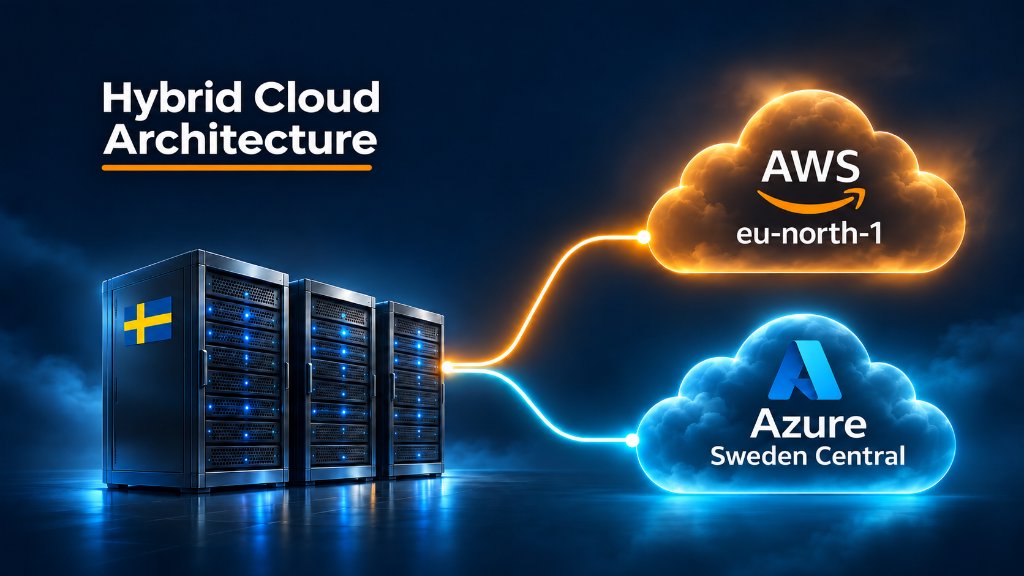
Direct Architecture Answer: Yes—you can connect dedicated Stockholm bare-metal servers directly to AWS eu-north-1 (Stockholm) or Azure Sweden Central (Gävle/Sandviken) over redundant encrypted WireGuard or IPsec VPN gateways, or via carrier interconnects where supported by the datacenter. Anchoring steady OLTP databases, NVMe caching tiers, and high-outbound origins on dedicated Stockholm bare metal completely eliminates hyperscaler egress taxes ($0.09/GB on AWS and $0.087/GB on Azure) while preserving sub-2ms regional round-trip latency.
Recommended Deployment Rule: Audit cross-boundary traffic flows before configuring tunnels. Keep stateful, IOPS-intensive databases and public delivery origins anchored on dedicated Stockholm Intel Xeon hardware, verify unthrottled 1 Gbps uplink capacity, and place VPN endpoints outside paid hyperscaler NAT Gateways.
Planning a hybrid cloud architecture linking Stockholm bare-metal infrastructure with AWS and Azure lets engineering teams leverage elastic cloud PaaS while eliminating hyperscaler markups on steady compute and outbound bandwidth. Because AWS operates eu-north-1 in Stockholm and Microsoft runs Azure Sweden Central across Gävle and Sandviken, regional proximity makes hybrid pairing highly practical. However, careless service boundaries turn hybrid links into costly metered egress loops. Designing strict traffic boundaries and redundant encrypted tunnels keeps both performance and infrastructure budgets completely predictable.
Anchor steady databases, heavy local I/O, and high-outbound API/media origins on Stockholm Intel Xeon bare metal; leave serverless bursts, CDN edge, and managed AI/ML in AWS or Azure.
AWS eu-north-1 bills $0.09/GB internet egress, $0.046/GB NAT GW processing, and $0.01/GB cross-AZ; Azure Sweden Central bills $0.087/GB egress and $0.01/GB VNet peering.
All verified Stockholm bare-metal plans ship with unmetered 1 Gbps uplinks; treat private cross-connects, Direct Connect/ExpressRoute ports, and BGP as pre-order engineering checks.
1. Why Teams Combine Stockholm Bare Metal with AWS eu-north-1 or Azure Sweden Central
Full cloud repatriation rarely makes sense when teams rely on managed hyperscaler services like Amazon SQS, AWS Lambda, S3, Azure Entra ID, Azure Functions, or managed GPU inference. Rebuilding those layers on bare metal consumes valuable engineering hours. Yet running steady-state, I/O-heavy, or high-egress workloads permanently inside public cloud virtual machines produces spiraling, unpredictable cloud bills.
A modern hybrid architecture delivers the best of both models:
- Cloud Elasticity at the Edge: AWS
eu-north-1and Azure Sweden Central handle traffic spikes, serverless endpoints, international CDN edge routing, and managed compliance platforms. - Deterministic Core on Bare Metal: Dedicated Stockholm Intel Xeon servers host high-IOPS PostgreSQL, MySQL, ClickHouse, Redis, and high-bandwidth API origins without shared hypervisors or noisy neighbors.
- Zero Cloud Egress Penalty on Core Delivery: By serving heavy outbound data directly from Stockholm bare metal over unmetered
1 Gbpsuplinks, companies bypass the$0.09/GB(AWS) and$0.087/GB(Azure) data egress fees entirely.
When architected correctly, the low-latency Stockholm regional transit corridor keeps inter-service RTT between bare metal and cloud zones within 1.5ms to 3.5ms, enabling synchronous microservice execution without performance degradation.
2. Workload Boundary Design: Core Compute & Data vs Elastic Edge PaaS
Hybrid cloud deployments fail when engineers split chatty microservices across a WAN or VPN link without strict boundary definitions. Every cross-boundary query adds encryption overhead, serialization delay, and potential cloud egress fees. Draw your architectural split around coarse-grained asynchronous interfaces rather than row-by-row ORM queries.
Hybrid Workload Placement Matrix
| Workload Pattern | Recommended Infrastructure | Architectural Rationale |
|---|---|---|
| Steady OLTP DB + Co-Located Core API | Stockholm Bare Metal (DSX14 / DSX15) |
Keeps chatty SQL queries on local RAM and mirrored SSDs—zero EBS IOPS or cross-AZ charges. |
| High-Outbound Media or Public API Origin | Stockholm Bare Metal (DSX5 / DSX8 / DSX14) |
Eliminates $0.09/GB AWS and $0.087/GB Azure public egress fees on large file distributions. |
| Elastic Web Spikes & Serverless Microservices | AWS eu-north-1 / Azure Sweden Central | Autoscale compute pods and serverless workers dynamically to absorb unpredictable visitor traffic. |
| Cold Backups & Immutable Disaster Recovery | AWS S3 / Azure Blob Storage | Inbound data upload to cloud storage is $0.00/GB, offering durable, geo-redundant archive tiers. |
| Managed ML/AI Inference Pipelines | AWS Bedrock / Azure OpenAI Service | Access specialized hyperscaler AI models via REST APIs without investing in dedicated on-premise GPU clusters. |
Matching Verified Stockholm Bare Metal to Hybrid Core Roles
Choosing the proper hardware SKU ensures that your bare-metal core handles database transactions and encrypted VPN encapsulation with high headroom:
- Dual-Drive Database Workhorses (
DSX14/DSX15): Intel XeonDSX14(2x Xeon E5-2630 v4, 20C/40T, 128 GB RAM,2x 1 TB SSD,$245/mo) andDSX15(2x Xeon E5-2680 v4, 28C/56T, 256 GB RAM,2x 2 TB SSD,$341/mo) include dual SSDs ready for hardware RAID 1 or OpenZFS mirroring—ideal for co-locating core APIs and primary databases. - High-Clock Gateway / Web Origin (
DSX5/DSX8): Intel XeonE-2388G(8C/16T, 3.2 GHz / up to 5.1 GHz Turbo, 64 GB RAM,960 GB SSD,$180/mo) excels as an encrypted VPN gateway or single-thread-heavy application origin. - Local NVMe Indexing / Cache (
DSX9): Intel XeonE5-2660 v3(10C/20T, 128 GB RAM,960 GB NVMe,$219/mo) provides rapid NVMe IOPS for Elasticsearch or Redis caching clusters.
Explore dedicated configurations on High-Performance Stockholm Dedicated Servers.
3. Connectivity Topologies: Redundant WireGuard/IPsec vs Carrier Interconnect
AWS eu-north-1 operates in the Stockholm metro area, while Azure Sweden Central operates across Gävle/Sandviken north of Stockholm. Real tunnel latency depends on datacenter transit routes. Never assume sub-2ms RTT from city labels alone; benchmark live paths from a cloud test VM to your provider’s Stockholm test IP using mtr --tcp --port 443.
Option A: Redundant Site-to-Site WireGuard or IPsec Over Public Transit
For links operating within 1 Gbps bandwidth profiles, dual encrypted tunnels over premium public transit deploy rapidly with zero long-term carrier interconnect contracts:
- AWS
eu-north-1: Deploy AWS Site-to-Site VPN (dual IPsec tunnels to Virtual Private Gateway or Transit Gateway with BGP failover) or run redundant EC2 WireGuard routers across two separate Availability Zones with automated health-check routing. - Azure Sweden Central: Configure an Active-Active Azure VPN Gateway (IPsec/IKEv2 with BGP) or redundant Linux WireGuard Network Virtual Appliances (NVAs) within a hub VNet.
ROUTING & CONSOLE ACCESS SAFEGUARD: Before modifying ip route tables, nftables forwarding rules, or setting WireGuard AllowedIPs = 0.0.0.0/0 on a remote Stockholm gateway, verify active IPMI/KVM out-of-band console access and schedule an automated rollback timer (such as systemd-run --on-active=180 systemctl restart networking). Never route your active management SSH session through an untested tunnel.
Verified Linux WireGuard and MTU diagnostic commands on the bare-metal gateway:
# 1. Confirm Path MTU to cloud gateway peer before locking WireGuard MTU
ping -M do -s 1472 -c 4 <CLOUD_GATEWAY_PUBLIC_IP>

# 2. Inspect active WireGuard handshake and cryptographic transfer counters
sudo wg show

# 3. Verify IPv4 kernel forwarding and reverse-path filtering settings
sysctl net.ipv4.ip_forward net.ipv4.conf.all.rp_filter

# 4. Enforce TCP MSS Clamping to prevent packet fragmentation over tunnel
iptables -t mangle -A FORWARD -p tcp --tcp-flags SYN,RST SYN -j TCPMSS --clamp-mss-to-pmtu
Option B: AWS Direct Connect / Azure ExpressRoute & Carrier Interconnects
Private Layer-2 interconnects (AWS Direct Connect or Azure ExpressRoute) bypass the public internet entirely, delivering dedicated bandwidth slices and reduced cloud egress unit rates. However, they introduce recurring cross-connect fees, dedicated port pricing, and BGP routing complexity.
Pre-Order Verification Note: Standard Stockholm bare-metal plans include premium 1 Gbps internet transit. If your infrastructure demands dedicated private VLAN cross-connects (Equinix Fabric or Netnod Cloud Connect), confirm feasibility, cross-connect authorization letters (LOA-CFA), and lead times with Onlive Server engineering prior to provisioning.
4. Preventing Accidental Egress Loops ($0.09/GB AWS & $0.087/GB Azure)
An accidental cloud egress loop—repeatedly streaming high-volume data out of AWS or Azure across metered boundaries—quickly erodes the cost advantages of hybrid hosting. Hyperscalers charge zero for incoming data transfer, but heavily monetize data leaving their availability zones.
Four Common Hybrid Egress Traps and Architectural Solutions
| Egress Risk Pattern | Hyperscaler Cost Trigger | Architectural Remedy |
|---|---|---|
| Cross-Boundary DB Queries | AWS: $0.09/GB • Azure: $0.087/GB |
Co-locate API application workers on the bare-metal database node; return only finalized JSON responses to the cloud edge. |
| Cloud NAT Gateway Routing | AWS NAT GW: $0.045/hr + $0.045/GB |
Route hybrid VPN traffic via VPC route tables targeting Virtual Private Gateway (VGW) directly, bypassing NAT Gateways. |
| Inter-AZ Cloud Replication | AWS Inter-AZ: $0.01/GB each way |
Pin cloud gateway instances to the specific AZ hosting your primary application tier to avoid double-charging. |
| Full Backup Cloud Extraction | Egress: $0.09/GB on large image restores |
Keep primary backup repositories and point-in-time snapshots on local bare-metal NVMe/SATA storage; ship only encrypted diffs to S3. |
Illustrative Egress-Loop Financial Impact
Consider an application streaming 25 TB of outbound monthly reporting data from an AWS EC2 instance to an external analytics server:
- Inside AWS (Egress Tax): 25 TB x $0.09/GB = $2,250/month in pure bandwidth fees alone, plus NAT Gateway processing charges.
- On Stockholm Bare Metal: The same 25 TB streams over an unmetered
1 Gbpsdedicated server connection at $0 extra egress cost.
Anchoring data-heavy pipelines on bare metal protects your balance sheet from unforecasted transfer surcharges.
5. Unified Monitoring, Identity & Automated Failover Across Hybrid Tiers
Hybrid infrastructure succeeds operationally when telemetry, identity management, and degraded-mode fallbacks operate as a cohesive system rather than fragmented silos:
- Cost-Aware Observability: Deploy Prometheus node exporters on Stockholm bare metal paired with Grafana dashboards. Track bandwidth utilization on WireGuard
wg0interfaces and configure alerting thresholds on hyperscaler CloudWatch / Azure Monitor metrics to catch accidental traffic spikes immediately. - Unified Identity & Secret Management: Utilize HashiCorp Vault or Azure Key Vault with WireGuard mTLS certificates for server authentication. Rotate WireGuard private keys automatically every 90 days via Ansible or Terraform workflows.
- Resilient Degraded-Mode Routing: In the event of primary public transit degradation, configure BGP multi-pathing or automated route health monitors to switch tunnel transit over secondary carrier paths within sub-second convergence windows.
6. Frequently Asked Questions: Stockholm Hybrid Cloud Architecture
Q Does uploading backups from Stockholm bare metal into AWS S3 or Azure Blob incur cloud transfer fees?
$0.00/GB (capacity and API request charges still apply). High egress charges only occur if you pull large snapshot restores back out ($0.09/GB on AWS / $0.087/GB on Azure). We recommend validating routine snapshot restores on an in-region cloud VM via private VPC Gateway Endpoints to avoid egress penalties.
Q Why choose WireGuard over managed AWS or Azure IPsec VPN gateways for Stockholm hybrids?
Q What latency can we expect between Stockholm bare metal and AWS eu-north-1 or Azure Sweden Central?
eu-north-1 typically measures between 1.2ms and 2.5ms. Connectivity north to Azure Sweden Central (Gävle/Sandviken) typically ranges between 2.8ms and 4.5ms depending on intermediate carrier routing. We recommend requesting an Onlive Server Stockholm test IP to verify ping metrics prior to deployment.
Q Can Onlive Server set up a direct cross-connect or AWS Direct Connect port in Stockholm?
1 Gbps public transit ports. Custom physical cross-connects, Equinix Fabric integration, or AWS Direct Connect / Azure ExpressRoute Layer-2 connectivity require a pre-order engineering evaluation to confirm datacenter meet-me-room facility feasibility and monthly cross-connect fees.
Q How do we prevent packet fragmentation and stalled TLS handshakes across hybrid tunnels?
MTU = 1420 (or 1360–1400 on networks with nested encapsulation) and enable TCP MSS Clamping (iptables -t mangle -A FORWARD -p tcp --tcp-flags SYN,RST SYN -j TCPMSS --clamp-mss-to-pmtu) to guarantee unfragmented TCP packet flows.
⚡ HYBRID CLOUD BARE-METAL INFRASTRUCTURE
Anchor Your Swedish Hybrid Core on Predictable Stockholm Bare Metal
Pair AWS eu-north-1 or Azure Sweden Central elasticity with single-tenant Intel Xeon Stockholm servers. Enjoy unthrottled 1 Gbps bandwidth, hardware RAID NVMe storage, sub-2ms metro latency, and zero surprise hyperscaler egress taxes.
