

Enterprise Resilience Benchmark • London Tier-3 Facilities
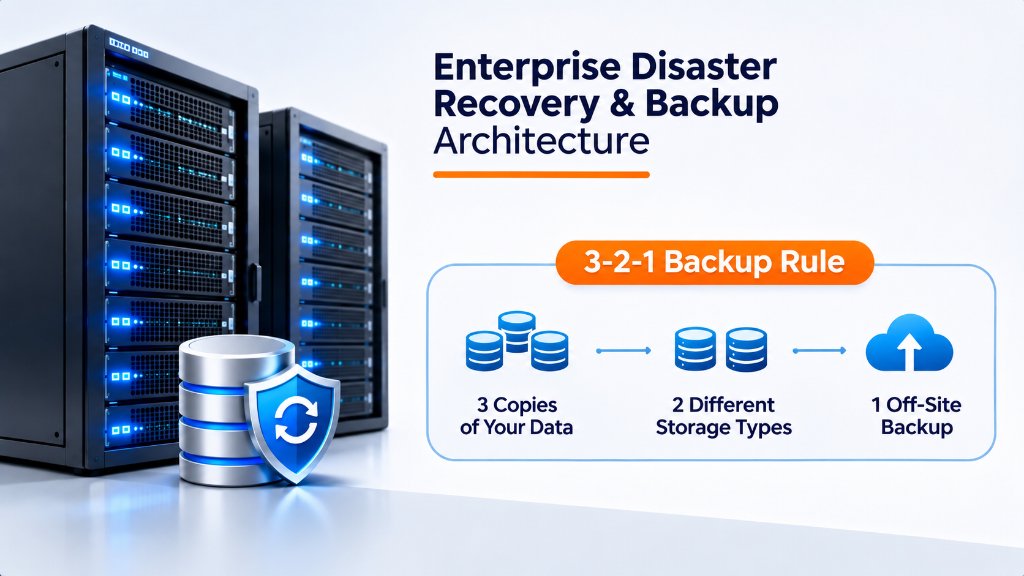
The enterprise 3-2-1 backup standard dictates that production infrastructure maintain at least 3 distinct copies of mission-critical data across 2 separate media formats, with at least 1 copy isolated offsite in an independent, geographically separated data facility. On UK dedicated servers, this protocol prevents total loss from catastrophic hardware failures, silent bit rot, hypervisor crashes, and ransomware attacks while guaranteeing sub-15-minute RPO and sub-1-hour RTO compliance under strict UK GDPR frameworks.
Maintain 3 distinct data copies: primary NVMe array, secondary on-premise/NFS backup, and third offsite cold vault.
Store across 2 different physical media technologies (e.g., Enterprise PCIe Gen4 NVMe RAID-10 + S3 Object Storage/ZFS).
Ensure at least 1 offsite facility is separated by 50+ km (e.g., London to Manchester or Frankfurt) to survive regional outages.
Enforce client-side AES-256 encryption with WORM (Write Once, Read Many) Object Locking to immunize archives against ransomware.
Validated Infrastructure Protocol • Automated Verification
Implementing a resilient 3-2-1 backup architecture on a UK dedicated server requires moving past local RAID controller mirroring into automated, client-side encrypted snapshot pipelines. By pairing local deduplicated BorgBackup or Restic repositories with offsite S3-compatible immutable object storage, system administrators achieve continuous recovery point objectives (RPO < 15 min) and deterministic recovery time objectives (RTO < 60 min) with zero single points of failure.
Primary production + local backup repository + offsite cold vault.
High-speed NVMe block storage + independent object/ZFS storage.
Geographically separated facility immune to local hypervisor failures.
Zero-knowledge client encryption with immutable object locking.
Across modern enterprise IT environments, one of the most perilous architectural misconceptions is treating hardware RAID 1 or RAID 10 mirroring as a substitute for an enterprise backup strategy. Hardware RAID exists exclusively to provide immediate hardware high availability during a physical drive failure. If an operator accidentally executes an unindexed DROP DATABASE, a malicious ransomware payload encrypts the filesystem, or a kernel panic corrupts the ext4/XFS metadata, RAID mirrors that catastrophic damage instantly across every physical disk in the array with sub-millisecond precision.
Operating high-throughput production workloads requires dedicated hardware isolation to eliminate hypervisor contention, CPU steal, and memory bus saturation. Enterprise engineering teams rely on UK bare metal dedicated server infrastructure engineered for deterministic compute, unthrottled PCIe Gen4 NVMe throughput, and sub-2ms LINX optical peering across London datacenters to stream multi-gigabit delta snapshots without impacting active web visitors.
Under UK GDPR, Data Protection Act 2018, and ISO 27001 guidelines, financial, healthcare, and enterprise commerce platforms must demonstrate documented business continuity protocols, cryptographic backup protection, and verifiable restoration runbooks. Architecting offsite backups across independent UK facilities ensures full data sovereignty and regulatory compliance while maintaining air-gapped immunity against zero-day supply chain breaches.
The 3-2-1 Resilience Benchmark
Maintain 3 complete copies of data on 2 distinct media technologies, with 1 copy permanently isolated offsite in an independent datacenter.
Zero-Knowledge AES-256 Vaults
Enforce client-side cryptographic hashing prior to transit so that offsite storage providers and untrusted networks never access decryption keys.
Content-Defined Deduplication
Slashing bandwidth consumption and storage capacity by 70–90% via block-level rolling hashes across repetitive snapshots.
1. 3-2-1 Enterprise Backup Strategy: Beyond Local Mirroring
The architectural necessity of the 3-2-1 backup rule is rooted in strict failure domain isolation: ensuring that no single physical event, human misconfiguration, or malicious intrusion can simultaneously destroy production workloads and disaster recovery copies. While a hardware RAID 10 array across four enterprise NVMe drives provides stellar I/O throughput and survives a single physical SSD controller burnout, it remains a single failure domain. Corrupt database transactions, file system table damage, and ransomware immediately destroy all mirrored drives.
Implementing the 3-2-1 rule on high-performance UK dedicated servers introduces decoupled resilience by separating data lifecycle tiers across physical, media, and geographic boundaries. By combining high-speed local ZFS snapshot pools with geographically separated S3-compatible cold repositories, organizations satisfy the rigorous criteria outlined in NIST SP 800-209 Guidelines for Storage Security.
Three Data Copies
One live production copy on the dedicated server’s primary NVMe array, one secondary local backup copy on an attached storage volume, and one offsite cold copy stored in a remote datacenter.
Two Media Types
Store copies across 2 distinct media technologies (e.g., enterprise PCIe NVMe block devices + ZFS/NFS network-attached storage or S3-compatible cloud object storage) to eliminate firmware vulnerabilities.
One Geographically Isolated
Store at least 1 backup copy in an independent facility located over 50 km away (such as pairing a London primary host with a secondary backup vault in Frankfurt or Amsterdam) to withstand power grid failures.
When scaling mission-critical platforms, organizations often combine bare metal hosts with secondary UK VPS instances or dedicated backup storage nodes. This architecture facilitates rapid live recovery drills without burdening production CPUs. For complex multi-jurisdiction environments, integrating cross-border disaster recovery principles—similar to our cross-border disaster recovery architectures—guarantees continuous availability even during severe geopolitical or grid disruptions.
2. Automated Snapshot Engines: BorgBackup vs Restic vs Rsync
Selecting the appropriate snapshot engine determines the operational efficiency, network consumption, and restore speed of your disaster recovery pipeline. While traditional utilities like rsync synchronize raw files efficiently across SSH tunnels, they lack cryptographic deduplication, atomic snapshot rollbacks, and native client-side encryption. Modern enterprise deployments rely on Restic or BorgBackup to achieve sub-minute incremental backup cycles across large datasets.
| Technical Capability | Restic | BorgBackup | Legacy Rsync |
|---|---|---|---|
| Storage Targets | Native S3, B2, Azure, SFTP, REST | SSH, Local Disk, SFTP | SSH, Local Disk, NFS |
| Deduplication | Content-Defined Chunking (CDC) | Chunk-Level Deduplication | None (Full file or hardlinks) |
| Client-Side Encryption | AES-256 GCM / Poly1305 (Mandatory) | AES-256 / ChaCha20-Poly1305 | None (Requires LUKS / EncFS) |
| Snapshot Immutability | Supported with S3 Object Lock (WORM) | Append-Only Mode (SSH restricted) | None (Vulnerable to overwrite) |
| Memory Footprint | Moderate (Index-based caching) | Extremely Low (Optimized C core) | High on millions of files |
Setting precise Recovery Point Objectives (RPO) and Recovery Time Objectives (RTO) dictates backup execution frequency. When combined with granular disaster recovery RTO and RPO strategies, system administrators can schedule automated hourly delta snapshots that consume negligible disk I/O and network bandwidth.
bash — root@uk-dedi-srv:~ — 120×34 (PuTTY SSH – London Telehouse)
RESTIC PIPELINE
export RESTIC_PASSWORD_FILE=”/root/.restic_vault_key”
export AWS_ACCESS_KEY_ID=”004ukdedi77a8b9c”
export AWS_SECRET_ACCESS_KEY=”K004xEnterpriseSecretVaultToken”
restic init
gzip -9 |
restic backup –stdin –stdin-filename “production_db_$(date +%Y%m%d_%H%M%S).sql.gz” –tag “database-hourly”
–exclude=”/var/www/*/cache/*”
–exclude=”/var/log/*.gz”
–tag “fs-daily” –verbose
3. Hardened Encryption & S3 WORM Object Locking
Ransomware threat actors targeting enterprise infrastructure no longer merely encrypt live production systems—they actively seek out, purge, and overwrite local backup directories and mounted network shares before triggering production encryption. To counter sophisticated attacks, disaster recovery pipelines must enforce two foundational security protocols: zero-knowledge client-side encryption and Write Once, Read Many (WORM) storage immutability.
Client-side encryption ensures that before any data chunk leaves your UK dedicated server’s RAM, it is encrypted using AES-256 in Galois/Counter Mode (GCM) or ChaCha20-Poly1305. The remote offsite storage provider only receives cryptographically opaque blobs. Even in the event of an untrusted cloud provider compromise or sub-tenant security incident, your intellectual property and customer records remain unreadable without the local master cryptographic key.
/etc/systemd/system/enterprise-backup.timer — Automated Systemd Daemon
SYSTEMD ACTIVE
When coupling offsite storage with high-capacity enterprise networks, network perimeter security is equally paramount. To safeguard replication endpoints from malicious intrusion and traffic manipulation, dedicated hosts should be backed by hardware DDoS protection and volumetric scrubbing to prevent external attackers from saturating the uplink during critical disaster recovery data restoration windows.
4. Retention Frameworks, Sizing & GFS Policies
An uncontrolled backup regime without structured retention policies inevitably results in repository bloat, escalating cloud storage costs, and sluggish snapshot index traversals. To maintain predictability, enterprise backup architects deploy the Grandfather-Father-Son (GFS) rotation scheme. This protocol balances granular point-in-time recovery for recent operational incidents with economical multi-year compliance archives.
Son (Hourly / Daily)
Retain 24 hourly snapshots and 7 daily snapshots. Designed for rapid operational rollback following failed software updates or accidental deletions.
Father (Weekly / Monthly)
Retain 4 weekly and 12 monthly snapshots. Protects against dormant malware infections or data anomalies discovered weeks after occurrence.
Grandfather (Yearly)
Retain 3 to 7 annual archival snapshots in cold immutable storage. Satisfies corporate financial auditing and statutory legal compliance frameworks.
Pruning and garbage collection should execute on a separate schedule from active snapshot generation to prevent lock contention. For example, executing weekly maintenance reorganizes the index and releases unreferenced storage blocks without interrupting active production operations:
5. Enterprise Disaster Recovery Architecture Matrix
Comparing different storage resilience approaches illustrates why enterprise bare metal environments require multi-tiered disaster recovery rather than relying solely on local disk parity or ad-hoc cloud snapshots.
| Disaster Recovery Dimension | Single Local RAID Array | Cloud VPS Daily Snapshots | Onlive Server 3-2-1 Enterprise Architecture |
|---|---|---|---|
| Primary Failure Protection | Physical disk failure only | Virtual machine failure only | Hardware, software, ransomware, & datacenter outages |
| Protection Against Ransomware | Zero (Mirrors encrypted blocks instantly) | Poor (Vulnerable to control plane compromise) | 100% Immutable (Client-side encrypted WORM Object Lock) |
| Geographic Datacenter Isolation | None (All data in single chassis) | Typically same availability zone | Independent offsite facility (>50 km geographic separation) |
| Target Recovery Point Objective (RPO) | 0 min for disk drop (Fatal for data corruption) | 24 hours (Daily snapshot interval) | < 15 minutes (Continuous block deduplication) |
| Target Recovery Time Objective (RTO) | Instant for disk drop (Infinite if corrupted) | 2 to 6 hours (Hypervisor image restore) | < 45 minutes (Bare metal PXE / delta restore pipeline) |
| Network Throughput & Bandwidth | Internal SATA / SAS / PCIe bus | Throttled shared vNIC bandwidth | 1 Gbps to 10 Gbps Unmetered Dedicated Optical Uplink |
6. Production Readiness Checklist & Disaster Runbook
Executing an enterprise disaster recovery drill before going live ensures that automated backup routines function flawlessly and recovery time objectives can be met under real-world emergency conditions.
- Map all critical stateful data (databases, user uploads, config files).
- Formulate business-approved RPO (<15 min) and RTO (<60 min) metrics.
- Establish 3 data copies across 2 distinct physical media types.
- Procure an independent offsite storage facility separated by >50 km.
- Deploy Restic or BorgBackup with client-side AES-256 encryption.
- Store master encryption keys in an air-gapped password vault.
- Configure S3 Object Locking in Compliance Mode for WORM immutability.
- Ensure backup credentials possess append-only write permissions.
- Configure systemd timers for automated hourly database dumps.
- Enforce Grandfather-Father-Son retention (7 daily, 4 weekly, 12 monthly).
- Set up automated email / webhook alerting for backup job failures.
- Schedule weekly cryptographic repository integrity checks (
check --read-data).
- Perform a dry-run bare-metal restore onto a staging server or rescue environment.
- Validate database consistency checks and test sample user logins.
- Measure actual recovery duration against target RTO thresholds.
- Document step-by-step failover runbook and train sysadmin on-call staff.
7. Frequently Asked Questions
What is the 3-2-1 backup strategy for enterprise dedicated servers?
Why is hardware RAID mirroring not considered a backup?
DROP TABLE commands, and ransomware encryption across all mirrored disks simultaneously. True backups maintain point-in-time snapshots decoupled from the primary storage controller.
What is the difference between BorgBackup, Restic, and Rsync?
How does client-side encryption protect backups against ransomware?
What are Recovery Point Objective (RPO) and Recovery Time Objective (RTO)?
How should production databases be backed up within a 3-2-1 architecture?
mariadb-dump --single-transaction, pg_dump, or Percona XtraBackup) piped directly into an encrypted snapshot engine like Restic or Borg. This guarantees ACID compliance and point-in-time recovery without locking database tables.
How frequently should disaster recovery restoration runbooks be tested?
Does Onlive Server provide dedicated offsite backup infrastructure in the UK?
Deploy High-Performance UK Dedicated Servers with 3-2-1 Disaster Recovery
Protect mission-critical enterprise applications with isolated AMD EPYC and Intel Xeon bare metal hardware, enterprise NVMe storage arrays, and sub-2ms LINX London datacenter connectivity.
