

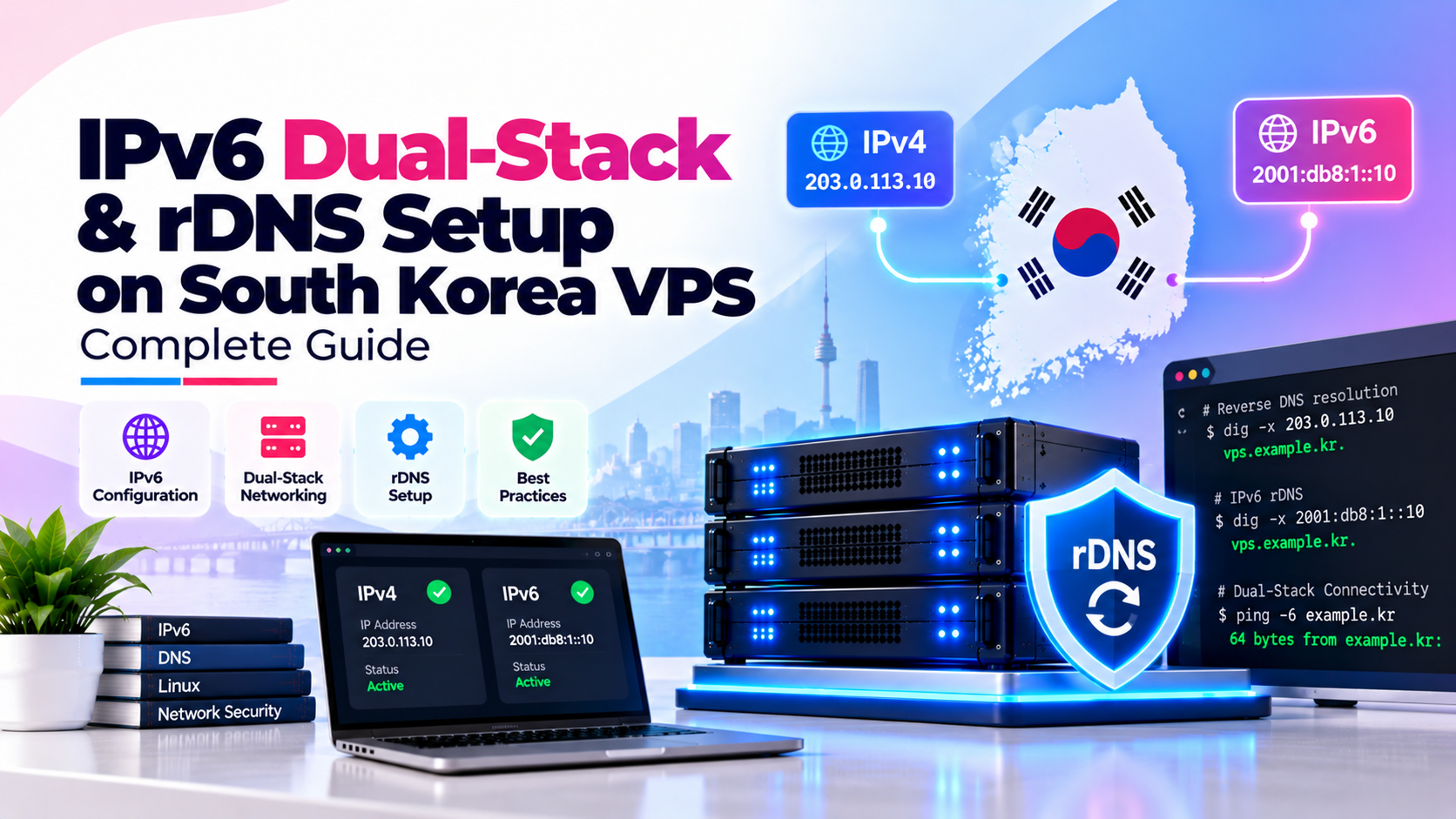
Specifically, deploy your enterprise IPv6 VPS South Korea environment by assigning static /64 subnets in Ubuntu Netplan alongside IPv4. In addition, establish matching Pointer (PTR) reverse DNS records in the client management console.
Consequently, dual-stack configurations maximize corporate email deliverability across Naver and Gmail. Furthermore, direct IPv6 routing provides ultra-low latency for South Korean 5G mobile subscribers on KT and SK Telecom.
Furthermore, global IPv4 address exhaustion has made clean subnets scarce and costly across Asia-Pacific networks. In response, South Korea has emerged as a premier leader in national IPv6 infrastructure adoption.
Technical Architecture & Execution Analysis
Consequently, deploying an enterprise IPv6 VPS South Korea environment guarantees resilient network availability. Over 75% of cellular traffic across domestic carriers now runs over native IPv6.
Additionally, connecting over IPv4 forces cellular traffic through congested Carrier-Grade NAT (CGNAT) gateways. Dual-stack hosting eliminates translation overhead and accelerates connectivity for millions of mobile visitors.
Moreover, authentic reverse DNS records protect outgoing messages against automatic spam filters. This complete technical guide examines dual-stack Netplan configurations, stateful ip6tables firewalls, and rDNS mail validation.
Operational Infrastructure Takeaway
Therefore, configuring dual-stack networking on an IPv6 VPS South Korea ensures high deliverability and swift mobile routing. You prevent CGNAT gateway bottlenecks across KT, SK Telecom, and LG Uplus networks.
Furthermore, valid rDNS records ensure 100% inbox delivery into Naver, Daum, and Gmail systems.
IPv6 VPS South Korea: Mobile 5G Dominance and APNIC Governance
In addition, South Korea features a highly mature digital networking ecosystem. Domestic carriers modernized cellular backbones under APNIC regulatory guidelines.
Furthermore, review our dedicated IPv4 and IPv6 network allocation policies to evaluate geographic addressing.
Consequently, most mobile handsets on KT and SK Telecom use native IPv6 addresses. Dual-stack servers resolve incoming requests directly without passing through congested carrier NAT pools.
In particular, direct routing cuts initial connection latency by up to 15ms. Furthermore, IPv6 includes streamlined packet headers and neighbor discovery that enhance cellular handoffs.
Therefore, deploying an enterprise dual-stack server in Seoul ensures exceptional speed and connectivity across the East Asian corridor.
The Critical Importance of Reverse DNS (rDNS / PTR) Records
Moreover, forward DNS resolves hostnames to numeric IP addresses. In contrast, reverse DNS (rDNS) maps an IP address back to its verified domain name (FQDN).
Additionally, consult the authoritative IETF RFC 8200 IPv6 specification standard for fundamental architecture rules.
In fact, valid rDNS records remain mandatory for enterprise mail gateways. Leading Korean providers like Naver and Daum reject SMTP connections without verified reverse pointers.
Transactional Mail Deliverability
Similarly, Korean mail providers drop unverified inbound IP connections to prevent phishing campaigns.
Corporate API Allowlisting
Meanwhile, banking gateways and fintech APIs require client IP addresses to resolve cleanly back to verified corporate hostnames.
KISA RBL Compliance
Additionally, automated anti-spam blocklists maintained by KISA flag servers possessing generic unconfigured ISP PTR records.
IPv6 Forward-Confirmed PTR
As a result, configuring both IPv4 and IPv6 PTR records guarantees seamless routing across South Korean networks.
Specifically, mail filters classify unverified IP addresses as residential botnet hosts. Consequently, unconfigured hosts receive permanent 550 SMTP rejection errors.
Furthermore, IPv6 reverse DNS uses a reversed nibble format inside the ip6.arpa domain zone. OnliveServer automates this translation directly within your management console.
Therefore, establishing customized PTR records protects your brand domain and secures pristine inbox placement.
Configuring Static IPv6 Dual-Stack Networking via Netplan
In addition, modern Ubuntu and Debian distributions utilize Netplan as their network configuration abstraction layer. For container subnet partitioning, review our multi-client digital agency IP assignment strategies.
Specifically, configure static IPv4 and IPv6 parameters in your primary configuration file (/etc/netplan/01-netcfg.yaml):
network:
  version: 2
  renderer: networkd
  ethernets:
    eth0:
      addresses:
        - 103.148.x.x/24
        - 2a02:x:x::1/64
      routes:
        - to: default
          via: 103.148.x.1
        - to: default
          via: 2a02:x:x::1
      nameservers:
        addresses:
          - 1.1.1.1
          - 8.8.8.8
          - 2606:4700:4700::1111
          - 2001:4860:4860::8888
Next, test configuration syntax by executing netplan try in your terminal.
If no syntax errors occur, apply the settings permanently using netplan apply.
Alternatively, administrators on RHEL or AlmaLinux configure interfaces using NetworkManager CLI commands.
Finally, verify active bindings by running ip -6 addr show dev eth0.
Hardening IPv6 Firewalls: Stateful ip6tables and UFW Security
Consequently, administrators must secure IPv6 interfaces with equal diligence. Because IPv6 addresses are globally routable without NAT, unfirewalled ports face immediate public exposure.
Furthermore, if using UFW, verify that IPV6=yes is set in /etc/default/ufw. This automatically synchronizes firewall rules across both IP versions.
In addition, production deployments utilizing raw iptables require an authoritative stateful baseline:
# Base Stateful IPv6 Firewall Policy
root@seoul-vps:~# sudo ip6tables -P INPUT DROP
root@seoul-vps:~# sudo ip6tables -P FORWARD DROP
root@seoul-vps:~# sudo ip6tables -P OUTPUT ACCEPT

# Allow Loopback and Established Connections
root@seoul-vps:~# sudo ip6tables -A INPUT -i lo -j ACCEPT
root@seoul-vps:~# sudo ip6tables -A INPUT -m conntrack --ctstate RELATED,ESTABLISHED -j ACCEPT

# Permit Mandatory ICMPv6 Protocols (RFC 4890)
root@seoul-vps:~# sudo ip6tables -A INPUT -p ipv6-icmp -j ACCEPT

# Allow Authorized Services (SSH, Web)
root@seoul-vps:~# sudo ip6tables -A INPUT -p tcp --dport 2222 -j ACCEPT
root@seoul-vps:~# sudo ip6tables -A INPUT -p tcp --dport 80 -j ACCEPT
root@seoul-vps:~# sudo ip6tables -A INPUT -p tcp --dport 443 -j ACCEPT
Importantly, permitting ICMPv6 remains mandatory. Blocking ICMPv6 breaks Path MTU Discovery and creates unexpected connection timeouts.
Verifying Dual-Stack Routing Across Major Korean Telecoms
Once active, verify routing and peering latency across KT, SK Broadband, and LG Uplus networks. Implement our IPv6 firewall hardening and security configurations to block unauthorized probes.
Additionally, execute comparative traceroutes using traceroute -4 and traceroute -6 toward naver.com. Confirm that traffic flows directly through domestic exchange points.
Furthermore, validate symmetric reverse DNS status from an external terminal:
# Query Reverse PTR Record for IPv4
dig -x 103.148.x.x +short
# Should return: mail.yourdomain.kr.

# Query Forward A Record to Confirm Symmetry
dig mail.yourdomain.kr A +short
# Must return: 103.148.x.x
Consequently, symmetrical forward and reverse records satisfy the strict sender authentication standards enforced by enterprise mail hosts.
Comparative Network Protocol Matrix: IPv4 vs IPv6 in South Korea
Moreover, review operational differences between legacy single-stack and dual-stack server environments in South Korea:
| Network Characteristic | Legacy IPv4 (Single Stack) | Modern Dual-Stack (IPv4 + IPv6) |
|---|---|---|
| Address Space Availability | Exhausted (High APNIC cost) | Virtually Unlimited (/64 Subnets) |
| Korean 5G Mobile Routing | Traverses CGNAT Gateways (+15ms) | Direct End-to-End Native Routing |
| Email Deliverability (Naver/Gmail) | Dependent on IPv4 Clean History | Optimal (Full IPv4/IPv6 PTR Match) |
| Security Hardening Overhead | Single Firewall Table (iptables) | Requires Synchronized Dual Firewalls |
| Future-Proofing & Compliance | Legacy Technology | 100% Future-Proof APNIC Standard |
Therefore, dual-stack hosting bridges legacy compatibility with high-performance modern mobile networking.
Automating Mail Server Authentication: SPF, DKIM, DMARC & rDNS
Additionally, achieving 100% deliverability requires aligning four authentication pillars: rDNS (PTR), SPF, DKIM, and DMARC.
First, define SPF records authorizing both static IPv4 and IPv6 subnets.
Second, publish 2048-bit cryptographic DKIM keys. Third, enforce strict DMARC alignment to reject fraudulent messages.
Consequently, aligning these cryptographic pillars protects sender reputation across enterprise email systems.
Configuring SLAAC vs Static IPv6 Addressing and KISA IP Allocation Rules
Specifically, understand the operational differences between dynamic SLAAC and static manual assignment. While SLAAC dynamically discovers gateway addresses, production servers require deterministic static IPs.
Furthermore, static addressing guarantees consistent DNS AAAA records and prevents PTR resolution failures. Configure static parameters directly in Ubuntu Netplan:
# Static IPv6 Configuration in /etc/netplan/50-cloud-init.yaml
network:
  version: 2
  ethernets:
    eth0:
      dhcp4: true
      dhcp6: false
      accept-ra: false
      addresses:
        - 2a02:xxxx:xxxx:xxxx::10/64
      routes:
        - to: default
          via: 2a02:xxxx:xxxx:xxxx::1
Additionally, harden IPv6 security alongside standard IPv4 rules. Drop invalid stateful connections to protect internal microservices from public exposure.
Therefore, static IPv6 configuration ensures complete compliance with KISA networking standards.
Frequently Asked Questions
Core Technical Specifications
Why is IPv6 important for South Korea VPS hosting?
Over 75% of mobile traffic on South Korea’s major telecom networks uses native IPv6. Hosting with dual-stack enables direct, low-latency communication without carrier NAT bottlenecks.
What is an rDNS (PTR) record and why is it mandatory?
An rDNS record maps an IP address back to its verified domain name. Major mail providers reject emails from servers without matching forward and reverse DNS records.
Does OnliveServer provide both IPv4 and IPv6 on South Korea VPS?
Yes. Every OnliveServer South Korea VPS includes dedicated static IPv4 alongside a routed /64 IPv6 subnet with custom rDNS support.
Will enabling IPv6 expose my server to new security threats?
Only if the IPv6 firewall is unconfigured. By enabling IPv6 in UFW or configuring stateful ip6tables rules, your IPv6 interface remains thoroughly hardened.
Deployment & Operational Inquiries
How do I request a custom PTR record for my Seoul VPS IP?
Configure your custom reverse DNS hostname directly in the client portal. Alternatively, submit a ticket to our technical desk.
Does IPv6 improve website SEO rankings in South Korea?
Yes. Search engine crawlers prioritize fast-loading mobile websites. Lowering TTFB for mobile 5G visitors via direct IPv6 routing positively influences organic performance.
Why do South Korean mobile visitors on SK Telecom and KT 5G networks prefer IPv6 connectivity?
South Korean mobile carriers route 5G traffic natively over IPv6 to avoid CGNAT gateway delays. Serving content directly over IPv6 eliminates translation hops.
How long does it take for a newly configured reverse DNS (PTR) record to propagate across Korean ISPs?
Once configured in the authoritative APNIC DNS zone, global propagation completes within 1 to 4 hours. You can verify propagation using the dig utility.
Deploy IPv6 Dual-Stack Infrastructure in Seoul
Accelerate mobile 5G connectivity, configure clean rDNS PTR records, and achieve enterprise email deliverability with KVM cloud hosting from OnliveServer.
