

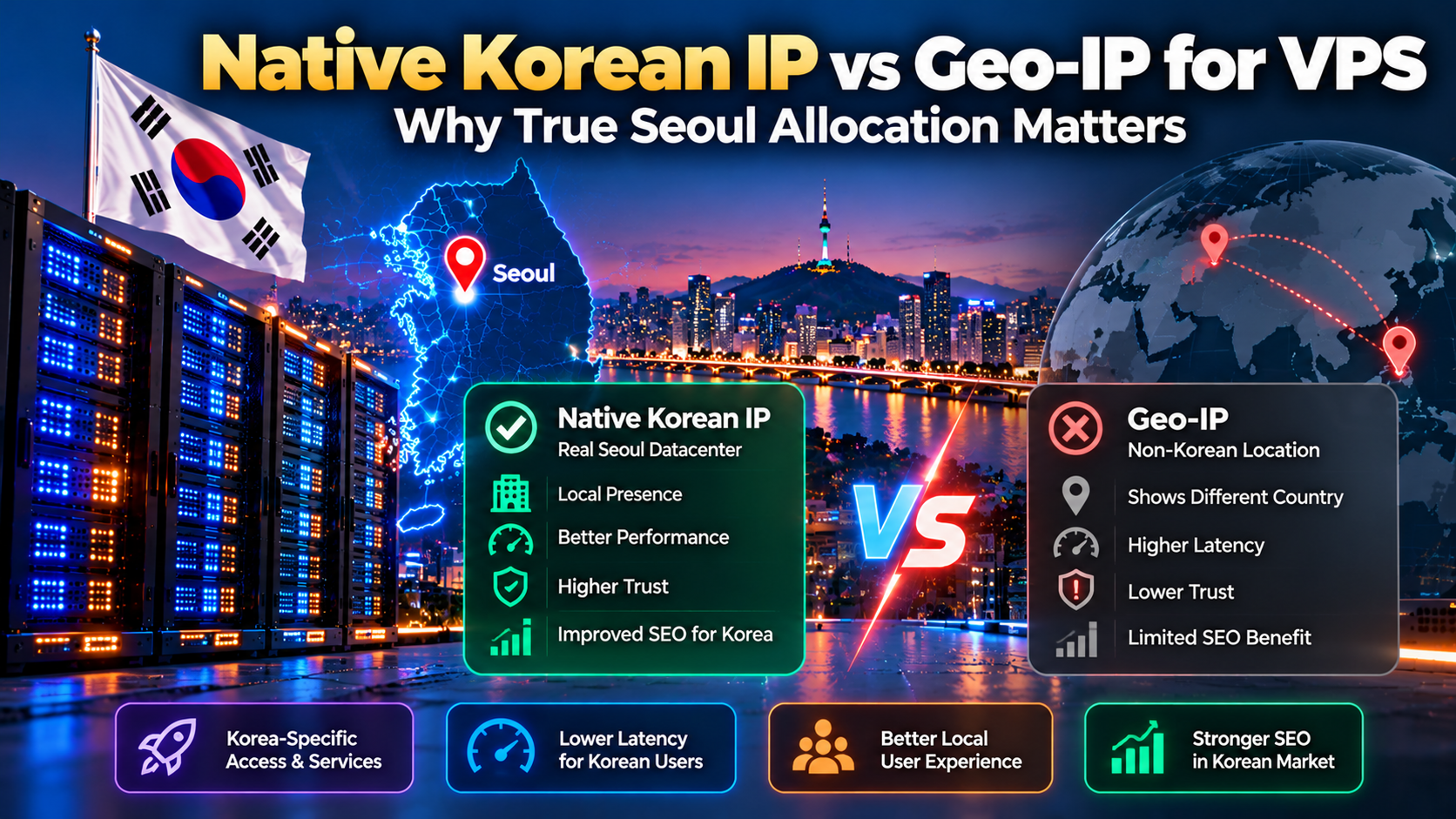
When evaluating an enterprise Korea VPS native IP, your VPS was flagged because your provider assigned a broadcasted Geo-IP (an IP prefix registered in Hong Kong or the US with spoofed WHOIS location tags) rather than a native South Korean IP registered with APNIC and KISA. Domestic platforms like Naver, Coupang, and Korean commercial banks inspect Autonomous System numbers (ASN) and BGP route origins. OnliveServer guarantees 100% native Seoul-allocated dedicated unicast IPs that pass all domestic security audits.
Specifically, when procuring cloud infrastructure, engineering teams often assume that an IP address is a fungible digital identifier. In global hosting markets, network administrators frequently remap IP ranges across continents using commercial geolocation registries like MaxMind or IP2Location. On paper, a server located in Hong Kong or Tokyo can appear as a Seoul IP in browser-based lookup tools. Furthermore, simple web queries may report green status across superficial IP checkers.
Consequently, aligning these configurations with your Korea VPS native IP environment ensures optimal uptime and throughput. However, South Korea’s digital architecture maintains rigorous national verification baselines. Domestic payment gateways, corporate APIs, local streaming services, and domestic search engines like Naver evaluate Autonomous System Numbers (ASN) and regional registry provenance directly. Therefore, deploying on a superficial Geo-IP remapped address creates severe operational hurdles. This guide explores the technical, legal, and operational distinctions between native APNIC Korean IP space and spoofed Geo-IP hosting.
Operational Infrastructure Takeaway
Furthermore, Operational Takeaway: Securing a genuine Korea VPS native IP is essential for seamless operation within the South Korean digital ecosystem. Many budget hosts re-announce American or European IP addresses and rely on commercial Geo-IP database updates. However, domestic Korean financial institutions, Naver search algorithms, and national payment gateways (Toss Payments, KG Inicis) query APNIC registry records directly. Consequently, spoofed IP subnets trigger automated fraud flags, lower search visibility, and transaction failures, whereas native APNIC Seoul subnets guarantee uninterrupted domestic compatibility.
Korea VPS native IP: The Architectural Difference Between Native APNIC and Geo-IP
Consequently, every public IPv4 and IPv6 address belongs to a regional internet registry (RIR). The Asia-Pacific Network Information Centre (APNIC) manages IP allocations across the Asia-Pacific region, including South Korea. When an organization obtains a native Korean IP subnet, the address block is assigned directly through APNIC and registered with the Korea Internet & Security Agency (KISA).
In contrast, Geo-IP spoofing occurs when an international provider utilizes IP blocks originally allocated through ARIN (North America) or RIPE NCC (Europe). The provider submits manual geolocation override requests to commercial databases such as MaxMind GeoIP2. While consumer websites may report the IP location as Seoul, the underlying BGP routing tables and national registry databases still reflect foreign ownership.
Native APNIC Allocated Korean Subnets
In addition, iP address blocks registered directly with APNIC and KISA under South Korea (KR). These subnets originate from domestic Autonomous System Numbers (ASNs) with verifiable physical routing in Seoul.
Remapped Commercial Geo-IP Subnets
In particular, overseas subnets (often US or HK) that have had their MaxMind or IP2Location coordinates manually modified. They fail BGP origin validation and trigger domestic fraud algorithms.
Furthermore, commercial Geo-IP databases synchronize updates on asynchronous cycles. During the weeks between database updates, local applications may misclassify your server as originating from Ohio or Amsterdam. This discrepancy introduces unpredictable security challenge screens and automated API rejections.
Consequently, network equipment and security firewalls evaluating autonomous systems can immediately detect foreign provenance. Deploying reliable South Korea VPS hosting in Seoul guarantees native APNIC allocations with verified Korean national identification.
Korea VPS native IP: Domestic Payment Gateway Rejections and Fraud Triggers
Therefore, south Korea possesses one of the most strictly regulated financial payment systems in the world. National payment gateways like Toss Payments, KG Inicis, and NHN KCP process billions of dollars in domestic digital transactions. These gateways enforce strict anti-fraud rules mandated by the Financial Supervisory Service (FSS). To optimize backend webhook connectivity and eliminate API connection throttling, inspect our guide to Naver Commerce and Coupang open API integration.
Moreover, when an e-commerce platform processes checkout transactions from a virtual server, the gateway inspects the server’s origin IP. If the origin IP resolves to an ARIN or RIPE subnet remapped as Korean, fraud prevention engines categorize the connection as a high-risk proxy or VPN. As a result, transactions face automated cancellation or forced multi-factor challenge authentication.
In addition, domestic credit card issuers enforce automated risk scoring on merchant origin IPs. A payment submission originating from a non-domestic autonomous system triggers immediate velocity caps. For an online store processing high-volume flash sales, these security blocks result in devastating revenue losses.
In fact, by contrast, servers operating on native APNIC subnets pass automated fraud scoring instantly. High-volume merchants maintain uninhibited checkout flow, protecting conversion rates during high-concurrency shopping events.
Comparative Analysis: Native APNIC Subnets vs Remapped Geo-IP
Similarly, the operational consequences of IP selection extend across security, search indexing, and network throughput. The table below outlines the core technical distinctions between native and spoofed IP allocations: For statutory IP allocation policies and regional Internet registry delegation guidelines, consult APNIC IP address management policies.
| Evaluation Metric | Native APNIC Korean IP | Spoofed / Remapped Geo-IP |
|---|---|---|
| Registry Authority | APNIC / KISA National Registry | ARIN / RIPE Foreign Registry |
| Korean Payment Gateways | 100% Acceptance across PG Gateways | Frequent proxy/fraud flagging |
| Naver Local SEO Trust | Highest geographic ranking weight | Deprioritized in regional search results |
| Domestic Traceroute Hops | Sub-5ms direct terrestrial routing | 40ms+ cross-border international detour |
| KISA Security Audits | Fully auditable domestic subnet | Non-compliant data residency posture |
| BGP Peering Origin | Direct Seoul IXP / Telco announcement | Foreign transit lease announcement |
Meanwhile, this comparison highlights that relying on Geo-IP overrides introduces systemic risk into commercial digital operations.
Naver and Localized Search Engine Geolocation Signals
Additionally, search algorithms on Naver evaluate multiple technical signals when indexing content for South Korean searchers. In addition to language encoding and domain extensions (.kr or .co.kr), Naver’s crawler evaluates physical server network responses. For encrypted point-to-point administrative tunnels using dedicated Korean endpoints, consult our tutorial on WireGuard private tunnel configurations.
As a result, when Naverbot spiders a web server, it measures connection turnaround time and queries BGP routing origin data. If an IP address maps to an offshore datacenter with elevated round-trip times, Naver depreciates the site’s regional relevance. In highly competitive categories like consumer electronics, financial services, or enterprise SaaS, this penalty results in lower organic rankings.
Moreover, Naver Search Advisor explicitly integrates server response reliability into site crawl budgets. When network hops to foreign remapped servers introduce intermittent latency spikes, Naverbot reduces its daily crawl frequency. Consequently, fresh product listings and newly published articles take days longer to appear in search indexes.
Furthermore, Google Korea integrates localized IP signals into its mobile ranking algorithms. Sites hosted on verified domestic infrastructure achieve superior search visibility and improved local snippet representation.
Streaming Media, Gaming, and API allowlisting Restrictions
Specifically, south Korea boasts a vibrant digital entertainment, streaming, and gaming industry. Platforms such as AfreecaTV, Wavve, Tving, and major online gaming portals enforce strict regional licensing restrictions. These services prevent content exfiltration by maintaining restrictive IP access control lists (ACLs). When configuring reverse DNS pointers and native dual-stack addressing, refer to our dual-stack IPv6 and custom rDNS records.
Furthermore, commercial Geo-IP lookup tables are updated irregularly, often on monthly cycles. During the lag interval between registry changes and database syncs, streaming services classify remapped IPs as unauthorized proxies. Users encountering these errors face immediate connection drops.
Domestic OTT & Streaming
Consequently, platforms like Wavve, TVING, and AfreecaTV enforce strict regional broadcast licensing, instantly dropping connections from remapped or VPN-associated IP blocks.
Korean Game Publishers
Nexon, NCSoft, and Smilegate maintain automated anti-cheat systems that cross-reference incoming server IPs with APNIC registries to prevent foreign bot-farm exploits.
Enterprise Banking APIs
Financial data aggregators and open banking APIs require authenticated, allowlisted domestic IPv4 addresses with pristine reputations before authorizing transaction synchronization.
Similarly, Korean corporate APIs—including Naver Cloud Platform APIs, Coupang Partner APIs, and Kakao Business APIs—frequently enforce IP allowlisting. Corporate firewalls require automated webhook callers and data scrapers to originate from verified domestic subnets. A foreign remapped IP address triggers automatic rate limiting or complete IP banning.
Native APNIC Korean IPs ensure permanent, uninterrupted API integration without unexpected IP blockages or administrative overhead.
KISA Cybersecurity Standards and IP Abuse Reputation
The Korea Internet & Security Agency (KISA) monitors national cyber threats, spam campaigns, and malicious network traffic. KISA maintains authoritative IP reputation feeds that are distributed daily to domestic ISPs and enterprise firewalls.
Foreign IP subnets that are frequently remapped across different countries accumulate negative reputation scores across international threat intelligence feeds (such as Spamhaus and AbuseIPDB). When a budget provider assigns a recycled American or European IP to your server, that IP may already carry active blocklisting records.
In contrast, enterprise hosting facilities in Seoul maintain clean, dedicated APNIC allocations. Providers actively monitor abuse complaints and isolate rogue tenants before IP reputation degrades. Operating on a clean domestic subnet guarantees high email deliverability and unhindered API connectivity.
Additionally, KISA anti-spam mandates require default blocking of outbound port 25. Operating on native infrastructure ensures that transactional email delivery complies fully with national anti-spam statutes.
Cross-Border Data Governance and PIPA Compliance
South Korea’s Personal Information Protection Act (PIPA) governs the collection, storage, and cross-border transfer of personal information. Article 28-8 of PIPA outlines strict legal prerequisites before citizen data can be transferred outside national borders.
When an organization hosts user records on a server with a remapped Geo-IP address located in Tokyo or Hong Kong, that architecture constitutes an international data transfer under PIPA. Organizations that fail to obtain explicit, separate statutory consent from users face severe civil penalties, reaching up to 3% of total revenue.
In contrast, deploying on native APNIC subnets within a physical Seoul datacenter ensures that customer records remain entirely within South Korean jurisdiction. This architecture eliminates the administrative burden of international data transfer agreements and simplifies regulatory compliance audits.
Consequently, chief information security officers (CISOs) and compliance directors consistently mandate native Seoul hosting for all user-facing digital applications.
Sysadmin Verification Playbook: Auditing True IP Provenance
Systems engineers must verify IP provenance upon provisioning any virtual instance. Do not rely on commercial web-based lookup tools. Instead, query regional internet registry databases directly via terminal:
Examine the output carefully. An authentic native Korean IP will return country: KR, designate a verified domestic network name, and demonstrate traceroute latency below 5ms within Seoul.
In addition, query the BGP looking glass of Korea Telecom (KT) or LG Uplus. Confirm that the announcing autonomous system terminates directly at an exchange point in Seoul rather than transiting overseas.
BGP Anycast vs Dedicated Unicast: Why Korean Banking Requires Fixed Seoul Subnets
Modern global cloud providers frequently advertise BGP Anycast IP routing as a resiliency feature. In an Anycast configuration, the same IP prefix is announced simultaneously from datacenters across Tokyo, Singapore, Los Angeles, and Frankfurt. While Anycast works well for static content distribution, it creates severe authentication failures across South Korean domestic financial and government platforms.
When an automated e-commerce bot or enterprise crawler connects to Coupang, Naver SmartStore, or Korean corporate banking portals over an Anycast IP, transient BGP routing recalculations can cause consecutive TCP packets to originate from different international nodes. Korean fraud detection engines immediately flag this IP flapping as credential hijacking, terminating active sessions and imposing temporary IP blocklists.
OnliveServer South Korea VPS instances utilize dedicated, non-broadcasted Unicast IP allocations directly registered with APNIC and KISA in Seoul. You can verify true domestic unicast ownership directly via the KISA WHOIS registry:
Dedicated Unicast IP architecture guarantees uninterrupted session persistence across sensitive South Korean domestic banking and e-commerce portals.
Frequently Asked Questions
Core Technical Specifications
How can I prove my server has a native APNIC Korean IP?
Execute `whois -h whois.apnic.net [YOUR_IP]` in your terminal. Genuine native allocations will explicitly display ‘country: KR’ and list a registered South Korean network authority.
Why do Korean payment gateways reject servers with remapped Geo-IPs?
Domestic payment gateways query RIR databases and automated fraud detection systems. Remapped foreign subnets are classified as high-risk proxies or VPN endpoints, triggering instant transaction rejections.
Does a native Korean IP improve Naver organic search rankings?
Yes. Naver’s search algorithms evaluate server geolocation and domestic network latency. Native Korean IPs receive higher regional relevance weighting than foreign-hosted sites.
Can I change the Geo-IP location of an American IP to Korea permanently?
While you can submit override requests to commercial vendors like MaxMind, RIR registration records remain with ARIN. Domestic Korean institutions that query APNIC directly will continue to detect foreign origin.
Deployment & Operational Inquiries
Are native Korean IPv6 subnets available with Seoul VPS instances?
Yes. Enterprise hosting providers in Seoul offer dual-stack configurations with native APNIC-allocated IPv4 and IPv6 subnets.
What are the legal compliance benefits of using a native Korean IP under PIPA?
Operating on native domestic IP subnets inside Seoul datacenters ensures compliance with South Korea’s Personal Information Protection Act (PIPA) data localization and security oversight rules.
Which Korean government and banking portals actively block foreign-assigned Geo-IP addresses?
Platforms such as Hometax (National Tax Service), Government24, and major commercial banking verification gateways regularly restrict access to IP subnets registered outside South Korea. A native APNIC-allocated IP registered with KISA ensures immediate, friction-free allowlisting.
Can an IP address broadcasted via BGP change its recognized country without an APNIC database update?
No, third-party Geo-IP databases like MaxMind, IPinfo, and DB-IP rely on primary APNIC and KISA delegation records to establish country origin. Until the authoritative Regional Internet Registry (RIR) record shows South Korea (KR), domestic Korean fraud filters will treat the IP as foreign.
Secure Authentic Native APNIC South Korea IP Subnets
Avoid transaction failures, API blocks, and search ranking penalties. Deploy your applications on genuine Seoul infrastructure with native Korean IP allocations and dedicated 1Gbps ports.
