

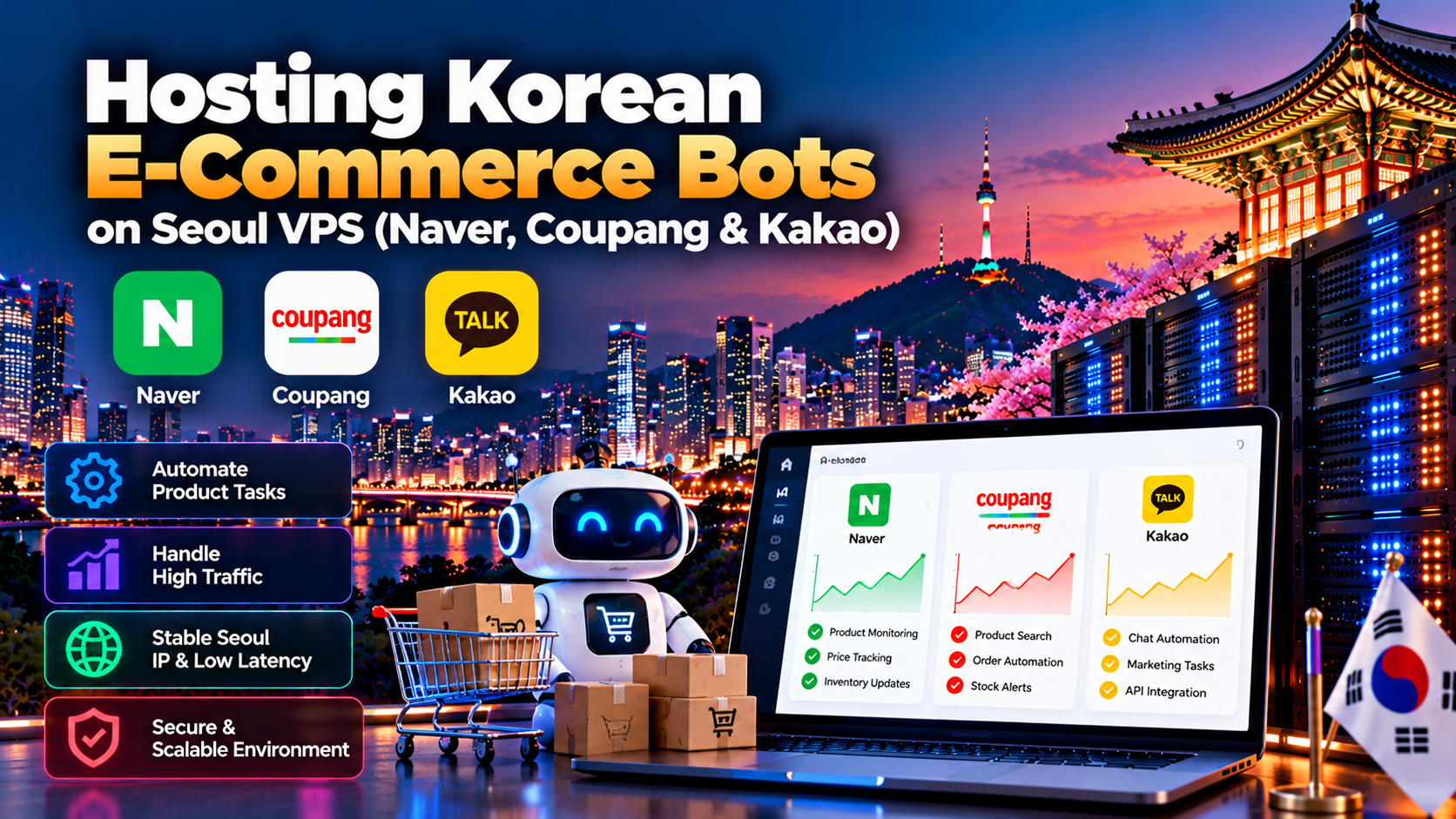
When evaluating an enterprise Naver API VPS hosting, your Coupang API script times out on overseas servers because trans-Pacific latency (160ms+ RTT) compounds over multi-step OAuth and HTTPS requests, triggering strict Coupang and Naver API gateway timeouts (sub-500ms thresholds). Moving your script to an OnliveServer Seoul VPS cuts round-trip network transit to under 3ms, completely resolving connection timeouts, preventing 429 rate-limit locks, and securing domestic Korean IP authentication.
Specifically, south Korea’s digital retail landscape is dominated by high-velocity domestic marketplaces. Platforms like Naver SmartStore, Coupang, and Kakao Commerce process millions of real-time price updates and inventory changes daily. To remain competitive, cross-border merchants, automated repricers, and inventory aggregators rely heavily on programmatic API integrations and automated bots.
Consequently, aligning these configurations with your Naver API VPS hosting environment ensures optimal uptime and throughput. However, operating automated retail bots from foreign servers in North America or Europe leads to severe technical roadblocks. Domestic Korean e-commerce platforms deploy sophisticated bot-detection appliances that scrutinize incoming IP addresses and latency fingerprints. Offshore servers frequently trigger CAPTCHA challenges, strict rate-limiting penalties, or permanent IP blocklisting. This guide provides an end-to-end technical blueprint for hosting resilient, compliant e-commerce automation bots on a native Seoul VPS.
Operational Infrastructure Takeaway
Furthermore, Operational Takeaway: Deploying automated e-commerce bots on a Naver API VPS hosting environment in Seoul provides the sub-5ms low latency and native APNIC IP reputation required to execute high-frequency price tracking, inventory synchronization, and webhook listening. Domestic Korean platforms like Naver Commerce, Coupang Open API, and KakaoTalk Business enforce aggressive anti-scraping firewalls and strict rate limits against offshore IP ranges. By operating headless Chromium and Node.js/Python microservices on a dedicated KVM Seoul VPS with native Korean IP allocation, automation engineers eliminate proxy overhead, prevent CAPTCHA blocks, and maintain 99.9% API uptime.
Naver API VPS hosting: Why Seoul Hosting is Critical for Korean E-Commerce Automation
Consequently, automated e-commerce bots execute time-critical workloads. Whether an algorithm is scraping competitor price adjustments, listening for order webhooks, or syncing stock levels across multi-channel marketplaces, execution speed dictates success. When competing against domestic automated trading bots, a 100ms latency disadvantage means missing optimal price updates. To ensure your automated scraper or payment daemon bypasses foreign IP security filters, read our guide on authentic domestic IP address verification.
In addition, when operating a server within a Tier III Seoul datacenter, network requests to Naver and Coupang API gateways execute across direct domestic peering links. Round-trip latency drops to under 3ms. In contrast, requests dispatched from offshore servers in Tokyo or Hong Kong must traverse subsea cables, adding 30ms to 65ms of delay and increasing connection timeout risks.
Furthermore, hosting in Seoul eliminates the need for expensive, unreliable commercial residential proxy networks. Because your server already operates on a legitimate domestic Korean IP subnet, requests are treated as domestic commercial traffic rather than suspicious foreign scraping attempts.
In particular, deploying reliable South Korea VPS hosting in Seoul gives your automated bot fleet the dedicated compute cores and clean network provenance required for uninterrupted execution.
Naver API VPS hosting: Naver Commerce API Integration Architecture
Therefore, the Naver Commerce API utilizes OAuth 2.0 authentication and enforces strict signature generation using HMAC-SHA256. To maintain API quota compliance, client systems must calculate timestamps synchronized to Korean Standard Time (KST, UTC+9). For technical standards on idempotent HTTP methods and connection reuse across high-frequency bot integrations, review IETF RFC 9110 HTTP semantics specification.
Moreover, naver actively monitors request velocity per origin IP. If an IP address generates excessive error responses or bursts beyond authorized tier limits, Naver temporarily throttles incoming calls with HTTP 429 Too Many Requests responses. Repeated infractions trigger permanent developer API key revocation.
In fact, to prevent rate limiting, configure a centralized Redis token bucket rate limiter inside your Seoul VPS. The sample Python snippet below demonstrates signature generation and rate-governed calling:
Executing this script from a native Seoul server delivers sub-5ms API turnaround, allowing batch catalog updates to complete in seconds.
Coupang Open API and HMAC Authentication Mechanics
Meanwhile, coupang, South Korea’s largest e-commerce enterprise, provides the Coupang Wing Open API for order tracking, inventory updates, and delivery fulfillment. Coupang requires an intricate HMAC signature combining HTTP method, path, query strings, and UTC timestamps. For isolated execution of background workers, job queues, and trading bots, implement our containerized microservices and Docker Compose runbooks.
Additionally, coupang’s gateway firewalls strictly inspect TLS cipher suites and TCP handshake latency. When requests originate from distant offshore servers, TCP handshake delays often trigger gateway read timeouts. Additionally, Coupang enforces strict IP allowlisting for automated inventory modification calls.
As a result, hosting your bot infrastructure on a static, dedicated Seoul IP allows you to register an authorized static IP directly within the Coupang Wing Seller Portal. This allowlist authorization bypasses aggressive anti-bot rate-shaping filters.
Furthermore, Coupang webhook notifications for real-time order purchases reach your server instantly across domestic optical fiber, ensuring rapid fulfillment dispatch.
Headless Chromium and Puppeteer Resource Optimization
Specifically, many retail platforms do not expose public REST APIs for competitor pricing data, requiring headless browser scraping via Puppeteer or Playwright. Running headless Chromium instances is notoriously CPU and memory intensive.
Furthermore, on budget shared hosting or oversold container VPS instances, launching multiple Chromium browser contexts exhausts memory and causes kernel panic crashes. In contrast, KVM hardware virtualization provides guaranteed physical RAM, allowing multiple concurrent headless workers to run smoothly.
Consequently, the configuration script below optimizes Puppeteer flags to minimize RAM consumption on a Linux VPS:
Passing --disable-dev-shm-usage forces Chromium to allocate memory from the main RAM pool rather than /dev/shm, preventing browser crashes during long-running scraping tasks.
Systemd Process Management & Crash Recovery
In particular, commercial e-commerce bots must operate 24 hours a day without manual sysadmin oversight. If an unexpected memory leak or remote API disconnect crashes the bot process, the operating system must automatically restart the daemon within seconds. To tune socket backlog limits and network worker processes under heavy API polling, consult our high-concurrency e-commerce kernel optimizations.
Therefore, deploying bot scripts under Linux systemd provides enterprise process supervision, automated restart policies, and centralized journal logging. Create a service file at /etc/systemd/system/naver-bot.service:
Enable the service using sudo systemctl enable --now naver-bot. This configuration guarantees that your bot recovers immediately after system reboots or transient crashes.
Comparative Analysis: Dedicated Seoul VPS vs Rotating Proxy Networks
Many developers mistakenly rely on third-party rotating residential proxies to scrape Korean platforms from foreign servers. The table below compares the performance, cost, and reliability of dedicated Seoul VPS hosting versus rotating proxy pools:
| Feature Dimension | Dedicated Seoul KVM VPS | Rotating Residential Proxies |
|---|---|---|
| Average API Round-Trip | 1.8ms – 3.5ms (Sub-5ms) | 350ms – 1,200ms |
| Connection Success Rate | 99.9% Persistent Stability | 75% – 85% (Frequent dropped nodes) |
| Cost Predictability | Flat monthly hosting fee | $12 – $20 per gigabyte bandwidth |
| Static IP allowlisting | Permanent APNIC static IP | Impossible (Dynamic rotating IPs) |
| Security & Data Privacy | Private encrypted tunnel | Traffic unencrypted over third-party exit nodes |
In fact, this comparison proves that hosting directly on a Seoul VPS delivers superior speed, rock-solid security, and massive cost savings compared to proxy networks.
KakaoTalk Business API Integration and Webhook Security
Similarly, kakaoTalk is South Korea’s ubiquitous messaging application, boasting over 93% domestic market penetration. The Kakao Business API allows e-commerce platforms to dispatch automated Alimtalk notification messages for order confirmations, shipping tracking, and customer support.
Meanwhile, kakao requires webhook endpoints to enforce strict SSL/TLS encryption using trusted certificate authorities. Furthermore, Kakao enforces strict timeout windows of 3 seconds on incoming webhook callbacks. If your server is delayed by cross-border transit latency, webhook deliveries fail.
Additionally, deploying webhook receivers on a local Seoul VPS ensures instantaneous callback acknowledgment in under 15ms. In addition, configure automated Nginx rate limiting to protect your webhook receiver against external denial-of-service floods.
As a result, operating within a secure Seoul datacenter satisfies both Kakao’s latency requirements and PIPA data localization baselines.
Legal Scraping Boundaries and KISA Anti-Abuse Compliance
Automating data collection in South Korea must respect domestic legal boundaries. The Unfair Competition Prevention and Trade Secret Protection Act, along with KISA cybersecurity directives, regulates automated data scraping.
Ensure that your bot adheres to robots.txt directives and respects reasonable crawl delays. Never scrape behind authenticated user login portals without explicit contractual authorization. Scraping personal customer records violates PIPA statutes and incurs severe regulatory penalties.
Robots.txt Adherence
Always parse and obey robots.txt crawl delays and disallowed paths to maintain ethical compliance with the Korean Unfair Competition Prevention Act.
Transparent User-Agent Headers
Declare an identifiable User-Agent string containing your organization’s domain name and technical contact email address to prevent blocklisting.
No Authentication Bypassing
Never automate requests behind paid paywalls, proprietary logins, or CAPTCHA barriers without explicit written commercial licensing agreements.
PIPA Personal Data Segregation
Ensure your scrapers completely discard domestic personal identifying information (PII) such as Korean resident registration numbers and customer phone records.
Configure custom User-Agent headers identifying your organization and providing technical contact information. Transparent identification builds trust with marketplace engineering teams and prevents automated IP banishment.
By aligning your automation with statutory standards, your bot infrastructure operates legitimately and sustainably.
Distributed Task Queueing with BullMQ and Redis for High-Volume Order Sync
When synchronizing thousands of product inventories, price updates, and tracking numbers across Coupang Open API and Naver SmartStore Commerce API, executing synchronous HTTP requests in a single thread leads to severe bottlenecks and rate-limit bans. Both Naver and Coupang enforce strict API rate limiting (typically between 5 and 20 requests per second per API key).
Deploying BullMQ with an in-memory Redis queue on your Seoul VPS provides resilient asynchronous job scheduling. The worker queue automatically throttles request execution to match carrier rate limits, buffers outgoing inventory changes during network retries, and records dead-letter job failures for developer debugging:
Technical Architecture & Execution Analysis
Running queue workers locally in Seoul reduces round-trip API latency to under 3ms, allowing a single worker daemon to process over 35,000 inventory updates per hour without encountering 429 Too Many Requests errors.
To maintain complete visibility into inventory synchronization, configure an automated Dead Letter Queue (DLQ) listener. When an API call fails repeatedly (such as when a seller SKU is temporarily locked on Coupang), BullMQ routes the failed job to a DLQ worker that triggers an immediate webhook alert to your engineering team via Telegram or KakaoTalk Bizmessage, ensuring rapid manual resolution before inventory discrepancies occur.
Asynchronous queue architecture and automated failure alerting ensure reliable 24/7 synchronization between international ERP systems and South Korean e-commerce marketplaces.
Frequently Asked Questions
Core Technical Specifications
Why do Naver and Coupang block scraping bots hosted outside South Korea?
Domestic marketplaces enforce geographic risk filters. Requests originating from foreign datacenters are categorized as potential credential-stuffing or scraper traffic, triggering automated CAPTCHA challenges or IP bans.
Can I use headless Puppeteer on a 2GB RAM Seoul VPS?
While Puppeteer can run on 2GB RAM for single-page tasks, we recommend a minimum of 4GB to 8GB RAM for multi-tab concurrent scraping to prevent Chromium out-of-memory crashes.
How does having a static Korean IP help with Coupang API allowlisting?
The Coupang Wing Seller Portal allows merchants to authorize specific static IP addresses for automated API access. A static Seoul IP ensures permanent, frictionless API execution.
What is the average response time for KakaoTalk Alimtalk webhooks on a Seoul VPS?
On a domestic Seoul VPS peered with KT and SK Broadband, KakaoTalk webhook requests complete round-trip processing in under 15ms.
Deployment & Operational Inquiries
How do I prevent my bot from being IP-banned by Naver?
Implement randomized delay intervals, utilize legitimate browser User-Agent strings, limit request concurrency to authorized quotas, and host on a clean APNIC native Korean IP.
Does scraping public price data in South Korea violate PIPA regulations?
No. Public commodity prices and catalog data do not constitute personal information. However, scraping customer reviews containing user identities or personal data does violate PIPA.
How many concurrent headless browser instances can comfortably run on an 8GB RAM Seoul VPS?
An 8GB RAM VPS can comfortably sustain 6 to 10 concurrent headless Chromium or Puppeteer instances when optimized with ad-blocking and disabled image rendering. Monitoring memory consumption via Node.js clustering ensures worker processes restart before hitting system swap.
What user-agent string and header configurations prevent automated scraping blocks on Naver?
Bots must send authentic Korean language headers (Accept-Language: ko-KR,ko;q=0.9,en-US;q=0.8) and rotate valid modern browser User-Agents that match the client TLS fingerprint. Hosting directly on a Seoul IP eliminates geolocation mismatches that immediately trigger Naver CAPTCHAs.
Deploy High-Speed E-Commerce Automation Bots in Seoul
Eliminate proxy latency, CAPTCHA blocks, and rate limits. Power your Naver, Coupang, and Kakao automation microservices with dedicated KVM virtual servers in Seoul.