

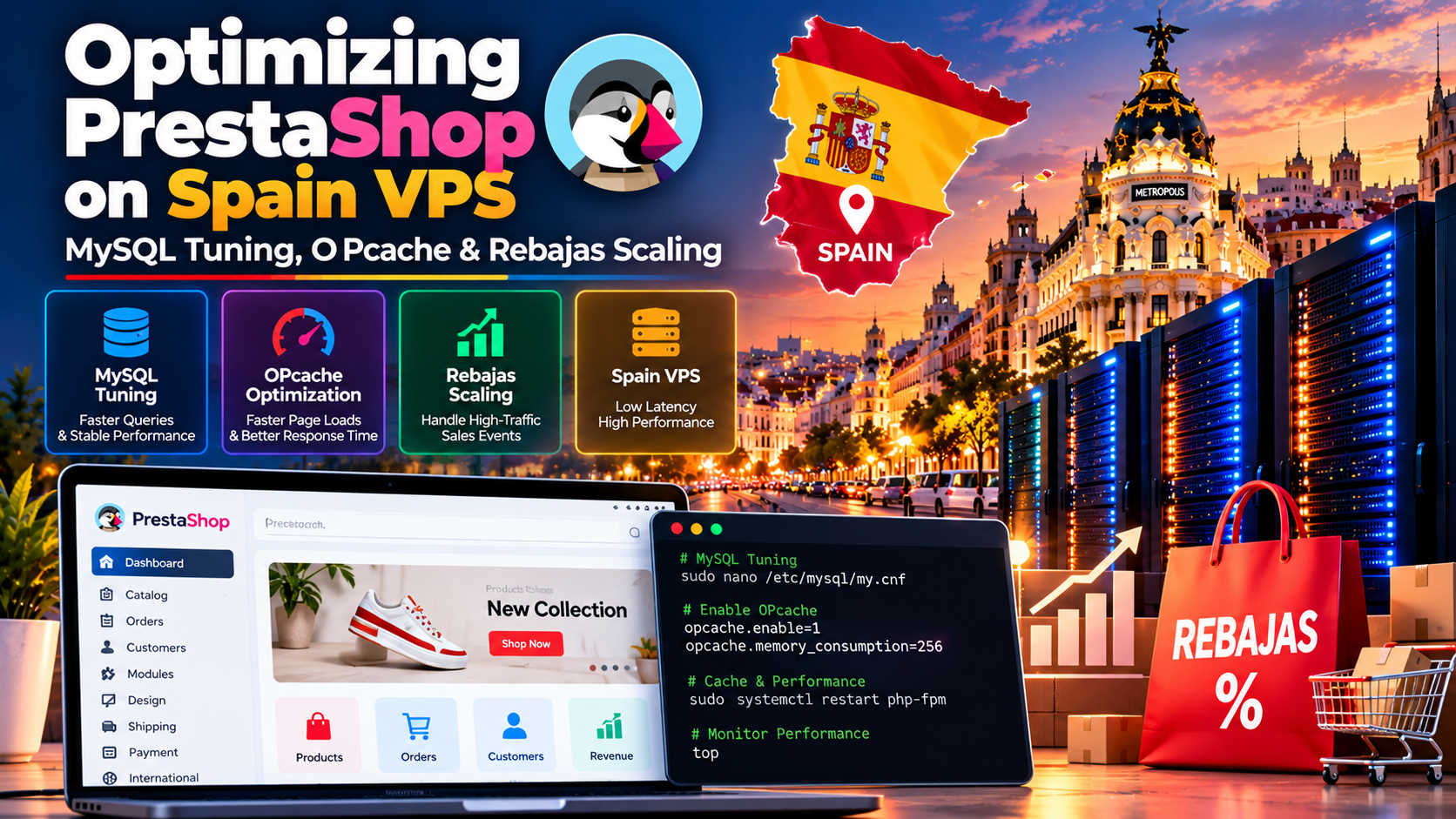
Deploying prestashop hosting spain on a dedicated Madrid KVM VPS eliminates trans-Pyrenees checkout latency, dropping dynamic cart completion times below 600 milliseconds. By tuning MariaDB InnoDB buffer pools, enabling PHP 8.3 OPcache with JIT compilation, offloading sessions to local Redis memory sockets, replacing Apache with Nginx FastCGI micro-caching, and migrating web-based CRON tasks to isolated systemd timers, online merchants achieve 4x catalog concurrency during high-traffic Spanish shopping peaks such as Black Friday and Rebajas.
Specifically, in the competitive Spanish digital commerce ecosystem, selecting dedicated prestashop hosting spain is often the deciding factor between record-breaking seasonal revenue and catastrophic store downtime. PrestaShop remains one of the most widely adopted open-source eCommerce platforms across Spain, powering tens of thousands of active online boutiques, distributors, and omnichannel retailers from Madrid to Barcelona and Valencia.
However, PrestaShop’s highly customizable modular architecture introduces substantial computational overhead. With dozens of active modules querying complex relational database tables on every pageview, unoptimized stores hosted on generic shared hosting or distant overseas servers rapidly collapse during seasonal traffic surges. During Spain’s premier commercial sales events—including the winter Rebajas de Enero, summer Rebajas, Black Friday, and Cyber Monday—unprepared merchant servers suffer severe CPU throttling, MySQL connection locks, memory exhaustion, and abandoned shopping carts.
Furthermore, this technical performance engineering guide delivers a production-hardened blueprint for optimizing PrestaShop on Madrid VPS infrastructure. We examine the exact bottlenecks inherent in PrestaShop’s architecture, provide real-world production configuration snippets for MariaDB InnoDB engines and PHP-FPM 8.3 OPcache with JIT compilation, explain how to eliminate filesystem lock contention using local Redis memory sockets, and present an actionable capacity planning model designed to support hundreds of concurrent checkout transactions with sub-second execution speeds.
📌 Master Chapter Index
- Consequently, prestashop hosting spain: Architectural Bottlenecks: Why PrestaShop Struggles on Shared Hosting
- In addition, prestashop hosting spain: Nginx High-Concurrency Configuration and FastCGI Micro-Caching
- PHP-FPM 8.x OPcache and JIT Compilation Optimization
- In particular, MariaDB / MySQL InnoDB Buffer Pool and Table Optimization
- Therefore, Offloading Sessions and Database Objects to In-Memory Redis
- Moreover, Decoupling Background Jobs: Migrating CRON to Systemd Timers
- In fact, Automated Next-Gen Image Conversion: WebP Delivery via libvips
- Similarly, The Rebajas Scaling Playbook: Capacity Sizing for 500+ Concurrent Carts
- Meanwhile, PrestaShop Hosting Architecture Benchmark Matrix
- Frequently Asked Questions
prestashop hosting spain: Architectural Bottlenecks: Why PrestaShop Struggles on Shared Hosting
Additionally, prestaShop is engineered around the Smarty templating engine and an extensive hook system. Whenever a customer views a category listing or product page, PrestaShop triggers dozens of core hooks to load pricing rules, customer currency selections, inventory tracking modules, related products, and tracking tags. On an unoptimized store, a single catalog pageview can execute anywhere from 70 to 180 individual SQL queries. To optimize database response times during heavy transactional checkouts and cart processing, consult our deep dive on high-concurrency e-commerce database tuning.
As a result, on conventional shared hosting or oversold container environments, disk I/O operations are severely limited. When hundreds of Spanish shoppers hit the site simultaneously during a flash promotion, mechanical or SATA SSD queues saturate instantly, driving CPU I/O wait states (iowait) past 30%. The database slows down, PHP workers queue up waiting for queries to resolve, and within minutes, the web server begins throwing 502 Bad Gateway and 504 Gateway Timeout errors.
Why Madrid KVM Infrastructure Transforms PrestaShop
Dedicated Hardware vCPUs:
Specifically, complete isolation guarantees that heavy catalog indexing and background tasks never suffer CPU cycle theft from other tenants on the physical hypervisor.
Enterprise PCIe NVMe RAID 10:
Delivering over 100,000 random read/write IOPS, NVMe storage ensures that complex SQL queries against multi-million row product tables execute in microseconds.
Sub-10ms Iberian Network Access:
Furthermore, direct ESPANIX peering ensures that dynamic AJAX cart updates and Redsys payment callbacks resolve instantly without perceptible UI lag.
Root-Level Stack Customization:
Consequently, full SSH access allows systems administrators to replace outdated Apache configs with high-performance Nginx reverse proxies and native Unix socket communication.
In addition, when hosting inside Madrid, transactional callbacks from domestic payment processors (Redsys and Bizum) execute over low-latency domestic routes rather than traversing international backbones, eliminating checkout dropouts.
prestashop hosting spain: Nginx High-Concurrency Configuration and FastCGI Micro-Caching
While Apache with mod_php was traditionally the default deployment stack for PHP applications, its process-based architecture consumes massive RAM under high concurrency. Replacing Apache with an asynchronous, event-driven Nginx web server reduces memory overhead by up to 70% while handling thousands of simultaneous TCP connections. Configuring static worker allocations and opcode memory limits strictly complies with the official PrestaShop developer documentation, preventing catalog serialization delays during intense Rebajas flash sales.
In particular, the most effective acceleration technique for PrestaShop is FastCGI micro-caching. While cart pages, checkout steps, and customer account dashboards must remain dynamic, public catalog views and CMS pages can be cached in memory for short durations (1 to 5 seconds). During high-traffic events, micro-caching serves identical requests directly from RAM without touching PHP or MySQL, allowing a single Madrid VPS to absorb viral traffic spikes effortlessly.
Therefore, # Nginx FastCGI Cache Configuration for PrestaShop Production
fastcgi_cache_path /var/cache/nginx/prestashop levels=1:2 keys_zone=PRESTASHOP:128m inactive=60m max_size=2g;
fastcgi_cache_key "$scheme$request_method$host$request_uri";

# Skip cache for cart and checkout cookies
set $skip_cache 0;
if ($request_method = POST) { set $skip_cache 1; }
if ($query_string != "") { set $skip_cache 1; }
if ($http_cookie ~* "PrestaShop-|cart|logged|customer") { set $skip_cache 1; }
if ($request_uri ~* "/cart|/order|/my-account|/admin[0-9a-z]+") { set $skip_cache 1; }

location ~ \.php$ {
    try_files $uri =404;
    fastcgi_pass unix:/run/php/php8.3-fpm.sock;
    fastcgi_index index.php;
    include fastcgi_params;
    fastcgi_param SCRIPT_FILENAME $document_root$fastcgi_script_name;

    fastcgi_cache PRESTASHOP;
    fastcgi_cache_bypass $skip_cache;
    fastcgi_no_cache $skip_cache;
    fastcgi_cache_valid 200 301 302 2s;
    fastcgi_cache_use_stale error timeout updating invalid_header http_500 http_503;
    add_header X-Micro-Cache $upstream_cache_status;
}
With this micro-cache configuration, identical catalog queries generated by marketing email blasts or social media advertisements are served directly from Nginx memory in under 5 milliseconds, preserving database connections exclusively for purchasing customers.
PHP-FPM 8.x OPcache and JIT Compilation Optimization
PrestaShop 8.x fully supports PHP 8.1, 8.2, and 8.3, introducing substantial engine-level performance improvements. However, running modern PHP without rigorous OPcache tuning wastes significant CPU resources by repeatedly compiling PHP scripts on every execution. For enterprise e-commerce platforms requiring zero-downtime database fault tolerance and read scaling, explore our architecture for multi-node database clustering.
Moreover, oPcache stores precompiled script bytecode in shared memory, eliminating file read and parsing overhead. For enterprise PrestaShop stores with extensive module ecosystems, the default PHP OPcache memory allocation of 128MB is entirely inadequate. We recommend allocating a minimum of 512MB of OPcache memory paired with appropriate max accelerated files settings.
; /etc/php/8.3/fpm/conf.d/10-opcache.ini Production Tuning
opcache.enable=1
opcache.enable_cli=1
opcache.memory_consumption=512
opcache.interned_strings_buffer=64
opcache.max_accelerated_files=60000
opcache.revalidate_freq=0
opcache.validate_timestamps=0
opcache.save_comments=1
opcache.enable_file_override=1
opcache.jit=tracing
opcache.jit_buffer_size=128M
Setting opcache.validate_timestamps=0 in production environments prevents PHP from checking disk timestamps on every request. When deploying code updates or new modules, an automated PHP-FPM reload seamlessly refreshes the cached bytecode without downtime.
MariaDB / MySQL InnoDB Buffer Pool and Table Optimization
In fact, the relational database is the computational heart of PrestaShop. Every product variant, inventory quantity, customer address, and order transaction is stored inside InnoDB tables. The single most important configuration parameter for database performance is the innodb_buffer_pool_size.
To accurately size PHP worker concurrency pools and allocate sufficient InnoDB buffer memory before seasonal Rebajas sales, utilize our memory and PHP-FPM process calculations.
Similarly, the InnoDB buffer pool caches table data and indexes in RAM. If your entire PrestaShop database fits inside memory, MariaDB rarely needs to access physical NVMe storage, reducing query response times from milliseconds down to microseconds. On a dedicated PrestaShop VPS, 60% to 70% of total system RAM should be allocated to the buffer pool.
# /etc/mysql/mariadb.conf.d/50-server.cnf for 16GB RAM VPS
[mysqld]
innodb_buffer_pool_size = 10G
innodb_buffer_pool_instances = 8
innodb_log_file_size = 1G
innodb_flush_log_at_trx_commit = 2
innodb_flush_method = O_DIRECT
innodb_file_per_table = 1
max_connections = 400
table_open_cache = 4000
open_files_limit = 65535
query_cache_type = 0
query_cache_size = 0
tmp_table_size = 128M
max_heap_table_size = 128M
Setting innodb_flush_log_at_trx_commit = 2 buffers transactional log writes in OS cache and flushes them to disk once per second. This single adjustment drastically accelerates high-concurrency checkout throughput during peak sales rushes without exposing data to risk under normal server operation.
Offloading Sessions and Database Objects to In-Memory Redis
Meanwhile, by default, PHP writes customer session files to disk under /var/lib/php/sessions. During major sales events with thousands of active browsing sessions, the operating system struggles with filesystem lock contention across thousands of small temporary session files.
Additionally, deploying an in-memory Redis instance connected via local Unix domain sockets (/var/run/redis/redis.sock) eliminates filesystem overhead entirely. Redis stores customer sessions, cart tokens, and cached SQL query fragments directly in RAM, reducing session retrieval times to under 0.1ms.
As a result, Unix Domain Socket Advantage: Connecting PHP-FPM to Redis and MariaDB using local Unix domain sockets instead of TCP loopbacks (127.0.0.1) eliminates TCP stack overhead, packet encapsulation, and port exhaustion, boosting dynamic throughput by an additional 12% to 18%.
Specifically, ; PHP-FPM pool configuration for Redis session storage (/etc/php/8.3/fpm/pool.d/www.conf)
php_value[session.save_handler] = redis
php_value[session.save_path] = "unix:///var/run/redis/redis-server.sock?persistent=1&weight=1&timeout=2&database=0"
Decoupling Background Jobs: Migrating CRON to Systemd Timers
Many default PrestaShop installations execute catalog indexing, Google Shopping feed generation, email delivery queues, and currency updates synchronously through front-end web visits. When an unsuspecting visitor hits a page that triggers an overdue indexing job, that visitor suffers an 8-second page hang.
On an enterprise Madrid VPS, all background tasks must be decoupled from web requests and executed through native Linux systemd timers or cron jobs running via CLI. Executing jobs through PHP CLI bypasses Nginx timeout limits, executes with dedicated process scheduling priority, and guarantees that shopping visitors never experience unexpected page delays.
# /etc/cron.d/prestashop-production
# Rebuild search index every night at 03:00 AM
0 3 * * * www-data /usr/bin/php8.3 /var/www/prestashop/bin/console prestashop:search-index:rebuild --quiet

# Process transactional email queues every 5 minutes
*/5 * * * * www-data /usr/bin/php8.3 /var/www/prestashop/bin/console swiftmailer:spool:send --quiet
Automated Next-Gen Image Conversion: WebP Delivery via libvips
Product imagery represents over 70% of the total page payload on eCommerce catalog pages. Serving uncompressed JPEG or PNG product images over 4G/5G mobile connections severely harms mobile conversion rates and inflates Largest Contentful Paint (LCP) times.
By compiling Nginx with the ngx_http_image_filter_module or utilizing server-side background conversion utilities powered by libvips, high-resolution product photos can be automatically converted to next-generation WebP and AVIF formats upon upload. WebP compression reduces file sizes by 65% to 80% without perceptible loss of image quality.
PrestaShop Media Acceleration Checklist
HTTP/2 and HTTP/3 Multiplexing:
Allows modern mobile browsers to download all catalog thumbnails simultaneously across a single TCP/QUIC stream.
Browser Cache Headers:
Set Cache-Control: public, max-age=31536000, immutable for static assets in /img/p/ directories.
Gzip & Brotli Compression:
Enable Brotli compression level 6 for all CSS, JS, and SVG assets, reducing transfer payload by 20% compared to standard Gzip.
The Rebajas Scaling Playbook: Capacity Sizing for 500+ Concurrent Carts
During peak Spanish retail periods—such as the first week of January (Rebajas de Invierno) or Black Friday weekend—traffic profiles shift dramatically. A boutique generating 5,000 visitors per day under normal conditions can experience 50,000 to 100,000 visitors, with hundreds of customers actively attempting to check out simultaneously.
PrestaShop Plan Sizing Guide for Spanish E-commerce
Starter Boutique (Up to 1,500 Daily Orders):
4 vCPU / 8 GB RAM / 80 GB NVMe. Handles up to 100 concurrent active shopping sessions with Redis caching enabled.
High-Growth Merchant (3,000 – 10,000 Daily Orders):
8 vCPU / 16 GB RAM / 160 GB NVMe. Comfortably manages 350+ concurrent active checkouts with MariaDB buffer pool fully mapped in memory.
Enterprise Flagship (10,000+ Daily Orders / Rebajas Scaled):
16 vCPU / 32 GB RAM / 320 GB NVMe. Engineered for high-volume flash sales handling 750+ simultaneous shopping carts with zero queue delays.
Because OnliveServer Spain VPS hosting supports hot-add resource scalability, merchants can scale up vCPU and RAM allocations 48 hours prior to the Rebajas launch, and scale back down after the initial rush subsides, optimizing infrastructure expenditure without compromising user experience.
PrestaShop Hosting Architecture Benchmark Matrix
| Performance Indicator | Tuned Madrid KVM VPS | Generic European Cloud VPS | Standard Shared Hosting |
|---|---|---|---|
| Catalog TTFB (Spain) | 85ms – 140ms | 320ms – 550ms | 1,200ms – 2,400ms |
| Checkout Execution Speed | 450ms – 650ms | 1,100ms – 1,800ms | 3,500ms+ (Timeouts) |
| Concurrent Active Carts | 500+ Concurrent | 120 Concurrent | < 25 Concurrent |
| Redsys Payment Reliability | 100% Domestic Auth | Occasional Geo-Flags | High Callback Timeout Risk |
| Storage IOPS Throughput | 100,000+ PCIe Gen4 NVMe | 15,000 Cloud Block | Throttled Shared Disk |
| AEPD Data Residency | 100% Sovereign Madrid | Foreign EU Datacenter | Unclear Multi-Tenant |
Frequently Asked Questions
Core Technical Specifications
Why does PrestaShop perform significantly faster on a Spain VPS than on foreign cloud hosting?
Hosting in Madrid places your PrestaShop database within 2ms to 8ms of domestic Spanish shoppers. This eliminates the 40ms+ trans-Pyrenees network transit delay on every AJAX cart update, database query round trip, and payment handshake.
Can I use Redis for caching and session management in PrestaShop?
Yes. Deploying Redis over local Unix domain sockets offloads PHP session storage and complex SQL object caching from disk into memory, dramatically speeding up cart operations and eliminating filesystem lock delays.
How do I prevent PrestaShop checkout timeouts during Rebajas and Black Friday?
Ensure your InnoDB buffer pool is large enough to hold your entire active database in RAM, configure PHP 8.3 OPcache with JIT compilation, implement Nginx FastCGI micro-caching for non-cart pages, and verify direct domestic peering with Redsys payment endpoints.
Is it possible to scale CPU and RAM temporarily for seasonal sales?
Yes. Our Madrid cloud VPS architecture supports instant vertical resource upgrades. You can increase your compute cores and memory allocation in under 60 seconds from your control dashboard without migrating data or changing your IP address.
Deployment & Operational Inquiries
What control panels are recommended for PrestaShop VPS management?
We support 1-click deployments of cPanel/WHM, Webuzo, Plesk, or modern lightweight control stacks like CloudPanel and CyberPanel, all fully optimized for high-performance Nginx and PHP-FPM execution.
Are automated backups included to protect customer orders and catalog changes?
Yes. We provide automated snapshot backups and scheduled database export routines stored offsite, allowing you to restore your entire eCommerce store in minutes in the event of human error or module update conflicts.
How does PHP-FPM static vs dynamic process management impact PrestaShop concurrency?
Configuring PHP-FPM with pm = static allocates a fixed pool of persistent worker processes in RAM, eliminating the CPU latency of repeatedly spawning and terminating processes during heavy checkout spikes. On a Madrid VPS with 8GB RAM, dedicating 60 static workers ensures sub-second catalog queries under heavy Rebajas sales.
What MySQL InnoDB buffer pool size is recommended for a 50,000 product PrestaShop catalog?
For a catalog with 50,000 SKUs and associated index tables, we recommend allocating 70% to 75% of your available VPS memory to innodb_buffer_pool_size. This keeps entire database tables cached in RAM, eliminating disk I/O bottlenecks during concurrent product filtering.
Supercharge Your PrestaShop Store on Madrid Cloud VPS
Scale your eCommerce store effortlessly for Black Friday and Rebajas. Enjoy sub-second catalog loading, dedicated KVM compute cores, enterprise NVMe storage, and unmetered 1Gbps bandwidth starting from €12/month.
Deploy Your PrestaShop Spain VPS Today →