

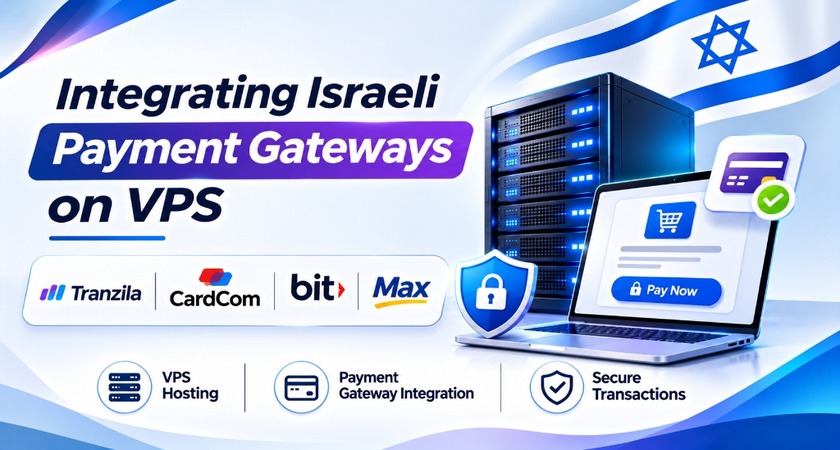
Integrating Israeli payment gateways requires direct domestic network connectivity. Therefore, deploying an israel payment gateway vps inside Tel Aviv ensures sub-5ms API verification.
In addition, enforcing TLS 1.3 encryption, static IPv4 allowlisting, and asynchronous queueing prevents webhook timeouts. Consequently, e-commerce stores maintain zero cart dropouts during peak shopping periods.
Online retail platforms in Israel depend heavily on domestic clearinghouse networks. In fact, routing transactions offshore introduces unpredictable network latency and shopping cart failures.
This technical implementation guide details architectural sizing, asynchronous queueing, and PCI-DSS compliance. Follow these tested configurations to integrate Tranzila, CardCom, Bit, and Max flawlessly.
• Core Payment Processing Architecture
Local Tel Aviv presence provides sub-5ms round-trip latency to Tranzila, CardCom, and Pelecard gateway APIs.
Redis-backed queue workers buffer rapid checkout surges, preventing lost orders during flash sales events.
Hardware-isolated KVM virtualization and TLS 1.3 tokenization protect cardholder data without burdensome compliance audits.
Clean static IP allocations enable instant allowlisting across Pelecard, CreditGuard, and Hyp authorization firewalls.
Deploying payment applications within Tel Aviv Tier-3 datacenters provides direct access to domestic fiber peering. Furthermore, local interconnections eliminate transit delays across the Mediterranean.
Paired with enterprise KVM virtualization, your application instances avoid noisy-neighbor compute spikes. Consequently, database authorization locks clear in milliseconds under heavy transactional volumes.
Additionally, strict regulatory standards govern Israeli consumer transactions. Hosting your infrastructure locally satisfies in-country residency rules while protecting sensitive customer cardholder data.
Primary Chapter Index
Israeli Payment Gateways on VPS
1. Tel Aviv Datacenter Infrastructure
Deploying mission-critical payment workloads in Israel requires localized telecommunications engineering. Specifically, instances situated inside Tel Aviv facilities peer directly with domestic clearinghouse networks.
For high-traffic e-commerce architectural guidance, explore our guide on WooCommerce and Magento optimization on Israel VPS.
2. Sizing Workloads for Shva Clearinghouse APIs
All domestic Israeli debit and credit card authorizations pass through Shva (Automated Banking Services). When customer webhooks route through offshore servers, transit handshakes introduce dangerous latency delays.
In contrast, local KVM instances complete the entire round-trip verification in under 5 milliseconds. Therefore, payment verification completes instantly without frustrating checkout timeouts.
Subterranean Tel Aviv datacenters connect directly to the Israel Internet Exchange (IIX). Consequently, gateway callbacks resolve in sub-5ms times across all domestic Israeli telecommunications carriers.
Israeli Payment Gateway Ecosystem
1. Domestic Gateway Providers: Tranzila, CardCom, Bit & Max
The Israeli digital payments ecosystem centers around leading providers like Tranzila, CardCom, Pelecard, and Hyp. Additionally, mobile digital wallet apps like Bit and Apple Pay command massive consumer adoption.
For detailed network peering telemetry, check our technical breakdown on Israel VPS latency and IIX peering transit.
2. Geographic Route Comparison Across Israel
Terminating traffic locally ensures sub-2ms network routing to Tel Aviv financial clusters. Moreover, latencies to Haifa and Jerusalem remain under 6ms consistently.
In comparison, routing traffic to Frankfurt or Dublin incurs 60ms to 85ms delays. Therefore, domestic VPS hosting delivers vastly superior responsiveness during peak checkout hours.
Buffering payment webhooks with Redis queues isolates web servers from database deadlocks. Furthermore, idempotency keys prevent accidental double-billing during retry operations.
Asynchronous Webhook Architecture
1. Hardened Nginx TLS 1.3 Reverse Proxy Configuration
Securing payment callbacks requires modern cryptographic protocols. The official RFC 8446 TLS 1.3 specification eliminates outdated cryptographic handshakes completely.
The following hardened Nginx configuration enforces modern cipher suites and applies rate limiting to webhook endpoints:
2. Redis Queue Workers & High-Throughput NVMe Storage
Handling transaction surges requires decoupling webhook ingestion from core order fulfillment. By streaming incoming payment events to Redis queues, your web tier returns HTTP 200 responses instantly.
Meanwhile, background workers process inventory updates and digital invoice generation asynchronously. This pattern shields checkout carts from processing bottlenecks under high concurrency.
Using hosted payment fields and gateway tokenization ensures raw credit card numbers bypass your servers completely. As a result, your organization qualifies for simplified SAQ-A audits.
PCI-DSS Compliance on KVM VPS
1. SAQ-A Compliance & Gateway Hosted Fields
Modern e-commerce architectures minimize PCI-DSS compliance scope by using hosted iframe fields. When users enter payment data, card details transmit directly to Tranzila or CardCom servers.
Consequently, your server receives only an opaque authorization token. This tokenized workflow qualifies your business for simplified Self-Assessment Questionnaire A (SAQ-A) compliance.
2. Server Isolation & LUKS Disk Encryption
Dedicated KVM virtualization isolates your virtual machine from neighboring tenants on the physical hypervisor. Furthermore, enabling LUKS AES-256 disk encryption protects data-at-rest across all NVMe volumes.
In addition, strict SSH key authentication and granular kernel audit logs prevent unauthorized access. Thus, your infrastructure remains fully prepared for formal cybersecurity assessments.
Local fiber cross-connects inside Tel Aviv bypass congested international gateways. Consequently, authorization callbacks arrive within 5ms to finalize transactions without checkout drops.
Eliminating Cart Timeouts in Tel Aviv
1. Israeli Privacy Protection Regulations (PPL)
Regulatory compliance is vital for organizations managing Israeli citizen data and payment records. Storing customer information domestically fulfills the statutory mandates of the Israeli Privacy Protection Law (PPL).
For comprehensive datacenter design blueprints, explore our technical breakdown on Israel VPS hosting architecture in Tel Aviv datacenters.
2. Static IPv4 Address Allowlisting
Israeli clearinghouses like Pelecard and CreditGuard require merchants to submit static IPv4 addresses for authorization allowlisting. Dynamic cloud addresses create severe operational risks when IP pools rotate unexpectedly.
In contrast, Onlive Server assigns dedicated, clean Israeli IPv4 addresses to every instance. Therefore, your gateway connections remain permanently authenticated without unexpected connection drops.
Every VPS receives dedicated, clean Israeli IP addresses. Thus, payment clearinghouses permanently allowlist your endpoints without the disruptions caused by dynamic cloud IP recycling.
Verification & Test Protocol
1. Sandbox Testing & Webhook Simulation
Before transitioning to production, engineering teams must validate payment processing workflows in developer sandboxes. Tranzila and CardCom provide test environments simulating authorizations, declines, and refunds.
Additionally, administrators should simulate sudden network interruptions to verify background retry workers. If your workloads demand dedicated compute hardware, explore our bare-metal dedicated server Israel options.
2. Production Cutover & Latency Auditing
Once sandbox tests pass, schedule the live cutover during low-traffic windows. During the initial hours, monitor cURL round-trip response metrics closely across all payment gateway endpoints.
Specifically, confirm that webhook handshakes complete within expected sub-5ms thresholds. Consequently, your live checkout system delivers rapid, dependable transaction fulfillment.
Executing comprehensive test transactions verifies signature validation and error handling routines. As a result, production payment pipelines operate with zero unexpected billing drops.
Architectural Specifications Matrix
The following technical matrix contrasts dedicated Tel Aviv Tier-3 VPS hosting with regional offshore cloud instances:
| Infrastructure Dimension | Enterprise Israel VPS (Tel Aviv Tier-3) | Standard Regional Offshore Cloud |
|---|---|---|
| Datacenter Location | Tel Aviv Subterranean Facility (Tier-3 Fortified) | Frankfurt, Paris, or Dublin (Remote Offshore) |
| IXP Interconnection | Direct IIX Peering (<2ms Tel Aviv, <6ms Haifa/Jerusalem) | Subsea trans-Mediterranean routing (55-85ms) |
| Virtualization Type | Bare-Metal KVM Hypervisor (0% CPU Steal) | Shared Containers (LXC/OpenVZ) with Overcommit |
| Storage Subsystem | Enterprise PCIe Gen4 NVMe RAID-10 (85,000+ IOPS) | Legacy SATA SSD or Throttled SAN Volumes |
| Regulatory Sovereignty | Israeli PPL & EU GDPR In-Country Residency | Cross-border data transit & foreign jurisdiction |
| Network & Billing Model | 1Gbps Port with Flat Unmetered Monthly Rate | High Egress Bandwidth Fees ($0.09-$0.12/GB) |
Frequently Asked Questions (FAQ)
A. Core Payment Gateway Architecture & Peering
B. Security, Compliance & Static IP Allowlisting
Deploy Your High-Performance Israel Cloud VPS Today
Deploy enterprise KVM instances in Tel Aviv Tier-3 facilities with sub-5ms payment clearing latency and pure NVMe storage.
