

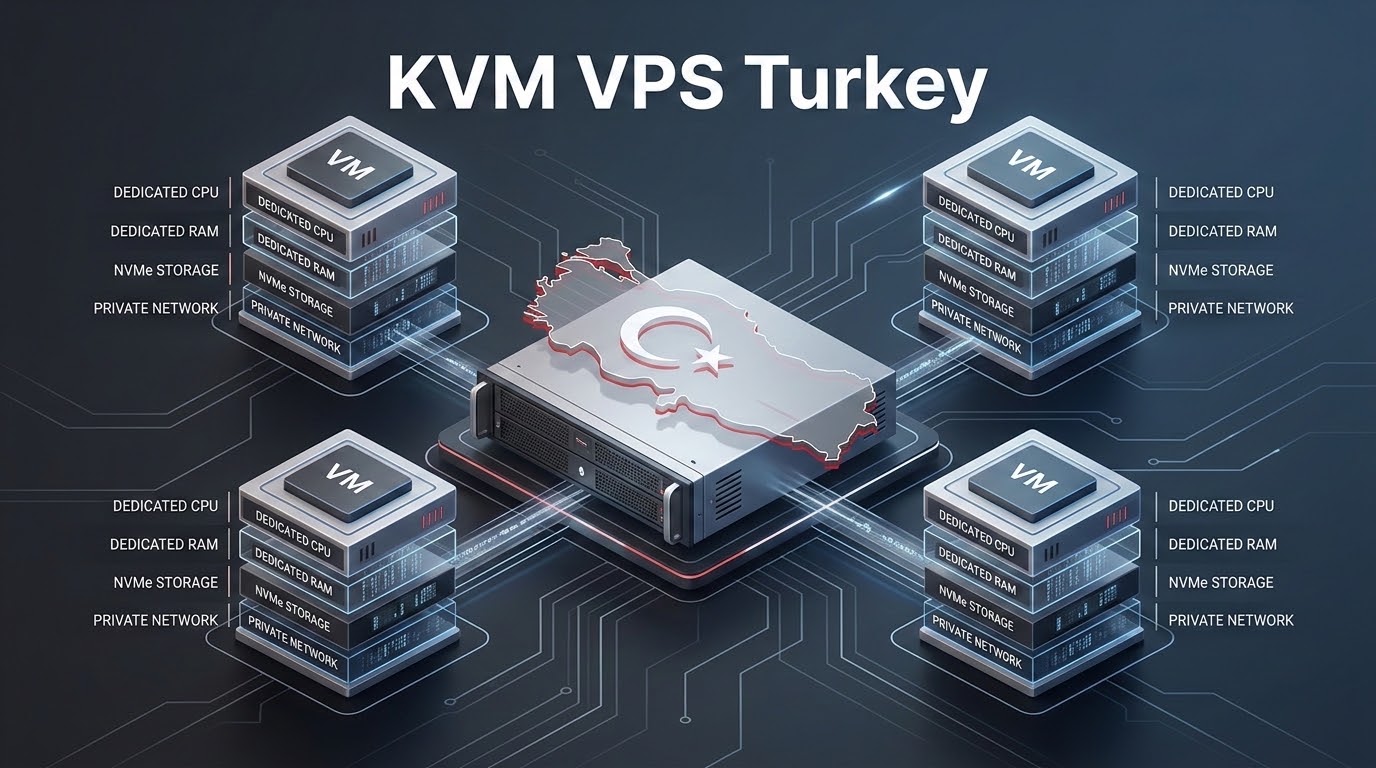
Why Is KVM Hardware Isolation Crucial for Turkey Cloud VPS?
Kernel-based Virtual Machine (KVM) provides true Type-1 hardware-level virtualization with dedicated vCPU scheduling and private physical RAM allocation. Unlike shared-kernel container hosting (such as OpenVZ or LXC), KVM guarantees complete operating system isolation and prevents noisy-neighbor CPU steal time (%st) during peak Turkish e-commerce traffic hours. For businesses hosting in Istanbul data centers, KVM architecture ensures stable database I/O performance, custom Linux kernel modules, and direct hardware support required for strict KVKK data protection compliance.
When operating production web applications, high-concurrency e-commerce portals, or transactional APIs targeted at users across Türkiye, underlying hypervisor architecture determines system stability. Many buyers select a server based solely on surface specifications—such as RAM and vCPU count—without verifying whether those resources are strictly isolated at the hardware layer or dynamically overcommitted across a shared host kernel. Choosing KVM-virtualized Turkey VPS hosting stationed physically in Istanbul ensures that your virtual instance functions as an independent bare-metal partition, completely insulated from adjacent tenants and optimized for low-latency Turkish transit networks.
✔ Key Architectural Takeaways
- True Hardware Virtualization: KVM utilizes CPU hardware extensions to execute guest code directly on physical cores, allowing custom kernel modules, WireGuard, and Docker without host restrictions.
- Zero CPU Steal Degradation: Dedicated vCPU scheduling prevents context-switching bottlenecks and eliminates CPU steal during peak Istanbul trading hours.
- Guaranteed Memory Allocation: Unlike containerized virtualization where parent hosts dynamically balloon RAM, KVM locks 100% of your allocated memory into physical ECC RAM.
- Paravirtualized VirtIO Drivers: Direct ring-buffer communication bypasses legacy device emulation, unlocking maximum IOPS on enterprise NVMe storage arrays.
- Hardware-Enforced Security: Private memory spaces and hardware-level address translation isolate customer databases in compliance with Turkish KVKK data protection standards.
Table of Contents
- Understanding KVM Hypervisor Architecture vs. Container Virtualization
- Eliminating CPU Steal Time: How Dedicated vCPU Scheduling Protects Istanbul Workloads
- Memory Allocation and Kernel Independence: Why Dynamic Ballooning Kills Databases
- VirtIO Network and NVMe Storage Drivers: Benchmarking I/O Performance in Turkey
- Security and Regulatory Compliance: Private Kernel Spaces for Turkish Enterprise Data
- Technical Configuration: Verifying KVM Hardware Acceleration on Your Server
- Decision Matrix: When KVM Virtualization Is Essential for Your Turkish Stack
- Frequently Asked Questions (FAQ)
Understanding KVM Hypervisor Architecture vs. Container Virtualization
Virtualization architecture directly dictates production stability for cloud workloads. In the hosting industry, virtualization falls into two distinct categories: hardware-assisted full virtualization (KVM) and OS-level container virtualization (OpenVZ or LXC).
Kernel-based Virtual Machine is integrated directly into the mainline Linux kernel. When the KVM kernel module (kvm.ko) initializes alongside processor modules (kvm-intel.ko or kvm-amd.ko), it turns the host Linux OS into a Type-1 bare-metal hypervisor. The hypervisor exposes a character device (/dev/kvm) that QEMU utilizes to construct completely isolated virtual hardware environments.
Every KVM virtual server executes instructions directly on physical CPU cores using hardware extensions. Non-sensitive instructions execute at native hardware speed. Sensitive instructions that manage hardware interrupts or page tables trigger a hardware-assisted VM-Exit, allowing KVM to arbitrate access before resuming execution via VM-Entry.
Conversely, container-based architectures share a single host kernel across every tenant on the node. While containers offer rapid provisioning, they lack hardware isolation. If a neighboring tenant triggers an unhandled kernel panic or heavy I/O spike, all containers sharing that kernel experience degraded responsiveness. For production applications hosted in Istanbul datacenters, true KVM virtualization ensures that your workload is insulated inside its own virtualized BIOS, memory space, and virtual hardware controllers.
Eliminating CPU Steal Time: How Dedicated vCPU Scheduling Protects Istanbul Workloads
A frequent performance bottleneck on shared hosting nodes in Türkiye is CPU steal time, denoted as %st in telemetry tools like top and vmstat. CPU steal occurs when a virtual machine is ready to execute instructions on its allocated vCPU, but the hypervisor forces it to wait because physical cores are servicing other overcommitted tenants.
Between 09:00 and 18:00 TRT, thousands of concurrent users flood Turkish e-commerce portals. On oversold container nodes, multiple tenants burst simultaneously, triggering hypervisor context switching. Your server may show 25% CPU utilization, yet database queries stall because your vCPU is queued behind competing tenants.
You can diagnose this behavior directly on any Linux terminal using standard system telemetry tools:
# Monitor CPU metrics with 1-second refresh intervals
$ vmstat 1 3
procs -----------memory---------- ---swap-- -----io---- -system-- ------cpu-----
 r  b   swpd   free   buff  cache   si   so    bi    bo   in   cs us sy id wa st
 2  0      0 425120  48212 984512    0    0    12    45  312  480 18  6 76  0  0
 4  1      0 412080  48212 984520    0    0     0    80  640  920 42 12 46  0  0
In the final column (st), any sustained value above 3% indicates that the hypervisor is throttling your workloads. On full KVM virtualization provisioned with dedicated physical threads or hard CPU pinning (cgroups CPU quota and cpuset controllers), CPU steal time remains at 0.0% even during extreme peak concurrency periods across Istanbul fiber interchanges.
This deterministic CPU availability is essential for high-performance stacks, including Redis caching, PHP-FPM worker pools, and PostgreSQL query execution. When query planning algorithms rely on predictable clock cycles, query latency remains steady within single-digit milliseconds rather than fluctuating unpredictably under neighbor load.
Memory Allocation and Kernel Independence: Why Dynamic Ballooning Kills Databases
Memory management is another layer where full hardware virtualization establishes uncompromised performance stability. In shared container environments, memory allocation is subject to dynamic ballooning and host-level page sharing. The host hypervisor inflates a virtual balloon inside the guest OS to reclaim memory pages that appear idle, allocating them to other consumers. When the guest suddenly demands that memory to handle an incoming traffic surge, the OS must wait for the hypervisor to allocate physical pages, resulting in latency spikes or invocation of the Linux Out-Of-Memory (OOM) killer.
Relational databases such as MySQL, MariaDB, and PostgreSQL rely heavily on in-memory caching mechanisms—such as the InnoDB Buffer Pool or PostgreSQL shared buffers—to prevent disk reads. When dynamic memory ballooning steals memory pages from an active database instance, the Linux kernel terminates the highest-consuming process to protect system stability:
# Kernel log when memory ballooning triggers OOM
[ 4821.391024] Out of memory: Kill process 1842 (mysqld) score 842
[ 4821.391052] Killed process 1842 (mysqld) total-vm:4218920kB, anon-rss:2841024kB
Under KVM virtualization, memory allocation is static and dedicated. An OnliveServer KVM instance provisioned with 8 GB or 16 GB RAM in Istanbul receives dedicated physical DDR4/DDR5 ECC RAM. The guest OS manages page tables using Extended Page Tables (Intel EPT) or Nested Page Tables (AMD NPT), guaranteeing cached tables remain resident without hypervisor reclamation. To verify how hardware-assisted hypervisors isolate host resources and prevent noisy-neighbor memory contention, review the official Linux Kernel KVM virtualization documentation detailing guest execution boundaries.
Furthermore, KVM provides total kernel independence. Because each virtual machine runs its own private Linux or Windows kernel, system administrators have unrestricted root authority to modify low-level operating system parameters:
- Custom Kernel Modules: Load network filters, WireGuard VPN tunnels, and customized eBPF telemetry hooks that shared container hosts forbid.
- TCP Stack Optimization: Configure advanced congestion control algorithms such as Google BBR (
net.ipv4.tcp_congestion_control = bbr) to accelerate throughput over Turkish mobile networks. - Custom File Descriptors: Elevate
fs.file-maxandsomaxconnparameters to support tens of thousands of concurrent WebSocket connections. - Docker and Container Stacks: Run container runtimes (Docker, containerd, k3s) inside your KVM instance with full nested virtualization and private cgroup namespaces.
VirtIO Network and NVMe Storage Drivers: Benchmarking I/O Performance in Turkey
Legacy full virtualization historically suffered from an I/O overhead penalty caused by hardware emulation. Early hypervisors emulated physical devices, requiring translation of every register command. Modern KVM virtualization completely bypasses hardware emulation through VirtIO paravirtualization, an abstraction layer communicating directly with the host hypervisor via shared memory ring buffers:
virtio_net: Delivers multi-queue network paravirtualization processing millions of packets per second, enabling full 1Gbps line-rate throughput across Türk Telekom (AS9121) and Turkcell Superonline (AS34984) peering links.virtio_blk/virtio_scsi: Interfaces directly with enterprise PCIe NVMe storage arrays in the Istanbul datacenter, achieving over 100,000 IOPS with sub-millisecond access latencies.
| Dimension | KVM Full Virtualization | Container Hosting |
|---|---|---|
| Virtualization Layer | Type-1 Hypervisor | Shared Host Kernel |
| Kernel Isolation | 100% Dedicated Kernel | Shared Host Kernel |
| RAM Allocation | Dedicated Physical ECC | Dynamic Ballooning |
| CPU Steal Risk | Zero Deterministic | High in Peak Hours |
| Storage Protocol | VirtIO Native NVMe | Shared Host FS |
| Production Readiness | Enterprise & Databases | Testing & Dev Only |
When running database applications in Istanbul, VirtIO-backed NVMe arrays eliminate disk wait bottlenecks (%wa). In synthetic storage benchmarks using fio, KVM VirtIO instances consistently deliver 4K random write performance exceeding 45,000 IOPS, ensuring transactional commits write instantly to non-volatile storage.
Security and Regulatory Compliance: Private Kernel Spaces for Turkish Enterprise Data
Beyond performance, hardware virtualization provides a strict security boundary. In shared-kernel environments, host Linux kernel vulnerabilities (privilege escalation or Dirty COW exploits) can allow a malicious tenant to escape container boundaries and inspect adjacent tenant memory.
KVM solves this architectural vulnerability by enforcing hardware-isolated address spaces. Under KVM, guest memory pages are isolated using Intel VT-d or AMD-Vi I/O Memory Management Units (IOMMUs). Even if an attacker gains root access inside an adjacent virtual machine, the hardware hypervisor prevents them from reading or modifying your private memory structures. Each guest operates within a private cryptographically isolated execution context, shielding proprietary business logic, API keys, and customer data.
This structural isolation is especially significant for businesses subject to the Turkish Personal Data Protection Law (KVKK – Law No. 6698). Under Article 12 of KVKK, data controllers are legally mandated to implement all necessary technical and organizational measures to prevent unlawful processing of and unauthorized access to personal data. While physical server placement in an Istanbul Tier III datacenter satisfies domestic data residency preferences, true hardware virtualization provides the requisite cryptographic and memory isolation required to demonstrate adequate technical safeguards during regulatory audits.
Additionally, Turkish enterprises processing payments via local gateways (PayTR or Iyzico) must adhere to PCI-DSS. Section 2.2.1 requires strict multi-tenant hardware or logical isolation between distinct instances. KVM infrastructure provides the auditable kernel separation necessary to pass compliance assessments without bare-metal overhead.
Technical Configuration: Verifying KVM Hardware Acceleration on Your Server
A rigorous engineering practice requires verifying that your virtual machine is truly operating under full KVM hardware virtualization rather than an emulated or containerized environment. When provisioning a new virtual server in an Istanbul facility, you can execute a sequence of diagnostic commands to confirm hypervisor status, CPU feature flags, and driver paravirtualization.
First, verify the underlying virtualization technology detected by systemd:
# Detect the hypervisor virtualization environment
$ systemd-detect-virt
kvm
If the command returns kvm, your operating system communicates directly with a genuine KVM hypervisor. If it returns lxc or openvz, the instance is running on a shared-kernel container without KVM isolation.
Next, inspect the PCI bus to ensure storage controllers and network adapters utilize high-throughput VirtIO paravirtualized device drivers:
# Inspect VirtIO PCI device controllers
$ lspci -k | grep -A 2 -i "virtio"
00:03.0 Ethernet controller: Red Hat, Inc. Virtio network device
    Kernel driver in use: virtio-pci
00:04.0 SCSI storage controller: Red Hat, Inc. Virtio SCSI
    Kernel driver in use: virtio-pci
The presence of virtio-pci drivers confirms that networking packets and storage operations utilize paravirtualized ring buffers, achieving near-bare-metal I/O throughput across Istanbul datacenter backbones.
Finally, confirm that your virtual CPU exposes dedicated hardware flags and that hypervisor timing mechanisms are synchronized:
# Verify CPU model, flags, and hypervisor identification
$ lscpu | grep -E "Hypervisor|Virtualization"
Virtualization type:     full
Hypervisor vendor:       KVM
Decision Matrix: When KVM Virtualization Is Essential for Your Turkish Stack
While KVM virtualization is the standard for production workloads, selecting the right virtualization tier depends on your application architecture, performance requirements, and commercial objectives. The decision matrix below provides practical architectural guidance for technical decision-makers in Türkiye:
Choose KVM-Virtualized Turkey VPS When:
- Running Relational Databases: Deployments of MySQL, PostgreSQL, MariaDB, or MS SQL Server that require dedicated RAM buffers, zero memory ballooning, and consistent I/O write throughput.
- Operating High-Traffic E-Commerce Stores: WooCommerce, OpenCart, or Magento stores serving Turkish shoppers during campaign peaks (Black Friday, Ramadan, or seasonal discount events) where CPU steal would cause checkout timeouts.
- Deploying Microservices & Docker Stacks: Workloads orchestrating Docker containers, Kubernetes nodes, or Traefik reverse proxies that demand private Linux kernel namespaces and custom network routing tables.
- Terminating Encrypted VPN Gateways: Corporate WireGuard or IPsec VPN tunnels connecting remote branch offices in Ankara, Izmir, and Bursa to Istanbul private cloud backbones.
- Requiring Windows Server OS: Enterprise applications requiring Windows Server 2022/2025, Active Directory, or Remote Desktop Services (RDS) which strictly require full hardware virtualization.
Container Hosting (OpenVZ/LXC) Is Acceptable Only When:
- Running non-critical staging or development environments where temporary downtime or CPU steal does not affect business revenue.
- Hosting static, low-traffic personal blogs with minimal database interaction and no strict SLA requirements.
- Operating under extreme budget constraints where resource predictability is entirely subordinate to upfront hosting cost.
By pairing genuine KVM hypervisor isolation with enterprise hardware stationed in Istanbul Tier III facilities, engineering teams eliminate the risks associated with multi-tenant overcommitment, ensuring rock-solid stability for Turkish and regional end-users.
Frequently Asked Questions (FAQ)
Why does my application experience intermittent latency spikes on shared-kernel Turkish VPS, and how does KVM solve it?
On shared-kernel VPS platforms (such as OpenVZ containers), all tenants share the host kernel and CPU scheduler. During peak Turkish business hours, neighboring containers consume CPU bursts, causing your server to suffer from CPU steal time (%st). KVM solves this by providing hardware-assisted virtualization where vCPU cores are scheduled independently, ensuring predictable execution latency.
What is the primary difference between a KVM VPS and a VDS in the Turkish hosting market?
In Türkiye, the term VDS (Virtual Dedicated Server) indicates a virtual instance with 100% dedicated hardware resources and no CPU overcommitment. A properly configured KVM VPS is technically identical to a VDS because KVM provides hardware-level virtualization, dedicated RAM, and private vCPU scheduling without dynamic ballooning. For a deeper evaluation of dedicated kernel allocations versus virtual dedicated slices, examine our comprehensive VPS vs. VDS architectural comparison in Turkey.
Can I run Docker containers and Kubernetes inside a Turkey KVM VPS?
Yes. Because KVM provides a complete, independent Linux kernel, you have full root permissions to load overlay filesystems, manage cgroups, and configure iptables rules required by container engines. Container-based VPS solutions often restrict Docker due to shared host kernel limits, whereas KVM runs Docker, containerd, and microk8s seamlessly.
Does KVM virtualization guarantee that my RAM is not oversold or ballooned?
When provisioned by a reputable infrastructure provider like OnliveServer, KVM instances in Istanbul are assigned static physical memory blocks. Dynamic memory ballooning is disabled on production nodes, ensuring that 100% of your allocated RAM remains locked in hardware for your guest operating system and database caching pools.
How do VirtIO drivers enhance storage and network speeds on KVM Turkey VPS?
VirtIO drivers are paravirtualized device drivers that eliminate legacy hardware emulation. Instead of translating physical IDE or Ethernet register calls, the guest kernel communicates directly with the KVM hypervisor through shared memory ring buffers. This slashes CPU overhead and allows high-throughput NVMe drives and 1Gbps network ports to operate at near-native speeds.
Is KVM virtualization required to install Windows Server on a Turkey VPS?
Yes. Windows Server requires full hardware-assisted virtualization because it runs a proprietary, non-Linux NT kernel. Container virtualization (such as Linux OpenVZ/LXC) cannot host Windows. KVM fully supports Windows Server 2019, 2022, and 2025 with native VirtIO Windows drivers for optimal storage and networking performance.
How does KVM isolation assist in complying with Turkish KVKK regulations?
KVKK (Law No. 6698) mandates strict technical measures to prevent unauthorized data access. Because KVM enforces hardware-level memory boundaries via IOMMU and private kernel spaces, adjacent tenants cannot access your data in memory. This provides an essential security safeguard that satisfies legal data confidentiality mandates during technical compliance audits.
How can I verify if my existing Turkish server is running true KVM virtualization?
You can execute systemd-detect-virt in your Linux terminal. If the output displays kvm, your server is running under full KVM virtualization. Additionally, running lscpu will display “Virtualization type: full” with “Hypervisor vendor: KVM”.
Deploy High-Frequency KVM Turkey VPS in Istanbul
Eliminate CPU steal time and guarantee dedicated hardware isolation for your mission-critical applications. Benefit from pure enterprise NVMe storage, 1Gbps unmetered bandwidth, and direct BGP routing across Türk Telekom and Turkcell Superonline.