

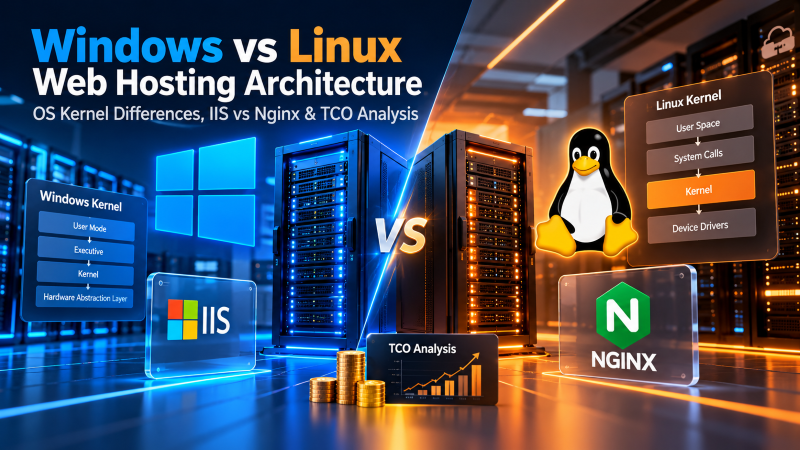
What Are the Differences in Total Cost and Performance Between Linux and Windows VPS in the UAE?
Specifically, when planning an enterprise deployment for Linux vs Windows VPS UAE, enterprise Linux (Ubuntu/AlmaLinux) is free and open-source with zero OS licensing fees, consuming only ~200MB RAM at idle, making it ideal for web apps and containers. Windows Server requires Microsoft SPLA core licensing surcharges (~75–180 AED/mo) and 4GB+ baseline RAM, but is essential for Active Directory, .NET 4.x legacy code, and MetaTrader desktop execution.
- Consequently, aligning these configurations with your Linux vs Windows VPS UAE environment ensures optimal uptime and throughput. Licensing Cost Disparity: Open-source Linux distributions (Ubuntu, AlmaLinux, Rocky Linux) incur zero OS licensing fees, whereas Windows Server Standard incurs Microsoft SPLA core licensing surcharges billed in AED.
- Consequently, aligning these configurations with your Linux vs Windows VPS UAE environment ensures optimal uptime and throughput. Workload Alignment: Windows Server is mandatory for .NET Core legacy enterprise applications, Active Directory domain controllers, and MetaTrader 5 terminals; Linux dominates PHP, Node.js, Python, and containerized microservices.
- Furthermore, Hypervisor Resource Overhead: Windows Server requires a minimum baseline of 4GB RAM and 50GB storage purely for OS footprints, whereas headless Linux runs efficiently on 1GB RAM and 15GB disk.
- Consequently, Bare-Metal Performance: Deploying OnliveServer reliable UAE VPS hosting services guarantees dedicated KVM kernel isolation, genuine NVMe storage, and localized low-latency network transit regardless of operating system.
Linux vs Windows VPS UAE: Introduction: Operating System Selection for UAE Cloud Workloads
In addition, selecting an operating system for your enterprise cloud infrastructure in the United Arab Emirates represents one of the most critical foundational architecture decisions. Whether deploying in Dubai, Abu Dhabi, or Sharjah, the operating system dictates your server maintenance overhead, software compatibility, administrative skillset requirements, and total cost of ownership (TCO) in United Arab Emirates Dirhams (AED).
Historically, enterprise IT departments across the Gulf Cooperation Council (GCC) favored Microsoft Windows Server due to widespread desktop adoption of Active Directory and Exchange. However, the rise of cloud-native microservices, containerization with Docker, and rapid adoption of high-performance web stacks (LEMP and LAMP) have positioned open-source Linux distributions as the predominant choice for regional web platforms, fintech APIs, and mobile backends.
In particular, evaluating Linux vs Windows VPS UAE requires a rigorous technical comparison spanning licensing expenditure, kernel performance characteristics, hardware resource overhead, administrative interfaces, and security baselines aligned with TDRA and DESC regulations. This comprehensive guide provides systems architects and business decision-makers with the operational data required to select the optimal platform.
Therefore, kernel tuning, memory management parameters, and operating system operational best practices are documented in the official Linux Kernel documentation for system administrators.
Linux vs Windows VPS UAE: Technical & Operational Comparison Matrix
Moreover, understanding the architectural tradeoffs between enterprise Linux and Windows Server environments is essential prior to provisioning cloud compute resources:
| Technical Parameter | Enterprise Linux (Ubuntu / AlmaLinux) | Windows Server (2022 / 2025 Standard) | UAE Enterprise Impact |
|---|---|---|---|
| OS Licensing Cost | Free & Open Source (0 AED) | Microsoft SPLA Core Surcharge (~75–180 AED/mo) | Linux saves 30% to 50% on annual cloud hosting invoices. |
| Minimum Baseline RAM | 512MB – 1GB (Headless CLI) | 4GB – 8GB (Desktop Experience GUI) | Linux leaves 90%+ RAM free for application databases and caching. |
| Storage Footprint | 5GB – 15GB base installation | 35GB – 60GB base installation (WinSxS) | Windows consumes substantial premium NVMe storage before apps are installed. |
| Primary Web Stacks | Nginx, Apache, LiteSpeed, Node.js, Python, Go | IIS, ASP.NET Core, MSSQL, Windows Services | Linux offers native performance for WooCommerce, Magento, and WordPress. |
| Administrative Access | SSH Keypair Authentication (Port 22) | Remote Desktop Protocol (RDP Port 3389) | SSH keypairs offer superior automated security; RDP requires VPN or NLA. |
| Container Ecosystem | Native Linux Kernel Namespaces / cgroups | Windows Containers / WSL2 Layering | Linux delivers microsecond container startup and zero virtualization translation overhead. |
In fact, organizations prioritizing open-source stability and lightweight footprints can explore optimized Linux web hosting solutions.
Total Cost of Ownership (TCO) Breakdown in United Arab Emirates Dirhams (AED)
Similarly, when calculating infrastructure budgets under UAE Corporate Tax guidelines, companies must distinguish between operational compute costs and recurring proprietary software licensing fees. Microsoft server operating systems are licensed through the Microsoft Services Provider License Agreement (SPLA), which bills cloud providers on a per-core basis every calendar month.
Meanwhile, for a standard 4-vCPU, 8GB RAM enterprise virtual private server instance hosted in Dubai:
Additionally, Linux VPS Monthly Cost: The base compute invoice reflects pure hardware allocation, enterprise NVMe storage, and high-speed UAE-IX network bandwidth. A standard 4-core Linux instance averages 180 AED to 260 AED per month, with zero additional licensing surcharge. Over a three-year operational lifecycle, total OS licensing fees equal exactly 0 AED.
As a result, Windows Server VPS Monthly Cost: The same 4-vCPU hardware allocation requires Microsoft SPLA licensing for Windows Server Standard edition, which adds between 90 AED and 150 AED per month. Furthermore, if the server hosts Microsoft Remote Desktop Services (RDS) for remote staff, client access licenses (RDS CALs) add an additional 25 AED to 35 AED per named user every month. Over three years, licensing alone adds between 3,240 AED and 5,400 AED to the infrastructure cost.
Consequently, unless your application relies fundamentally on proprietary Microsoft frameworks, Linux delivers an immediate 35% to 55% reduction in recurring cloud expenditures.
Workload Compatibility & Application Ecosystems
Specifically, beyond fiscal considerations, technical architecture dictates the correct operating system choice. Certain enterprise workloads exhibit strict ecosystem dependencies:
Furthermore, When Windows Server VPS is Essential:
1. Legacy .NET Framework & ASP.NET: Enterprise enterprise applications built on full-framework .NET 4.x or Microsoft Internet Information Services (IIS) require native Windows APIs and cannot compile on Linux runtimes without extensive re-architecture.
2. Microsoft SQL Server (Enterprise Features): While MSSQL now supports Linux environments, advanced features such as PolyBase, Distributed Transactions (MSDTC), and native Windows Authentication integration perform natively within Windows Server.
3. Active Directory Domain Services (AD DS): Regional corporate branches in Dubai and Abu Dhabi requiring centralized identity management, Kerberos authentication, and Group Policy Objects (GPOs) must host domain controllers on Windows Server.
4. Financial Algorithmic Trading (MT4/MT5): Retail and institutional forex trading desks operating Expert Advisors (EAs) in Dubai depend on MetaTrader 4/5 desktop clients, which require native Windows graphics and win32 thread execution.
Consequently, When Linux VPS is the Superior Choice:
1. Modern Web Commerce & CMS: WordPress, WooCommerce, Magento (Adobe Commerce), Drupal, and PrestaShop run natively on Linux LEMP/LAMP stacks. PHP execution via PHP-FPM and OPcache is significantly faster on Linux due to lightweight process management.
2. Containerization & DevOps: Docker, Podman, and Kubernetes rely on native Linux kernel cgroups and namespaces. Running containers on Linux incurs virtually zero virtualization translation penalty, enabling hundreds of microservices per node.
3. Data Science & AI Inferencing: Python libraries (PyTorch, TensorFlow, Pandas) and modern caching systems (Redis, Valkey, Memcached) are engineered primary-tier for Linux kernels, maximizing hardware memory bandwidth.
Kernel Performance, Memory Management & System Overhead
In addition, the Linux kernel operates with architectural minimalism. When provisioning an enterprise distribution such as Ubuntu 24.04 LTS or AlmaLinux 9 without a graphical user interface (GUI), the baseline operating system consumes approximately 120MB to 250MB of physical RAM and less than 0.5% idle CPU cycles. This architectural efficiency ensures that virtually 98% of your provisioned hardware capacity remains dedicated to servicing user HTTP requests and database queries.
In contrast, Windows Server Standard boots with the Windows Desktop Experience (Explorer shell, window manager, visual styles, and background telemetries). Even when running completely idle with zero web applications active, Windows Server consumes 2.8GB to 4.2GB of physical RAM. On an entry-level 4GB RAM VPS, Windows Server leaves fewer than 800MB of memory for applications, triggering heavy disk swapping to the pagefile and severely degrading overall server responsiveness.
Furthermore, the Linux unified page cache manages file system caching dynamically. Free RAM is automatically allocated to cache frequently accessed static files, code scripts, and database blocks, flushing instantly when active processes require heap space. Windows file caching is historically more rigid, necessitating larger memory allocations to achieve equivalent I/O throughput.
Security Hardening & Compliance Under TDRA and DESC Frameworks
In particular, cloud systems operating within the United Arab Emirates must comply with cybersecurity directives issued by the Telecommunications and Digital Government Regulatory Authority (TDRA) and the Dubai Electronic Security Center (DESC). Both operating systems can be hardened to satisfy high-assurance standards, but their operational attack surfaces differ substantially.
Therefore, windows Server systems face relentless brute-force attacks against Remote Desktop Protocol (RDP Port 3389). Securing Windows infrastructure demands implementing Network Level Authentication (NLA), enforcing complex 16-character passphrases, changing default listening ports, and configuring automated IP lockout policies using tools like RdpGuard. Operating system updates frequently mandate server reboots, requiring carefully orchestrated maintenance windows to prevent daytime service disruption.
Moreover, linux servers eliminate remote desktop attack vectors entirely by relying on SSH keypair authentication (ed25519 cryptographic signatures) with password authentication completely disabled. Furthermore, technologies like KernelCare and Canonical Livepatch enable zero-downtime kernel patching, allowing systems engineers to apply critical security fixes against zero-day vulnerabilities without rebooting production web servers.
Technical Runbook: Hardening Linux and Windows Deployments
In fact, to establish baseline operational security upon provisioning your UAE VPS, systems administrators should execute standardized hardening runbooks tailored to each operating system:
Linux (Ubuntu / AlmaLinux) Baseline Security Script:
Windows Server PowerShell Security Runbook:
Enterprises reliant on .NET frameworks and Microsoft SQL Server should evaluate dedicated Windows web hosting environments.
Frequently Asked Questions (FAQ)
Core Technical Specifications
Optimize Total Cost of Ownership with Linux or Windows Server VPS
Select genuine Windows Server licensing or enterprise Linux distributions backed by 24/7 technical support and transparent AED pricing.
