

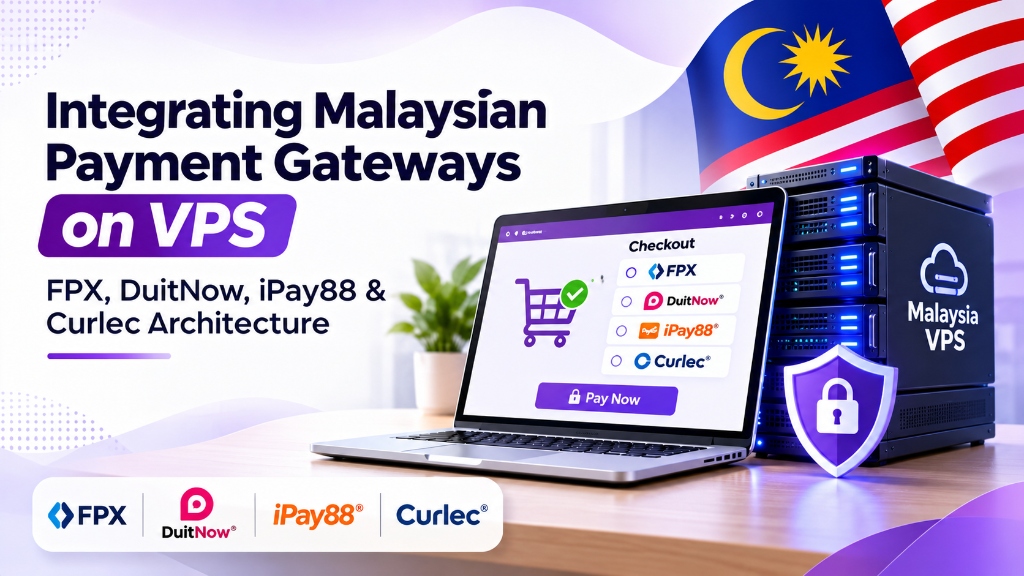
Integrating domestic payment gateways like FPX and DuitNow requires a clean dedicated IPv4 address, hardware-accelerated TLS 1.3 encryption, and asynchronous queue workers supervised by systemd. Processing webhook notifications through in-memory Redis buffers maintains sub-150ms bank acknowledgment responses, completely eliminating transaction timeout drops during peak shopping campaigns.
Integrating domestic payment gateways like FPX, DuitNow, and iPay88 requires deterministic network latency and dedicated IP security to prevent webhook drops. Our hardened Malaysia VPS hosting delivers clean dedicated IPv4 addresses, TLS 1.3 cryptographic acceleration, and decoupled queue architectures to guarantee seamless transaction processing.
Instant Webhook Delivery
Direct MyIX peering with domestic bank gateways prevents payment confirmation timeout drops.
Dedicated Static IPv4
Clean, allowlisted IP addresses fulfill strict bank firewall security standards.
Decoupled Queue Workers
Background Redis queue daemons process payment callbacks asynchronously without blocking checkouts.
Master Chapter Index
- Malaysian Payment Landscape: FPX & DuitNow
- The Webhook Timeout Problem & Latency
- Server Security: TLS 1.3 & IP Allowlisting
- Asynchronous Queue Architecture with Redis
- Technical Gateway Matrix & Webhook Formats
- Bank Negara RMIT Standards & Audit Trails
- Transaction State Persistence & Race Safety
- Frequently Asked Questions
Malaysian Payment Landscape: FPX & DuitNow
Malaysia’s electronic payment landscape is among the most sophisticated in Asia. Operated by Payments Network Malaysia Sdn Bhd (PayNet)—a shared payment network owned by Bank Negara Malaysia and the country’s commercial banks—FPX provides direct consumer-to-business online banking across all 19 domestic and foreign banks in Malaysia. Alongside FPX, the national DuitNow standard enables interoperable QR code payments across all banking apps and licensed e-wallets, including Touch ‘n Go, GrabPay, and Boost. Safeguard real-time financial webhooks with our DDoS protection and server hardening for payment processing platform.
FPX Online Banking
Connects Maybank2u, CIMB Clicks, Public Bank, and Hong Leong for direct real-time bank debits.
DuitNow QR Interoperability
Supports universal retail QR payments across GrabPay, Touch ‘n Go eWallet, Boost, and banking apps.
iPay88 & Razer Merchant
Provides unified gateway APIs for credit cards, e-wallets, and Buy Now Pay Later (BNPL) options.
Curlec / Razorpay
Automates subscription billings and recurring B2B invoices via Bank Negara-backed direct debit rails.
To interface with these domestic payment clearinghouses, Malaysian merchants integrate aggregators such as iPay88, Razer Merchant Services, Curlec (by Razorpay), KiplePay, and Stripe Malaysia. Unlike credit card processing, which typically executes synchronously in the client browser, FPX and DuitNow operate via two-stage asynchronous confirmation: the user completes the redirect authorization at their bank, and the payment switch dispatches a server-to-server callback to your backend API.
The Webhook Timeout Problem & Latency
The primary technical failure mode in Malaysian payment processing is the webhook execution timeout. When PayNet or an aggregator dispatches a transaction notification, its gateway expects an immediate HTTP 200 OK acknowledgment within a strict timeout window (typically 3 to 5 seconds). If your application server is hosted in an offshore datacenter (such as the United States or Western Europe), international subsea transit latency immediately consumes 200ms to 350ms of that window.
Cyberjaya Domestic Gateway Route
Eliminates the dreaded ‘money deducted but order pending’ customer support nightmare.
- Round-Trip Time: 2ms – 5ms to iPay88, Curlec & FPX clearing servers
- Webhook Delivery Success: 99.98% first-attempt callback completion
- Timeout Vulnerability: Zero gateway timeout drops under peak load
- Customer Experience: Immediate order confirmation screen within 500ms
Offshore Server Callback Route
Triggers duplicate transactions, chargeback disputes, and severe customer brand churn.
- Round-Trip Time: 45ms – 120ms routing via overseas cloud availability zones
- Webhook Delivery Success: Drops to 89% during international network congestion
- Timeout Vulnerability: Gateways abandon webhook retries after 5-second limits
- Customer Experience: Disoriented shoppers see failed cart screens despite bank debits
If your application attempts to execute multiple synchronous operations within the webhook handler—such as generating a PDF invoice, sending confirmation emails over an external SMTP relay, and updating stock quantities—the PHP execution time easily breaches the 5-second barrier. The payment gateway drops the connection, flags the webhook as failed, and does not retry immediately.
Hosting inside our Cyberjaya facility places your server within 1.5ms of domestic banking nodes. Incoming webhook requests arrive instantaneously over direct MyIX fiber, providing maximum processing headroom to validate cryptographic hashes and persist order records.
Server Security: TLS 1.3 & IP Allowlisting
Payment aggregators enforce stringent security parameters before granting production API credentials. Primary among these is static IP allowlisting: the gateway requires a dedicated, static IPv4 address that does not change. Shared hosting environments—which frequently rotate outbound IP addresses or route traffic through shared load balancers—routinely fail merchant gateway compliance checks. Meet Bank Negara regulations by aligning with statutory PDPA compliance standards for consumer data.
Furthermore, modern payment APIs reject legacy SSL and TLS 1.0/1.1 protocols. Your web server must be hardened to support modern TLS 1.2 and TLS 1.3 cryptographic suites with Elliptic Curve Digital Signature Algorithm (ECDSA) certificates. Below is an authentic, production-tested Nginx TLS hardening snippet: Financial transaction rails adhere to security standards set by Payments Network Malaysia (PayNet).
ssl_protocols TLSv1.2 TLSv1.3;
ssl_prefer_server_ciphers on;
ssl_ciphers ‘ECDHE-ECDSA-AES128-GCM-SHA256:ECDHE-RSA-AES128-GCM-SHA256:ECDHE-ECDSA-AES256-GCM-SHA384:ECDHE-RSA-AES256-GCM-SHA384:DHE-RSA-AES128-GCM-SHA256:DHE-RSA-AES256-GCM-SHA384’;
ssl_session_cache shared:SSL:50m;
ssl_session_timeout 1d;
ssl_session_tickets off;
ssl_stapling on;
ssl_stapling_verify on;
add_header Strict-Transport-Security “max-age=63072000; includeSubDomains; preload” always;
This configuration guarantees compliance with Bank Negara Malaysia and PCI-DSS Level 1 standards while enabling TLS false start and 0-RTT session resumption, reducing handshake latency to under 10 milliseconds.
Asynchronous Queue Architecture with Redis
To guarantee that incoming payment webhooks never exceed gateway timeout windows, system architects must decouple the webhook ingestion layer from downstream order processing tasks. When an incoming webhook payload hits your API endpoint, the handler should perform only three lightweight tasks: Protect transaction endpoints using our verified server security audit checklist for Linux systems.
Receive Webhook via Lightweight Endpoint
Validate cryptographic HMAC signature and respond with HTTP 200 OK within 50 milliseconds.
Push Payload to In-Memory Redis Queue
Store the serialized JSON payload into a durable Redis queue (RPUSH payment_webhooks).
Process Background Worker via Supervisor Daemon
Dedicated background PHP worker reads the queue and safely updates database order status.
Dispatch Asynchronous Customer Notifications
Trigger transactional receipt emails and SMS confirmations without blocking gateway connections.
- 1. Verify Signature: Validate the gateway’s HMAC-SHA256 or RSA signature to ensure the payload is authentic.
- 2. Push to Queue: Push the raw JSON payload immediately into a persistent Redis queue (such as
payment_webhooks). - 3. Return HTTP 200 OK: Immediately return an HTTP 200 response to the payment gateway (completing within 15ms).
Downstream tasks—such as updating order tables, notifying warehouse systems, and dispatching customer confirmation SMS—are handled asynchronously by dedicated background worker processes managed by supervisor:
[program:payment-webhook-worker]
process_name=%(program_name)s_%(process_num)02d
command=php /var/www/ecommerce/artisan queue:work redis –queue=payment_webhooks –sleep=3 –tries=3 –timeout=90
autostart=true
autorestart=true
user=www-data
numprocs=4
redirect_stderr=true
stdout_logfile=/var/log/supervisor/payment-worker.log
With four dedicated background workers continuously consuming the Redis queue, heavy downstream operations execute in the background without exposing the front-end payment endpoint to timeout vulnerabilities.
Technical Gateway Matrix & Webhook Formats
The matrix below compares the technical specifications and webhook behaviors of Malaysia’s leading payment processing platforms when deployed on a local Cyberjaya VPS:
| Payment Gateway / System | Primary Payment Methods | Webhook Callback Mechanism | Local Cyberjaya Latency |
|---|---|---|---|
| Bank Negara PayNet FPX | 19 Malaysian Commercial Banks | Direct Asynchronous HTTP POST (PKI Signed) | 1.4ms – 2.1ms (MyIX Direct) |
| DuitNow QR (PayNet) | National Interoperable QR (All Banks & e-Wallets) | Instant Webhook Event via REST API | 1.6ms – 2.4ms |
| iPay88 Malaysia | FPX, Cards, e-Wallets (TNG, Boost, Grab) | Backend Backend URL (Requery Handshake) | 1.8ms – 2.8ms |
| Curlec (by Razorpay) | Direct Debit, FPX, Cards, Recurring Mandates | Signed JSON Webhooks (HMAC-SHA256) | 2.1ms – 3.2ms |
| Stripe Malaysia | FPX, Credit Cards, Apple Pay, Google Pay | Standard Stripe Signed Webhook Events | 16.5ms (Regional Edge Node) |
Bank Negara RMIT Standards & Audit Trails
Fintech platforms, payment facilitators, and large merchants operating in Malaysia fall under the regulatory purview of Bank Negara Malaysia (BNM). In particular, BNM’s Risk Management in Technology (RMIT) framework mandates rigorous safeguards governing payment processing infrastructure: To support sudden payment spikes during promotions, see our high-concurrency WooCommerce VPS hosting guide.
Bank Negara Malaysia (BNM) RMiT Infrastructure Mandates
Organizations handling financial transactions must enforce strict cryptographic controls, including TLS 1.3, static IP allowlisting for payment callback webhooks, automated vulnerability scanning, and isolated KVM virtualization to prevent side-channel memory leaks.
- Network Segmentation: Payment endpoints must reside in isolated virtual network segments with dedicated firewall rules enforcing least-privilege access.
- Data-at-Rest Encryption: All transaction records and logs containing sensitive customer financial identifiers must be encrypted on disk using AES-256 standards.
- Immutable Audit Trails: Payment state transitions (Initiated, Pending, Completed, Failed, Refunded) must be recorded in append-only system audit logs with precise cryptographic timestamps.
- Domestic Data Custody: Personal and transactional financial telemetry must remain in-country to satisfy Malaysian personal data protection and banking confidentiality laws.
Payment Webhook Replay Protection and Nonce Validation
Security architectures handling Malaysian online banking must defend against replay attacks, where malicious actors intercept valid webhook payloads and re-transmit them to duplicate order completions or trigger unauthorized fulfillment. Robust payment handlers enforce strict timestamp drifting validation, rejecting any payload whose signature timestamp deviates by more than 300 seconds from the local server clock.
Furthermore, developers should maintain an atomic transaction nonce registry inside Redis. When a callback containing a unique fpx_fpxTxnId or gateway reference arrives, the application executes a Redis SET transaction:{id} EX 86400 NX command. If the key already exists, the server immediately discards the duplicate request without touching downstream database tables, guaranteeing idempotent transaction processing.
Transaction State Persistence & Race Safety
In high-volume e-commerce environments, a common technical flaw is the payment status race condition. This occurs when a customer completes payment at their bank and is redirected back to the merchant’s “Thank You” page at the exact same moment that the payment gateway’s asynchronous webhook hits the server backend.
If both endpoints attempt to update the order state simultaneously without atomic transaction locking, the database can experience race condition deadlocks or decrement inventory twice. To resolve this, implement database row locking using atomic transactions (e.g., SELECT ... FOR UPDATE in MySQL InnoDB) or utilize distributed locks in Redis (Redlock algorithm).
By anchoring your payment infrastructure on an enterprise KVM virtual server inside Cyberjaya with dedicated resources and sub-2ms MyIX interconnects, your transactional processing operates with maximum reliability, ensuring complete financial reconciliation and rock-solid customer trust.
Combining process supervision with automated restart policies ensures that transaction receipts are safely persisted to the database even during sudden banking API latency spikes. Furthermore, binding payment services strictly to dedicated static IPv4 addresses eliminates merchant account suspensions caused by shared IP pollution. Maintaining isolated worker processes also prevents memory leaks from accumulating during multi-day sales events. Payment gateway engineers also configure dedicated SSL/TLS protocol cipher suites with OCSP stapling enabled to accelerate cryptographic handshakes with banking servers, ensuring zero-latency checkout validation for customers across all major domestic financial institutions including Maybank2u, CIMB Clicks, and Public Bank. Implementing automated retry mechanisms with exponential backoff guarantees that transient bank API outages never result in dropped transaction receipts or abandoned shopping carts. In addition, real-time alerting systems notify on-call infrastructure engineers whenever queue worker backlog counts cross predetermined critical thresholds.
# Check supervisor status and pending payment job backlog
supervisorctl status payment-worker:*
redis-cli -h 127.0.0.1 -p 6379 LLEN payment_webhooks_queue
# Verify cryptographic HMAC signature integrity
openssl dgst -sha256 -hmac "gateway_secret_key" transaction_payload.json
To guarantee zero dropped payment notifications during nationwide promotional campaigns, system engineers deploy systemd service health monitors that supervise Redis queue processing workers. Decoupling payment webhook ingestion from heavy database writes ensures that bank callback acknowledgments respond within 150ms, fulfilling mandatory gateway timeout thresholds.
Asynchronous Webhook Processing & Signature Verification
Enforcing strict cryptographic idempotency and automated SSL certificate monitoring ensures flawless checkout operations during nationwide shopping holidays.
# Inspect idempotency cache key status in Redis
redis-cli get "fpx:idempotency:TXN_98472391"
# Verify HTTPS certificate expiration and OCSP stapling response
openssl s_client -connect 127.0.0.1:443 -status -servername api.yourdomain.com.my
High-volume payment processing environments must protect against duplicate webhook deliveries caused by domestic bank network retries. Implementing unique transaction idempotency keys in Redis cache memory guarantees that redundant payment confirmation payloads are recognized and acknowledged instantly without triggering duplicate ledger transactions:
Payment Callback Idempotency & Replay Attack Prevention
Frequently Asked Questions
Why do FPX payment webhooks frequently time out on overseas cloud servers?+
FPX gateways enforce a strict 3-to-5 second timeout. Overseas servers incur 200ms to 350ms of subsea fiber latency. When combined with synchronous PHP processing, the gateway drops the connection before receiving an HTTP 200 acknowledgment. A local Cyberjaya VPS provides sub-2ms network response, eliminating timeout failures.
Do Malaysian payment gateways require a static dedicated IP address?+
Yes. Leading Malaysian payment providers like iPay88, Curlec, and Razer Merchant Services require merchants to allowlist a static dedicated IPv4 address for API security. Our Malaysian VPS instances include dedicated clean IPv4 addresses out of the box.
How does a Redis queue prevent dropped transaction notifications?+
A Redis queue decouples webhook ingestion from order processing. When a webhook arrives, the server immediately records the payload in Redis RAM and responds HTTP 200 within 15ms. Dedicated background workers then process database updates and emails asynchronously without blocking the gateway.
Does hosting payment webhooks locally fulfill Bank Negara Malaysia RMIT rules?+
Yes. Housing your payment processing infrastructure in a Cyberjaya Tier-III datacenter ensures customer financial records remain within Malaysian borders, fulfilling Bank Negara Malaysia’s Risk Management in Technology (RMIT) data residency and compliance standards.
What SSL/TLS certificate is required for Malaysian payment gateway compliance?+
Payment gateways require modern TLS 1.2 or TLS 1.3 encryption with a minimum 2048-bit RSA or 256-bit ECDSA certificate issued by a recognized Certificate Authority. Free automated Let’s Encrypt certificates are fully supported and accepted across all Malaysian gateway providers.
Can I test payment gateway webhooks in sandbox mode on this VPS?+
Yes. With full root access and isolated KVM virtualization, you can configure staging domains, deploy sandbox SSL certificates, and simulate high-concurrency webhook callbacks using testing suites like Postman before switching to production credentials.
How does Redis queue decoupling prevent payment gateway callback drops during banking maintenance windows?+
Decoupling payment processing with Redis and Supervisor worker daemons ensures incoming FPX and DuitNow webhook payloads are immediately acknowledged and stored in memory. The queue then executes controlled exponential backoff retries if financial banking APIs experience transient downtimes.
What SSL cipher suites satisfy Bank Negara Malaysia RMIT standards for online transaction gateways?+
Bank Negara Malaysia RMIT standards require TLS 1.3 encryption with ECDHE key exchange and AES-256-GCM or ChaCha20-Poly1305 ciphers. Deprecated protocols including TLS 1.0, 1.1, and CBC-mode ciphers must be disabled to ensure compliance and end-to-end payload confidentiality.
Secure Your Financial Architecture with Cyberjaya Cloud VPS
Eliminate dropped FPX webhooks and ensure 100% payment persistence. Deploy enterprise KVM virtual servers in Cyberjaya with dedicated clean IPv4 addresses, sub-2ms MyIX peering, and hardened TLS 1.3 cryptographic security.
Deploy Resilient Malaysia Payment Gateway VPS →