

⚡ Quick Answer (Key Takeaway / Executive Answer)
Verified SLA & Cost Analysis
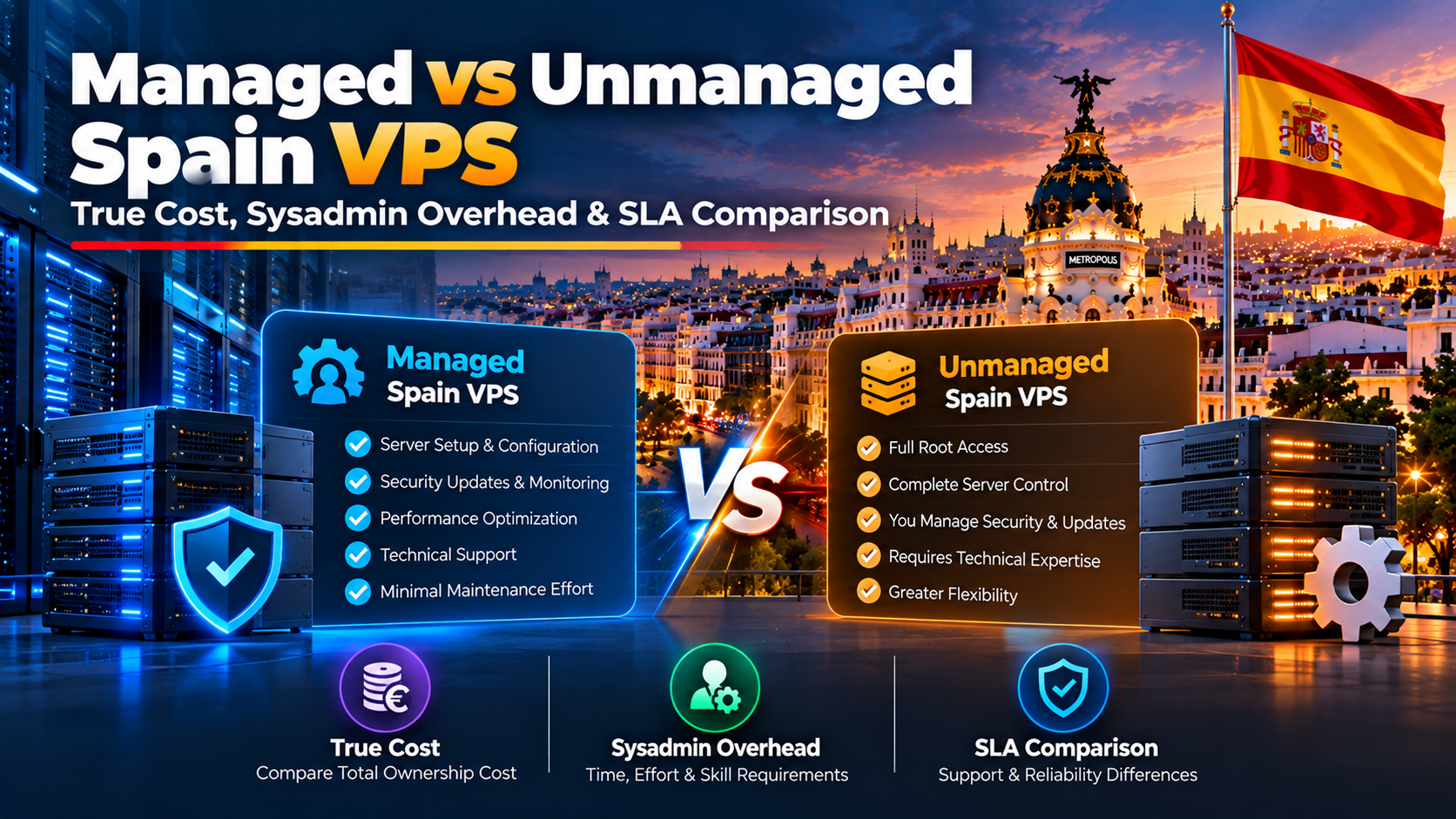
Choosing between managed and unmanaged Spain VPS hosting depends on balancing monthly subscription costs against internal engineering labor and SLA requirements. Managed Spain VPS hosting includes 24/7 proactive monitoring, kernel patching, automated offsite backups, and web stack optimization by certified Madrid datacenter engineers—eliminating 15 to 25 hours of monthly sysadmin overhead. Conversely, an Unmanaged VPS delivers complete root access at baseline hardware pricing (from €12/month) for technical teams with established in-house DevOps capabilities.
Choosing between managed and unmanaged Spain VPS hosting comes down to balancing monthly infrastructure expenses against your team’s internal sysadmin bandwidth. While unmanaged servers offer direct root access at lower baseline rates, fully managed hosting offloads security patching, proactive monitoring, and SLA uptime guarantees to dedicated infrastructure engineers.
Managed VPS
Dedicated sysadmin coverage with 24/7 proactive monitoring, zero-day OS patching, and incident response—saving 15+ internal hours monthly.
Unmanaged VPS
Full root authority and custom kernel control at baseline rates (€12/mo)—purpose-built for experienced DevOps and sysadmins.
Madrid Tier-III SLA
Direct ESPANIX peering delivers sub-10ms latency across Spain and Portugal, backed by 99.99% uptime and strict GDPR compliance.
📌 Master Chapter Index
- Defining Management Tiers: What Managed Truly Includes
- Labor Economics: In-House Sysadmin vs Managed Cost
- Security Governance: Kernel Patching, Zero-Days & AEPD Compliance
- Disaster Recovery & Backup SLAs: RTO and RPO Benchmarks
- Proactive Stack Tuning: Web Servers, Databases & Redis Cache
- When Unmanaged is Superior: The DevOps & Custom Stack Scenario
- Managed vs Unmanaged SLA & Feature Comparison Matrix
- Frequently Asked Questions
Defining Management Tiers: What Fully Managed VPS Truly Includes
Choosing between managed and unmanaged hosting defines the operational boundary between your internal engineering team and your infrastructure provider. While both tiers utilize identical enterprise hardware housed in our Tier-III Madrid datacenter, the operational commitments differ fundamentally. On an unmanaged instance, you retain unhindered root freedom but carry sole responsibility for configuration, security patching, and disaster recovery. In contrast, a fully managed deployment offloads continuous administration to certified Linux systems engineers, ensuring high availability while freeing your developers to focus on core product innovation.
Unmanaged (Self-Managed)
Full root SSH access paired with pure hardware-level and power SLAs. Built specifically for experienced Linux system administrators who control bespoke Docker topologies, custom reverse proxies, or specialized database engines.
Fully Managed (Turnkey SLA)
Comprehensive 24/7 proactive telemetry, automated CVE security patching, live Linux kernel updates, and hands-on performance profiling managed directly by OnliveServer infrastructure specialists.
The OnliveServer Fully Managed Scope of Service
Our fully managed service goes well beyond routine server reboots. When you deploy a managed virtual private server in Spain, our engineering team assumes contractual responsibility across five critical maintenance domains:
24/7/365 Proactive Telemetry
Automated monitoring tracks CPU load, RAM utilization, disk I/O, MariaDB connection states, and network latency at 60-second intervals. Systems engineers intervene before resource bottlenecks impact end users.
Core Security Hardening
Immediate implementation of custom SSH port binding, automated UFW/iptables firewall rules, Fail2ban brute-force protection, ModSecurity Web Application Firewall (WAF) deployment, and automated vulnerability scanning.
Zero-Downtime Kernel Patching
Kernel live patching technology applies critical Linux security updates without requiring operating system reboots or dropping active client TCP connections.
Application Stack Optimization
Custom compilation and tuning of Nginx, Apache, PHP-FPM, MariaDB, and Redis tailored specifically to CMS platforms including WordPress, PrestaShop, and Magento.
Complimentary White-Glove Migration
Full-service migration of databases, email accounts, SSL certificates, and DNS records from your previous hosting provider with verified zero downtime and complete data integrity.
For underlying networking architecture and transport protocols, consult the official standards on the Internet Engineering Task Force (IETF) portal.
Labor Economics: The Hidden Cost of In-House Sysadmin Maintenance
Calculating the true Total Cost of Ownership (TCO) for virtual server infrastructure requires evaluating both direct hosting invoices and internal engineering labor expenses. In Spain, senior Linux systems administrators and DevOps engineers command market salaries between €45,000 and €60,000 annually—translating to roughly €35 to €50 per billable hour. When routine server maintenance diverts 15 to 25 hours of skilled developer time each month, an unmanaged instance incurring €12/month in hosting fees easily generates €600 to €1,000+ in indirect labor costs.
In-House Sysadmin Overhead
Diverting in-house senior developers into routine kernel updates, database troubleshooting, and emergency off-hours server restarts consumes 15–25 hours/month, costing over €650/month in billable developer productivity.
Managed VPS Fixed Efficiency
A managed plan replaces erratic internal labor expenses with a predictable monthly subscription, delivering 24/7 proactive coverage while keeping your engineering team 100% focused on revenue-generating product features.
Monthly Engineering Hours Consumed by Unmanaged VPS Maintenance
The table and breakdown below illustrate where engineering bandwidth disappears when managing an unmanaged Linux server in production:
OS Updates & Security Patching
Applying Linux kernel security updates, software package upgrades, and library compatibility tests: 3 – 5 hours/month.
Backup Audits & Disaster Tests
Verifying snapshot cron integrity, testing offsite replication, and performing simulated recovery drills: 2 – 4 hours/month.
Database Tuning & Slow Queries
Profiling MySQL/MariaDB slow query logs, optimizing InnoDB buffer pools, and defragmenting indexes: 4 – 6 hours/month.
Firewall, SSL & WAF Maintenance
Configuring iptables/UFW rules, rotating TLS certificates, and mitigating Layer-7 DDoS anomalies: 2 – 3 hours/month.
Emergency Incident Response
Diagnosing unplanned service crashes, OOM killer terminations, and application downtime: 3 – 8 hours/month.
Compliance & Vulnerability Audits
Auditing system compliance with GDPR and LOPDGDD standards and updating cryptographic suites: 2 – 4 hours/month.
Security Governance: Kernel Patching, Zero-Days & AEPD Compliance
Operating production servers on the public internet requires round-the-clock defense against automated vulnerability scanning botnets. Within minutes of provisioning a public IPv4 address, automated threat actors begin probing standard service ports for unpatched OpenSSH vulnerabilities, legacy PHP runtime flaws, and unauthenticated database interfaces. To audit whether your self-managed server matches enterprise security baselines for kernel isolation and firewall policies, consult our production server security hardening checklist.
Under the Spanish Data Protection Act (LOPDGDD) and European General Data Protection Regulation (GDPR), businesses processing personal data are legally obligated to maintain state-of-the-art technical security controls. In the event of a security incident resulting from an unpatched CVE vulnerability, the Spanish Data Protection Agency (AEPD) does not view lack of in-house technical resources as a valid defense. Fines for systemic negligence can reach up to €20 million or 4% of global annual turnover.
Regulatory Governance Advisory (AEPD / GDPR)
OnliveServer Managed Spain VPS hosting includes automated zero-day vulnerability audits, isolated root jail containment, and cryptographic TLS hardening to assist in meeting rigorous European compliance standards. While server management ensures infrastructure-level compliance, organizations remain responsible for application-layer privacy governance and customer data handling policies.
Disaster Recovery & Backup SLAs: RTO and RPO Benchmarks
Enterprise business continuity is governed by two contractual benchmarks: Recovery Point Objective (RPO) and Recovery Time Objective (RTO). On self-managed infrastructure, backup reliability is entirely dependent on client-written cron scripts and manual snapshot exports. In contrast, OnliveServer Managed Spain VPS infrastructure replaces manual uncertainty with contractually guaranteed disaster recovery SLAs executed by our 24/7 on-duty systems engineers.
RPO (Recovery Point Objective)
Measures the maximum acceptable data loss window during a disaster. Automated 6-hour hypervisor-level snapshots guarantee a data loss window of under 6 hours during extreme storage incidents.
RTO (Recovery Time Objective)
Measures the time required to restore operations after failure. Our bare-metal image replication allows engineers to restore complete virtual machine states to operational status in under 15 minutes.
Disaster Recovery SLAs: Managed vs Unmanaged
The key operational differences in backup automation, retention frequency, and emergency restoration responsibilities include:
Managed Spain VPS RPO Guarantee
Guaranteed 24-hour RPO. Nightly encrypted differential backups are replicated to physically isolated offsite European storage, with hourly database snapshots available for transactional stores.
Managed Spain VPS RTO Guarantee
Guaranteed sub-30 minute bare-metal recovery. In catastrophic data corruption scenarios, OnliveServer systems engineers restore your full image environment from verified snapshots.
Unmanaged VPS Self-Service
Completely self-service. The subscriber is entirely responsible for provisioning backup storage volumes, maintaining backup cron scripts, and executing manual restorations during outages.
Proactive Stack Tuning: Web Servers, Databases & Redis Cache
Default Linux software distributions are intentionally shipped with conservative, generic resource parameters designed to boot on low-spec development virtual machines. Deploying a production application on standard default configurations severely throttles server throughput, introduces artificial socket queue limits, and starves high-concurrency database queries.
On a Managed Spain VPS, our performance engineers conduct comprehensive workload profiling. We tune the Linux network stack (enabling Google TCP BBR congestion control, expanding ephemeral port limits, and optimizing socket backlogs), configure Nginx FastCGI micro-caching, calibrate MariaDB InnoDB buffer pool allocations to match your active dataset, and configure in-memory Redis caching over local Unix domain sockets.
These proactive sysctl optimizations, combined with MariaDB query cache tuning, deliver measurable reductions of 35% to 50% in Time to First Byte (TTFB) for dynamic e-commerce platforms and high-traffic CMS installations without requiring costly compute tier upgrades.
When Unmanaged is Superior: The DevOps & Custom Stack Scenario
Despite the substantial efficiency benefits of managed hosting, raw unmanaged virtual private servers remain the industry benchmark for specialized technical workflows and seasoned engineering teams. If your organization already maintains full-time DevOps personnel and automated infrastructure pipelines, an unmanaged Spain VPS provides complete root authority at the lowest baseline price point.
An unmanaged virtual private server is specifically recommended for the following four engineering scenarios:
CI/CD Automation Pipelines
Automated delivery pipelines orchestrated through GitLab CI, GitHub Actions, or Jenkins that dynamically provision, test, and tear down ephemeral environments via Ansible, Terraform, or Puppet.
Custom Kernel & Container Runtimes
Workloads requiring customized Linux kernel compilation, WireGuard VPN mesh overlays, specialized Docker daemon bridge configurations, or lightweight Kubernetes nodes (K3s).
Full In-House Sysadmin Team
Organizations with dedicated systems administrators who manage existing enterprise observability stacks (Prometheus, Grafana, Datadog) and standardized internal incident response playbooks.
Development & Staging Sandboxes
Non-production test environments, staging instances, and developer sandboxes where commercial uptime SLAs and 24/7 monitoring are not required by business operations.
Managed vs Unmanaged SLA & Feature Comparison Matrix
To help engineering leads evaluate operational responsibilities across both deployment models, the matrix below details the exact support boundaries, maintenance tasks, and contractual SLAs provided by OnliveServer:
| Service Responsibility | OnliveServer Managed Spain VPS | OnliveServer Unmanaged Spain VPS |
|---|---|---|
| Physical Hardware & Hypervisor | 100% Guaranteed by Provider | 100% Guaranteed by Provider |
| Network & ESPANIX Peering Uptime | 99.99% Network SLA | 99.99% Network SLA |
| OS & Security Patching | Included (Proactive Live Patching) | Client Responsibility |
| 24/7 Service Telemetry & Alerts | Included (60-Second Polling) | Client Responsibility |
| Web & Database Stack Tuning | Included (Nginx, MariaDB, Redis) | Client Responsibility |
| Automated Disaster Recovery Backups | Included (Offsite Replication) | Available as Optional Add-on |
| Disaster Recovery SLA (RTO) | Guaranteed < 30 Minutes | Best-Effort Self-Service |
| Full Root SSH Authority | Yes (Coordinated Access) | Yes (Unrestricted Root) |
Frequently Asked Questions
Core Technical Specifications
What is the primary difference between managed and unmanaged Spain VPS hosting?
Managed hosting includes full technical support, 24/7 proactive monitoring, security updates, automated backups, and stack performance optimization by our engineers. Unmanaged hosting provides raw root access, leaving all operating system and software maintenance to your internal team.
Do I receive full root SSH access with a managed Spain VPS?
Yes. You maintain full root access on both managed and unmanaged servers. On managed instances, our team coordinates with your developers to ensure that any custom packages or configurations remain fully compatible with automated monitoring and security policies.
How fast does the technical support team respond to managed server incidents?
Managed VPS clients benefit from a priority SLA guaranteeing under 15-minute response times for critical incidents. Because our monitoring systems detect service degradation automatically, our engineers often resolve bottlenecks before clients even notice.
Can OnliveServer migrate my existing website from another hosting provider?
Yes. Complimentary white-glove migration is included with all managed Spain VPS plans. Our migration engineers handle database syncing, file transfers, SSL configuration, and DNS cutover testing with zero downtime.
Deployment & Operational Inquiries
Can I upgrade an unmanaged VPS plan to a managed plan later?
Yes. You can attach our management tier to any active unmanaged Spain VPS at any time directly through your client billing portal without migrating data or changing your server IP address.
Where is the management engineering team physically based?
Our Tier-3 support engineers work directly with our European Network Operations Center (NOC) and Tier-III Madrid datacenter infrastructure, operating 24/7/365 to deliver rapid, expert assistance in Spanish and English.
What maintenance tasks are covered under OnliveServer Managed Spain VPS hosting?
Our managed support tier covers 24/7 proactive monitoring, operating system security patch installation, kernel updates, firewall configuration, automated backup management, control panel troubleshooting, and LAMP/LEMP stack performance optimization by certified sysadmins.
Can I convert an Unmanaged Spain VPS to a Managed hosting plan without server migration?
Yes. If your operational requirements evolve, our management team can seamlessly attach enterprise managed support services to your existing virtual private server without requiring operating system reinstallation, IP address changes, or application downtime.
Free Your Engineering Team with 24/7 Managed Spain Cloud Infrastructure
Leave server administration to our certified Madrid datacenter engineers. Enjoy proactive monitoring, kernel patching, enterprise backups, and sub-10ms ESPANIX peering with managed plans starting from €45/month.
