

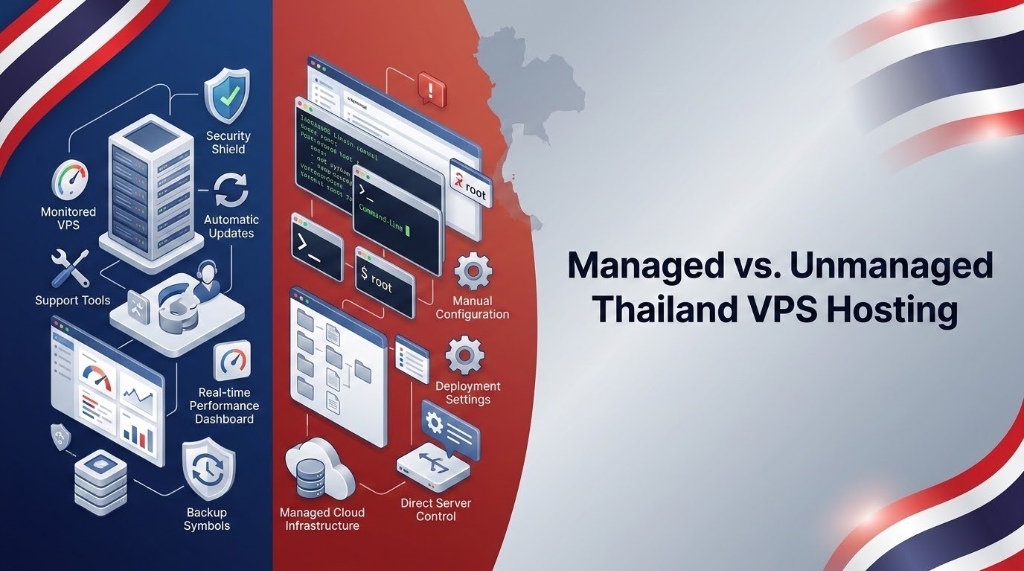
Managed vs. Unmanaged VPS in Thailand: Which Should You Choose?
Choose a managed VPS in Thailand if you lack dedicated in-house Linux sysadmins and need 24/7 technical monitoring, automated security patching, and proactive disaster recovery. Choose an unmanaged VPS if you have skilled engineers who require root access, custom software stacks, and want to eliminate management overhead costs.
Transitioning from shared hosting to virtual private servers in Thailand often exposes an unexpected operational crossroads: who maintains the operating system once the server is provisioned? In the fast-growing digital economy of Bangkok, Chiang Mai, and Phuket, businesses frequently confuse basic datacenter hardware uptime with day-to-day operating system management. Selecting the right operational model between managed Thailand VPS cloud servers and self-managed unmanaged instances directly governs your team’s administrative workload, security posture, and total cost of ownership.
✔ Key Decision Takeaways
- Support Boundary Definition: Unmanaged VPS providers guarantee only physical hardware, power, and upstream network connectivity; all software configuration, security updates, and database maintenance fall on your shoulders.
- Fully Managed Scope: Managed VPS includes proactive OS updates, firewall tuning (CSF/UFW), web server optimization (NGINX/LiteSpeed), automated backups, and 24/7 uptime monitoring.
- Local Talent Economics: Hiring a certified mid-level Linux system administrator in Bangkok costs 45,000 to 75,000 THB monthly, making managed VPS support an extraordinarily cost-effective alternative for Thai SMEs.
- Root Privilege Access: Both models provide root authority, but managed environments provide an enterprise safety net where certified engineers resolve configuration mishaps and service outages.
- Incident Response SLA: Managed servers stationed in Bangkok offer guaranteed response times during critical Thai business hours and overnight campaign bursts.
Table of Contents
- Defining Managed vs. Unmanaged VPS in the Thai Hosting Market
- What Does Unmanaged VPS Actually Mean for Your Team?
- The Anatomy of Fully Managed Support: OS Updates, Security & Monitoring
- Total Cost of Ownership: In-House Thai Sysadmin vs. Managed VPS Service
- When Unmanaged VPS Makes Pure Financial and Technical Sense
- Resolving the 24/7 Timezone Dilemma: Support Coverage in Bangkok (UTC+7)
- Decision Matrix: Which Operational Model Fits Your Workload?
- Frequently Asked Questions (FAQ)
1
In Thailand’s web hosting ecosystem, marketing jargon frequently blurs the line between infrastructure provisioning and server administration. Many local hosting companies advertise “24/7 technical support,” leading non-technical entrepreneurs to assume that their server will be comprehensively maintained. However, unless the service is explicitly designated as Fully Managed, standard hosting support covers only physical hardware health, hypervisor node stability, and network routing into Bangkok telecom interchanges (such as BKNIX and CAT Bangrak).
When you purchase an unmanaged server, the hosting company provisions the virtual machine with a pristine operating system image (such as Ubuntu 24.04 or AlmaLinux 9) and hands over the root credentials. From that second forward, every operational responsibility—including package upgrades, SSH key generation, firewall configuration, web server installation, SSL/TLS certificate renewals, database performance tuning, and backup restoration—falls entirely upon your internal staff. If an NGINX syntax error crashes your website at 02:00 Bangkok time, an unmanaged hosting provider’s support desk will confirm that the virtual machine is powered on and pingable, but will decline to troubleshoot your web server configuration.
Conversely, Managed Thailand VPS hosting establishes a cooperative administrative partnership. Under this operational model, OnliveServer’s certified systems engineers handle the setup, hardening, monitoring, and ongoing maintenance of the operating system and core application stacks. Your team focuses entirely on developing web applications, managing digital marketing campaigns, and expanding e-commerce sales, while our infrastructure team ensures server uptime, optimal memory utilization, and airtight cybersecurity.
2
To accurately assess whether unmanaged VPS hosting aligns with your organization’s technical capabilities, you must evaluate the real-world maintenance tasks required to operate a public-facing cloud server in Bangkok. Running an unmanaged server demands systematic execution of mission-critical sysadmin runbooks:
Initial Security Baseline and Hardening
Fresh Linux installations are inherently vulnerable if exposed directly to the public internet without hardening. Within minutes of provisioning a public IPv4 address in Thailand, automated botnets will initiate brute-force dictionary attacks against default SSH port 22. On an unmanaged server, your team must immediately execute foundational hardening:
Beyond initial setup, unmanaged administration requires ongoing vigilance. Your staff must configure automated vulnerability alerts, track zero-day Common Vulnerabilities and Exposures (CVEs), manage log rotation under /var/log, audit database slow-query logs, and periodically test full disaster recovery snapshots. If your organization lacks team members with seasoned Linux command-line expertise, managing these responsibilities internally creates severe operational vulnerability.
3
A premier managed VPS service does not merely react when a server goes offline; it operates as an active extension of your engineering team. At OnliveServer, our managed Thailand VPS ecosystem encompasses four foundational operational pillars: If your team operates unmanaged instances, follow our step-by-step runbook for troubleshooting high CPU load and memory exhaustion to isolate misbehaving worker threads and runaway queries. System administrators managing custom web stacks can audit event-driven concurrency models through the Apache Multi-Processing Modules documentation.
1. Continuous OS Maintenance & Proactive Kernel Patching
We execute routine kernel and operating system updates without disrupting business continuity. When critical vulnerabilities are discovered in standard Linux packages (such as OpenSSL, glibc, or NGINX), our senior administrators apply hotfixes promptly. We manage kernel live-patching, ensuring your server remains fortified against remote code execution exploits without requiring unannounced reboots during peak Thai e-commerce hours.
2. Web Stack Optimization and High-Concurrency Tuning
Out-of-the-box web server configurations are rarely optimized for production traffic. Our managed engineers calibrate your LEMP (Linux, NGINX, MySQL/MariaDB, PHP-FPM) or LAMP stack to match your allocated hardware specifications. We tune PHP-FPM process managers (pm.max_children, pm.start_servers), configure Redis object caching pools, and optimize MySQL InnoDB buffer allocations to eliminate memory bottlenecks and keep page generation times under 200 milliseconds.
3. Multi-Layer Cyber Security & Web Application Firewall (WAF)
Thai web servers face intense scanning from regional botnets and automated credential stuffing tools. We implement multi-tier defense mechanisms, including ConfigServer Security & Firewall (CSF), Fail2ban intrusion prevention, ModSecurity Web Application Firewall rules, and malware scanning via ClamAV/Maldet. We enforce automated brute-force IP rate-limiting, protecting your login portals and administrative endpoints from credential stuffing.
4. Automated Snapshots, Offsite Replication & Disaster Recovery
Data loss can destroy an enterprise in an instant. Our managed hosting packages include automated daily and weekly system-level snapshots stored on physically isolated backup storage arrays. In the event of a catastrophic database corruption, ransomware attack, or developer deployment error, our team can restore your entire virtual environment to a clean state within minutes, fulfilling strict Recovery Time Objectives (RTO).
| Operational Responsibility | Managed Thailand VPS | Unmanaged Thailand VPS |
|---|---|---|
| Datacenter Hardware & Power | Provider (100% Covered) | Provider (100% Covered) |
| Network Routing & BKNIX Peering | Provider (100% Covered) | Provider (100% Covered) |
| OS Installation & Upgrades | Provider (Fully Managed) | Customer Responsibility |
| Control Panel Setup (cPanel/Plesk) | Provider (Fully Managed) | Customer Responsibility |
| Security Hardening & WAF Tuning | Provider (Proactive) | Customer Responsibility |
| Database Optimization (MySQL/PG) | Provider (Performance Tuned) | Customer Responsibility |
| Daily Backups & Restore Support | Provider (Automated Daily) | Customer Responsibility |
| 24/7 Service Monitoring & Alerts | Provider (Proactive Monitoring) | Self-Monitored (Reboot Portal Only) |
4
When evaluating the financial wisdom of unmanaged versus managed cloud hosting, corporate decision-makers frequently commit the error of comparing only monthly hosting invoice figures. An unmanaged 4 vCPU, 8 GB RAM KVM cloud server in Bangkok may cost approximately $25 to $40 per month, whereas a fully managed server package with round-the-clock sysadmin support and enterprise control panel licensing may range between $65 and $120 per month. On the surface, unmanaged hosting appears substantially cheaper.
However, calculating the true Total Cost of Ownership (TCO) requires factoring in the real costs of technical labor within Thailand. In metropolitan Bangkok, a competent junior Linux system administrator commands a base salary between 35,000 and 50,000 THB ($1,000 – $1,450 USD) monthly. A seasoned DevOps or senior infrastructure engineer commands upwards of 70,000 to 110,000 THB ($2,000 – $3,200 USD) monthly, excluding social security contributions, healthcare benefits, and corporate overhead.
Moreover, a single in-house administrator cannot provide 24/7/365 coverage. An administrator working standard business hours (09:00 to 18:00 ICT) leaves your infrastructure unmonitored during evening peak shopping hours, weekends, and Thai national holidays. To achieve true around-the-clock on-call coverage internally, an enterprise must employ a rotational shift of at least three engineers—escalating monthly payroll costs beyond 180,000 THB ($5,200 USD).
By opting for a Managed Thailand VPS from OnliveServer, an SME, marketing agency, or fast-growing e-commerce merchant gains access to an entire team of certified Linux engineers, database specialists, and cybersecurity professionals for a negligible monthly management premium. The managed support tier eliminates the operational risk of staff turnover, saves hundreds of hours of internal developer time, and ensures that critical server updates are executed flawlessly.
5
Despite the immense advantages of managed hosting, unmanaged Thailand VPS hosting is not an inferior product; it is a specialized tool engineered for a distinct technical audience. There are clear operational scenarios where purchasing an unmanaged cloud instance is the most practical and efficient strategy: Organizations requiring round-the-clock sysadmin coverage can leverage proactive server management support to manage kernel updates, monitoring alerts, and incident responses.
Optimal Scenarios for Unmanaged Thailand VPS
- Dedicated In-House DevOps Teams: Technology firms, software startups, and digital product agencies that already employ full-time Linux engineers. These teams manage infrastructure as code (IaC) via Ansible, Puppet, or Terraform and actively prefer zero interference from third-party hosting panels.
- Custom Kernel and Low-Level Networking: Workloads requiring bespoke Linux kernel compilation, custom WireGuard network namespaces, eBPF telemetry hooks, or customized packet filtering rules that standard managed server templates do not support.
- Staging, Testing, and CI/CD Build Runners: Ephemeral development environments, automated testing pipelines, and Docker build runners that spin up and down dynamically. Paying for ongoing managed support on disposable staging instances provides negligible business value.
- Strict Technical Privacy and Regulatory Data Silos: Financial institutions or corporate entities whose internal data governance policies legally forbid third-party managed access to system shells or production database stores.
For organizations meeting these criteria, an OnliveServer unmanaged KVM VPS provides raw, unthrottled hardware performance, pure NVMe storage throughput, and complete administrative control with zero artificial constraints.
6
A frequent challenge for Thai digital businesses utilizing international hosting providers is the timezone mismatch. Global hosting giants headquartered in North America or Western Europe often align their senior engineering escalation shifts with US Eastern or Central European time zones. When an e-commerce website in Bangkok experiences a database crash at 14:00 Indochina Time (ICT), the international host’s primary tier-3 engineering desk may still be off-duty, leaving support tickets languishing in level-1 triage queues for hours.
In the digital commerce landscape of Thailand, peak transaction hours occur between 11:30 and 14:00 (lunchtime mobile shopping) and 19:30 to 23:30 (evening leisure browsing). Furthermore, major retail shopping festivals—such as 11.11, 12.12, and Payday promotions—generate massive transactional spikes midnight to 02:00 Bangkok time.
OnliveServer’s managed infrastructure support operates on a true follow-the-sun 24/7/365 architecture with native coverage throughout Bangkok time (UTC+7). Our Network Operations Center (NOC) continuously monitors server ping, memory thresholds, HTTP/HTTPS response codes, and disk capacity. When an anomaly occurs, our automated telemetry alerts on-duty engineers immediately, resolving server issues proactively before Thai shoppers notice degraded site performance.
7
To assist your executive and technical leadership in making an informed infrastructure selection, use the following decision matrix to evaluate your workload requirements against our operational models:
Choose Managed Thailand VPS Hosting When:
- You operate a revenue-generating WooCommerce, Magento, or Shopify-integrated store where even 15 minutes of downtime causes direct financial loss.
- Your organization does not have a full-time, certified Linux system administrator on payroll.
- You need cPanel, Plesk, or DirectAdmin configured, licensed, and secured without manual terminal configuration.
- You require guaranteed daily offsite backups and on-demand snapshot restoration support.
- Your primary focus is business growth, marketing, and software development, rather than routine server maintenance.
Choose Unmanaged Thailand VPS Hosting When:
- You have experienced Linux administrators capable of configuring firewalls, resolving service crashes, and managing SSH keys independently.
- You run custom software environments, proprietary container swarms, or non-standard Linux distributions.
- You are setting up development, staging, or testing servers where downtime does not impact public users.
- You require the absolute lowest infrastructure price point and can handle all system administration internally.
Regardless of which operational tier you select, OnliveServer’s Thailand cloud infrastructure delivers uncompromised underlying hardware quality: dedicated KVM virtualization, pure PCIe NVMe storage, and 1Gbps unmetered domestic bandwidth connected directly to BKNIX in Bangkok.
8
Experience Worry-Free Managed Thailand VPS Hosting
Focus on scaling your digital business across Southeast Asia while our certified Linux sysadmins manage your server security, kernel updates, automated patches, and 24/7 uptime in Bangkok.
