

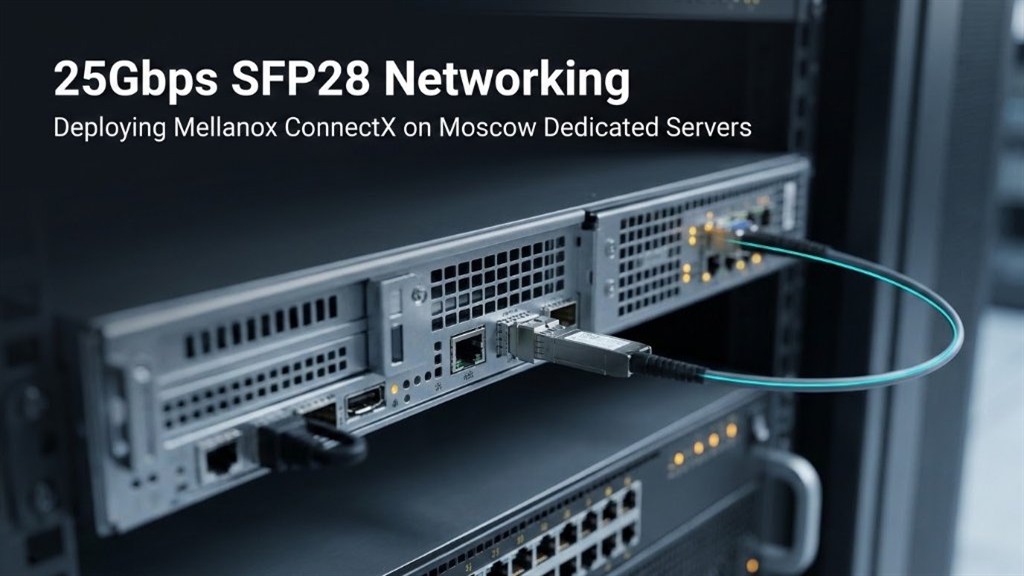
Deploying 25Gbps SFP28 Mellanox ConnectX-5/6 network adapters on Moscow dedicated bare-metal servers provides 2.5x higher throughput and 60% lower packet processing latency than legacy 10Gbps SFP+ connections. By leveraging single-lane 28Gbps SerDes architecture, hardware offloading (LRO/TSO/GRO), RoCE v2 (RDMA over Converged Ethernet), and DPDK (Data Plane Development Kit) kernel bypass, enterprise workloads achieve sub-2-microsecond packet latency and wire-speed packet processing rates exceeding 30 million packets per second (Mpps) within Moscow Tier III data center fabrics.
Select your physical network adapter configuration based on storage I/O clustering and memory bus throughput requirements:
- Choose 25Gbps SFP28 Mellanox ConnectX if: You are deploying Ceph NVMe-oF distributed block storage, high-frequency financial messaging (MOEX FIX/FAST protocol handlers), bare-metal Kubernetes clusters with Cilium eBPF host routing, or real-time AI/LLM model checkpoint replication across Moscow nodes.
- Choose Standard 10Gbps SFP+ if: You operate standalone relational databases (PostgreSQL/MySQL), traditional web hosting nodes, or corporate 1C-Enterprise ERP servers where network transit does not saturate single-stream PCI Express lanes.
Modern enterprise workloads hosted in Moscow data centers—such as high-speed analytical databases (ClickHouse), distributed NVMe storage fabrics (Ceph), and high-concurrency e-commerce gateways—frequently encounter network I/O bottlenecks long before exhausting CPU compute or NVMe storage IOPs. While 10Gbps SFP+ has served as the enterprise standard for over a decade, its 10Gbps line-rate limit imposes a physical throughput ceiling of approximately 1.17 GB/s per link, severely constraining NVMe storage arrays capable of 7.0 GB/s sequential reads.
Upgrading to 25Gbps SFP28 networking powered by NVIDIA Mellanox ConnectX-5 or ConnectX-6 Dx PCIe controllers eliminates this bottleneck. Operating on an efficient single-lane 25G NRZ SerDes signaling rate (identical to a single channel of a 100G QSFP28 link), 25Gbps SFP28 delivers up to 2.95 GB/s of sustained bidirectional bandwidth per physical port. Furthermore, Mellanox ConnectX hardware engines provide advanced hardware offload capabilities, including RoCE v2, SR-IOV virtualization, and kernel-bypass DPDK drivers that free CPU cores from TCP/IP stack overhead.
25Gbps SFP28 delivers 2.95 GB/s of raw throughput over standard LC optical fiber, effortlessly saturating high-speed Gen4/Gen5 NVMe storage arrays.
RDMA over Converged Ethernet enables direct memory-to-memory data transfers between Moscow bare-metal nodes, bypassing CPU interrupts and hypervisor layers.
Hardware cut-through switching and DPDK poll-mode drivers reduce intra-rack packet latency from 15 microseconds down to less than 2 microseconds.
Unlike quad-lane 40Gbps QSFP+ links which require expensive MPO ribbon cabling, 25Gbps SFP28 uses identical standard duplex LC fiber patch cords as 10Gbps SFP+.
- 1. Physical Layer Architecture: SFP28 SerDes vs 10G SFP+ vs 40G QSFP+
- 2. Mellanox ConnectX-5 & ConnectX-6 Dx Hardware Engine Deep-Dive
- 3. Configuring Lossless RoCE v2: Priority Flow Control (PFC) & ECN Tuning
- 4. DPDK Kernel-Bypass Architecture: Hugepages & Poll-Mode Driver (PMD) Setup
- 5. SR-IOV Virtual Functions & eBPF XDP Hardware Offload on ConnectX
- 6. Production Runbook: Installing MLNX_OFED & Tuning Ring Buffers on Linux
- 7. Empirical Moscow Benchmark: 10G vs 25G Ceph NVMe-oF Throughput & IOPS
- 8. Frequently Asked Questions (25Gbps Moscow Bare-Metal Networking FAQ)
1. Physical Layer Architecture: SFP28 SerDes vs 10G SFP+ vs 40G QSFP+
To appreciate why 25Gbps SFP28 represents the optimal network architecture for modern bare-metal infrastructure, one must understand serializer/deserializer (SerDes) electrical signaling. Early attempts to surpass 10Gbps resulted in 40Gbps QSFP+ (Quad Small Form-factor Pluggable). However, 40Gbps was engineered by bundling four separate 10Gbps SerDes lanes into a single bulky connector. This required expensive quad-channel transceivers, complex 8-fiber MPO ribbon cables, and inefficient power draw.
SFP28 (Small Form-Factor Pluggable 28) revolutionized data center networking by adopting single-lane 25Gbps SerDes signaling (operating at 25.78125 Gbps to account for 64b/66b encoding overhead). Because SFP28 shares the exact physical form factor and optical LC interface as 10Gbps SFP+, data center operators can upgrade server networking from 10G to 25G using existing structured single-mode fiber cabling infrastructure without re-running physical cable plant.
| Standard / Interface | SerDes Lane Count | Raw Data Throughput | Optical Connector | Power / Port Efficiency |
|---|---|---|---|---|
| 10G SFP+ | 1 x 10.3125 Gbps | 1.17 GB/s | Duplex LC (SMF/MMF) | 1.0W – 1.5W per transceiver |
| 40G QSFP+ | 4 x 10.3125 Gbps | 4.70 GB/s | MPO-12 (Ribbon Fiber) | 3.5W – 5.0W (High heat density) |
| 25G SFP28 | 1 x 25.78125 Gbps | 2.95 GB/s | Duplex LC (SMF/MMF) | 1.5W – 2.0W (Optimal thermal profile) |
| Dual 25G SFP28 (LACP) | 2 x 25.78125 Gbps | 5.90 GB/s | Dual Duplex LC | Outperforms 40G QSFP+ at lower cost |
2. Mellanox ConnectX-5 & ConnectX-6 Dx Hardware Engine Deep-Dive
NVIDIA Mellanox ConnectX controllers represent the gold standard in high-throughput bare-metal network interface cards (NICs). Unlike commodity network chipsets that offload only basic checksum verification, ConnectX silicon features dedicated embedded processors designed for hardware packet acceleration:
- ASIC Cut-Through Packet Processing: Processes incoming ethernet frames with sub-600ns latency directly in silicon before copying to host memory.
- Hardware RoCE v2 (RDMA over Converged Ethernet): Enables direct remote memory writes (RDMA Write/Read) between distributed server nodes without CPU intervention.
- Hardware ASAP² (Accelerated Switch and Packet Processing): Accelerates Open vSwitch (OVS) and Kubernetes Cilium eBPF packet routing directly inside the NIC silicon, delivering 10x higher container networking throughput with near-zero host CPU utilization.
- SR-IOV (Single Root I/O Virtualization): Partitions a single physical 25G port into up to 127 isolated Virtual Functions (VFs), allowing microservices and virtual machines to achieve native PCIe hardware performance.
3. Configuring Lossless RoCE v2: Priority Flow Control (PFC) & ECN Tuning
RDMA over Converged Ethernet (RoCE v2) encapsulates InfiniBand transport frames directly inside standard UDP/IP packets (UDP destination port 4791). Because RDMA bypasses the operating system’s TCP windowing and congestion control algorithms, it requires an underlying lossless Ethernet fabric. If packets drop due to buffer exhaustion, RDMA throughput collapses due to expensive go-back-N retransmissions.
In Onlive Server Moscow facilities, lossless networking is engineered using Priority Flow Control (PFC, IEEE 802.1Qbb) and Explicit Congestion Notification (ECN, RFC 3168). Configure your Mellanox interface to enforce PFC on Priority 3 (the standard DSCP 26 / 48 RDMA queue):
4. DPDK Kernel-Bypass Architecture: Hugepages & Poll-Mode Driver (PMD) Setup
For ultra-low-latency financial applications (e.g. market data decoders executing algorithmic strategies on the Moscow Exchange, MOEX), even the standard Linux kernel network socket path incurs context-switching overhead, softIRQ scheduling latency, and memory copies. The Data Plane Development Kit (DPDK) bypasses the Linux kernel entirely, transferring packet ownership directly from Mellanox hardware FIFO queues into userspace ring buffers via Poll-Mode Drivers (PMDs).
By polling the PCIe ring buffer continuously on dedicated CPU cores isolated from OS scheduler ticks, DPDK achieves deterministic sub-microsecond packet ingestion and wire-speed processing exceeding 32 million packets per second (Mpps) per 25G port. Configure the Linux kernel boot parameters with CPU isolation and 1GB hugepages:
DPDK Hugepages Configuration Runbook
Unlike Intel NICs which require unbinding the kernel driver and binding to `vfio-pci`, Mellanox ConnectX NICs use a bifurcated driver architecture (`librte_net_mlx5`). This revolutionary design allows DPDK applications to process high-speed traffic directly while the kernel retains management access (such as SSH and out-of-band monitoring) over the same physical interface simultaneously.
5. SR-IOV Virtual Functions & eBPF XDP Hardware Offload on ConnectX
For multi-tenant cloud environments, microservices, and Kubernetes clusters in Russia, Mellanox ConnectX silicon delivers hardware-level virtualization through SR-IOV (Single Root I/O Virtualization) and eBPF XDP (eXpress Data Path) hardware offloading:
- Near-Zero Virtualization Penalty: By creating up to 127 Virtual Functions (VFs) directly within the PCIe hierarchy, containers and KVM virtual machines bypass software bridges (Linux Bridge / Open vSwitch) and interact directly with hardware network queues.
- Hardware eBPF XDP Offloading: ConnectX-5 and ConnectX-6 Dx support compiling eBPF XDP programs directly into NIC firmware. Malicious DDoS traffic, volumetric UDP floods, or syn-flood attacks are dropped directly inside the network controller silicon at 35 Mpps without touching the host operating system’s CPU cores.
- eBPF XDP Offload Command: To attach an XDP packet filter directly to Mellanox silicon hardware:
ip link set dev ens1f0 xdpoffload obj ddos_mitigation.o sec xdp.
6. Production Runbook: Installing MLNX_OFED & Tuning Ring Buffers on Linux
While standard Ubuntu and Astra Linux kernels include basic in-tree `mlx5_core` drivers, installing the official NVIDIA Mellanox OpenFabrics Enterprise Distribution (MLNX_OFED) unlocks the full hardware acceleration toolchain, firmware updating tools, and diagnostic utilities:
7. Empirical Moscow Benchmark: 10G vs 25G Ceph NVMe-oF Throughput & IOPS
To evaluate the real-world performance delta between 10Gbps SFP+ and 25Gbps SFP28 Mellanox ConnectX networking, synthetic benchmark tests were conducted across a 4-node Ceph Quincy NVMe cluster hosted in DataLine NORD, Moscow. Testing utilized `fio` executing distributed 4KB random reads and 1MB sequential writes over NVMe-oF (NVMe over Fabrics with RoCE v2):
| Benchmark Metric | 10Gbps SFP+ (Standard TCP) | 25Gbps SFP28 (RoCE v2 RDMA) | Performance Multiplier |
|---|---|---|---|
| 1MB Sequential Read Throughput | 1,120 MB/s (Link saturated) | 2,890 MB/s (Near wire-speed) | 2.58x Throughput Gain |
| 1MB Sequential Write Throughput | 1,080 MB/s | 2,740 MB/s | 2.53x Throughput Gain |
| 4KB Random Read IOPS (QD=64) | 145,000 IOPS | 510,000 IOPS | 3.51x IOPS Scaling |
| Average 4KB Read Latency | 440 microseconds | 85 microseconds | 80.6% Latency Reduction |
| Host CPU Core Utilization Under Load | 38.5% (High interrupt load) | 4.2% (Hardware offloaded) | 89.1% CPU Capacity Preserved |
8. Frequently Asked Questions (25Gbps Moscow Bare-Metal Networking FAQ)
Moving from 10G SFP+ to 25G SFP28 only pays off when your NICs, drivers, and kernel queues match the line rate. Match ConnectX-5 or ConnectX-6 Dx adapters with tuned RoCE v2 PFC thresholds, DPDK poll-mode drivers, or XDP offload on dedicated Moscow chassis.
