

Direct Technical Answer
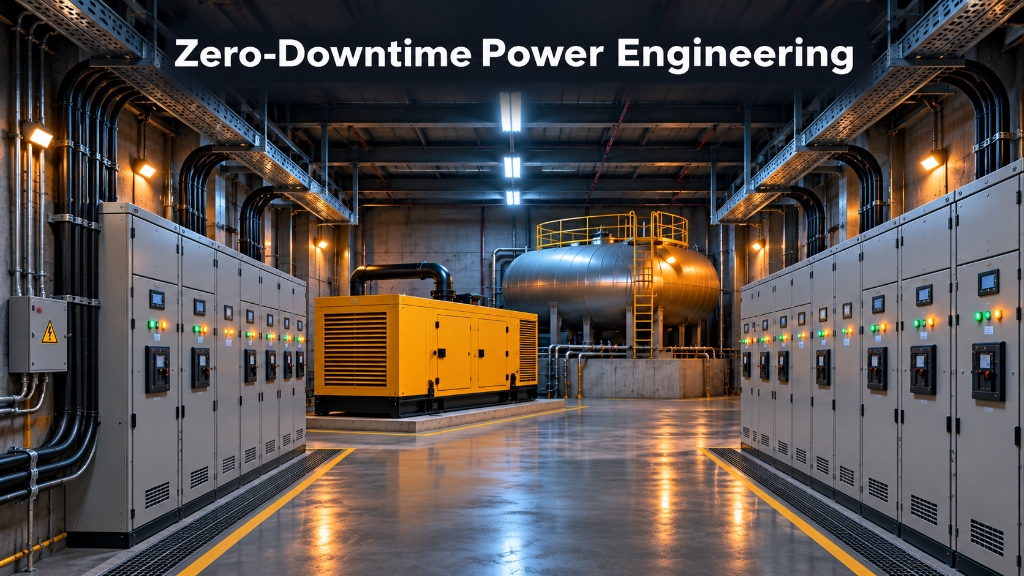
Achieving 100% uptime with a Loadshedding power backup dedicated server South Africa during severe Eskom Stage 6 and Stage 8 national grid failures requires a true 2N concurrent maintainable electrical topology. Deployed inside premier Johannesburg (Teraco JB1) and Cape Town facilities, bare-metal servers utilize dual independent A+B power paths fed by rotary dynamic UPS (DRUPS) systems and multi-megawatt Caterpillar diesel generator arrays backed by 72-hour onsite fuel reserves and SLA fuel delivery contracts, ensuring zero millisecond power interruption to enterprise hardware.
Electrical Resilience & Loadshedding Evaluation Matrix
- Utility Separation Architecture: Verify that the datacenter maintains physical medium-voltage connections to two separate municipal power substations (Eskom / City Power) to isolate localized grid faults.
- Rotary vs Static UPS: Diesel Rotary Uninterruptible Power Supply (DRUPS) eliminates reliance on chemical lead-acid battery banks, utilizing mechanical kinetic flywheels to bridge the 10-second transition to diesel generation.
- Chassis-Level Dual PSUs: Ensure server hardware features dual redundant 80-Plus Platinum Power Supply Units connected to separate A and B in-rack Power Distribution Units (PDUs).
- Onsite Fuel Reserves: The facility must store minimum 72 hours of diesel fuel at 100% generator load on premises, supported by priority refueling SLAs with major fuel distributors (Sasol, BP, Shell).
Operating digital enterprise systems in South Africa requires confronting an operational reality unique among industrialized economies: the national power crisis. Eskom, South Africa’s state-owned electrical utility, implements rotational power cuts known as “loadshedding” to prevent total collapse of the national transmission grid. During elevated stages—such as Stage 6 (shedding 6,000 MW) or Stage 8 (shedding 8,000 MW)—commercial and residential areas experience up to 12 hours of rolling blackouts per day in alternating 2 to 4-hour intervals.
For mission-critical digital workloads—such as high-frequency trading on the Johannesburg Stock Exchange (JSE), online banking payment gateways, e-commerce checkouts, and 24/7 cloud microservices—even a 10-millisecond power flicker forces server motherboards to hard reboot, corrupting transactional database tables and crashing active TCP sessions. Operating unmanaged on-premises server rooms or substandard colocation facilities during loadshedding is commercially untenable. This technical guide outlines the electrical engineering architecture, rotary UPS systems, generator infrastructure, and IPMI power telemetry that guarantee continuous 99.999% uptime on dedicated bare-metal servers in South Africa.
Completely redundant electrical distribution (A-feed and B-feed) from independent municipal substations directly to dual server PSUs.
Kinetic energy flywheels bridge the 10-second transition to diesel generator crank without chemical battery degradation.
Hundreds of thousands of liters of bulk diesel stored onsite, supported by priority commercial replenishment contracts.
Real-time Linux kernel monitoring of AC input voltages, power consumption, and power supply health via IPMI and IPMI Exporter.
Table of Contents
- 1. The Reality of South Africa’s Energy Crisis: Surviving Stage 6 and Stage 8 Eskom Loadshedding
- 2. Electrical Distribution Architecture: True 2N Isolated Power Paths (A+B Feeds) to Bare Metal Racks
- 3. Rotary UPS and Flywheel Systems: Bridging the 15-Second Gap to Generator Crank
- 4. Diesel Turbine Redundancy and Guaranteed 72-Hour Bulk Fuel Replenishment Contracts
- 5. IPMI Telemetry: Monitoring Server Power Supply Unit (PSU) Redundancy and Voltage Fluctuations
- 6. Frequently Asked Questions (Eskom Loadshedding & Power SLAs)
1. The Reality of South Africa’s Energy Crisis: Surviving Stage 6 and Stage 8 Eskom Loadshedding
To understand the critical necessity of enterprise power engineering in South Africa, one must comprehend the mechanics of Eskom’s national loadshedding stages. Loadshedding is an emergency controlled rotational blackout mechanism implemented when national demand exceeds available generation capacity. Each “Stage” represents the removal of 1,000 Megawatts (MW) of electrical load from the national grid.
| Loadshedding Stage | Load Shed (MW) | Outage Frequency & Duration | Impact on Standard Infrastructure | Teraco / Onlive Server Bare Metal |
|---|---|---|---|---|
| Stage 2 | Up to 2,000 MW | Up to 4 hours / day (2-hr blocks) | Small UPS battery drain; AC cooling stress | 100% Continuous Uptime |
| Stage 4 | Up to 4,000 MW | Up to 7.5 hours / day (3-4 cycles) | Standard office generators overheat; fuel runs dry | 100% Continuous Uptime |
| Stage 6 | Up to 6,000 MW | Up to 10 hours / day (Multiple 4-hr slots) | Telecom base stations go dark; brownouts surge | 100% Continuous Uptime |
| Stage 8 | Up to 8,000 MW | Up to 12 – 14 hours / day (Continuous) | Total commercial infrastructure collapse | 100% Continuous Uptime (72h+ Island) |
When utility power is cut during Stage 8, the incoming electrical substation voltage drops to absolute zero. Without industrial-scale power generation, server components instantly shut down. Worse, when grid power is restored, massive inductive inrush currents cause severe voltage spikes (surges up to 400V) that physically burn out server power supplies and motherboard capacitors.
When deploying high-availability enterprise services in Southern Africa, opting for resilient 99.99% uptime South Africa Dedicated Server infrastructure provides raw compute isolation and multi-megawatt redundant power engineering inside Teraco JB1 and CT1.
2. Electrical Distribution Architecture: True 2N Isolated Power Paths (A+B Feeds) to Bare Metal Racks
The cornerstone of Tier-3 datacenter resilience in South Africa is true 2N electrical distribution. Unlike basic N+1 redundancy (which merely adds a spare generator or UPS module to a single shared busbar), a 2N topology constructs two completely independent, physically separated power distribution systems designated as Feed A and Feed B.
Each path features its own dedicated medium-voltage transformers, switchboards, UPS filtering systems, distribution panels, and rack PDUs. There is zero physical or electrical crossover between Feed A and Feed B prior to the server chassis:
- Feed A (Primary Path): Substation 1 → MV Switchgear A → DRUPS System A → PDU A → Server Power Supply Unit 1 (PSU1).
- Feed B (Secondary Path): Substation 2 → MV Switchgear B → DRUPS System B → PDU B → Server Power Supply Unit 2 (PSU2).
In this configuration, an entire electrical distribution chain can be completely shut down for scheduled maintenance, transformer replacement, or breaker testing without causing a single millisecond of downtime to active dedicated servers. Each server PSU is sized to support 100% of the system’s thermal and compute load independently.
3. Rotary UPS and Flywheel Systems: Bridging the 15-Second Gap to Generator Crank
When utility power is severed by Eskom, diesel backup generators cannot deliver full electrical load instantly. Heavy industrial diesel engines (such as Caterpillar 3516B or Cummins QSK60 turbines) require approximately 8 to 14 seconds to crank, achieve 1,500 RPM operating velocity, stabilize frequency at 50Hz (±0.1Hz), and close the automatic transfer switch (ATS).
In traditional facilities, this 14-second gap is bridged by chemical valve-regulated lead-acid (VRLA) batteries. However, in South Africa’s intense loadshedding environment—where blackouts occur multiple times per day—chemical batteries experience rapid thermal degradation, electrolyte dry-out, and failure within 12 to 18 months due to repeated deep discharge cycles.
Teraco JB1 and modern Tier-3 facilities solve this by deploying Diesel Rotary Uninterruptible Power Supply (DRUPS) systems:
How DRUPS Kinetic Flywheels Bridge Power Cuts
- Continuous Normal Operation: Under normal utility conditions, the synchronous motor rotates a massive steel flywheel in a vacuum chamber at 3,000 RPM, storing immense kinetic energy while conditioning utility power and filtering voltage harmonics.
- Grid Failure Event: When Eskom utility voltage drops, the kinetic energy stored in the rotating flywheel immediately discharges through an electromagnetic clutch, driving the alternator to sustain 100% clean AC electrical output with zero millisecond phase discontinuity.
- Generator Engagement: Simultaneously, the diesel turbine cranks and synchronizes with the alternator within 8 seconds. Once synchronized, the diesel engine assumes the load, and the flywheel returns to full rotational speed.
4. Diesel Turbine Redundancy and Guaranteed 72-Hour Bulk Fuel Replenishment Contracts
Generating off-grid electrical power at datacenter scale requires immense fuel logistics. Teraco Isando (JB1) maintains an installed generator capacity exceeding 60 Megawatts (MW) across multiple multi-megawatt generator banks.
To survive extended national grid emergencies without utility power, facilities maintain:
- Onsite Underground Storage: Multiple double-walled underground bulk fuel tanks holding hundreds of thousands of liters of clean, conditioned low-sulfur diesel, providing guaranteed continuous operation for a minimum of 72 consecutive hours at full facility load.
- Continuous Polishing Systems: Automated fuel filtration units continuously circulate, dehydrate, and filter stored diesel to eliminate microbial growth, algae, and particulate contamination.
- Priority Commercial Fuel Refueling SLAs: Legally binding primary and secondary fuel replenishment agreements with national distributors (Sasol, BP, Shell) guaranteeing priority tanker deliveries within 6 hours of dispatch, enabling indefinite islanded operation.
5. IPMI Telemetry: Monitoring Server Power Supply Unit (PSU) Redundancy and Voltage Fluctuations
At the bare-metal server level, systems administrators can continuously monitor physical power health via Intelligent Platform Management Interface (IPMI 2.0) and Power Management Bus (PMBus) telemetry. Dual enterprise power supplies expose real-time input AC voltages, output DC wattages, and internal temperatures directly to the operating system.
By integrating PMBus telemetry into Prometheus and Grafana dashboards, sysadmins receive instant notifications if an in-rack PDU breaker trips or if an A/B feed experiences voltage drop, enabling hot-swap remediation before server stability is compromised.
To compare regional datacenter routing latency across South Africa and the wider SADC trading bloc, explore our technical benchmark analyzing Johannesburg vs Cape Town datacenter latency to SADC countries.
6. Frequently Asked Questions (Eskom Loadshedding & Power SLAs)
Grid blackouts expose single-feed racks and undersized battery banks within minutes. Pair true 2N A+B power feeds, rotary flywheel bridging, and 72-hour onsite diesel contracts with active IPMI PSU telemetry so your production hardware rides out Stage 8 Eskom loadshedding without unplanned shutdowns.
