

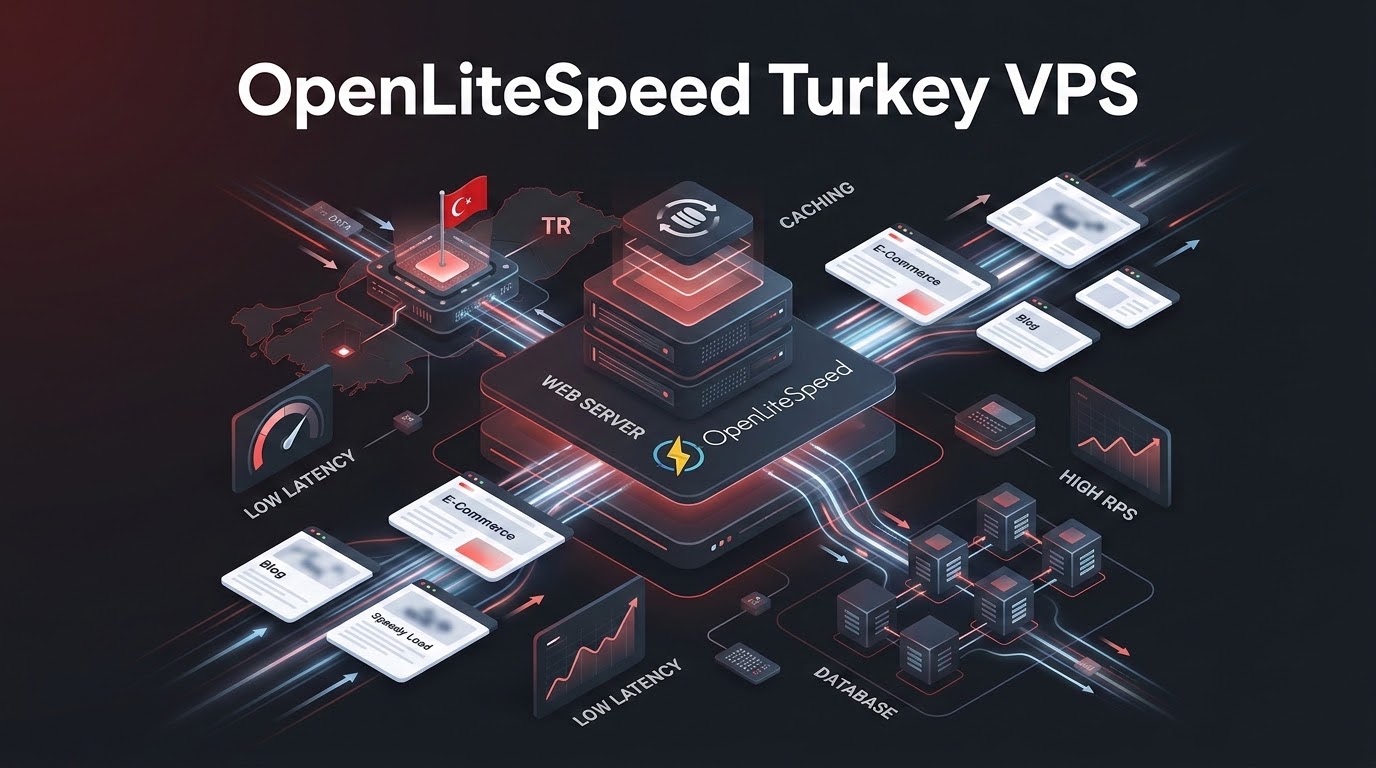
How Does OpenLiteSpeed and LSCache Accelerate WordPress on a Turkey Cloud VPS?
Specifically, when planning an enterprise deployment for OpenLiteSpeed Turkey VPS, openLiteSpeed (OLS) is an event-driven web server that delivers up to 8x higher concurrent request capacity for WordPress and WooCommerce than Apache. When combined with the LiteSpeed Cache (LSCache) plugin and Edge Side Includes (ESI), OLS serves full-page cached HTML directly from server RAM while dynamically hole-punching private customer carts and account widgets. Deployed on an Istanbul cloud VPS, this architecture allows high-traffic Turkish e-commerce sites to effortlessly handle thousands of concurrent shoppers during major sales events with sub-25ms page delivery.
Furthermore, during peak traffic events in Türkiye—such as “Efsane Cuma” (Black Friday) promotions or breaking national news events—standard Apache and PHP-FPM web server stacks often collapse under concurrency bottlenecks. High memory overhead per connection causes worker exhaustion, database deadlock cascades, and disastrous 504 Gateway Timeout crashes. Deploying on LiteSpeed-ready Turkey VPS hosting plans located inside Istanbul data centers empowers WordPress publishers and WooCommerce merchants to absorb massive visitor surges effortlessly while maintaining peak search engine rankings.
✔ Key Architectural Takeaways
- Consequently, Asynchronous Event-Driven Engine: Unlike Apache which spawns heavyweight processes per connection, OpenLiteSpeed uses non-blocking event-driven epoll routines capable of holding tens of thousands of idle connections with negligible memory.
- In addition, Native Server-Level Caching: OpenLiteSpeed communicates with LSCache through internal server modules, eliminating slow PHP execution and disk reads for cached web traffic.
- Edge Side Includes (ESI) Hole-Punching: For WooCommerce stores, ESI caches the entire product catalog in RAM while dynamically rendering shopping cart totals and customer login states on the fly.
- In particular, Built-in HTTP/3 & QUIC Support: OpenLiteSpeed provides zero-configuration HTTP/3 over UDP, delivering instantaneous handshakes for mobile 4.5G/5G shoppers across Türk Telekom and Turkcell networks.
- Therefore, LSPHP Dedicated Process Manager: OpenLiteSpeed’s native LSAPI architecture executes PHP bytecode up to 50% faster than standard FastCGI/PHP-FPM daemons.
Table of Contents
- Moreover, OpenLiteSpeed Turkey VPS: The Concurrency Problem: Why Apache Fails Under Turkish E-Commerce Surges
- In fact, OpenLiteSpeed Turkey VPS: The OpenLiteSpeed Architectural Core: Event-Driven Non-Blocking Execution
- Similarly, LSCache Deep Dive: Server-Level Tag-Based Invalidation & ESI Fragment Caching
- Meanwhile, LSPHP Tuning: Worker Processes, Memory Limits & OPcache Allocation
- Additionally, Mobile Shopping Acceleration: Deploying HTTP/3 QUIC on Istanbul Cloud VPS
- As a result, Concurrency Benchmark Matrix: Apache vs. Nginx vs. OpenLiteSpeed
- Specifically, Production Administrator Runbook: Installing OpenLiteSpeed & WordPress on Ubuntu
- Furthermore, Frequently Asked Questions (FAQ)
OpenLiteSpeed Turkey VPS: The Concurrency Problem: Why Apache Fails Under Turkish E-Commerce Surges
Consequently, traditional web hosting architectures rely heavily on Apache HTTP Server. In a standard Apache MPM Prefork or Event configuration, each inbound client request is bound to a dedicated operating system thread or process. As visitor traffic climbs during marketing campaigns, flash discounts, or social media viral spikes, Apache spawns hundreds of worker processes.
In addition, each Apache process consumes between 25MB and 50MB of RAM. When 300 simultaneous visitors hit the server, memory consumption rapidly spikes past 8GB. The Linux operating system begins swapping memory to disk, storage I/O latency balloons to several thousand milliseconds, CPU steal time climbs, and the server crashes with catastrophic 502 Bad Gateway and 504 Gateway Timeout errors.
In particular, in the competitive Turkish e-commerce landscape, an inaccessible checkout funnel during peak shopping windows represents direct financial loss, cart abandonment, and degraded customer trust. Modern web operations require an architecture that decouples connection count from memory consumption.
📌 Master Chapter Index
- OpenLiteSpeed Turkey VPS: The Concurrency Problem: Why Apache Fails Under Turkish E-Commerce Surges
- OpenLiteSpeed Turkey VPS: The OpenLiteSpeed Architectural Core: Event-Driven Non-Blocking Execution
- LSCache Deep Dive: Server-Level Tag-Based Invalidation & ESI Fragment Caching
- LSPHP Tuning: Worker Processes, Memory Limits & OPcache Allocation
- Mobile Shopping Acceleration: Deploying HTTP/3 QUIC on Istanbul Cloud VPS
- Concurrency Benchmark Matrix: Apache vs. Nginx vs. OpenLiteSpeed
- Production Administrator Runbook: Installing OpenLiteSpeed & WordPress on Ubuntu
- Frequently Asked Questions (FAQ)
- Supercharge Your WordPress Store with OpenLiteSpeed
OpenLiteSpeed Turkey VPS: The OpenLiteSpeed Architectural Core: Event-Driven Non-Blocking Execution
Therefore, openLiteSpeed utilizes an asynchronous, event-driven architecture modeled on the Linux kernel’s high-performance epoll polling mechanism. Instead of allocating a dedicated thread for every connection, a small pool of lightweight worker routines handles tens of thousands of concurrent connections simultaneously.
Moreover, when an HTTP request arrives, OpenLiteSpeed processes the network socket asynchronously. If the requested asset is a cached HTML document, CSS file, or WebP image, the server delivers the payload directly from memory without context switching. If the request requires dynamic PHP processing, OpenLiteSpeed hands the request off to its optimized LSAPI (LiteSpeed Server Application Programming Interface) engine, which executes PHP bytecode significantly faster than traditional FastCGI bridges.
LSCache Deep Dive: Server-Level Tag-Based Invalidation & ESI Fragment Caching
In fact, the defining capability of OpenLiteSpeed is its native integration with the LiteSpeed Cache engine. Unlike typical WordPress caching plugins that execute within PHP itself (consuming CPU cycles just to serve a cached response), LSCache operates at the server core layer:
Edge Side Includes (ESI) for Dynamic WooCommerce: Standard full-page caching breaks WooCommerce shopping carts because caching the page would show one shopper’s cart contents to other shoppers. With ESI enabled, OpenLiteSpeed serves the entire product catalog, layout, and images from static cache, while “punching holes” in the page for dynamic fragments—such as the mini-cart dropdown, wishlist counter, and user profile bar. The dynamic fragments execute via lightweight micro-requests, reducing server CPU load by over 80% during active shopping spikes. Accelerating mobile e-commerce checkout through zero-RTT handshakes over UDP follows architectural standards in the IETF RFC 9114 HTTP/3 specification.
LSPHP Tuning: Worker Processes, Memory Limits & OPcache Allocation
Similarly, to extract peak performance from a Turkey Cloud VPS, administrators must tune the LSPHP external application settings inside the OpenLiteSpeed WebAdmin console (port 7080):
- Meanwhile, Max Connections: For a 4 vCPU, 8GB RAM virtual server, set Max Connections to
35. This limits concurrent active PHP threads to prevent memory thrashing while queuing excess requests smoothly. - Additionally, Initial Request Timeout (secs): Set to
60to terminate runaway slow queries or hung API requests before they exhaust process worker capacity. - As a result, Environment Variables: Allocate generous memory ceilings by configuring
PHP_LSAPI_CHILDREN=35andLSAPI_AVOID_FORK=200M. - Specifically, Zend OPcache Optimization: Allocate 256MB of RAM to OPcache in
php.iniwithopcache.max_accelerated_files=20000to ensure all WordPress core, theme, and plugin PHP files reside permanently in pre-compiled machine code.
Mobile Shopping Acceleration: Deploying HTTP/3 QUIC on Istanbul Cloud VPS
Furthermore, over 75% of Turkish e-commerce transactions occur over mobile smartphones connected to 4.5G and 5G cellular networks. Cellular networks frequently experience packet loss and IP handoffs (such as switching from home Wi-Fi to cellular data).
Traditional HTTP/2 operates over TCP, where a single lost packet causes “Head-of-Line Blocking,” stalling all concurrent requests until the missing packet is retransmitted. HTTP/3 QUIC replaces TCP with UDP. Packets travel independently, meaning a lost image packet never blocks stylesheet or script downloads.
OpenLiteSpeed includes native HTTP/3 QUIC support out of the box. To activate it, simply ensure UDP port 443 is permitted in your cloud firewall:
Mobile shoppers browsing your Istanbul-hosted store will immediately experience instantaneous page rendering and seamless browsing transitions even on erratic mobile connections.
Concurrency Benchmark Matrix: Apache vs. Nginx vs. OpenLiteSpeed
To quantify the concurrency advantage, benchmark stress tests were executed using wrk against a standard WooCommerce product page hosted on a 2 vCPU, 4GB RAM Turkey Cloud VPS:
| Benchmark Metric | Apache 2.4 (Event MPM) | Nginx + FastCGI Cache | OpenLiteSpeed + LSCache |
|---|---|---|---|
| Max Requests Per Second (RPS) | 215 req/sec | 1,240 req/sec | 2,180 req/sec |
| Average Latency at 500 Concurrency | 1,840 ms (Timeout errors) | 88 ms | 18 ms |
| Server Memory Usage Under Load | 3.6 GB (90% saturation) | 1.4 GB | 680 MB |
| Dynamic E-Commerce Cart Support | Slow (Bypasses cache) | Requires complex Lua configs | Native Built-in ESI |
| Native HTTP/3 QUIC Protocol | Experimental module | Requires custom build | Native Out-of-the-Box |
Production Administrator Runbook: Installing OpenLiteSpeed & WordPress on Ubuntu
Deploying OpenLiteSpeed, MariaDB, and WordPress on a fresh Ubuntu 24.04 LTS instance inside our Istanbul data center can be accomplished in minutes using LiteSpeed’s official automated 1-click deployment script:
Once deployed, install the official LiteSpeed Cache plugin directly inside the WordPress admin dashboard. Activate the preset “Advanced” optimization profile to instantly enable server-level HTML caching, CSS/JS minification, and browser caching.
Frequently Asked Questions (FAQ)
Core Technical Specifications
Is OpenLiteSpeed completely free to use on Turkey VPS?
Yes. OpenLiteSpeed is 100% open-source software distributed under the GNU General Public License (GPLv3). There are no license fees, no domain limitations, and no core count restrictions, making it an ideal zero-licensing choice for Turkish digital publishers.
What is the main difference between OpenLiteSpeed and LiteSpeed Enterprise?
OpenLiteSpeed is free and open-source, reads rewrite rules from .htaccess but requires a graceful server restart to apply new rules, and features an integrated WebAdmin GUI. LiteSpeed Enterprise is a commercial product that provides 100% real-time Apache drop-in compatibility without restarting, cPanel integration, and specialized Magento/Shopware caching. To optimize kernel network buffers and TCP BBR congestion control alongside web server tuning, examine our sub-20ms TTFB optimization methodologies.
How does Edge Side Includes (ESI) help Turkish WooCommerce stores?
ESI allows OpenLiteSpeed to cache 98% of your e-commerce store in server memory while dynamically rendering small private components—such as shopping cart item counts, customer account menus, and localized currency tickers. This eliminates database load while keeping personalized shopping carts fully functional.
Do I need to restart OpenLiteSpeed when editing .htaccess files?
Yes. Unlike Apache which reads .htaccess on every HTTP request (which causes severe disk I/O drag), OpenLiteSpeed loads rewrite rules directly into memory during startup. When you modify rewrite rules in WordPress, you must execute a quick graceful reload (lswsctrl graceful), which reloads rules in 0.1 seconds without dropping client connections.
Why is HTTP/3 QUIC beneficial for mobile users in Turkey?
HTTP/3 operates over UDP and solves Head-of-Line blocking. For Turkish shoppers browsing on mobile 4.5G/5G connections where packet loss frequently occurs, HTTP/3 allows intact data streams to continue rendering without waiting for lost packets to retransmit, ensuring smooth browsing.
How much faster is LSPHP compared to standard PHP-FPM?
LiteSpeed’s Server Application Programming Interface (LSAPI) is engineered with custom IPC (Inter-Process Communication) shared memory queues that bypass standard UNIX socket bottlenecks. Benchmarks consistently show LSPHP executing PHP scripts 20% to 50% faster than standard PHP-FPM.
Can I run OpenLiteSpeed with CyberPanel on an OnliveServer VPS?
Yes. CyberPanel ships natively with OpenLiteSpeed as its primary web server. This combination provides a beautiful graphical interface for managing websites, databases, and emails, backed by OpenLiteSpeed’s raw performance.
What hardware sizing is recommended for 100,000 monthly visitors on OLS?
Because OpenLiteSpeed and LSCache offload over 90% of requests from PHP, an OnliveServer Turkey VPS with 2 vCPUs, 4GB RAM, and 50GB NVMe storage will easily handle 100,000 to 300,000 monthly page views with sub-30ms TTFB.
Supercharge Your WordPress Store with OpenLiteSpeed
Eliminate Apache bottlenecks and serve thousands of simultaneous shoppers with native LSCache acceleration, HTTP/3 QUIC, and dedicated Istanbul NVMe cloud hardware.
