

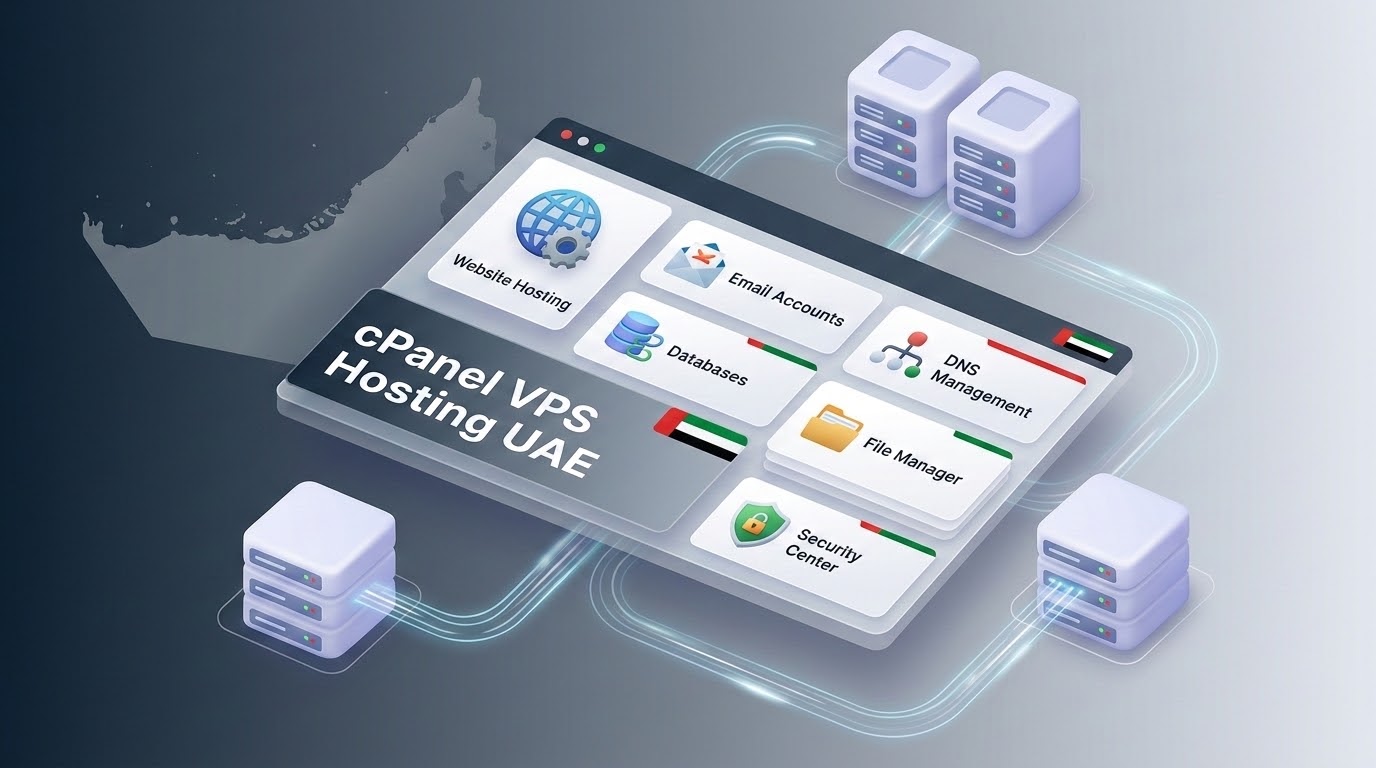
Specifically, when planning an enterprise deployment for cPanel VPS hosting UAE, cPanel/WHM enforces per-account recurring licensing fees that heavily penalize growing agencies, whereas CyberPanel on OpenLiteSpeed provides 100% free open-source hosting with native LSCache acceleration. Plesk Obsidian offers a balanced tiered model with superior WordPress staging toolkits and Git automation for enterprise DevOps teams.
- Consequently, aligning these configurations with your cPanel VPS hosting UAE environment ensures optimal uptime and throughput. Licensing Economics for Agencies: cPanel’s per-account pricing structure significantly increases monthly overhead for multi-client Dubai agencies, whereas CyberPanel offers open-source LiteSpeed hosting with zero licensing fees.
- Consequently, aligning these configurations with your cPanel VPS hosting UAE environment ensures optimal uptime and throughput. Web Server Engine Differentiation: CyberPanel is engineered natively around OpenLiteSpeed/LiteSpeed Enterprise, delivering up to 3x higher concurrent WordPress throughput than standard cPanel Apache setups.
- Furthermore, Resource Overhead Profiles: cPanel requires at least 2GB–4GB of baseline RAM purely for daemon management; CyberPanel operates on 1GB RAM, leaving greater hardware headroom for application workloads.
- Consequently, Turnkey Deployment: Deploying OnliveServer versatile UAE VPS hosting packages provides 1-click automated template installations for cPanel/WHM, CyberPanel, and Plesk Obsidian with optimized local Dubai routing.
cPanel VPS hosting UAE: Introduction: Selecting the Optimal Web Hosting Control Panel for Dubai Agencies
In addition, digital creative agencies, web development studios, and managed IT service providers across Dubai, Abu Dhabi, and the wider United Arab Emirates manage dozens—often hundreds—of client web properties simultaneously. These client portfolios span corporate WordPress sites, custom e-commerce stores, real estate portals, and staging environments. Efficiently managing these disparate workloads demands a robust, intuitive, and secure web hosting control panel.
In particular, for more than two decades, cPanel/WHM served as the undisputed industry standard for multi-tenant web management. However, drastic licensing restructuring and aggressive price increases enacted by cPanel’s parent company (Oakley Capital / WebPros) have transformed control panel licensing from a minor operational cost into a massive monthly expense billed in foreign currency.
Consequently, forward-thinking Gulf agencies are re-evaluating their platform architecture, comparing mature solutions like Plesk Obsidian alongside modern, high-speed open-source alternatives like CyberPanel. Sizing the right solution on a cPanel VPS hosting UAE instance requires balancing licensing overhead, raw web server performance, RAM footprint, client self-service usability, and automated security features.
Therefore, server provisioning, multi-PHP environment management, and account administration follow the official cPanel and WHM documentation.
📌 Master Chapter Index
- cPanel VPS hosting UAE: Introduction: Selecting the Optimal Web Hosting Control Panel for Dubai Agencies
- cPanel VPS hosting UAE: Web Server Architecture: OpenLiteSpeed vs Apache vs Nginx
- Feature, Performance & Licensing Comparison Matrix
- The Economic Realities of Agency Control Panel Licensing in AED
- Production Sizing Guide: RAM & CPU Allocation per Client Website
- Production Runbook: Automated CyberPanel Deployment & Redis Tuning
- Multi-Tenancy Security & Chroot Jail Isolation under DESC Baselines
- Frequently Asked Questions (FAQ)
cPanel VPS hosting UAE: Web Server Architecture: OpenLiteSpeed vs Apache vs Nginx
Moreover, beyond fiscal considerations, the control panel dictates your underlying HTTP server architecture and caching pipeline. The performance disparity between these architectures during high-concurrency traffic spikes is dramatic:
In fact, cPanel (Traditional Apache Stack): By default, cPanel deploys the Apache web server. While cPanel now offers Nginx reverse-proxy caching, Apache’s process-driven architecture creates high memory overhead under concurrent user loads. Dynamic PHP requests spawn dedicated worker processes, rapidly consuming available RAM and causing thread lockups during sudden traffic rushes.
Similarly, CyberPanel (Event-Driven OpenLiteSpeed): CyberPanel is designed ground-up for OpenLiteSpeed. OpenLiteSpeed utilizes an asynchronous, event-driven architecture that handles tens of thousands of concurrent connections on minimal CPU and RAM. Furthermore, OpenLiteSpeed integrates natively with the official LSCache WordPress plugin, enabling server-level page caching, automated image optimization, critical CSS generation, and dynamic ESI (Edge Side Includes) block caching directly in RAM with zero PHP execution overhead.
Plesk (Optimized Nginx Reverse Proxy): Plesk deploys Nginx in front of Apache as a reverse proxy, serving static files (images, CSS, JS) directly from Nginx while routing dynamic PHP requests to Apache via PHP-FPM. Plesk also allows administrators to run pure Nginx-only web stacks, achieving exceptional raw throughput for modern PHP and Node.js applications.
Feature, Performance & Licensing Comparison Matrix
Meanwhile, the following technical evaluation highlights the critical operational differences between cPanel, CyberPanel, and Plesk Obsidian when deployed on UAE cloud servers:
| Operational Criteria | cPanel & WHM | CyberPanel (OpenLiteSpeed) | Plesk Obsidian |
|---|---|---|---|
| Default Web Server | Apache / Nginx Reverse Proxy | OpenLiteSpeed / LiteSpeed Ent. | Nginx + Apache Hybrid |
| Licensing Model | Per-Account Recurring Surcharge (~110–220+ AED/mo) | 100% Free & Open Source (0 AED) | Tiered Account Surcharge (~55–165 AED/mo) |
| Idle RAM Footprint | 1.8GB – 2.5GB (Heavy daemon stack) | 500MB – 900MB (Lightweight event-driven) | 1.2GB – 1.8GB (Moderate overhead) |
| WordPress LSCache Support | Requires paid LiteSpeed Web Server license | Native out-of-the-box integration | Requires extension or Nginx fastcgi caching |
| Docker & Node.js Support | Basic Application Manager (Passenger) | Built-in Docker container manager | Best-in-class native Docker & Git integration |
| Target User Base | Traditional shared hosting & non-technical clients | WordPress power users & performance agencies | DevOps agencies & full-stack app developers |
Additionally, agencies managing multi-client web portfolios can streamline operations using cPanel and WHM management solutions.
The Economic Realities of Agency Control Panel Licensing in AED
As a result, when calculating monthly operating expenditures under UAE Corporate Tax and VAT rules, control panel licensing is frequently the single largest recurring cost outside of raw compute infrastructure. Prior to 2019, cPanel offered unlimited-domain VPS licenses for a flat fee. Today, cPanel enforces tiered account limits that penalize growing web agencies:
Specifically, cPanel/WHM Agency Cost Model: A base cPanel “Admin” license covers only 5 accounts for approximately 110 AED per month. The “Pro” tier permits up to 30 accounts for roughly 160 AED per month. The “Premier” tier covers 100 accounts for ~220 AED per month, plus an additional 1.80 AED per month for every individual account beyond 100. For a busy Dubai digital agency hosting 250 client websites across their cloud servers, cPanel licensing alone demands over 490 AED every calendar month—often exceeding the cost of the underlying high-performance VPS hardware!
Furthermore, CyberPanel Zero-Licensing Advantage: CyberPanel is entirely open-source and leverages the high-speed OpenLiteSpeed web server engine at zero cost. Whether an agency hosts 5 client sites or 500 client sites, the licensing fee remains permanently 0 AED. Agencies can redirect these substantial savings into marketing, client acquisition, or upgrading physical server compute specs (RAM, NVMe storage, and dedicated vCPUs).
Plesk Obsidian Middle Ground: Plesk (also owned by WebPros) utilizes fixed domain tiering: Web Admin (10 domains for ~55 AED/mo), Web Pro (30 domains for ~95 AED/mo), and Web Host (Unlimited domains for ~165 AED/mo). For agencies that demand a polished client portal with robust security tooling and Git staging workflows, Plesk Web Host edition provides a predictable, capped monthly licensing expense.
Production Sizing Guide: RAM & CPU Allocation per Client Website
Consequently, to prevent server degradation, agencies must match their VPS compute resources to the resource profile of their chosen control panel and client website density:
In addition, Small Agency Tier (10 to 25 Client Sites):
In particular, recommended Hardware: 2 vCPU, 4GB RAM, 80GB NVMe SSD. On CyberPanel, 4GB of RAM comfortably supports 25 active WordPress sites because the control panel consumes less than 800MB, leaving over 3GB for MariaDB caching and PHP-FPM workers. On cPanel, a 4GB VPS reaches capacity with approximately 15 client sites due to heavy daemon overhead.
Therefore, Medium Agency Tier (25 to 75 Client Sites):
Moreover, recommended Hardware: 4 vCPU, 8GB–16GB RAM, 160GB NVMe SSD. Ideal for Plesk Obsidian Web Pro or CyberPanel. Enables deploying Redis persistent object caching instances per client site and running automated staging environments.
In fact, Enterprise Agency Tier (75 to 200+ Client Sites):
Similarly, recommended Hardware: 8 vCPU, 32GB RAM, 320GB+ NVMe SSD. High-density multi-tenancy requiring dedicated database buffer pools, automated off-site backups, and strict CloudLinux OS resource isolation per cPanel/Plesk tenant.
Production Runbook: Automated CyberPanel Deployment & Redis Tuning
Meanwhile, deploying CyberPanel on a clean Ubuntu 22.04 or 24.04 LTS instance provides an instant, production-ready LiteSpeed hosting environment. Below is an automated deployment and performance tuning runbook for UAE VPS instances:
Once deployed, administrators can log in via port 8090, create client hosting accounts, configure automated Let’s Encrypt SSL certificates, and activate LSCache with 1-click simplicity.
As a result, for teams seeking high efficiency and lower licensing overhead, review our lightweight aaPanel server deployment guide.
Multi-Tenancy Security & Chroot Jail Isolation under DESC Baselines
Specifically, digital agencies hosting multiple client websites on a shared VPS server face severe security risks if a single client site is compromised through an outdated WordPress plugin or insecure theme script. In poorly configured environments, an attacker who gains web shell access to one virtual host can browse server file systems (such as reading /etc/passwd or neighboring wp-config.php database credentials), triggering a catastrophic multi-site breach.
To comply with Dubai Electronic Security Center (DESC) multi-tenancy isolation standards, agency administrators must enforce strict chroot jail environments. Technologies like CloudLinux CageFS (on cPanel and Plesk) or systemd service sandboxing (on CyberPanel) encapsulate each client account inside a virtualized private file system. Even if an attacker gains root-level access to a compromised WordPress directory, they remain trapped inside their isolated container jail, completely unable to view or access neighboring agency client data.
Frequently Asked Questions (FAQ)
Core Technical Specifications
Manage High-Traffic Client Portfolios with cPanel, CyberPanel or Plesk
Deploy automated staging, one-click WordPress installs, and multi-tenant PHP pools tailored for Middle Eastern digital design agencies.
