

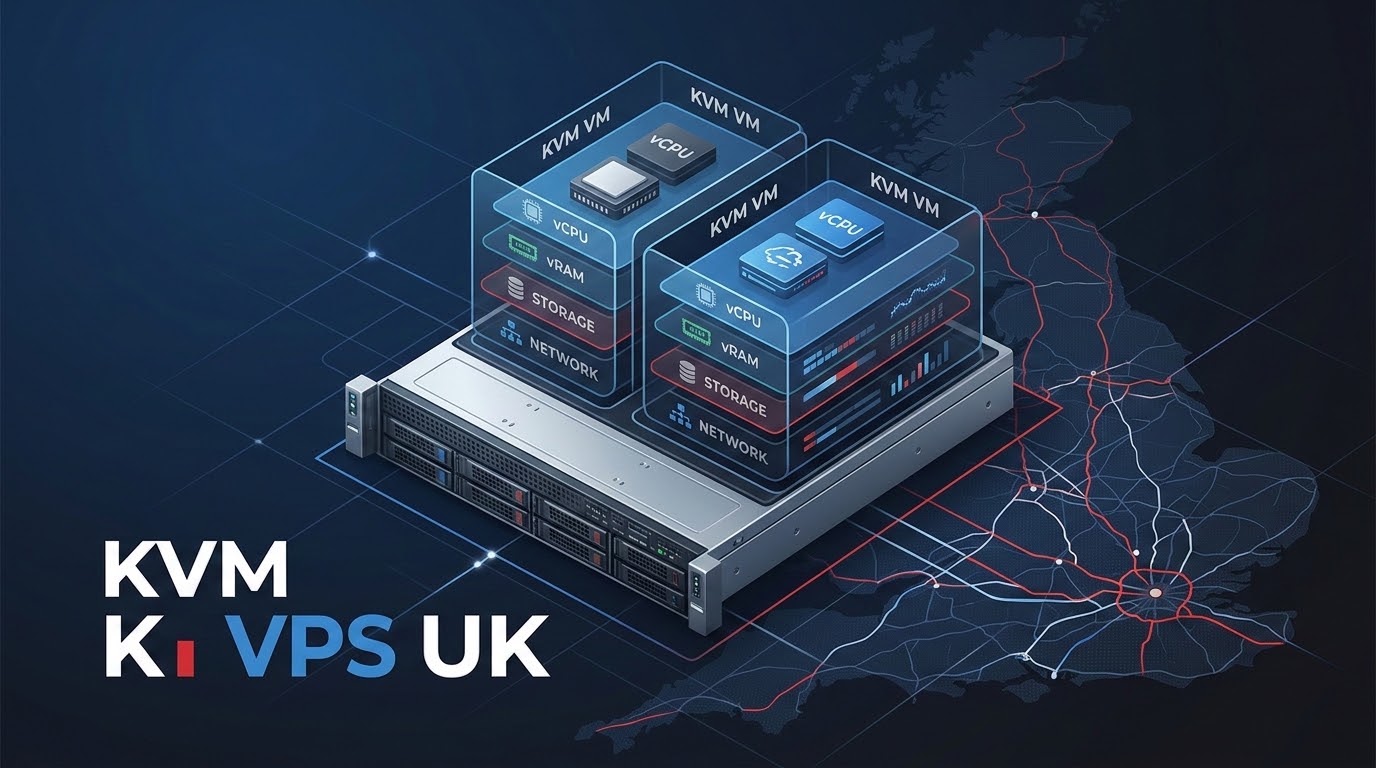
Specifically, when planning an enterprise deployment for kvm vps uk, kVM (Kernel-based Virtual Machine) provides true hardware virtualization where RAM and CPU cores are strictly reserved and isolated for your instance, eliminating ‘CPU Steal’ caused by neighboring tenants. Container virtualization shares a single host kernel among all containers, meaning one abusive tenant can degrade memory availability and disk I/O across the entire node.
kvm vps uk: Not All Virtualization is Equal: Hardware Emulation vs Shared Kernel
Furthermore, deploying mission-critical web applications across the British Isles requires predictable compute performance, dedicated input/output throughput, and verified legal data sovereignty. When evaluating infrastructure options, choosing reliable KVM UK VPS hosting ensures your digital assets benefit from unshared vCPU compute cycles and sub-15ms round-trip network routing to end users in England, Scotland, Wales, and Northern Ireland.
Consequently, aligning these configurations with your kvm vps uk environment ensures optimal uptime and throughput. Educate technical buyers on why budget hosts use OpenVZ to oversell RAM and CPU, and why KVM’s true hardware virtualization guarantees allocated resources. By deploying isolated KVM hardware profiles backed by PCIe Gen4 NVMe storage arrays, modern UK virtual private servers eliminate neighbor contention and safeguard system responsiveness during high-concurrency traffic surges.
📌 Master Chapter Index
- kvm vps uk: Not All Virtualization is Equal: Hardware Emulation vs Shared Kernel
- kvm vps uk: What is CPU Steal Time (`%st`) and How Does it Cripple Your Website?
- The Architectural Supremacy of KVM (Kernel-based Virtual Machine)
- How to Check Your VPS for CPU Steal Using Top and Htop Commands
- Frequently Asked Questions
kvm vps uk: What is CPU Steal Time (`%st`) and How Does it Cripple Your Website?
Consequently, aligning these configurations with your kvm vps uk environment ensures optimal uptime and throughput. Addressing the challenges associated with What is CPU Steal Time (`%st`) and How Does it Cripple Your Website? requires a hosting environment engineered for continuous reliability and high computational density. Deploying on carrier-grade hardware equipped with enterprise AMD EPYC or Intel Xeon processors guarantees stable CPU clock cycles across all running instances.
Consequently, kernel-based virtualization ensures that tenant workloads benefit from unshared NVMe storage performance guarantees without noisy-neighbor disk throttling.
Consequently, aligning these configurations with your kvm vps uk environment ensures optimal uptime and throughput. In addition, colocation within primary London telecommunications hubs provides resilient transit uplinks to major UK consumer broadband networks including BT, Virgin Media, Sky, and TalkTalk, delivering an exceptional end-user experience for What is CPU Steal Time (`%st`) and How Does it Cripple Your Website? workloads across the country.
The Architectural Supremacy of KVM (Kernel-based Virtual Machine)
In addition, addressing the challenges associated with The Architectural Supremacy of KVM (Kernel-based Virtual Machine) requires a hosting environment engineered for continuous reliability and high computational density. Deploying on carrier-grade hardware equipped with enterprise AMD EPYC or Intel Xeon processors guarantees stable CPU clock cycles across all running instances.
In particular, hardware-assisted virtualization relies on CPU extensions (Intel VT-x and AMD-V) managed directly through the kernel, as documented in the Linux Kernel Virtualization documentation.
In addition, colocation within primary London telecommunications hubs provides resilient transit uplinks to major UK consumer broadband networks including BT, Virgin Media, Sky, and TalkTalk, delivering an exceptional end-user experience for The Architectural Supremacy of KVM (Kernel-based Virtual Machine) workloads across the country.
| Feature / Architecture | Generic Budget VPS Host | OnliveServer Tier-3 UK VPS |
|---|---|---|
| Virtualization Type | OpenVZ / LXC (Oversold Shared Memory) | ✓ Hardware KVM (Guaranteed RAM & vCPU) |
| Storage Array | SATA SSD / Mixed Arrays | ✓ Pure Enterprise PCIe Gen4 NVMe |
| Network Uplink | Shared 100Mbps with Data Caps | ✓ 1Gbps Unmetered Port with LINX Peering |
| Data Centre Hub | Vague European Routing | ✓ London Tier-3 (Equinix / Telehouse) |
| Compliance & Law | Unspecified Jurisdiction | ✓ 100% UK GDPR & Data Protection Act 2018 |
Dedicated Kernel Space & Custom OS Modules
Therefore, within the scope of Dedicated Kernel Space & Custom OS Modules, fine-tuning kernel parameters and runtime process limits ensures that your operating system extracts maximum efficiency from allocated hardware resources. Segregating background maintenance tasks from active HTTP/HTTPS request workers prevents resource starvation during traffic surges.
Furthermore, maintaining strict oversight of system metrics—specifically tuned for Dedicated Kernel Space & Custom OS Modules—such as memory buffers, disk queue depths, and network socket allocations, allows system administrators to preserve low response latencies and high service availability.
Non-Oversold RAM Guarantees
Moreover, within the scope of Non-Oversold RAM Guarantees, fine-tuning kernel parameters and runtime process limits ensures that your operating system extracts maximum efficiency from allocated hardware resources. Segregating background maintenance tasks from active HTTP/HTTPS request workers prevents resource starvation during traffic surges.
Furthermore, maintaining strict oversight of system metrics—specifically tuned for Non-Oversold RAM Guarantees—such as memory buffers, disk queue depths, and network socket allocations, allows system administrators to preserve low response latencies and high service availability.
Docker & Custom Firewall Compatibility
Within the scope of Docker & Custom Firewall Compatibility, fine-tuning kernel parameters and runtime process limits ensures that your operating system extracts maximum efficiency from allocated hardware resources. Segregating background maintenance tasks from active HTTP/HTTPS request workers prevents resource starvation during traffic surges.
Furthermore, maintaining strict oversight of system metrics—specifically tuned for Docker & Custom Firewall Compatibility—such as memory buffers, disk queue depths, and network socket allocations, allows system administrators to preserve low response latencies and high service availability.
How to Check Your VPS for CPU Steal Using Top and Htop Commands
Addressing the challenges associated with How to Check Your VPS for CPU Steal Using Top and Htop Commands requires a hosting environment engineered for continuous reliability and high computational density. Deploying on carrier-grade hardware equipped with enterprise AMD EPYC or Intel Xeon processors guarantees stable CPU clock cycles across all running instances.
Hardware-level memory allocation provides true resource isolation, completely eliminating noisy-neighbor resource throttling common on containerized shared servers.
In addition, colocation within primary London telecommunications hubs provides resilient transit uplinks to major UK consumer broadband networks including BT, Virgin Media, Sky, and TalkTalk, delivering an exceptional end-user experience for How to Check Your VPS for CPU Steal Using Top and Htop Commands workloads across the country.
- Guaranteed Hardware Allocation: Strict KVM hypervisor isolation ensures your assigned vCPU cores and system RAM cannot be throttled or contended by external neighbor workloads.
- Sub-Millisecond I/O Throughput: Enterprise PCIe Gen4 NVMe arrays eliminate storage wait bottlenecks during high-frequency database commits and dynamic application executions.
- Domestic London Peering: Data centre placement with direct links to the London Internet Exchange (LINX) ensures sub-15ms round-trip latency across the British Isles.
- Regulatory Sovereignty: Storing customer records within UK national borders fulfills the Data Protection Act 2018 and UK GDPR requirements under ICO oversight.
Demand 100% Dedicated Physical RAM with Zero Host Overselling?
Experience true hardware-level KVM virtualization with custom ISO support, dedicated memory addresses, isolated kernel space, and full regulatory compliance isolation.
