

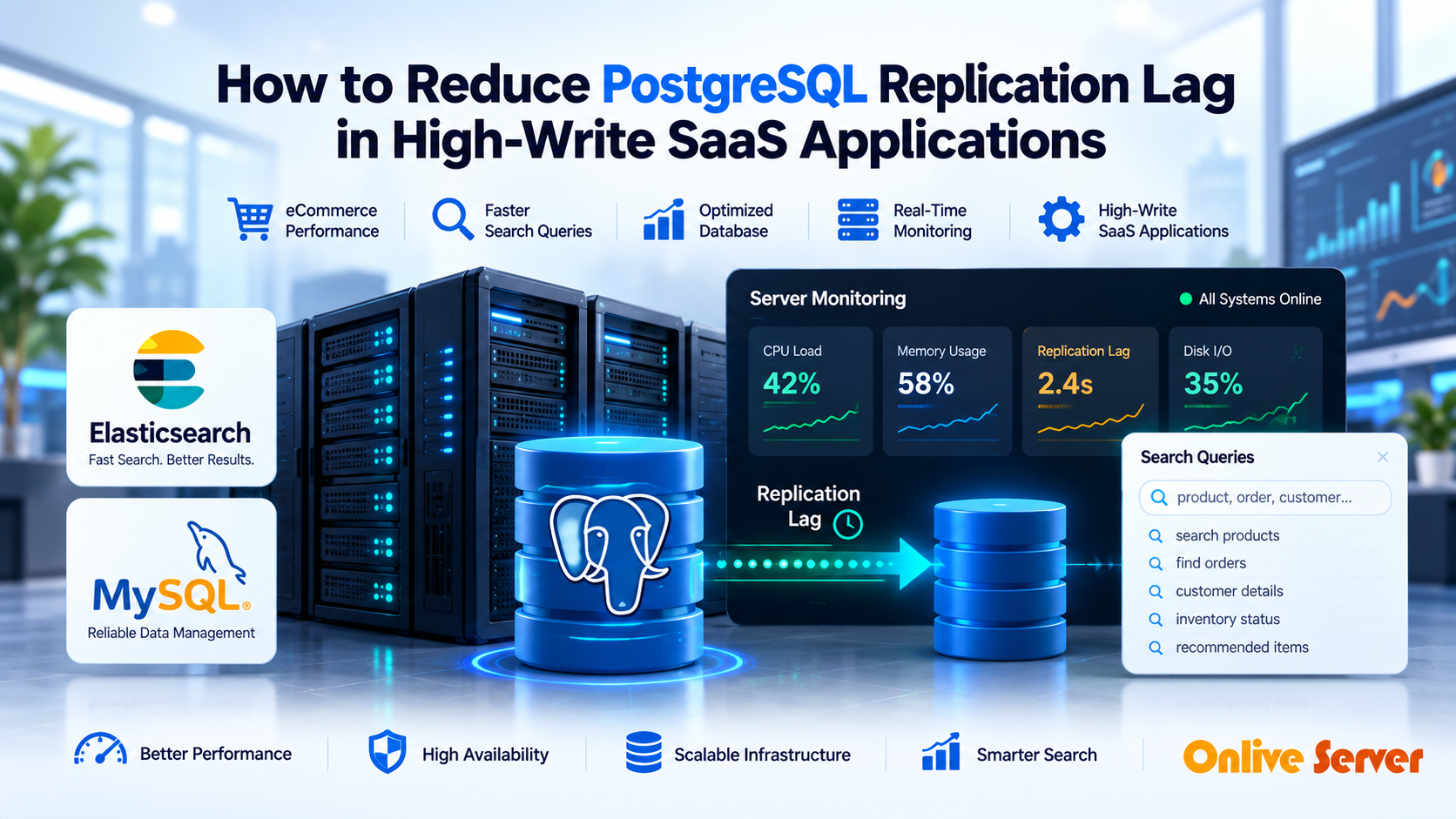
PostgreSQL replication lag in high-write SaaS applications is resolved by eliminating single-threaded WAL replay bottlenecks on read-replicas, matching replica NVMe disk I/O performance to the primary node, tuning `max_standby_streaming_delay` to prevent query conflict stalls, and enabling network WAL compression over low-latency private interconnects.
Modern multi-tenant SaaS applications depend on PostgreSQL read-replicas to scale user traffic. By routing read queries to secondary replicas, the primary database node remains free to handle incoming transactional updates.
However, when SaaS write volume escalates during batch jobs or peak hours, replication lag emerges. Users who update their profile or submit a payment are redirected to a read-replica that hasn’t processed the change yet, presenting stale data and triggering support tickets.
Eliminating replication lag requires harmonizing database replay configurations with robust infrastructure. Deploying primary and standby database instances on dedicated bare-metal database servers ensures both nodes possess symmetrical CPU power and enterprise NVMe throughput.
Why PostgreSQL Replication Lag Occurs
PostgreSQL streaming replication operates by having the primary WAL sender transmit transaction logs across the network to the standby WAL receiver process. While the primary node writes transactions using multiple parallel CPU worker threads, the replica has traditionally replayed them sequentially.
Additionally, long-running read queries on the replica can hold locks on tables that the incoming WAL stream needs to modify. If `max_standby_streaming_delay` is reached, PostgreSQL must choose between canceling the user query or allowing replication lag to widen.
Replication Bottleneck Diagnostic Matrix
| Lag Bottleneck | Primary Cause | System Indicator | Resolution Architecture |
|---|---|---|---|
| Asymmetric Storage Speed | Replica uses cheaper, slower cloud disks | High disk iowait on standby node | Provision identical NVMe RAID on replicas |
| Query Conflict Stalls | Standby queries block WAL replay process | Replication paused during long reports | Tune hot_standby_feedback & standby delay |
| Network Serialization | High network jitter or cross-region hops | TCP socket retransmission backlogs | Dedicated private VLAN with LZ4 compression |
| Massive Batch Updates | Bulk data migrations generating gigabytes of WAL | Sudden spike in replay byte lag | Chunk bulk write scripts into smaller batches |
Key Engineering Steps to Eliminate Replication Lag
To keep replication lag below 50 milliseconds in demanding multi-tenant SaaS environments, implement these three core technical adjustments:
First, maintain hardware parity. Running a powerful primary server alongside an under-provisioned replica is a guaranteed recipe for chronic lag. The replica must execute all write operations that the primary performed, often with additional read traffic overhead.
Second, configure `hot_standby_feedback = on`. This informs the primary server about transactions currently executing on the standby, preventing vacuum operations from removing dead rows that the replica is actively reading.
Third, optimize WAL network transmission. Sizable multi-tenant SaaS operations benefit from engaging a professional Linux server administrator to configure private point-to-point network routes and tune Linux TCP socket receive buffers.
Read-Your-Own-Writes Consistency Architecture
Even with optimal database tuning, asynchronous replication is subject to minor physical propagation delays. To guarantee a flawless user experience, application software should implement read-after-write routing.
When an authenticated SaaS user updates data, the application session marks the user session token. For the subsequent 5 to 10 seconds, all reads for that specific user are routed directly to the primary node, guaranteeing immediate consistency while normal traffic continues querying replicas.
For regional testing clusters or microservices requiring quick read scalability, pairing primary databases with high-performance cloud VPS instances offers cost-effective geographical distribution.
PostgreSQL Standby Tuning Parameter Matrix
| Parameter | Recommended Setting | Impact on Replication Lag |
|---|---|---|
| hot_standby_feedback | on | Prevents query cancellation conflicts on replicas |
| max_standby_streaming_delay | 30s (or match SLA) | Limits maximum time a read query can pause WAL replay |
| wal_receiver_timeout | 10s | Quickly detects severed network links and reconnects |
| wal_keep_size | 32GB to 64GB | Prevents replica disconnects during temporary traffic spikes |
Cascading Replication and Multi-Replica Topologies
When high-write SaaS applications scale to dozens of read-replicas across multiple geographical availability zones, connecting every replica directly to the primary server overwhelms the primary WAL sender threads and outbound network interfaces.
Implementing cascading replication resolves this scaling ceiling cleanly. A designated intermediary standby acts as a regional distribution hub, receiving transaction logs from the primary and re-broadcasting them to secondary local read-replicas.
This tiered streaming architecture preserves primary server CPU cycles and network capacity, ensuring that high-throughput writes remain completely uninhibited as your read architecture expands globally.
Summary and Key Recommendations
Replication lag is not an inevitable challenge of growing SaaS databases. It is an engineering bottleneck that can be resolved through symmetric hardware provisioning, sensible standby timeouts, and modern connection tuning.
Equipping both primary and secondary database instances with matching enterprise NVMe drives, configuring `hot_standby_feedback`, and adopting read-after-write application routing guarantees sub-second consistency and exceptional user experiences.
Physical Streaming Replication vs. Logical Replication Under Write Saturation
Modern SaaS applications require read replicas to distribute analytical queries and customer dashboard traffic. However, during high-volume bulk data imports or billing cycles, standby replicas frequently fall behind the primary database node by minutes or hours.
Infrastructure architects must understand the distinct operational differences between physical streaming replication and logical replication. Physical streaming replication operates at the disk block level, streaming raw write-ahead log (WAL) records directly to replicas with minimal CPU overhead.
In contrast, logical replication decodes WAL streams into discrete SQL transactions on the replica node, executing them as individual write statements. Under heavy multi-tenant write workloads, logical replication worker processes quickly saturate single CPU cores, creating severe replication bottlenecks.
Tuning Standby Delay Limits and Query Cancellation Conflicts
A primary driver of replication lag on read replicas is query conflict resolution. When a long-running read query holds locks on data rows that the primary node has updated or deleted, the replica startup process must pause applying WAL segments until the read query finishes.
If the pause exceeds the configured max_standby_streaming_delay threshold (default 30 seconds), PostgreSQL automatically terminates the conflicting client read query. Administrators tune this balance in postgresql.conf:
- hot_standby_feedback: Enabling this parameter instructs the standby to inform the primary about active read transactions, preventing the primary autovacuum from cleaning dead rows prematurely.
- max_standby_archive_delay: Increased to 60 seconds on dedicated analytical replicas to allow complex customer reporting queries time to complete without immediate cancellation.
- wal_receiver_status_interval: Reduced to 1 second to ensure the primary node receives real-time replication status acknowledgments continuously.
Parallel WAL Replay and Multi-Threaded Apply Engines
Historically, PostgreSQL applied write-ahead logs on standby nodes using a single-threaded recovery process. When the primary node utilized 32 CPU cores to process thousands of concurrent client writes, a single replay thread on the replica simply could not keep pace.
Modern PostgreSQL architectures benefit from parallel apply daemons and high-speed NVMe storage subsystems. Configuring max_parallel_maintenance_workers and ensuring the replica storage array matches primary write speeds allows the standby node to commit WAL segments as fast as they arrive over the wire.
Furthermore, isolating replication traffic onto dedicated 10GbE network interfaces with Jumbo Frames (MTU 9000) eliminates packet fragmentation and reduces network buffer queuing during high-volume write bursts.
Production Architecture Checklist for PostgreSQL Replication Stability
Eliminating replication lag across mission-critical SaaS database clusters requires comprehensive operational safeguards:
- Deploy enterprise NVMe storage with verified Power Loss Protection on all standby replica nodes to match primary commit speeds.
- Configure dedicated replication slots to guarantee the primary node retains necessary WAL segments during temporary network partitions.
- Enable Prometheus alerting when replication lag bytes exceed 100MB or replication lag time exceeds 15 seconds.
- Implement connection pooling layers (such as PgBouncer) to route latency-sensitive transactions strictly to the primary node.
- Schedule heavy data migrations and bulk batch updates during off-peak hours using small, batched transaction loops.
Automated Failover and Split-Brain Prevention
When primary database nodes suffer unexpected hardware failures, automated clustering daemons (such as Patroni or repmgr) evaluate standby replica lag before electing a new leader. Promoting a lagging replica results in catastrophic data loss for recently committed SaaS transactions.
Patroni integrates with distributed consensus stores (such as etcd or Consul) to enforce strict leader election rules. Standby nodes with unacceptable replication lag are disqualified from automatic promotion until data consistency is verified.
This automated consensus model guarantees zero data divergence while executing transparent failover promotions in under thirty seconds, preserving SaaS application availability.
Conclusion: Delivering Real-Time Multi-Region SaaS Reliability
Eliminating PostgreSQL replication lag requires harmonizing network transport, storage bandwidth, and database configuration settings. Isolating replication traffic onto dedicated high-speed interfaces and tuning standby conflict delays prevents read replicas from falling behind during write bursts.
By coupling physical streaming replication with automated consensus clustering and proactive telemetry, SaaS providers deliver instantaneous read scalability to global users. Robust database engineering ensures your multi-tenant platform remains responsive, consistent, and highly available under extreme transaction volumes.
Frequently Asked Questions
What is the acceptable replication lag for SaaS applications?
For high-performance SaaS applications, replication lag should remain under 100 milliseconds. Any lag exceeding 1 second creates visible data inconsistency for end-users refreshing screens.
Why does a read query on a replica cause replication lag?
If a read query accesses table rows that an incoming WAL record needs to update or delete, the replay process must pause until the read query finishes or exceeds max_standby_streaming_delay.
What is the downside of enabling hot_standby_feedback = on?
While it eliminates query conflicts, if someone runs an unoptimized query on the replica that takes hours, it prevents the primary node from cleaning dead rows, potentially causing table bloat on the primary.
Can replication lag be eliminated using synchronous replication?
Synchronous replication guarantees zero lag by forcing write transactions to wait until the replica acknowledges receipt, but this increases transaction commit latency and impacts write throughput.
How does read-your-own-writes session routing work?
When a user executes a write action, application middleware directs that user subsequent read requests to the primary database for a short window, ensuring they see their changes instantly.
