

Direct Technical Answer
Sijori Corridor Singapore VPS Architecture
Quick Answer: Architecting Low-Latency Hybrid Workloads Across Sijori
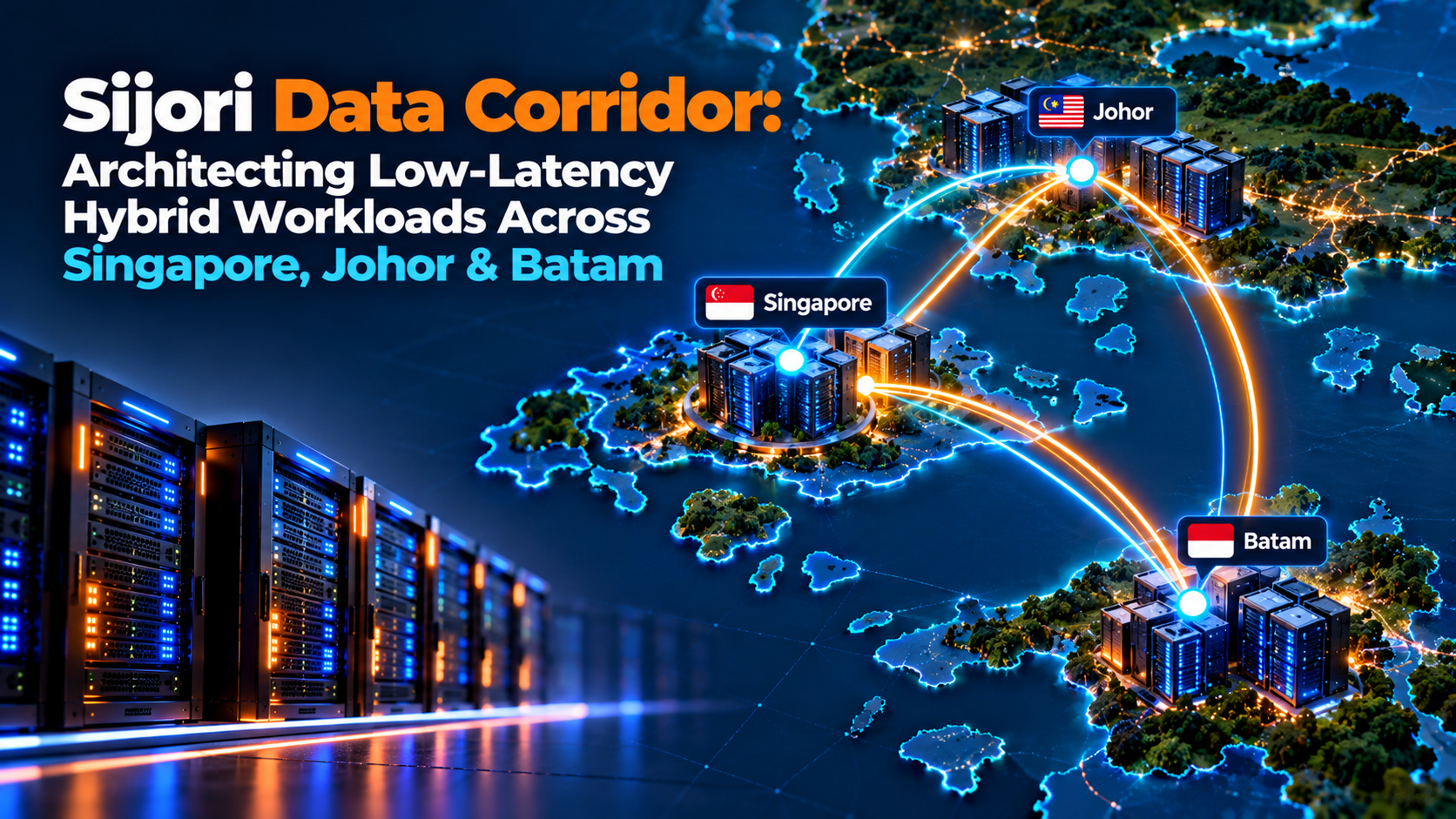
When architecting a Sijori Corridor Singapore VPS solution, the Sijori data corridor (Singapore–Johor–Batam) allows enterprises to architect low-latency hybrid cloud topologies by keeping master relational databases and mission-critical API gateways anchored on a high-availability Singapore VPS, while offloading high-capacity storage, batch workers, and AI training clusters to cost-effective facilities in Johor or Batam via cross-strait dark fiber with sub-2.5ms transit times.
Sijori Corridor Singapore VPS Infrastructure & Technical Guide
Singapore Data Center Constraints & Cross-Border Expansion
Specifically, the rapid growth of enterprise cloud workloads across Southeast Asia has created an intense engineering bottleneck. It has fundamentally constrained data center expansion within the city-state of Singapore across your Sijori Corridor Singapore VPS environment. Furthermore, while Singapore remains the premier financial, regulatory, and telecommunications nexus of the region, it faces acute physical constraints. Municipal land availability, industrial power allocation, and stringent environmental sustainability caps have made datacenter expansion increasingly selective and costly. In addition, in response, regional technology leaders and government ministries have spearheaded the expansion of the SIJORI Growth Triangle—a closely integrated economic and digital corridor uniting Singapore, Johor (southern Malaysia), and Batam (the Riau Islands of Indonesia).
Furthermore, rather than treating these neighboring geographies as fragmented sovereign islands, progressive infrastructure architects leverage the Sijori corridor as a unified, metropolitan-scale distributed computing fabric across your Sijori Corridor Singapore VPS environment. Consequently, the physical distances separating these territories are minuscule in optical fiber terms: Singapore to Johor is less than 30 kilometers across the Causeway, while Singapore to Batam is under 20 kilometers across the shallow Singapore Strait.
By anchoring core transaction processing and critical API endpoints on Equinix Singapore VPS hosting plans while orchestrating high-density compute, backup snapshots, and local data residency nodes across Johor and Batam, organizations achieve the ultimate synthesis of ultra-low latency, cost efficiency, and legal compliance across ASEAN.
Sijori Corridor Singapore VPS: Physical Optical Topography Across the Sijori Growth Triangle
The Changi North and Tuas cable landing stations interface directly with regional subsea optical systems. These include the Batam Singapore Cable System (BSCS) and Indonesia Global Gateway (IGG). Cross-strait dark fiber strands through the Johor Causeway and Second Link viaducts achieve propagation delays under 1.4 milliseconds, enabling enterprise network architects to configure jumbo MTU 9000 frame pipelines between sovereign Singapore compute nodes and peripheral Malaysian facility deployments.
The viability of the Sijori data corridor as a single coherent cloud architecture depends fundamentally on optical transport speed. In standard long-haul networking, connecting distinct countries introduces significant latency due to international carrier handoffs and circuitous submarine routes. In the Sijori triangle, however, direct dark fiber infrastructure bridges national borders directly.
Sijori Corridor Singapore VPS Infrastructure & Technical Guide
Between Singapore and Malaysia, dual physical fiber ducts cross the Johor-Singapore Causeway at Woodlands. A second route runs via the Malaysia-Singapore Second Link bridge at Tuas. These conduits connect Equinix SG1 and SG3 in Singapore directly into Sedenak Tech Park and Nusajaya Tech Park in Johor. Because these cables cross physical bridges over the Johor Strait, one-way transit delays stay under 0.8 milliseconds (round-trip under 1.6ms).
In addition, between Singapore and Batam, specialized shallow-water submarine fiber systems—including the Batam-Singapore Cable System (B2JS), the Matrix Cable, and the newly commissioned Nongsa Digital Park subsea spur—connect Changi on Singapore’s eastern coast straight to the Nongsa Special Economic Zone in Batam. This shallow-water crossing introduces just 2.2 milliseconds of round-trip latency. It enables seamless cross-border data transfer between Singapore and Indonesian sovereign territory.
| Corridor Interconnect | Physical Fiber Route | One-Way Latency | Round-Trip Time | Architectural Role |
|---|---|---|---|---|
| Singapore (Ayer Rajah) ↔ Johor (Iskandar) | Terrestrial Bridge Conduits (Causeway / Tuas) | 0.8 ms | 1.6 ms | Synchronous database replication & active-active failover |
| Singapore (Changi) ↔ Batam (Nongsa Digital) | Shallow-Water Subsea Fiber (B2JS / Nongsa Cable) | 1.1 ms | 2.2 ms | Indonesian data localization edge gateway & backup target |
| Johor (Kulai) ↔ Batam (Nongsa) | Direct Subsea / Singapore Transit Bypass | 1.8 ms | 3.6 ms | Independent secondary disaster recovery replication loop |
Workload Partitioning: Optimizing Cost, Power, and Computational Density
Consequently, an effective multi-node deployment across the Sijori triangle does not duplicate identical application stacks across every location. Instead, enterprise engineers practice strategic workload partitioning, allocating specific computing tasks to the geographic node best suited to handle them:
Therefore, 1. Singapore (The Ultra-Low Latency Core): Singapore serves as the mission-critical core. High-frequency algorithmic trading daemons and Singpass OIDC callback handlers demand sub-millisecond processing. PayNow real-time payment webhooks, and BGP border routing reverse proxies must reside within Singapore. Siting these in Equinix SG1 or SG3 ensures sub-millisecond proximity to the Singapore Exchange (SGX), MAS-regulated clearinghouses, and over 200 telecommunications carriers.
Notably, 2. Johor (The Scalable Compute & Storage Engine): Johor offers vast physical real estate, multi-megawatt industrial power feeds, and competitive colocation pricing. Workloads such as asynchronous video transcoding, LLM fine-tuning, and Elasticsearch indexing are optimally deployed in Johor nodes. Because round-trip latency to Singapore is only 1.6ms, background jobs ingest live transaction data with zero pipeline starvation.
Sijori Corridor Singapore VPS Infrastructure & Technical Guide
In contrast, 3. Batam (The Indonesian Data Residency Anchor): Batam serves as the essential compliance bridge into the Indonesian domestic market. Indonesian financial institutions, healthcare providers, and e-commerce platforms can position dedicated data ingestion gateways in Batam’s Nongsa Digital Park to satisfy statutory data localization rules while routing encrypted analytical queries across the 2.2ms fiber link into Singapore compute clusters.
Navigating Cross-Border Data Privacy: Singapore PDPA vs Indonesian UU PDP
Enterprise planners evaluating cross-strait bandwidth should reference verified subsea cable landing station diversity on regional fiber adoption and throughput growth.
Additionally, cross-border hybrid cloud topologies must satisfy diverging national data protection mandates. Singapore’s Personal Data Protection Act (PDPA) requires organizations transferring personal data outside of Singapore to ensure that the recipient jurisdiction provides a standard of protection comparable to the PDPA.
For example, simultaneously, Indonesia’s Personal Data Protection Law (Law No. 27 of 2022 / UU PDP) imposes strict localization rules on public electronic system operators and sensitive consumer financial records. By hosting core microservices on an Onlive Server Singapore VPS while maintaining data residency instances in Batam, multinational platforms fulfill both statutory standards without degrading end-user application responsiveness.
In addition, Malaysia’s Personal Data Protection Act (PDPA 2010) governs storage nodes deployed in Johor. By executing formal cross-border Data Processing Agreements (DPAs) with standard contractual clauses aligned with ASEAN model contractual guidelines, organizations establish a legally unassailable data management framework across all three jurisdictions.
Configuring Encrypted Cross-Border WireGuard Mesh on Linux VPS
To illustrate, when transmitting data between Singapore and neighboring facilities, network traffic must be cryptographically protected. At the kernel level, this happens without introducing software routing overhead. WireGuard provides near-line-rate throughput with ChaCha20-Poly1305 authenticated encryption:
Linux Network CLI
# On Singapore KVM VPS (Core Transaction Gateway)
[Interface]
Address = 10.100.0.1/24
PrivateKey = <SINGAPORE_SERVER_PRIVATE_KEY>
ListenPort = 51820
MTU = 1420

# Peer 1: Johor Secondary Compute Node (1.6ms RTT)
[Peer]
PublicKey = <JOHOR_NODE_PUBLIC_KEY>
Endpoint = 175.143.x.x:51820
AllowedIPs = 10.100.0.2/32
PersistentKeepalive = 15

# Peer 2: Batam Storage & Compliance Target (2.2ms RTT)
[Peer]
PublicKey = <BATAM_NODE_PUBLIC_KEY>
Endpoint = 103.150.x.x:51820
AllowedIPs = 10.100.0.3/32
PersistentKeepalive = 15

# Start and enable WireGuard interface
sudo systemctl enable --now wg-quick@wg0
sudo wg show
This WireGuard overlay creates a transparent, high-performance private subnet where nodes communicate securely across national borders with zero user-space translation overhead.
Database High Availability: Synchronous PostgreSQL Streaming Between Singapore and Johor
In particular, achieving a zero Recovery Point Objective (RPO=0) during catastrophic regional infrastructure events requires synchronous transaction log shipping. In traditional wide-area configurations with 40ms+ ping times, synchronous replication imposes unacceptable latency penalties. It forces database commits to wait hundreds of milliseconds.
As a result, the 1.6 millisecond round-trip between a Singapore VPS and a Johor secondary node enables synchronous replication without user-perceptible database commit lag. If the primary Singapore instance goes down, automated failover daemons (such as Patroni) promote the Johor standby node to primary in under 10 seconds with zero lost transactions.
Moreover, this architectural pairing delivers metropolitan-grade fault tolerance across sovereign borders. This gives fintech platforms and regional banks, and high-concurrency SaaS applications maximum uptime resilience at a fraction of hyperscale cloud costs.
Cross-strait fiber strands terminate directly into sovereign Equinix SG1 and SG3 urban datacenter campuses, providing seamless interconnection to regional banking cores.
Storage Engineering: NVMe Over Fabrics Across the Sijori Optical Corridor
In fact, advanced cross-border deployments utilize NVMe Over Fabrics (NVMe-oF) using RDMA over Converged Ethernet. This goes beyond traditional block storage replication (RoCE v2). Because the physical dark fiber run between Singapore and Johor exhibits ultra-low latency under 1 millisecond, storage controllers can present remote NVMe flash block devices to Singapore hypervisors with performance metrics virtually indistinguishable from local PCIe storage.
Similarly, this breakthrough enables database administrators to maintain active NVMe storage arrays in Johor. These store high-capacity historical ledger data and archival analytical storage, while running lightweight, compute-intensive execution nodes in Singapore. Random 4K read and write IOPS remain above 85,000 across the optical link. This provides unprecedented flexibility for multi-terabyte data warehousing without incurring Singapore premium datacenter real estate pricing.
Importantly, by pairing NVMe-oF storage in nearshore locations with KVM instances in Singapore, enterprise architectures achieve the optimal balance of massive storage capacity, localized statutory compliance, and sub-millisecond application response times.