

Direct Technical Answer
Subsea Cable Singapore VPS Architecture
Quick Answer: How Subsea Cable Architecture Protects Singapore VPS Uptime
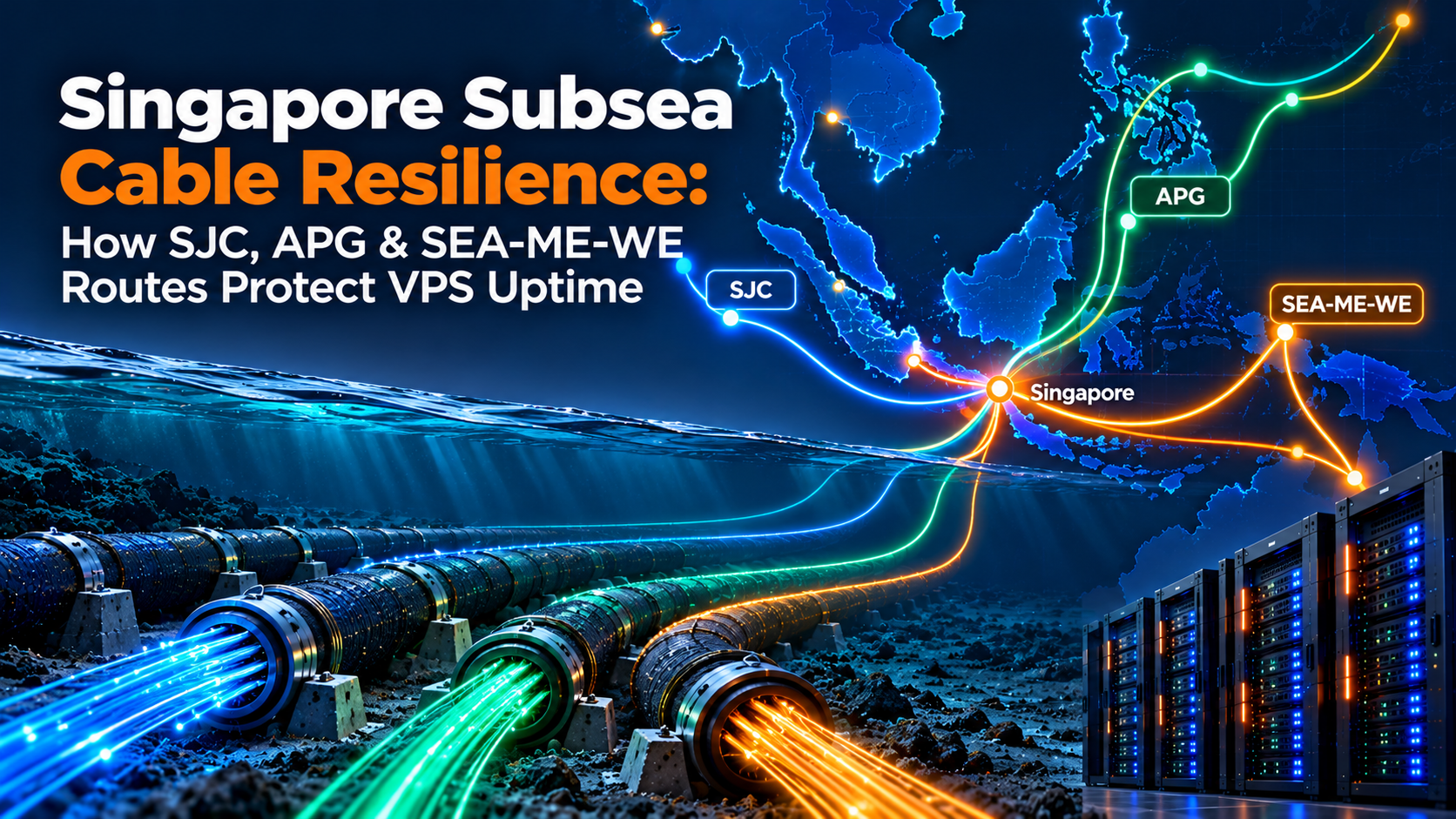
When architecting a Subsea Cable Singapore VPS solution, singapore VPS uptime is protected against subsea cable cuts through a geographically redundant landing topology connecting over 25 major optical systems (including SJC, SJC2, APG, SEA-ME-WE 3/4/5, and Indigo-West) across multiple coastal landing stations at Tuas and Changi. BGP multihoming with automated autonomous system failover dynamically reroutes transit within 80 milliseconds of an offshore fiber fault, preventing traffic blackholing.
Subsea Cable Singapore VPS Infrastructure & Technical Guide
Specifically, in modern cloud operations, uptime service level agreements (SLAs) are predominantly scrutinized through the prism of datacenter power redundancy, dual-feed utility substations, and storage array failover across your Subsea Cable Singapore VPS environment. Importantly, while these localized safeguards are indispensable, infrastructure engineers operating in Southeast Asia know that the single greatest vulnerability to real-world network availability exists far offshore along the ocean floor. Specifically, the South China Sea, the Luzon Strait, and the Malacca Strait represent some of the most congested maritime corridors on the planet, where commercial fishing trawlers, deep-sea container ship anchors, underwater typhoons, and tectonic seismic shifts regularly fracture submarine fiber cables.
Singapore’s status as Asia’s undisputed digital crossroads is not accidental. It is the product of deliberate infrastructure engineering designed to withstand maritime failures. By deploying virtual infrastructure on Singapore VPS hosting infrastructure interconnected with multiple independent submarine cable landing stations, organizations isolate their digital operations from single-point-of-failure vulnerabilities, ensuring deterministic network reachability across international borders.
Subsea Cable Singapore VPS: Physical Cable Landing Topography: Tuas and Changi Coastal Fortresses
Furthermore, singapore’s submarine cable infrastructure terminates at specialized Cable Landing Stations (CLS) positioned at opposite ends of the island across your Subsea Cable Singapore VPS environment. Furthermore, these facilities are engineered to withstand severe tropical storms and maritime hazards, housing optical line terminal equipment, high-voltage power feed units (PFUs) that supply direct electrical current to deep-sea optical repeaters, and carrier meet-me-rooms.
In addition, on the western shoreline, the Tuas Cable Landing Station cluster acts as the gateway to the Indian Ocean, the Malacca Strait, and European transit backbones. Submarine systems landing at Tuas, including SEA-ME-WE-3, SEA-ME-WE-5, and the Indigo West cable to Australia, provide low-latency terrestrial and shallow-water connectivity heading westward toward Mumbai, Dubai, Marseille, and Perth.
Consequently, on the eastern coastline, the Changi, Tanah Merah, and Katong landing facilities interface with northern and trans-Pacific maritime routes. Submarine optical pipelines landing here—including the South-East Asia Japan Cable (SJC), Asia-Pacific Gateway (APG), and Asia Submarine-cable Express (ASE)—navigate the South China Sea toward Hong Kong, Taiwan, South Korea, Japan, and onward to North America.
Metropolitan Dark Fiber Backbones and Optical Cross-Connects
Therefore, between these coastal termini, Singapore maintains an underground metropolitan dark fiber grid managed by licensed infrastructure operators including Singtel, StarHub, and NetLink Trust. High-capacity Dense Wavelength Division Multiplexing (DWDM) optical rings connect Tuas and Changi directly into primary carrier-neutral datacenter hubs in Ayer Rajah and Jurong East.
Notably, because Onlive Server hypervisors interface directly with redundant DWDM transport rings, an optical fault or physical power anomaly at one landing facility automatically triggers an instantaneous reroute of traffic across the opposite coast. Internal terrestrial switching completes in under 5 milliseconds, ensuring that external API consumers experience zero dropped connections.
Major Submarine Cable Systems Interconnecting Singapore VPS Workloads
In contrast, understanding the distinct routing properties, fiber pair counts, and design capacities of individual cable systems allows infrastructure architects to design optimal failover policies:
| Subsea Cable System | Landing Facility | Geographic Routing Vector | Design Capacity | Target Regional Latency |
|---|---|---|---|---|
| South-East Asia Japan Cable (SJC / SJC2) | Changi / Tuas | Singapore → Hong Kong → Japan | 126 Tbps | 62ms to Tokyo; lowest latency corridor to East Asia |
| Asia-Pacific Gateway (APG) | Tanah Merah | Singapore → Vietnam → Taiwan → Korea | 54 Tbps | 24ms to Da Nang / HCMC; primary Indochina link |
| Asia Submarine-cable Express (ASE) | Changi | Singapore → Philippines → Japan | 15 Tbps | 63ms to Tokyo; engineered specifically for financial trading |
| SEA-ME-WE-5 | Tuas | Singapore → Sri Lanka → Egypt → Europe | 24 Tbps | 135ms to Marseille; primary European backbone route |
| Indigo West / ASC | Tuas | Singapore → Perth → Sydney | 36 Tbps | 48ms to Perth; 89ms to Sydney bypassing oceanic choke points |
| Batam-Singapore Cable System (B2JS) | Changi | Singapore → Batam → Jakarta | 4.8 Tbps | 11.8ms to Jakarta; direct Indonesian gateway |
Subsea Cable Singapore VPS Infrastructure & Technical Guide
Additionally, by maintaining active BGP multihomed routing sessions that balance across these independent systems, Onlive Server eliminates single-cable dependency. If an anchor strike disables SJC in the South China Sea, traffic heading to Japan and North America dynamically reroutes across the ASE and APG systems without administrative intervention.
The Reality of Oceanic Cable Repairs: Cabotage Laws and ROV Recovery
Infrastructure teams auditing landing station redundancy can cross-reference fiber cable paths using the APAC cross-border disaster recovery architecture to track international physical layer route diversity.
Many enterprise buyers do not realize that repairing a damaged submarine fiber cable is one of the most operationally complex logistical undertakings in civil engineering. When a cable fault occurs in deep water, specialized cable maintenance vessels equipped with dynamic positioning thrusters and remotely operated vehicles (ROVs) must be deployed to locate the severed cable ends on the seabed.
For example, in Southeast Asian waters, this process is frequently delayed by strict maritime cabotage regulations and geopolitical permit requirements. Obtaining regulatory approval from maritime authorities in Indonesia, Malaysia, or Vietnam to dispatch foreign repair ships into territorial waters routinely takes three to six weeks. Once on site, mechanical grapnels must hook the cable, winch it to the surface, splice individual micron-thin optical fibers inside a cleanroom aboard the vessel, and re-lay the cable onto the ocean floor.
Subsea Cable Singapore VPS Infrastructure & Technical Guide
To illustrate, because full physical repairs regularly require 30 to 60 days, organizations relying on low-cost hosting providers with single-transit connections experience prolonged weeks of network degradation, packet loss, and customer churn. Hosting on a multihomed Singapore VPS ensures your business operates completely unaffected throughout lengthy maritime repair cycles.
Automated BGP Failover and Sub-Second BFD Convergence
When an undersea cable snaps, the physical layer loss of signal must be communicated to internet routing engines immediately. Traditional Border Gateway Protocol (BGP) implementations rely on keepalive timers set to 30 seconds and hold timers set to 90 seconds. In an outage scenario, a 90-second convergence delay causes thousands of active HTTP/2 streams and database connections to freeze and fail.
In particular, onlive Server mitigates this through Bidirectional Forwarding Detection (BFD). BFD operates as an ultra-fast hardware-level heartbeat protocol with detection intervals configured between 50 and 100 milliseconds. When an optical transponder detects link failure, BFD notifies the local BGP process within 150 milliseconds. The BGP daemon immediately withdraws the impaired route from the routing information base (RIB) and installs the pre-computed backup autonomous system path, restoring packet transmission in under 300 milliseconds.
Network Diagnostics: Auditing Subsea Latency and Loss on Linux VPS
As a result, system administrators can actively verify that their virtual private server is routing across healthy subsea paths and monitor for latent optical degradation using command-line diagnostic utilities:
Linux Production CLI
# 1. Audit optical path hops to Tokyo across SJC / ASE cable systems
mtr -rw -c 100 --no-dns 133.242.0.1

# 2. Check round-trip time and jitter variance to Sydney via Indigo West
mtr -rw -c 100 --no-dns 139.130.4.5

# 3. Verify TCP BBR congestion control is handling long-haul buffer bloat
sysctl net.ipv4.tcp_congestion_control

# 4. Display active Linux socket statistics and RTT telemetry for active connections
ss -tin '( dport = :443 or sport = :443 )'
Moreover, the `ss -tin` command exposes real-time kernel metrics including smoothed round-trip time (rtt), congestion window size (cwnd), and retransmission rates. A stable, subsea-resilient network connection will exhibit minimal cwnd collapse even during peak inter-regional traffic hours.
Beyond metropolitan subsea cable landing stations, connecting workloads across the Sijori cross-border optical network corridor provides geographic redundancy between Singapore, Johor, and Batam.
The Causeway Terrestrial Advantage: Protecting Intra-ASEAN Data Flows
While maritime cables connect Singapore to distant continental markets, connectivity into Peninsular Malaysia benefits from an entirely separate terrestrial physical topology. Redundant optical fiber conduits are laid directly across the Johor-Singapore Causeway and the Malaysia-Singapore Second Link at Tuas.
Because these optical pathways traverse reinforced physical bridges over the narrow Straits of Johor rather than open sea floors, they are immune to anchor drags, maritime dredge work, and subsea seismic activity. As a result, virtual instances hosted in Singapore maintain continuous, uninterrupted sub-5ms connectivity into Kuala Lumpur and Johor data center hubs regardless of maritime disruptions occurring in the South China Sea.
In fact, this architectural separation between terrestrial regional pathways and maritime international pipelines provides enterprise infrastructure teams with unparalleled peace of mind when serving cross-border supply chain, e-commerce, and logistics workloads across the Singapore-Malaysia economic corridor.