

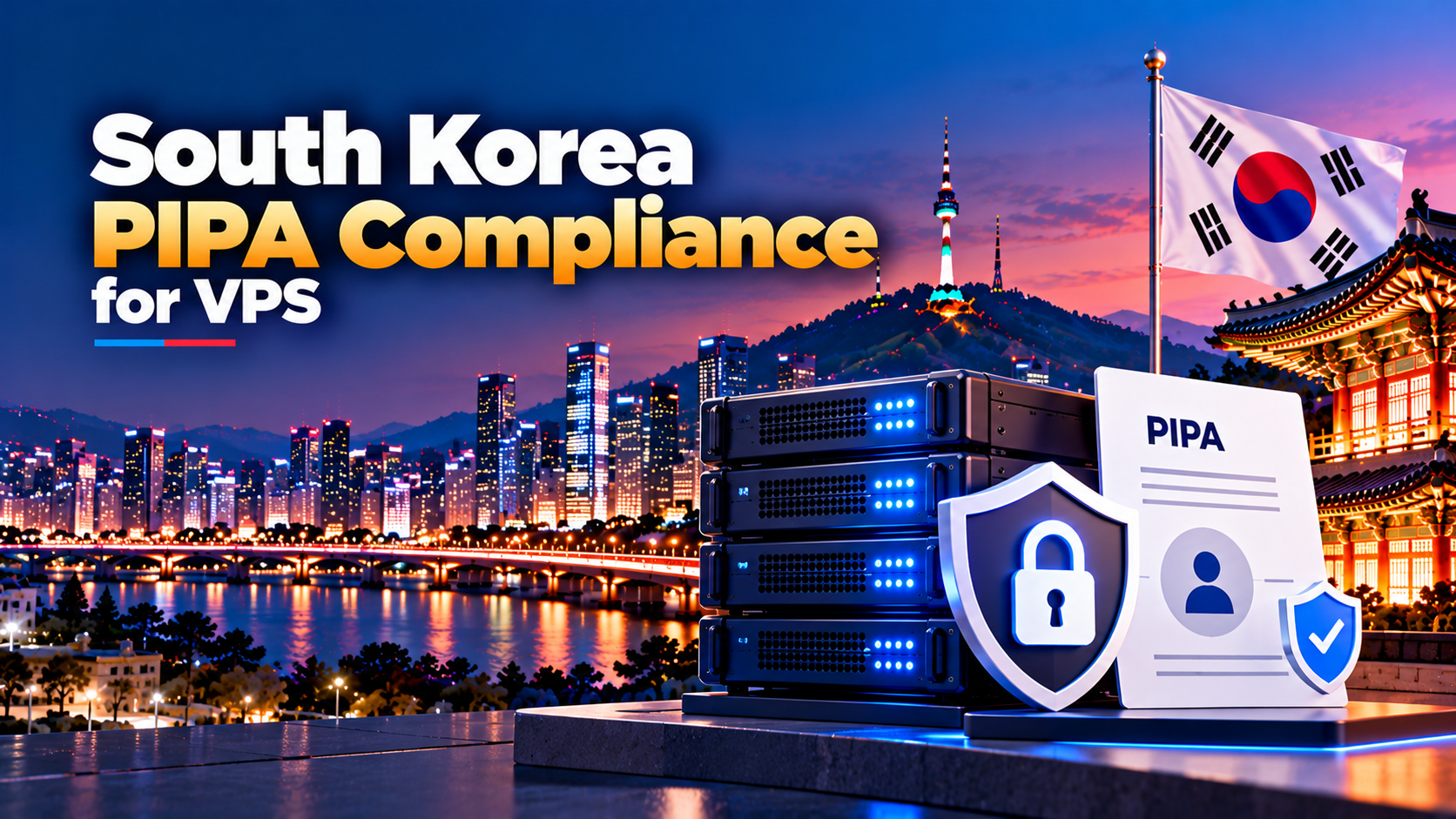
When evaluating an enterprise South Korea PIPA compliance, under South Korea’s Personal Information Protection Act (PIPA), cross-border transfer of resident data is permitted only with explicit, informed user consent or approved international transfer treaties; however, domestic storage in a Seoul datacenter dramatically simplifies compliance. Furthermore, PIPA mandates AES-256 encryption at rest for citizen identification numbers, TLS 1.3 in transit, strict access control logging, and 12-month audit trail retention certified under KISA guidelines.
Specifically, south Korea maintains one of the most stringent and rigorously enforced data privacy legal frameworks in the world. Enacted in 2011 and continuously modernized, the Personal Information Protection Act (PIPA) governs how organizations collect, process, store, and transfer personal data belonging to South Korean citizens. For global enterprises and domestic digital businesses, non-compliance represents an existential commercial risk that can halt digital expansion.
Technical Architecture & Execution Analysis
Consequently, aligning these configurations with your South Korea PIPA compliance environment ensures optimal uptime and throughput. Data privacy enforcement in South Korea is overseen by the Personal Information Protection Commission (PIPC), an independent ministerial agency with extensive regulatory powers. Recent amendments have intensified penalties for cross-border data breaches, authorizing fines reaching up to three percent of total annual turnover. Consequently, understanding how physical server hosting in Seoul impacts PIPA compliance is an essential prerequisite for any business operating in the Korean market.
Furthermore, South Korean consumers place immense value on corporate data transparency. When a service provider is subjected to a regulatory investigation or public reprimand by the PIPC, customer attrition occurs rapidly. Demonstrating verifiable in-country data residency on certified infrastructure provides an immediate trust dividend that accelerates commercial adoption.
Operational Infrastructure Takeaway
Furthermore, for optimal South Korea PIPA compliance operations, Operational Takeaway: Achieving South Korea PIPA VPS compliance requires hosting personal citizen information within physical datacenters located in South Korea or establishing explicit statutory cross-border consent mechanisms. The Personal Information Protection Act (PIPA) mandates technical safeguards including AES-256 encryption at rest, TLS 1.3 in transit, strict access control logging, and annual security audits. Hosting on a compliant Seoul VPS ensures data sovereignty, avoids cross-border legal liabilities, and shields enterprises from regulatory penalties up to 3% of global revenue.
South Korea PIPA compliance: Understanding PIPA and Its Regulatory Framework
Consequently, the Personal Information Protection Act applies to any individual, business entity, or public agency that processes personal data. Specifically, personal data is defined broadly under PIPA as any information relating to a living individual that identifies or could reasonably identify that person, either directly or when combined with other data. This encompasses names, phone numbers, resident registration numbers, IP addresses, and device identifiers. To fortify system daemons against unauthorized penetration in accordance with national cybersecurity audits, consult our KISA regulatory hardening and defensive baselines.
In addition, importantly, PIPA exercises extraterritorial jurisdiction. Therefore, even if your company has no physical headquarters in Seoul, providing digital services, e-commerce storefronts, or SaaS applications to South Korean citizens subjects your technical operations directly to PIPA enforcement. Foreign operators cannot claim jurisdictional immunity when processing Korean resident records.
Furthermore, PIPA establishes strict principles regarding data minimization, purpose limitation, and user transparency. Organizations cannot bundle data processing consent into standard terms of service. Consent must be explicit, informed, and categorized by specific operational functions. Users retain the statutory right to inspect, correct, and demand deletion of their personal records.
In particular, deploying on certified South Korea VPS hosting in Seoul provides the foundational data residency necessary to satisfy PIPC oversight.
South Korea PIPA compliance: Data Residency: Why Hosting in Seoul Simplifies Compliance
Therefore, under PIPA Article 28-8, transferring personal data of Korean residents overseas requires navigating strict regulatory hurdles. Specifically, cross-border data transfer is only permitted if the data subject grants separate, explicit consent, or if the destination country maintains an officially recognized adequacy certification. To verify statutory obligations regarding cross-border data transfer, cryptographic safeguards, and personal information handling, consult the official South Korea Personal Information Protection Act (PIPA) statutes.
However, obtaining individual consent for every international database transaction introduces substantial friction into user registration and payment flows. In contrast, by hosting production databases and application logic within a domestic Seoul datacenter, data remains entirely within South Korean national borders, completely bypassing cross-border transfer restrictions.
Consequently, organizations hosting locally eliminate cross-border transfer liabilities entirely. Domestic data residency simplifies corporate audit procedures, streamlines vendor risk assessments, and satisfies domestic banking and e-commerce accreditation bodies. Regulators view domestic hosting as a primary indicator of corporate diligence.
Moreover, for financial technology providers and healthcare platforms, maintaining in-country data residency is frequently a non-negotiable statutory requirement for operating licenses.
Technical Safeguards Mandated by PIPA Article 29
In fact, article 29 of PIPA outlines mandatory technical, managerial, and physical security measures required to prevent the loss, theft, alteration, or falsification of personal data. Server administrators must configure several vital operational layers across the hosting environment: For compliant snapshot retention schedules and automated cold-storage archiving, implement our immutable off-site backup and disaster recovery plans.
- Cryptographic Encryption: Resident Registration Numbers (RRNs), passport identifiers, passwords, and biometrics must be encrypted at rest using approved cryptographic algorithms such as AES-256 or ARIA.
- Access Control & Least Privilege: Access to database systems must be restricted through role-based access controls (RBAC), multi-factor authentication (MFA), and dedicated VPN tunneling.
- Comprehensive Access Logging: Server access records must be automatically captured and retained for a minimum of one to two years depending on the volume of processed records.
- Intrusion Prevention & Firewalls: Systems must feature host-based firewalls, automated intrusion detection systems (IDS/IPS), and daily vulnerability scanning to prevent unauthenticated ingress.
Similarly, deploying these technical safeguards directly on your Seoul VPS ensures compliance during KISA and PIPC inspection audits, protecting your digital assets.
Access Control Management
Meanwhile, enforcing least-privilege role boundaries, dedicated cryptographic key pairs, and automated session timeouts for all sysadmins accessing personal data stores.
Certified Data Encryption
Additionally, mandatory encryption of resident registration numbers, driver licenses, and payment credentials using ARIA-256 or AES-256 with isolated key management.
Tamper-Proof Log Auditing
As a result, retaining read, modification, and deletion logs of customer records for at least one full year with automated offsite backup replication.
Anti-Malware & Patch Hygiene
Specifically, automated operating system vulnerability patching, weekly Lynis audits, and real-time Fail2ban firewall synchronization to prevent credential exploitation.
PIPA Technical Requirements vs VPS Security Controls Matrix
Furthermore, the table below illustrates how specific PIPA statutory articles map directly to practical Linux server configurations on a South Korea VPS: To verify that your server IP range resolves strictly within Seoul jurisdiction for privacy audits, see our domestic Korean geolocation verification standards.
| PIPA Article & Mandate | Statutory Requirement | Practical VPS Implementation |
|---|---|---|
| Article 29 (Access Control) | Prevention of unauthorized external access | SSH key-only auth, non-standard ports, UFW/iptables |
| Article 29 (Encryption) | Encryption of sensitive personal identifiers | LUKS disk encryption, MariaDB tablespace AES-256 |
| Article 29 (Log Retention) | Retention of access logs for 12 to 24 months | Logrotate policies to encrypted immutable log store |
| Article 28-8 (Cross-Border Transfer) | Restrictions on overseas transmission | Domestic Seoul Tier III datacenter hosting |
| Article 34 (Breach Notification) | Mandatory 72-hour notification to PIPC/KISA | Fail2ban alerts, real-time SIEM webhook integration |
Consequently, aligning your server architecture with this matrix establishes an audit-ready compliance posture that withstands stringent regulatory scrutiny.
Log Retention and Access Auditing Best Practices
PIPA regulations mandate that access logs for personal data databases must be stored safely and protected against tampering. Specifically, for systems processing fewer than 50,000 records, logs must be retained for at least one year. For systems handling more than 50,000 records, retention extends to two full years.
Furthermore, administrators must record who accessed the data, the exact timestamp, the queried record parameters, and the performing IP address. Under audit conditions, the PIPC may demand complete access histories for specific user accounts. Missing or altered log records are treated as direct evidence of regulatory non-compliance.
In particular, to prevent compromised server root credentials from altering logs, best practice involves shipping audit logs immediately to a write-once read-many (WORM) storage bucket or a dedicated remote logging daemon in Seoul. Automated logrotate policies should compress, sign, and archive daily records securely.
Automating this telemetry guarantees compliance without consuming excessive local SSD storage space on your primary virtual machine.
Encryption at Rest and in Transit Implementation
Cryptographic standards under PIPA require strong end-to-end protection. In transit, all network traffic must be secured using modern TLS 1.3 or TLS 1.2 protocols. Legacy protocols such as SSLv3, TLS 1.0, and TLS 1.1 must be disabled across all web and mail daemons to eliminate interception vulnerabilities.
At rest, database files containing customer credentials, phone numbers, and payment tokens must be encrypted using block-level encryption (dm-crypt/LUKS) or database-level tablespace encryption. Specifically, MariaDB and MySQL offer native InnoDB tablespace encryption using AES-256 keys managed via secure keyrings.
Additionally, cryptographic keys must be stored separately from encrypted data volumes. Storing keys on the same partition as the database nullifies encryption protections in the eyes of regulatory auditors. Administrators should utilize external secret management daemons (such as HashiCorp Vault) or hardware security modules (HSMs).
Implementing hardware-assisted AES-NI acceleration on modern KVM hypervisors ensures full encryption with zero perceptible CPU overhead.
Cross-Border Data Transfer Penalties and Legal Liabilities
Recent legislative amendments have significantly elevated the stakes of PIPA non-compliance. Under amended Article 64-2, the PIPC can levy administrative fines of up to 3% of an organization’s total worldwide revenue for intentional or negligent data breaches involving personal citizen data.
In addition to corporate fines, PIPA includes criminal penalties for individual corporate officers. Chief Information Security Officers (CISOs) and data privacy officers can face personal fines and imprisonment for severe negligence. The law establishes personal liability to ensure executive oversight over data governance.
Moreover, class-action civil litigation for data breaches has become increasingly common in South Korea, with courts awarding statutory damages per impacted individual without requiring proof of actual financial harm. A single breach compromising 100,000 records can generate catastrophic civil liabilities.
Hosting on local Seoul infrastructure provides the highest level of legal defensibility against claims of cross-border data mishandling.
Security Incident Response and Mandatory Breach Notification
Under Article 34 of PIPA, if personal data is leaked, lost, or stolen, the data controller must notify impacted data subjects without delay. Furthermore, if the breach impacts more than 1,000 individuals, the incident must be officially reported to the PIPC or KISA within 72 hours.
To comply with these stringent deadlines, organizations must implement automated intrusion detection. Host-based tools like OSSEC or Wazuh monitor system integrity, detecting unauthorized privilege escalations and suspicious file modifications in real time.
Additionally, incident response playbooks must delineate exact chains of command, forensic evidence preservation procedures, and external communication protocols. Having a pre-established relationship with local security engineers ensures swift containment during an active attack.
Proactive monitoring and automated alert pipelines turn potentially catastrophic breaches into manageable, contained security events.
PIPA Compliance Readiness Checklist for Seoul VPS
Before deploying production services in South Korea, audit your infrastructure against this comprehensive compliance checklist:
- Physical In-Country Hosting: Primary databases and user identity records reside within a verified Seoul datacenter.
- Full Encryption at Rest: Database tablespaces and file backups are encrypted with AES-256 keys managed separately.
- TLS 1.3 Transport Security: Web servers enforce modern TLS ciphers with HSTS preloading enabled across all public routes.
- 2-Year Immutable Log Archive: System and database access logs are preserved with automated offsite synchronization to an independent storage node.
- Designated Local Privacy Officer: The organization maintains an appointed Data Privacy Officer (DPO) recognized under PIPC statutory guidelines.
Completing this checklist establishes complete technical and operational adherence to South Korean privacy legislation, positioning your brand for reliable growth.
Frequently Asked Questions
Core Technical Specifications
Does PIPA apply to overseas companies without an office in South Korea?
Yes. PIPA exercises extraterritorial jurisdiction over any foreign entity that processes personal data of South Korean citizens while providing goods or services in the Korean market.
Can I store Korean customer data on a US or EU server?
You can only store data overseas if you obtain separate, explicit consent from each individual data subject or fulfill strict statutory transfer conditions. Hosting domestically in Seoul bypasses these restrictions entirely.
What are the maximum financial penalties for PIPA violations?
The PIPC can impose administrative fines of up to 3% of an organization’s total annual global revenue, alongside personal criminal liability for corporate executives.
How long must database access logs be retained under PIPA?
Access logs must be retained for at least one year for standard databases, and at least two years for systems processing sensitive personal data or records of more than 50,000 individuals.
Deployment & Operational Inquiries
Is KVM virtualization sufficient for PIPA hardware isolation?
Yes. KVM virtualization provides complete kernel-level isolation, dedicated vCPU resources, and private storage spaces that fulfill KISA and PIPA multi-tenancy security criteria.
Does OnliveServer sign Data Processing Agreements (DPAs) for PIPA compliance?
Yes. OnliveServer provides enterprise Data Processing Agreements certifying physical datacenter presence in Seoul and adherence to domestic statutory data protection safeguards.
What specific cipher algorithms does KISA recommend for data-at-rest encryption on a Seoul VPS?
KISA recommends AES-256 or the domestic Korean ARIA and SEED block ciphers for encrypting resident registration numbers, financial records, and passwords at rest. Implementing full-disk LUKS encryption or database-level column encryption satisfies these regulatory requirements.
Are physical biometric access controls required for the Seoul datacenter housing PIPA-regulated servers?
Yes, Tier III facilities housing PIPA-regulated data must enforce multi-factor physical access controls, including biometric scanning and 24/7 CCTV surveillance with a minimum 90-day video log retention policy. OnliveServer’s Seoul facility fully adheres to these physical security standards.
Ensure Complete PIPA Compliance on Seoul VPS Infrastructure
Safeguard customer data, guarantee domestic data residency, and satisfy KISA security audits with enterprise-grade KVM virtual servers hosted directly in Seoul.
