

Direct Technical Answer
Shopee Lazada WooCommerce VPS Architecture
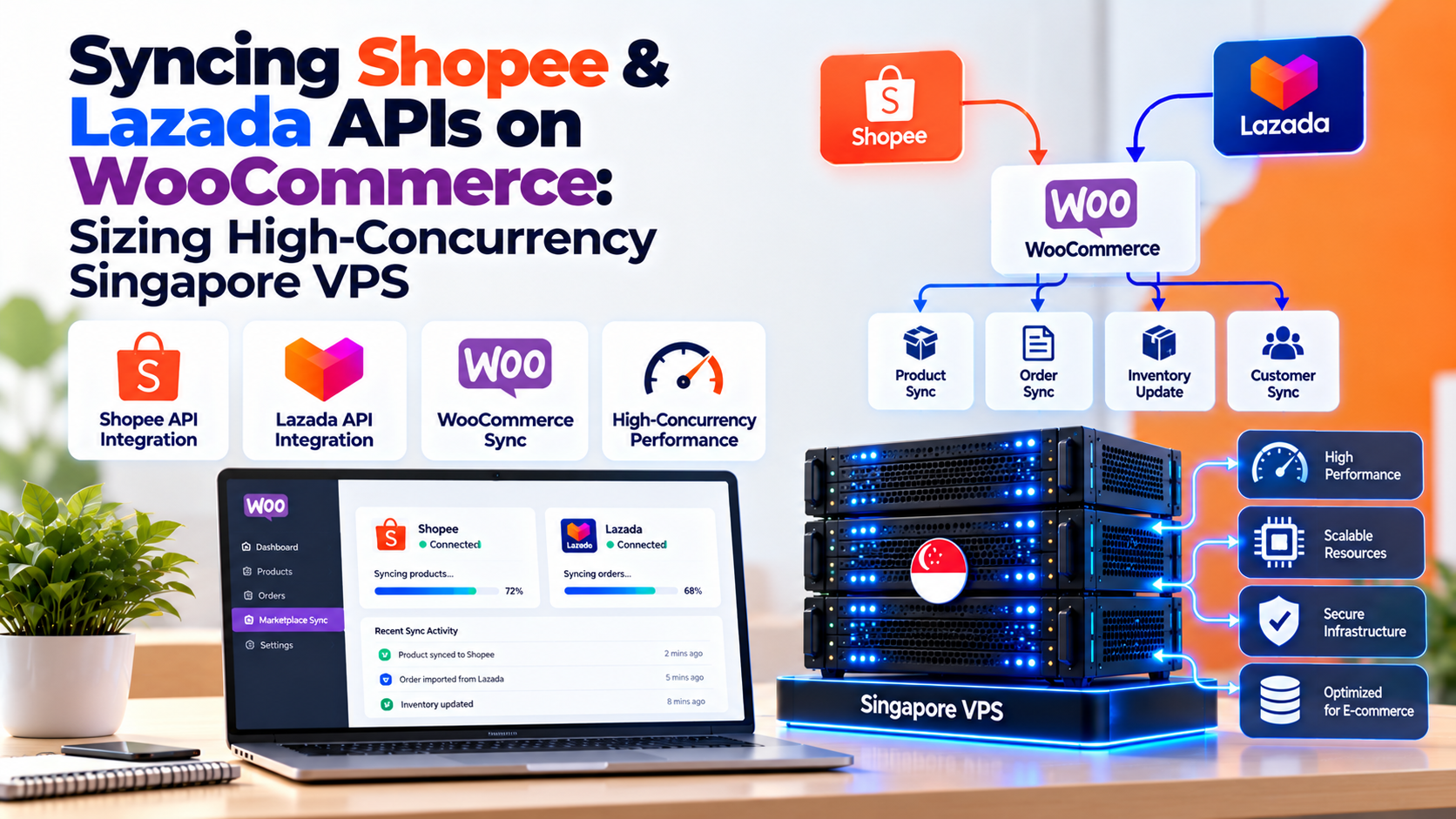
Quick Answer: Sizing High-Concurrency Singapore VPS for Shopee & Lazada Sync
Operating a high-concurrency Shopee Lazada WooCommerce VPS requires isolated compute resources. Additionally, it demands sub-2ms network proximity to regional marketplace API endpoints in Singapore.
For stores processing 500 to 3,000 daily orders, deploy an 8 vCPU KVM VPS with 16 GB RAM. Furthermore, configure enterprise NVMe Gen4 storage to eliminate disk latency.
Separate frontend traffic from inbound webhooks using dedicated PHP-FPM pools. In addition, activate WooCommerce HPOS and offload Action Scheduler queues to a continuous Linux systemd worker running Redis and WP-CLI.
Key Architecture Takeaways
- Dedicated Webhook Worker Pool: Isolate external Shopee and Lazada webhook listeners into separate PHP-FPM pools to ensure checkout browsing never stalls under high-volume catalog synchronization.
- InnoDB Row-Level Locking: Transition high-volume WooCommerce tables to High-Performance Order Storage (HPOS) and READ COMMITTED isolation to prevent catalog lock waits during massive inventory updates.
- Local ASEAN Peering: Deploying within an Equinix SG1/SG3 facility with direct SGIX cross-connects achieves sub-2ms network round-trips to regional marketplace edge gateways.
- Asynchronous Queue Offloading: Decouple incoming webhook ingestion from database commits using Redis and persistent Linux systemd Action Scheduler daemons.
Core Architecture Blueprint for Marketplace Workloads
Specifically, operating high-volume omnichannel retail across Southeast Asia requires bidirectional synchronisation. Your Shopee Lazada WooCommerce VPS must connect self-hosted stores with regional marketplace platforms seamlessly.
In addition, order volumes scale rapidly across Singapore, Malaysia, Indonesia, Thailand, Vietnam, and the Philippines. Generic shared hosting inevitably fails under heavy API polling and database write locks.
Consequently, a dedicated Singapore VPS delivers sub-millisecond network proximity to regional cloud endpoints. Moreover, it provides isolated compute resources to maintain real-time inventory parity without crashing your checkout.
Shopee Lazada WooCommerce VPS: Architectural Bottlenecks of Marketplace Multi-Channel Synchronization
Furthermore, marketplace synchronisation introduces high-frequency transactional workloads. This traffic differs fundamentally from standard visitor web browsing across your Shopee Lazada WooCommerce VPS environment.
Therefore, Shopee Open Platform and Lazada Open Platform push continuous webhook payloads. Notably, these include inventory reservations, payment confirmations, shipment labels, and cancellation requests. Meanwhile, merchant ERP middleware queries stock across thousands of SKUs.
In addition, when hosted on under-provisioned infrastructure, these concurrent processes trigger severe resource contention across three core subsystems:
- PHP-FPM Worker Starvation: Webhook listeners and REST API controllers consume execution workers. A burst of marketplace sales can consume all available PHP workers, leaving standard web visitors stranded with HTTP 504 Gateway Timeout errors.
- Relational Database Write Locking: Traditional WooCommerce architectures store product attributes and inventory records inside
wp_postmetaandwp_posts. Frequent inventory increments and decrements lock rows, resulting in severe lock wait timeouts on transactional tables. - Cron and Action Scheduler Backlogs: Asynchronous synchronization plugins rely on WordPress Cron or WooCommerce Action Scheduler. On generic hosting, Action Scheduler processes batches serially over HTTP requests, accumulating thousands of unprocessed queues during promotional flash events.
Network Proximity: Connecting to Regional Shopee and Lazada Endpoints
Consequently, Shopee and Lazada host primary ASEAN infrastructure within Singapore data centers. Specifically, they utilize AWS ap-southeast-1 and Alibaba Cloud Singapore clusters.
In contrast, deploying your VPS within a premier Singapore facility provides direct connections to SGIX. As a result, network round-trip latency to marketplace gateways drops below 1.5 milliseconds.
Therefore, minimizing network latency is essential for high-throughput batch operations. Additionally, round-trip transmission latency compounds rapidly when reconciling 50,000 product SKUs across six regional country stores.
For example, US West Coast servers experience 65ms latency querying Singapore endpoints. Consequently, processing 10,000 sequential API requests requires nearly 11 minutes of network transit alone.
To illustrate, a local Singapore VPS brings aggregate network wait times under 20 seconds. Thus, synchronization engines complete tasks within tight execution windows.
Hardware Sizing Matrix for Concurrency Tiers
| Store Tier | Daily Orders | SKU Count | Recommended VPS Specs | Storage & RAM Allocation |
|---|---|---|---|---|
| Emerging Brand | 100 – 500 | Under 2,500 | 4 vCPU (KVM Dedicated) | 8 GB DDR4 / 120 GB NVMe |
| High-Volume Merchant | 500 – 3,000 | 2,500 – 20,000 | 8 vCPU (High Compute) | 16 GB DDR4 / 250 GB NVMe Gen4 |
| Enterprise Omnichannel | 3,000 – 15,000+ | 20,000 – 100,000+ | 16 vCPU (Bare Metal / KVM) | 32–64 GB RAM / Enterprise NVMe |
| Flash Sale Campaign | Burst 20,000+ | 50,000+ Active | 32 vCPU Cluster + Redis | 64 GB RAM / Redundant NVMe |
Decoupling Frontend Traffic from Marketplace Webhook Processing
DevOps engineers can review our guide on bilingual English and Chinese WooCommerce optimizations. Furthermore, it details dynamic process sizing directives.
Notably, marketplace synchronization operations must be isolated from public HTTP request pipelines. This separation preserves lightning-fast checkout experiences for direct website shoppers.
In particular, web server backlogs occur if a single proxy handles both shopper traffic and webhook bursts. Consequently, connection queuing will severely degrade customer Core Web Vitals.
Implementing a dual-tier processing architecture ensures operational resilience:
- Dedicated Webhook Endpoint Routing: Configure Nginx to route all incoming webhook payloads (such as
/wp-json/marketplace/v1/webhook) into a decoupled caching and queuing endpoint. This endpoint immediately validates the cryptographic signature (HMAC-SHA256) and returns an HTTP 200 OK status to the marketplace gateway within 80ms, preventing marketplace retries. - Asynchronous Message Buffering: Instead of processing WooCommerce order records synchronously inside the HTTP request, the payload is pushed directly to an in-memory Redis queue.
- CLI-Based Action Scheduler Processing: Background workers running continuously via Linux systemd daemons consume queue items, executing updates through the WordPress CLI (WP-CLI) independently of the web server thread pool.
Optimizing PHP-FPM Pools for High-Throughput REST APIs
In contrast, default PHP-FPM settings on Linux distributions are tailored for lightly dynamic websites. They struggle significantly under high-concurrency API synchronisation workloads.
As a result, dynamic process managers create and destroy child processes erratically. This generates memory fragmentation and CPU thrashing. Therefore, switching to a tuned static pool configuration maximizes concurrency.
Additionally, review this production-hardened PHP 8.3 FPM pool configuration. It is tailored for a 16 GB RAM Singapore VPS handling storefront users and marketplace synchronization feeds:
PHP-FPM
; /etc/php/8.3/fpm/pool.d/woocommerce-sync.conf
[woocommerce-sync]
user = www-data
group = www-data
listen = /run/php/php8.3-fpm-sync.sock
listen.owner = www-data
listen.group = www-data
listen.mode = 0660

pm = static
pm.max_children = 40
pm.max_requests = 1500

request_terminate_timeout = 180s
request_slowlog_timeout = 5s
slowlog = /var/log/php8.3-fpm-sync.slow.log

php_admin_value[memory_limit] = 512M
php_admin_value[max_execution_time] = 120
php_admin_value[opcache.enable] = 1
php_admin_value[opcache.memory_consumption] = 256
php_admin_value[opcache.interned_strings_buffer] = 32
php_admin_value[opcache.max_accelerated_files] = 30000
php_admin_value[opcache.validate_timestamps] = 0
For example, allocate dedicated process pools for backend synchronization versus frontend customer browsing. Consequently, memory-intensive inventory import tasks cannot monopolize threads serving storefront shoppers.
Database Tuning: Preventing InnoDB Lock Contention and Table Bloat
Specifically, WooCommerce stores orders, customers, and product attributes within MySQL or MariaDB. Under continuous updates, database tables experience massive input/output operations per second (IOPS).
Without precise tuning, deadlocks occur frequently. For instance, conflicts arise when a customer purchases an item while an automated script updates Shopee inventory simultaneously.
To illustrate, deploying WooCommerce High-Performance Order Storage (HPOS) is mandatory. Furthermore, HPOS migrates orders into dedicated relational tables (wp_wc_orders). This reduces relational query overhead by up to 70%.
In particular, to further accelerate database throughput, apply the following adjustments within /etc/mysql/my.cnf on your NVMe-backed Singapore VPS:
MySQL
[mysqld]
# Memory Allocation for 16GB Dedicated VPS
innodb_buffer_pool_size = 10G
innodb_buffer_pool_instances = 8
innodb_log_file_size = 2G
innodb_log_buffer_size = 64M

# IO & Concurrency Optimization for NVMe Gen4 Storage
innodb_flush_log_at_trx_commit = 2
innodb_flush_method = O_DIRECT
innodb_io_capacity = 4000
innodb_io_capacity_max = 8000
innodb_read_io_threads = 8
innodb_write_io_threads = 8

# Concurrency & Lock Tuning
innodb_lock_wait_timeout = 30
innodb_deadlock_detect = ON
max_connections = 350
table_open_cache = 8000
table_definition_cache = 4000

# Query Tuning
tmp_table_size = 128M
max_heap_table_size = 128M
sort_buffer_size = 4M
read_rnd_buffer_size = 8M
Setting innodb_flush_log_at_trx_commit = 2 buffers commits to system file cache every second. Consequently, it avoids forcing immediate disk flushes upon every single query.
On enterprise-grade cloud VPS hardware, this dramatically reduces disk write amplification. Moreover, it accelerates intense marketplace inventory updates while maintaining complete data integrity.
Bypassing Nginx Cache for Marketplace Webhooks and REST Endpoints
Enterprise WooCommerce stores rely on Nginx FastCGI microcaching to deliver sub-100ms TTFB to human visitors. However, API webhooks must never be cached.
If marketplace webhooks get cached, platforms receive stale responses. In addition, they detect signature mismatches or drop inventory acknowledgments entirely.
As a result, Nginx must explicitly bypass FastCGI cache for all marketplace API pathways. Meanwhile, public catalog traffic remains fully cached for maximum speed:
Nginx
# Nginx Cache Exclusion Rule for Marketplace Webhooks
set $skip_cache 0;

# POST requests must never be cached
if ($request_method = POST) {
    set $skip_cache 1;
}

# Bypass cache for WooCommerce REST API and Marketplace Webhook routes
if ($request_uri ~* "/wp-json/wc/|/wp-json/marketplace/|/wc-api/|/shopee-api/|/lazada-api/") {
    set $skip_cache 1;
}

# Prevent caching for authenticated admin and sync sessions
if ($http_cookie ~* "comment_author|wordpress_[a-f0-9]+|wp-postpass|wordpress_no_cache|wordpress_logged_in") {
    set $skip_cache 1;
}

location ~ .php$ {
    include snippets/fastcgi-php.conf;
    fastcgi_pass unix:/run/php/php8.3-fpm-sync.sock;
    fastcgi_cache WORDPRESS;
    fastcgi_cache_bypass $skip_cache;
    fastcgi_no_cache $skip_cache;
    fastcgi_cache_valid 200 301 302 5m;
    fastcgi_read_timeout 180;
}
Automating Action Scheduler Processing with Dedicated Linux Daemons
Moreover, WooCommerce Action Scheduler defaults to triggering task batches during page views via wp-cron.php. If traffic slows during early morning hours, scheduled marketplace tasks will stall.
Conversely, when shoppers arrive, the backlog executes simultaneously. As a result, this sudden surge severely degrades customer response times.
In fact, disable default WordPress cron to eliminate this instability. Instead, run Action Scheduler through a persistent Linux systemd service leveraging WP-CLI:
Bash
# Step 1: Disable Web-Triggered WP-Cron in wp-config.php
# Add to /var/www/html/wp-config.php:
# define('DISABLE_WP_CRON', true);

# Step 2: Create Persistent Systemd Service for High-Concurrency Worker
cat << 'EOF' > /etc/systemd/system/action-scheduler-worker.service
[Unit]
Description=Action Scheduler High-Concurrency Worker for WooCommerce
After=network.target mysql.service redis-server.service

[Service]
Type=simple
User=www-data
Group=www-data
WorkingDirectory=/var/www/html
ExecStart=/usr/local/bin/wp action-scheduler run --batch-size=200 --batches=0 --hooks=all --path=/var/www/html
Restart=always
RestartSec=5s
MemoryMax=1024M

[Install]
WantedBy=multi-user.target
EOF

# Step 3: Reload and Enable Systemd Service
systemctl daemon-reload
systemctl enable --now action-scheduler-worker.service
Similarly, this automated worker runs continuously in user space. It processes Shopee and Lazada queue items in batches of 200 tasks every 5 seconds.
Consequently, inventory updates propagate in near real time across all sales channels. Furthermore, this background processing eliminates jitter for web visitors.
Handling Marketplace Rate Limits and Retry Policies
Importantly, both Shopee and Lazada enforce strict API quota limits to protect cloud infrastructure. Shopee Open Platform imposes tiered requests-per-minute (RPM) limits.
Meanwhile, Lazada throttles REST calls with HTTP 429 Too Many Requests responses during volume spikes. Therefore, intelligent rate handling is mandatory.
Specifically, to prevent IP blocklists or dropped updates, implement exponential backoff algorithms. Configure this within your custom integration layer or queue middleware:
- Client-Side Rate Limiter: Use an in-memory Redis token bucket algorithm that caps outgoing requests to Shopee at 50 requests per second and Lazada at 40 requests per second.
- Idempotent Event Handling: Ensure that receiving duplicate webhook payloads for the same order status transition does not trigger repeated inventory deductions. Tag every incoming event payload with its unique
event_idin a fast Redis cache with a 24-hour expiration time. - Dead Letter Queues (DLQ): If an inventory update fails three consecutive times due to validation errors, route the record to a Dead Letter Queue table and trigger an administrative Telegram or Slack notification for manual review.
High-Volume Mega Sales Preparation
Online merchants preparing for holiday promotions should review our architectural blueprint on handling 11.11 mega sale e-commerce traffic surges. Furthermore, explore our dedicated high-performance Singapore VPS hosting solutions.
Monitoring Synchronisation Performance and MySQL Lock Health
Furthermore, uninterrupted synchronization requires active infrastructure observability during promotional events. System administrators should configure Prometheus or Percona Monitoring and Management (PMM). Additionally, track MySQL lock waits and Action Scheduler throughput metrics.
Key telemetry indicators to monitor include:
- Innodb_row_lock_current_waits: Should remain at zero during normal operations. A value exceeding 5 indicates that concurrent sync updates are conflicting with customer checkout transactions.
- Action Scheduler Queue Age: If the oldest pending job exceeds 120 seconds, your systemd workers are falling behind incoming webhook velocities, signaling the need to spin up secondary worker threads.
- Redis Memory Consumption: Ensure the Redis key eviction policy is set to
volatile-lruso temporary rate-limiting tokens and webhook deduplication locks do not exhaust system memory.
Frequently Asked Questions About Shopee and Lazada VPS Synchronization
Why is a Singapore VPS preferred over US or EU cloud hosting for Shopee and Lazada synchronization?
View Architectural Answer
How does WooCommerce High-Performance Order Storage (HPOS) benefit marketplace sync?
View HPOS Architecture Details
wp_posts and wp_postmeta tables into dedicated custom tables like wp_wc_orders and wp_wc_order_addresses. This architectural change eliminates complex SQL table joins and reduces database table locks by over 60%, allowing marketplace synchronization workers to insert new orders and update inventory statuses simultaneously without blocking storefront customers.What server specifications are required for syncing 10,000 SKUs across Shopee, Lazada, and WooCommerce?
View Hardware Sizing Recommendations
How can I prevent marketplace webhook floods from taking down my WooCommerce checkout?
View Webhook Isolation Strategy
Does Nginx FastCGI microcaching interfere with Shopee and Lazada API requests?
View Caching Rules & Bypass Details
fastcgi_cache_bypass and fastcgi_no_cache for all /wp-json/, /wc-api/, and marketplace webhook URL pathways while leaving public product and category pages fully cached for speed.Naveen Rajput is the CEO and Director of Onlive Server Private Limited. He brings over 16 years of expertise in enterprise cloud hosting, international datacenter operations, and low-latency networking.