

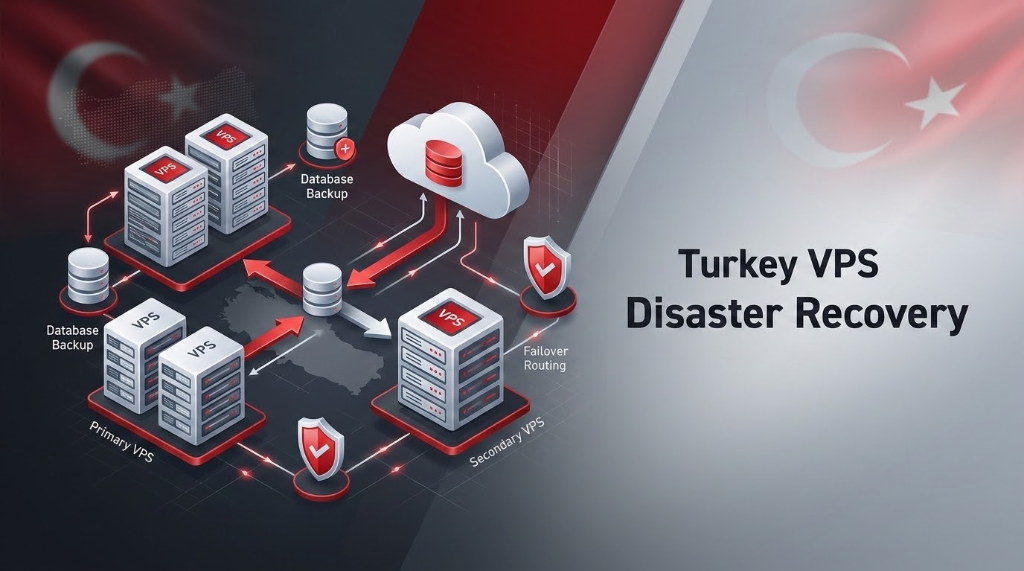
⚡ Quick Answer: How Do You Architect Turkey VPS Disaster Recovery?
Specifically, Turkey VPS disaster recovery requires a strict 3-2-1 backup architecture. Systems maintain three separate data copies across two formats with one European replica.
Consequently, client-side AES-256 encryption preserves KVKK Law 6698 compliance while BorgBackup block deduplication achieves sub-1-hour recovery objectives.
🌐 Geographic Offsite Replication
Stream encrypted database snapshots from Istanbul to secondary European cloud nodes. Therefore, local datacenter disruptions never threaten business continuity.
⚖️ Strict KVKK Law 6698 Compliance
Enforce zero-knowledge client-side AES-256-GCM encryption before offsite transit. Consequently, European storage nodes store unreadable ciphertext, preserving Turkish privacy mandates.
⚡ Chunk Deduplication & Efficiency
Leverage BorgBackup variable-block chunk deduplication across SSH. Thus, daily incremental backups transfer only modified database blocks, slashing bandwidth usage.
⏱️ Sub-15 Min RPO & Rapid Failover
Combine automated GFS retention pruning with Anycast DNS health monitoring. Hence, traffic shifts to Frankfurt standby nodes with negligible transaction loss.
Consequently, implementing Turkey VPS disaster recovery safeguards enterprise infrastructure against unexpected regional outages. Storing snapshots in the same Istanbul datacenter creates a single point of failure.
Furthermore, regional power failures or cut fiber cables make local snapshots completely unreachable. Therefore, smart organizations deploy disaster-resilient Turkey VPS hosting solutions with offsite replication.
Table of Contents
- 1. The Imperative for Geographic DR
- 2. Balancing RPO and RTO for E-Commerce
- 3. Client-Side Cryptography & KVKK Law 6698
- 4. Bandwidth Efficiency & Chunk Deduplication
- 5. Grandfather-Father-Son (GFS) Retention
- 6. Tooling Evaluation: BorgBackup vs Restic
- 7. Failover Automation & Standby Nodes
- 8. Architecture Matrix: Snapshot vs Standby
- 9. Production Administrator Runbook
- 10. Frequently Asked Questions (FAQ)
1. The Imperative for Geographic DR: Why Local Snapshots Fall Short
Most hosting providers offer automated daily hypervisor snapshot backups. While hypervisor snapshots restore files after small software bugs, they cannot replace disaster recovery planning.
Moreover, local hypervisor snapshots typically reside on the same storage chassis inside Istanbul. If a regional disaster strikes, you lose both systems simultaneously.
In fact, real operational resilience demands true geographic separation. Replicating encrypted archives to secondary nodes in Frankfurt or Amsterdam eliminates single points of failure.
As a result, your engineering team can restore critical operations quickly. Business systems resume even after total facility loss in Istanbul.
2. Turkey VPS Disaster Recovery: Balancing RPO and RTO for E-Commerce
Similarly, engineering leaders must align on two critical metrics before choosing backup automation tools:
Recovery Point Objective (RPO): The maximum data age your business can afford to lose during an emergency.
Recovery Time Objective (RTO): The total duration required to restore operational systems and database engines to functional production status.
Furthermore, for high-volume Turkish stores and financial platforms, we recommend an RPO under 15 minutes. Pair this target with an RTO under 45 minutes using pre-configured standby cloud templates.
Additionally, evaluate our comprehensive VPS backup strategy guide for optimal multi-region recovery schedules.
3. Client-Side Cryptography: Offsite Replication Without KVKK Law 6698 Violations
The primary compliance challenge for Turkish firms using European storage is Article 9 of KVKK Law No. 6698. Specifically, this law strictly governs personal data transfers outside Türkiye.
In addition, uploading plain database dumps to foreign servers constitutes an illegal transfer under KVKK. However, implementing client-side zero-knowledge encryption on your Istanbul VPS completely transforms the legal posture.
Engineering teams formulate recovery procedures following the NIST SP 800-34 Contingency Planning Guide. Key security mandates include:
- Consequently, the client encrypts data locally using military-grade AES-256-GCM before sending any network packets.
- Furthermore, encryption keys remain solely on your Istanbul VPS, never touching the remote European storage server.
- As a result, to foreign storage providers, your backup archives appear purely as random cryptographic noise.
Meanwhile, for organizations requiring dedicated bare-metal control, consider exploring our Turkey dedicated servers for isolated hardware governance.
4. Bandwidth Efficiency: Chunk Deduplication for Turkey VPS Disaster Recovery
Sending large database dumps over international transit lines each evening consumes valuable network bandwidth. Modern deduplication tools like BorgBackup and Restic solve this challenge effectively.
Specifically, BorgBackup splits files into variable-length chunks and calculates unique hashes. In addition, the system uploads only newly created or modified chunks.
If a 15GB database gains 60MB of updates today, BorgBackup uploads only that small delta. Therefore, this deduplication method slashes backup times from hours to minutes.
5. Grandfather-Father-Son (GFS) Retention & Automated Storage Pruning
A dependable recovery plan balances historical rollback capability against monthly storage expenses. Without automated pruning, backups consume available disk space and eventually fail.
Specifically, implementing an automated Grandfather-Father-Son (GFS) retention policy maintains predictable disk usage:
- Son (Daily Snapshots): Retain 7 daily snapshots for fast immediate file rollbacks.
- Father (Weekly Archives): Retain 4 weekly archives captured every Sunday at midnight.
- Grandfather (Monthly Milestones): Retain 6 to 12 monthly archives for corporate accounting audits.
Furthermore, BorgBackup executes this rotation cleanly with automated prune flags. Consequently, scheduled cron tasks remove expired chunks and compact storage archives automatically.
6. Tooling Evaluation: BorgBackup vs. Restic for Linux Cloud VPS
Both BorgBackup and Restic deliver enterprise client-side encryption, but their architectures serve different needs.
BorgBackup uses an SSH client-server model. Specifically, it runs on both the Istanbul VPS and the destination storage host.
This design offloads deduplication processing to the storage node, saving CPU cycles on your primary web server.
Meanwhile, Restic operates as a standalone Go binary connecting directly to object storage. However, Restic builds deduplication indexes entirely in local RAM.
In contrast, this memory usage can strain smaller 1GB or 2GB virtual instances during intense replication workloads.
For budget-friendly multi-node infrastructure, review our international multi-country VPS hub for cost-effective standby capacity.
7. Failover Automation: DNS Failover Routing & Standby VPS Provisioning
During an extended datacenter outage in Istanbul, your engineering team executes a structured failover workflow:
- First, Standby Cloud Instance: You maintain a lightweight standby VPS in Frankfurt with Nginx and Docker pre-configured.
- Second, Automated Archive Extraction: A restore script fetches the latest encrypted backup, restores databases, and launches containers.
- Finally, DNS Health Check Switchover: Anycast DNS monitors detect Istanbul downtime and update domain records within 30 seconds.
8. Turkey VPS Disaster Recovery Architecture Matrix: Local Snapshot vs. Active-Passive DR
The comparative matrix below illustrates disaster preparedness levels across different backup paradigms:
| Disaster Recovery Dimension | Local Hypervisor Snapshots | Encrypted Cross-Border Offsite DR |
|---|---|---|
| Geographic Redundancy | Zero (Single Datacenter Facility) | High (Istanbul Primary + Europe Standby) |
| Protection from Facility Disaster | None (Snapshots lost with facility) | 100% Isolated Data Preservation |
| KVKK Law No. 6698 Compliance | Compliant (Domestic Data) | Compliant (Client-side AES-256 Zero-Knowledge) |
| Recovery Point Objective (RPO) | 24 Hours (Daily Snapshot) | ≤ 1 Hour (Incremental Block Streaming) |
| Recovery Time Objective (RTO) | Instant (if hypervisor is healthy) | 15 – 45 Minutes (Full Standby Spin-up) |
9. Production Administrator Runbook: Automated BorgBackup Replication
Deploy this automation script on your Ubuntu 24.04 LTS Turkey VPS to stream encrypted archives offsite:
Schedule this script in your root crontab using 0 3 * * * /opt/scripts/execute_borg_dr.sh. Automated execution guarantees your web directories, databases, and SSL certificates remain secure offsite.
