

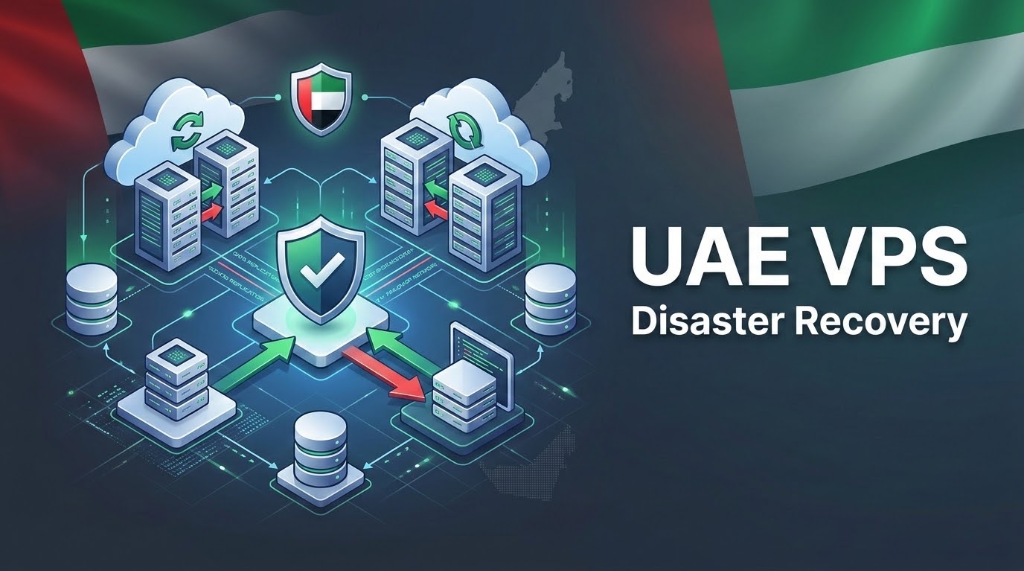
Specifically, architecting a resilient UAE VPS disaster recovery pipeline pairs primary Dubai compute with standby European cloud nodes. Secure systems configure encrypted WireGuard tunnels and continuous MySQL GTID log shipping.
Consequently, organizations achieve sub-15 minute RTO failovers while complying fully with UAE PDPL cross-border mandates.
🌐 Geo-Redundant Standby
Replicate database transactions from Dubai to Frankfurt standby clusters continuously. Therefore, regional fiber outages never compromise business uptime.
⚖️ UAE PDPL Compliance
Apply client-side AES-256 encryption before payloads leave UAE territorial boundaries. Consequently, your data transfers fulfill Federal Decree-Law No. 45 requirements.
⏱️ Sub-15 Minute RTO & RPO
Automate delta transfers and point-in-time binary logs across secure WireGuard tunnels. Thus, failovers execute rapidly with negligible data loss.
🔀 Anycast Health Routing
Deploy multi-node geographic monitoring probes with pre-configured 300-second DNS TTLs. Hence, web traffic shifts to Europe seamlessly during emergencies.
Table of Contents
- 1. The Imperative for Cross-Border Resilience in the GCC
- 2. Disaster Recovery Tiers: Cold, Warm & Hot Standby
- 3. Balancing Cross-Border Replication with UAE PDPL Law
- 4. Asynchronous Database Replication & Delta Syncing
- 5. Automated DNS Failover via Health-Checked Routing
- 6. Production Runbook: Encrypted Automated DR Pipeline
- 7. Architecture Matrix: Local Backups vs Cross-Border Standby
- 8. Frequently Asked Questions (FAQ)
1. The Imperative for Cross-Border Resilience in the GCC
Modern Gulf enterprises depend heavily on continuous digital uptime for financial and e-commerce transactions. However, hosting workloads exclusively within a single physical facility exposes businesses to regional disruptions.
Subsea telecom cable cuts, severe storms, or power grid failures can isolate local networks. Consequently, leading organizations deploy a multi-region UAE VPS disaster recovery architecture.
In fact, establishing primary instances on high-performance UAE VPS hosting ensures ultra-low domestic latency. Simultaneously, maintaining standby nodes in Europe delivers rock-solid disaster resilience.
2. Disaster Recovery Tiers: Cold, Warm & Hot Standby
Designing a disaster recovery strategy requires balancing financial cost against operational recovery time. Industry frameworks define three distinct disaster recovery operating models.
First, Cold Standby stores daily encrypted disk archives in Europe. However, provisioning compute from scratch takes hours during an unexpected outage.
Second, Warm Standby maintains an active virtual server with pre-configured web and database daemons. Databases synchronize continuously, enabling manual failover within 15 minutes.
Third, Hot Standby provisions active-active synchronized nodes across continents. While Hot Standby eliminates failover delays, it increases infrastructure expenditures significantly.
Furthermore, review our UAE VPS hosting cost AED breakdown to compare operating expenses across configurations.
3. Balancing Cross-Border Replication with UAE PDPL Law
Replicating sovereign citizen data across international borders requires strict regulatory compliance. The UAE Personal Data Protection Law (Federal Decree-Law No. 45) governs data transfers.
Specifically, Articles 22 and 23 permit international transfers to countries offering adequate protection standards. The European Union GDPR framework satisfies these legal requirements completely.
In addition, system architects must enforce client-side AES-256 encryption before data leaves Dubai. Encrypting database archives ensures zero unauthorized third-party access during cross-border transit.
Moreover, evaluate our managed vs unmanaged UAE VPS guide. Managed operational engineers enforce automated compliance patching around the clock.
4. Asynchronous Database Replication & Delta Syncing
Real-time database synchronization represents the technological foundation of effective disaster recovery. Connecting databases across the Mediterranean requires an encrypted network tunnel.
WireGuard creates an ultra-lightweight, high-throughput VPN tunnel between Dubai and Frankfurt. Below is the production WireGuard tunnel configuration.
/etc/wireguard/wg0.conf
# Dubai Primary VPS (10.100.0.1)
[Interface]
Address = 10.100.0.1/24
PrivateKey = <Dubai_Server_Private_Key>
ListenPort = 51820

[Peer]
# European Standby VPS Node
PublicKey = <Frankfurt_Server_Public_Key>
Endpoint = 194.26.198.50:51820
AllowedIPs = 10.100.0.2/32
PersistentKeepalive = 25
Next, configure asynchronous MySQL or MariaDB GTID replication over the private tunnel. As outlined in the official MariaDB replication architecture documentation, GTID tracking guarantees data consistency.
Similarly, synchronize static media uploads and documents using incremental tools. For global deployments, explore our international multi-country VPS hub for cost-efficient standby capacity.
5. Automated DNS Failover via Health-Checked Routing
Even perfectly synchronized databases provide no benefit if users cannot reach the standby server. Therefore, automated DNS health-check monitoring is mandatory.
Multi-region health probes test the primary Dubai web server every 30 seconds. If Dubai stops responding to HTTP GET probes, DNS routes fail over to Europe.
Additionally, pre-lower your DNS TTL to 300 seconds. Reviewing our VPS backup strategy guide explains optimal TTL configurations.
6. Production Runbook: Encrypted Automated DR Pipeline
The production script below executes daily encrypted database exports and transmits archives to European storage vaults. It integrates automated bandwidth throttling and alerting webhooks.
Automation Runbook
#!/usr/bin/env bash
set -eo pipefail

DATE=$(date +%Y%m%d_%H%M%S)
BACKUP_DIR="/tmp/dr_staging"
mkdir -p "$BACKUP_DIR"

# 1. Consistent database dump without table locking
mysqldump --single-transaction --quick -u root production_db | \
    gzip -9 | openssl enc -aes-256-cbc -salt -pbkdf2 -pass env:DR_SECRET \
    -out "${BACKUP_DIR}/db_enc_${DATE}.sql.gz.enc"

# 2. Sync encrypted payload to European standby vault with bandwidth cap
rclone copy "${BACKUP_DIR}/" "eu_vault:uae-dr-backups/" \
    --bwlimit 15M --transfers 4

# 3. Clean local temporary staging files
rm -rf "$BACKUP_DIR"

# 4. Notify security operations via webhook
curl -s -X POST -H 'Content-type: application/json' \
    --data "{"text":"[DR Success] UAE VPS backup replicated to Europe: db_enc_${DATE}"}" \
    https://hooks.slack.com/services/T00/B00/X00
Furthermore, pair this script with our UAE VPS vs AWS cloud comparison. Dedicated virtual instances eliminate hyperscaler egress bandwidth fees during cross-border transfers.
7. Architecture Matrix: Local Backups vs Cross-Border Standby
The table below highlights architectural differences between local on-server backups and a resilient UAE VPS disaster recovery pipeline.
| Operational Parameter | Local Data Center Backups | Cross-Border European Standby |
|---|---|---|
| Regional Outage Immunity | Vulnerable to facility disasters | 100% geographically isolated |
| Recovery Time Objective (RTO) | 4 to 12 hours server rebuilding | Sub-15 minute DNS failover |
| Recovery Point Objective (RPO) | 24 hours of lost transactions | Continuous near-zero data loss |
| UAE PDPL Compliance | Standard domestic retention | Client-side encrypted EU transfer |
| Manual Labor in Crisis | High; manual rebuild required | Automated health-probe cutover |
| SEO Continuity Protection | Extended downtime harms ranking | Standby serves live 200 HTTP pages |
