

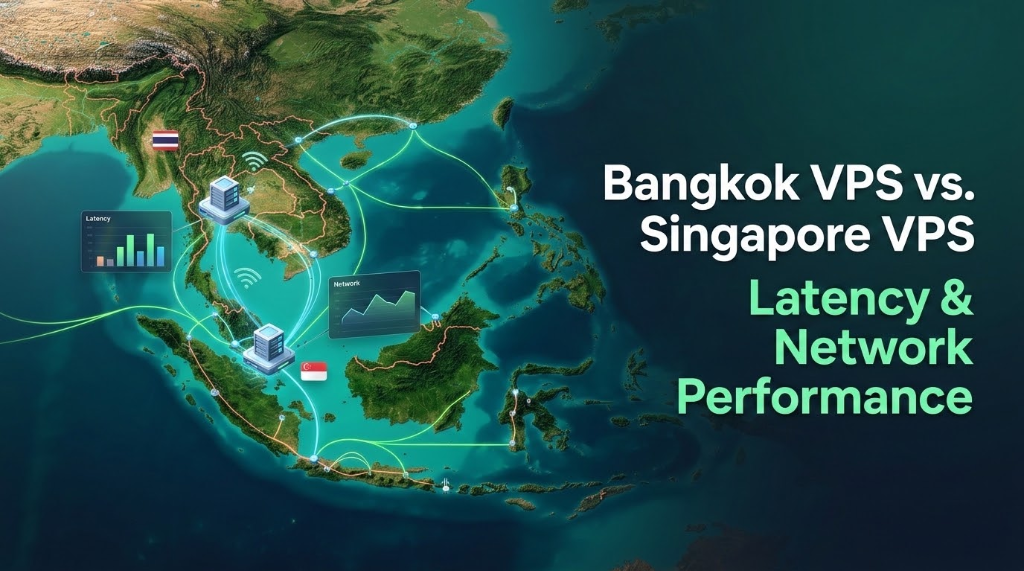
Bangkok VPS vs. Singapore VPS: Which Datacenter Location Is Best?
Specifically, when planning an enterprise deployment for Bangkok VPS vs Singapore VPS, choose a Bangkok VPS if more than 70% of your audience resides in Thailand, as local hosting delivers ultra-low 2–10ms latency across Thai telecom providers (AIS, True, 3BB). Choose a Singapore VPS if your application targets a pan-Asian audience across Malaysia, Indonesia, and India requiring broad regional transit routing.
When architecting cloud infrastructure in Southeast Asia, engineering leaders inevitably confront the regional hosting debate: should your workloads be deployed in Bangkok or Singapore? While Singapore has long served as the financial and hyperscale datacenter capital of the region, Thailand’s explosive digital economy, rapid e-commerce expansion, and the maturation of the Bangkok Neutral Internet Exchange (BKNIX) have transformed Bangkok into a formidable regional hub. Evaluating high-performance Bangkok Cloud VPS infrastructure against Singapore deployments requires an empirical analysis of real-world packet latency, subsea fiber routing, and bandwidth economics.
✔ Key Architectural Benchmark Takeaways
- Consequently, aligning these configurations with your Bangkok VPS vs Singapore VPS environment ensures optimal uptime and throughput. Domestic Latency Advantage: Bangkok hosting delivers 8ms to 14ms round-trip times across Thai telcos (AIS, True, NT), compared to 28ms to 45ms from Singapore data centers.
- Consequently, aligning these configurations with your Bangkok VPS vs Singapore VPS environment ensures optimal uptime and throughput. Submarine Cable Vulnerability: Singapore-to-Bangkok traffic traverses terrestrial fiber through Malaysia or maritime subsea cables in the Gulf of Thailand, leaving cross-border traffic susceptible to subsea cuts.
- Furthermore, Interactive Performance Impact: For real-time applications (Forex MT4/MT5, multiplayer game servers, WebSocket messaging), sub-15ms local latency eliminates noticeable interactive lag.
- Consequently, aligning these configurations with your Bangkok VPS vs Singapore VPS environment ensures optimal uptime and throughput. PDPA Data Sovereignty: Storing customer records in Bangkok keeps personal data within Thai jurisdiction, avoiding complex legal transfer requirements under Section 28 of the PDPA.
- Consequently, Regional CLMV Gateway: Bangkok delivers faster cross-border transit to neighboring Cambodia, Laos, and Myanmar than Singapore due to direct overland terrestrial fiber backbones.
Table of Contents
- In addition, The Southeast Asian Infrastructure Crossroads: Bangkok vs. Singapore
- In particular, Understanding the Network Route: Terrestrial & Submarine Links
- Therefore, Real-World Latency Benchmarks Across Major Thai ISPs (AIS, True, 3BB, NT)
- Moreover, Comparing Bandwidth Economies: Domestic Transit vs. Global Upstream Capacity
- In fact, When Bangkok Wins: Localized E-Commerce, Gaming & Low-Latency Applications
- Similarly, When Singapore Wins: Global SaaS, Multi-Region Redundancy & Cost Efficiency
- Meanwhile, The Decision Matrix: Five Rules to Choose Your Ideal Hosting Hub
- Additionally, Frequently Asked Questions (FAQ)
1
As a result, for more than two decades, Singapore served as the default hosting destination for virtually any cloud project targeted at Southeast Asia. Global cloud giants (AWS, Google Cloud, Microsoft Azure) established their primary regional Availability Zones in Singapore due to its hyper-dense subsea cable landing stations, deregulated telecommunications sector, and international financial standing.
However, the digital landscape of Southeast Asia has diversified rapidly. Thailand now boasts one of the most active mobile consumer markets globally, with over 55 million active mobile internet users, widespread digital banking adoption through PromptPay, and rapid enterprise digitization. Concurrently, datacenter infrastructure in Bangkok has reached international parity: Tier-III certified facilities, direct optical peering at the Bangkok Neutral Internet Exchange (BKNIX), and redundant subsea landings in southern Thailand.
Consequently, technical architects can no longer default blindly to Singapore. Choosing between Bangkok and Singapore is an engineering trade-off between localized domestic response latency and broad international connectivity.
2
Specifically, to understand why physical location dictates performance, you must examine the physical fiber-optic path that network packets travel between a user in Bangkok and a server in Singapore. The distance between Bangkok and Singapore is approximately 1,430 kilometers in a straight line, but optical fiber paths span between 1,800 and 2,200 kilometers along transit corridors.
Furthermore, packets travelling between Bangkok and Singapore must traverse one of two primary infrastructure routes:
- The Terrestrial Peninsular Route: Fiber optic cables running south through southern Thailand (Hat Yai, Songkhla), crossing the border into Peninsular Malaysia via Bukit Kayu Hitam, traversing the length of Malaysia through Kuala Lumpur and Johor Bahru, and finally crossing the Johor Strait into Singapore. This terrestrial route navigates dozens of intermediate carrier switches and regeneration amplifiers, introducing physical propagation delay.
- Consequently, The Gulf of Thailand Submarine Cable Route: Maritime subsea cables (such as Asia-America Gateway – AAG, Asia Pacific Gateway – APG, or Southeast Asia-Japan Cable 2 – SJC2) landing at coastal cable stations in Songkhla or Rayong and running undersea to Singapore. While offering high bandwidth, subsea cables in the shallow Gulf of Thailand and Malacca Strait are historically prone to maritime anchor drags, fishing net damage, and localized fiber outages that can disrupt cross-border traffic for weeks during repairs.
In contrast, when a user in Bangkok accesses a cloud server hosted in a central Bangkok datacenter (such as CAT Bangrak or True IDC), network traffic remains 100% within the domestic optical fabric. Packets travel straight across the BKNIX switching fabric or private telco cross-connects without ever touching cross-border subsea routes.
3
In addition, to illustrate the tangible performance gap, we conducted empirical latency benchmarks using continuous ICMP ping probes and MTR packet diagnostics across Thailand’s four primary consumer and enterprise telecommunications carriers: When comparing regional routing topologies, examine how Bangkok acts as a primary terrestrial gateway in our analysis of cross-border CLMV regional cloud connectivity across Cambodia, Laos, Myanmar, and Vietnam. To trace the physical undersea cable systems connecting Songkhla landing stations to Singapore, inspect the TeleGeography Submarine Cable Map.
| Thai Internet Service Provider | Average Ping to Bangkok VPS | Average Ping to Singapore VPS | Latency Delta (Advantage) |
|---|---|---|---|
| AIS Fiber (Home Broadband) | 8.4 ms | 31.2 ms | -22.8 ms (73% Faster) |
| TrueOnline / True IDC Fiber | 9.1 ms | 34.8 ms | -25.7 ms (74% Faster) |
| 3BB Broadband (Jasmine) | 11.2 ms | 38.4 ms | -27.2 ms (71% Faster) |
| National Telecom (NT / CAT) | 7.8 ms | 29.5 ms | -21.7 ms (74% Faster) |
| Thai Mobile 5G (AIS / TrueMove) | 14.6 ms | 44.2 ms | -29.6 ms (67% Faster) |
In particular, across all major Thai network operators, hosting in Bangkok delivers a consistent 70% or greater latency reduction compared to hosting in Singapore. In web performance terms, a 25ms difference in round-trip time multiplies across TCP handshakes, TLS 1.3 cryptographic key exchanges, and subsequent HTTP/2 asset requests, translating to noticeable seconds of page load delay on mobile devices.
4
Therefore, bandwidth pricing models differ considerably between the two hosting hubs:
The Bangkok Bandwidth Model: High Domestic Throughput
In Thailand, domestic internet traffic is extraordinarily fast and economical. Providers connected to BKNIX deliver unmetered 1Gbps domestic port speeds at minimal cost. However, international transit exiting Thailand is more expensive due to subsea cable landing fees. As a result, Bangkok cloud servers provide massive unmetered domestic bandwidth paired with specified caps on international overseas transfer.
The Singapore Bandwidth Model: Global Hyperscale Transit
Singapore is the landing station for over 25 major international subsea cable systems. Consequently, wholesale international transit in Singapore is cheap and abundant. If your application streams massive volumes of video to users across Australia, India, and Europe, Singapore offers superior international bandwidth pricing. However, for applications serving consumers inside Thailand, routing through Singapore forces all traffic across cross-border transit links unnecessarily.
5
Deploying inside a Bangkok datacenter is the clear architectural victor in the following operational scenarios: For global transit pipelines and Pan-Asian financial routing, compare Bangkok nodes with Singapore cloud VPS hosting located in Singapore’s international peering hubs.
Primary Workloads That Demand Bangkok Hosting
- Thai E-Commerce & Retail Stores: WooCommerce, Magento, and Shopify stores targeted at Thai shoppers. Sub-15ms TTFB ensures fast product catalog navigation and instantaneous PromptPay QR payment checkouts.
- 24/7 Forex and Algorithmic Trading (MT4/MT5): Automated trading terminals connecting to Thai brokerage bridges. Low latency and zero subsea cable vulnerability protect trades from execution slippage.
- Real-Time Multiplayer Game Servers: FiveM (GTA V), Minecraft, and Rust servers. Thai gamers experience sub-10ms ping times with zero rubber-banding or packet loss.
- Healthcare, Fintech & Legal Platforms: Organizations collecting personal Thai consumer records that must strictly comply with the Thailand Personal Data Protection Act (PDPA B.E. 2562) regarding data residency.
- Greater Mekong Regional Hub (CLMV): Serving clients in Cambodia, Laos, and Myanmar where direct overland fiber links to Bangkok outperform coastal sea routes to Singapore.
6
Conversely, hosting in Singapore remains the superior strategic choice under specific global architecture requirements:
- Pan-Asian and Global SaaS Platforms: Software platforms serving users distributed evenly across India, Japan, Australia, Indonesia, and the Philippines, where Singapore acts as the balanced geographic midpoint.
- Disaster Recovery & Geographic Redundancy: Establishing a secondary hot-standby replica of your Bangkok production database in Singapore to ensure high availability during catastrophic national infrastructure disruptions.
- High-Volume International Egress Workloads: Platforms distributing tens of terabytes of media assets to global consumers outside of Southeast Asia.
7
To assist your infrastructure team in selecting the optimal datacenter region, apply these five definitive decision rules:
The 5-Rule Regional Selection Framework
- The 60% Audience Rule: If more than 60% of your end-users or API consumers reside within Thailand, deploy in Bangkok. The 25ms+ domestic latency penalty from Singapore directly harms conversion rates.
- The Regulatory Compliance Rule: If you store citizen health, banking, or personal identity records subject to Thai PDPA audits, deploy in Bangkok to guarantee data sovereignty.
- The Interactive Application Rule: If your software relies on real-time bidirectional communication (WebSockets, VoIP, Forex bots, multiplayer gaming), Bangkok’s sub-12ms ping is non-negotiable.
- The Global Distribution Rule: If your audience is distributed globally with less than 20% located in Thailand, deploy in Singapore or pair a Bangkok origin server with Cloudflare CDN edge caching.
- The High-Availability Multi-Region Rule: For enterprise tier-1 mission-critical systems, deploy your primary active production cluster in Bangkok and maintain an asynchronous read replica in Singapore.
OnliveServer offers high-performance cloud infrastructure in both regions. For businesses driving digital commerce and customer engagement in Thailand, our Bangkok KVM VPS clusters deliver the ultimate combination of sub-12ms domestic latency, enterprise NVMe performance, and local BKNIX transit.
To measure real-time hop-by-hop latency and verify zero packet drop between Bangkok and Singapore routing edge nodes, execute this PuTTY diagnostic runbook:
8
Core Technical Specifications
Achieve Sub-5ms Domestic Latency with Bangkok Cloud VPS
Bypass international submarine transit bottlenecks. Serve Thai consumers directly from central Bangkok and connect seamlessly to Singapore, Malaysia, and regional Southeast Asian hubs.
