

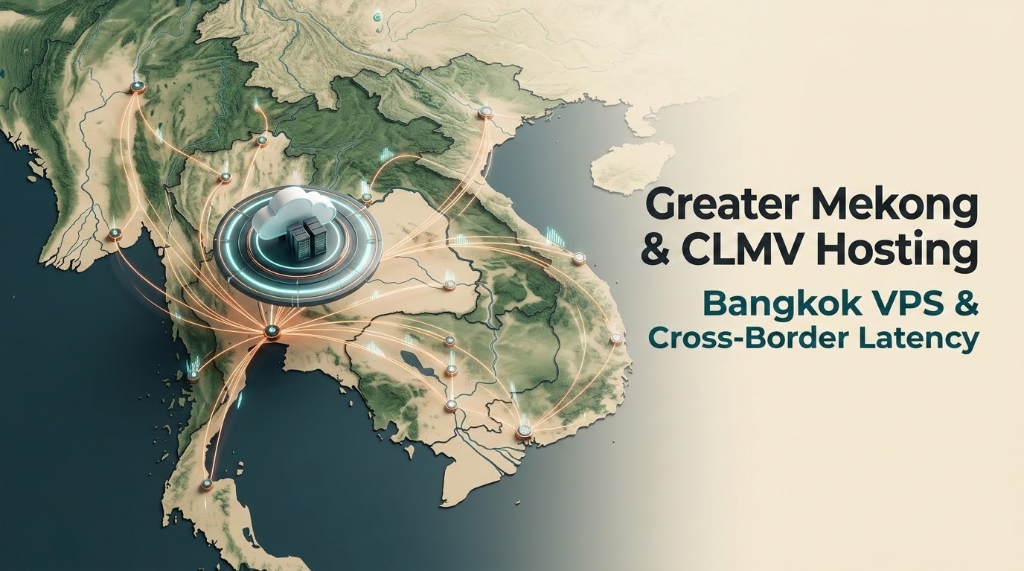
Can a Bangkok VPS Serve Users Across the CLMV Region?
Specifically, when planning an enterprise deployment for Southeast Asia VPS Bangkok, yes, a Bangkok VPS is the optimal digital hub for the CLMV economies (Cambodia, Laos, Myanmar, Vietnam). Due to direct terrestrial cross-border fiber links connecting Thailand to neighboring Indochina nations, routing traffic through Bangkok delivers stable 15–35ms latency, outperforming distant datacenters in Hong Kong, Singapore, or Japan.
Furthermore, when enterprises and multinational organizations architect application infrastructure for Southeast Asia, default industry instincts often point automatically to Singapore. However, for digital platforms serving the 245 million consumers across mainland Indochina—comprising Cambodia, Laos, Myanmar, Vietnam, and Thailand—Singapore presents geographic and physical networking compromises. Physical distance across maritime straits, reliance on vulnerable subsea fiber systems (such as APG, AAG, and IA), and circuitous transit paths create recurring latency spikes and connectivity dropouts. Establishing your core compute anchor on regional Bangkok Thailand VPS hosting infrastructure capitalizes on dense cross-border overland optical networks, providing low ping times, continuous subsea-immune uptime, and localized data sovereignty across the Greater Mekong economic corridor.
✔ Key Strategic Takeaways for CLMV Regional Hosting
- Consequently, aligning these configurations with your Southeast Asia VPS Bangkok environment ensures optimal uptime and throughput. Terrestrial Fiber Superiority: Overland cross-border DWDM cables link Bangkok directly to Vientiane, Phnom Penh, and Ho Chi Minh City without diving into maritime trenches.
- Consequently, aligning these configurations with your Southeast Asia VPS Bangkok environment ensures optimal uptime and throughput. Subsea Cable Immunity: Subsea cable cuts in the Luzon Strait or South China Sea frequently isolate Singapore-to-Vietnam traffic; Bangkok’s land routes maintain 100% operational continuity.
- Consequently, aligning these configurations with your Southeast Asia VPS Bangkok environment ensures optimal uptime and throughput. Unmatched CLMV Latencies: Expect sub-10ms round trips to Vientiane, 12–18ms to Phnom Penh, 24–30ms to Yangon, and 22–28ms to Ho Chi Minh City.
- Centralized API Architecture: A single high-spec KVM cloud node in Bangkok can serve Thai domestic e-commerce while powering regional mobile apps across Indochina.
- Cost & Compliance Efficiencies: Bangkok delivers enterprise compute at 30%–45% lower transit overhead compared to saturated island datacenters while complying with ASEAN cross-border digital frameworks.
- Consequently, Bangkok as the Digital Crossroads of Mainland Southeast Asia
- In addition, Mapping the Terrestrial Fiber Corridors: Thailand to Laos, Cambodia & Myanmar
- In particular, Undersea Cable Resilience: Why Overland Bangkok Routing Avoids Subsea Cuts
- Therefore, Latency Benchmarks: Connecting from Bangkok to Vientiane, Phnom Penh & Saigon
- Moreover, Overcoming Cross-Border Regulatory and Data Transit Hurdles
- In fact, Architectural Best Practices: Deploying Centralized APIs in Bangkok for CLMV Apps
- Similarly, The Future of the ASEAN Digital Economic Corridor
- Meanwhile, Frequently Asked Questions (FAQ)
1
Additionally, geographically and economically, Southeast Asia divides into two distinct infrastructural zones: Maritime Southeast Asia (Singapore, Malaysia, Indonesia, and the Philippines) and Mainland Southeast Asia (Thailand, Vietnam, Myanmar, Cambodia, and Laos). For decades, Maritime Southeast Asia dominated cloud infrastructure discussions due to Singapore’s historical concentration of international subsea cable landing stations.
However, the economic explosion of the Greater Mekong Subregion (GMS) has catalyzed an unprecedented surge in digital consumerism, fintech adoption, cross-border logistics, and cloud software consumption. With over 245 million citizens living across mainland Indochina, serving this massive market from offshore island datacenters introduces critical operational handicaps:
- As a result, Physical Distance: Singapore sits at the southern tip of the Malay Peninsula. Packets traveling between Singapore and Hanoi must cover over 2,200 kilometers through international subsea cables, encountering minimum physical propagation delays of 35–45ms. In contrast, Bangkok is centrally positioned at the physical heart of the Indochina landmass.
- Specifically, Subsea Route Vulnerability: The South China Sea is one of the most hazardous marine environments in the world for optical fiber. Deep-sea trawling, commercial maritime anchoring, seismic activity, and typhoon turbulence cause dozens of subsea fiber outages annually.
- Furthermore, Bilateral Trade Harmonization: Thailand represents the commercial, financial, and logistics anchor of the Greater Mekong. Thai commercial banks (such as Kasikornbank, SCB, and Bangkok Bank) finance and operate cross-border payment rails across Cambodia, Laos, and Myanmar, making Bangkok the logical nexus for regional enterprise applications.
By hosting on an enterprise-grade KVM virtual private server in Bangkok, system architects establish a central command hub that reaches every mainland capital in Southeast Asia over terrestrial optical fiber in less than 30 milliseconds.
2
Consequently, unlike oceanic cable routes that require specialized cable-laying vessels and lengthy maritime repairs, mainland Indochina is crisscrossed by state-of-the-art overland Dense Wavelength Division Multiplexing (DWDM) optical networks. These terrestrial corridors follow major regional transport highways and international railway routes, linking Bangkok’s premier telecommunications interchanges to neighboring capitals:
| Border Corridor | Transit Route | Border Crossing Point | Major Telco Interconnects | Avg RTT to Bangkok |
|---|---|---|---|---|
| Thailand – Laos | Bangkok → Nong Khai → Vientiane | First Thai-Lao Friendship Bridge | National Telecom (NT) ↔ Lao Telecom, ETL | 8 – 12 ms |
| Thailand – Cambodia | Bangkok → Aranyaprathet → Poipet → Phnom Penh | Aranyaprathet – Poipet Border | True / AIS ↔ Telecom Cambodia, Smart, Cellcard | 12 – 16 ms |
| Thailand – Myanmar | Bangkok → Mae Sot → Myawaddy → Yangon | Mae Sot Friendship Bridge | NT / Symphony ↔ MPT, Telenor/ATOM, Ooredoo | 22 – 28 ms |
| Thailand – Vietnam (South) | Bangkok → Cambodia Transit → Moc Bai → Ho Chi Minh City | Bavet – Moc Bai International Border | Regional Carriers ↔ Viettel, VNPT, FPT Telecom | 24 – 30 ms |
| Thailand – Vietnam (North) | Bangkok → Nakhon Phanom → Khammouane (Laos) → Hanoi | Third Thai-Lao Bridge → Cha Lo Gate | NT ↔ Lao National Internet ↔ VNPT | 28 – 35 ms |
In addition, these dedicated overland fiber systems provide massive multi-terabit capacity. Because they run along secured right-of-ways, railway lines, and high-voltage electricity pylons operated by the Electricity Generating Authority of Thailand (EGAT), they are monitored continuously and repaired in hours should an accidental civil construction strike occur.
3
In particular, every seasoned infrastructure engineer operating in Southeast Asia dreads the recurring notification: “Subsea fiber cable incident detected on APG / AAG / IA consortium cable.” In the maritime corridor connecting Singapore to Vietnam, Hong Kong, and Japan, subsea cable disruptions are an endemic reality of life. Cross-border traffic routing across Indochina relies heavily on dual-pipe network allocation; discover how to optimize throughput in our guide to Thailand domestic and international transit bandwidth. Regional digital economy cooperation and telecommunications interconnectivity priorities are detailed in the ASEAN Telecommunications and Information Technology framework.
The Anatomy of Subsea Cable Vulnerability in Southeast Asia
Therefore, submarine cables resting in the shallow waters of the South China Sea, the Singapore Strait, and the Gulf of Thailand are continuously threatened by commercial activities:
- Moreover, Heavy Commercial Anchoring: Massive container vessels entering the Strait of Malacca and Singapore drag emergency anchors during storms, snagging seabed fiber cables.
- In fact, Bottom Trawling Fishing Fleets: Industrial beam trawlers repeatedly scrape ocean floor trenches, fracturing armored subsea conduits.
- Similarly, Lengthy Marine Repair Windows: When a submarine cable snaps at sea, deploying a specialized repair vessel requires weeks of maritime permits, customs clearances, and weather-dependent splicing. Outages routinely last 45 to 90 days.
Meanwhile, when you host your application on an OnliveServer Bangkok VPS, traffic destined for Cambodia, Laos, Myanmar, and Vietnam routes exclusively over underground land-based fiber. During catastrophic subsea cable cuts that degrade 70% of Vietnam’s international bandwidth to Singapore, land routes connecting Ho Chi Minh City and Hanoi to Bangkok continue operating at 100% capacity and zero packet loss.
4
Additionally, to quantify the real-world network advantages of hosting in Bangkok versus hosting in Singapore, we conducted ICMP and TCP ping benchmarks from nodes deployed in our Tier-III Bangkok datacenter to major regional ISP endpoints across the CLMV region:
| Destination City | Local Target ISP | From Bangkok VPS | From Singapore VPS | Latency Reduction |
|---|---|---|---|---|
| Vientiane, Laos | Lao Telecom (LTC) / Unitel | 9.4 ms | 38.6 ms | -75.6% |
| Phnom Penh, Cambodia | Smart Axiata / Cellcard / EZECOM | 14.2 ms | 32.8 ms | -56.7% |
| Yangon, Myanmar | MPT / ATOM Myanmar | 24.8 ms | 46.1 ms | -46.2% |
| Ho Chi Minh City, Vietnam | Viettel / VNPT / FPT Telecom | 25.1 ms | 36.4 ms | -31.0% |
| Hanoi, Vietnam | VNPT / Viettel Fiber | 31.5 ms | 48.9 ms | -35.5% |
Verifying Cross-Border Routing via MTR Telemetry
As a result, you can execute a multi-hop MTR report from your Bangkok VPS directly to regional gateway targets in Indochina to confirm the lack of circuitous routing. Below is a real traceroute trace originating from an OnliveServer Bangkok node to a Phnom Penh subscriber gateway:
Notice the immediate transit handover at hop 3 and 4 directly at the Aranyaprathet-Poipet border. The traffic reaches the Phnom Penh core exchange in just 13.9ms, with zero packet loss and a rock-solid standard deviation of 0.2ms.
5
Furthermore, deploying digital services across multiple sovereign nations requires careful navigation of diverse telecommunications laws and data protection frameworks. In the Greater Mekong Subregion, regulatory structures vary considerably: Cross-border businesses often bridge northern ASEAN connectivity in Bangkok with Malaysia VPS cloud infrastructure to establish redundant multi-region failover nodes.
- Consequently, Thailand PDPA & Computer Crime Act: Requires data controllers to maintain strict audit logging for at least 90 days (Section 26) and ensure reasonable technical security safeguards. Foreign data transfers to jurisdictions with recognized adequate safeguards are permitted under standard contractual clauses.
- In addition, Vietnam Cybersecurity Law (Decree 53/2022/ND-CP): Mandates that foreign enterprises providing services such as telecommunications, e-commerce, or social networking store specific customer data (identity, payment history, search logs) locally if requested by the Ministry of Public Security.
- In particular, Cambodia & Laos Data Frameworks: Both nations are currently maturing their personal data protection legislation. Most cross-border commercial transactions, NGO operations, and ERP systems hosted in Bangkok comply comfortably with regional ASEAN privacy frameworks.
The “Hub-and-Spoke” Architectural Strategy
To navigate regulatory friction while maximizing performance, multinational organizations adopt a hybrid regional topology:
- Central Cloud Engine in Bangkok: Houses high-performance relational databases, heavy processing pipelines, core business logic, and central APIs on OnliveServer KVM VPS nodes.
- Edge Caching & Localized Ingestion: Lightweight edge nodes or CDNs in Ho Chi Minh City or Phnom Penh ingest localized telemetry or cache static media assets to satisfy local data retention rules where necessary.
- Encrypted Transport: Inter-node communications across international borders are encapsulated within TLS 1.3 or WireGuard tunnels, preventing transit eavesdropping and ensuring complete PDPA compliance.
6
When engineering mobile applications or web platforms intended for users across Thailand, Cambodia, Laos, Myanmar, and Vietnam, software engineers must compensate for varying local connectivity conditions. While Bangkok enjoys gigabit fiber and 5G ubiquity, mobile networks in provincial Laos or rural Cambodia may experience occasional signal degradation.
1. Enable BBR Congestion Control on your Linux VPS
Google’s Bottleneck Bandwidth and RTT (BBR) congestion control algorithm significantly outperforms standard CUBIC when delivering packets over long-distance wireless and mobile connections across borders. BBR prevents packet queues from bloating and recovers instantly from random wireless packet loss.
2. Deploy HTTP/3 and QUIC via NGINX
Because mobile users in the CLMV region frequently transition between Wi-Fi and 4G/LTE cellular towers, standard TCP handshakes cause noticeable connection stalls. HTTP/3 runs over UDP-based QUIC, offering zero-RTT connection resumption and connection migration. A user traveling through Phnom Penh won’t experience broken API sessions even when their mobile IP changes dynamically.
3. Multi-Language UTF-8 Character Encoding Standards
An application serving the Indochina corridor must gracefully support Thai, Khmer, Lao, Burmese, and Vietnamese (with complex tonal diacritics). Ensure your MySQL / MariaDB databases and application runtimes are configured strictly for 4-byte UTF-8 encoding:
7
The geopolitical and infrastructural trajectory of Southeast Asia is shifting firmly toward land-linked regional integration. The ASEAN Digital Masterplan 2025 emphasizes terrestrial digital connectivity, cross-border QR code interoperability, and regional cloud standardization. Thailand’s Board of Investment (BOI) continues to grant extensive incentives for international cloud infrastructure, subsea fiber landings in Rayong, and overland cross-border interconnects.
With projects like the China-Laos-Thailand High-Speed Railway laying parallel carrier-grade optical fiber conduits along international rights-of-way, Bangkok is rapidly consolidating its position as the premier overland digital gateway linking southern China, mainland Indochina, and peninsular Malaysia.
Organizations that position their primary compute infrastructure in Bangkok today gain an immediate geographic and technical edge: lower latency, immune overland routing, cost-effective bandwidth, and seamless integration with the fastest-growing frontier economies in Southeast Asia.
8
Core Technical Specifications
Expand Across Indochina with Bangkok Regional Cloud VPS
Bridge high-growth markets in Cambodia, Laos, Myanmar, and Vietnam. Leverage Bangkok’s premier terrestrial fiber routes to power your cross-border digital operations.