

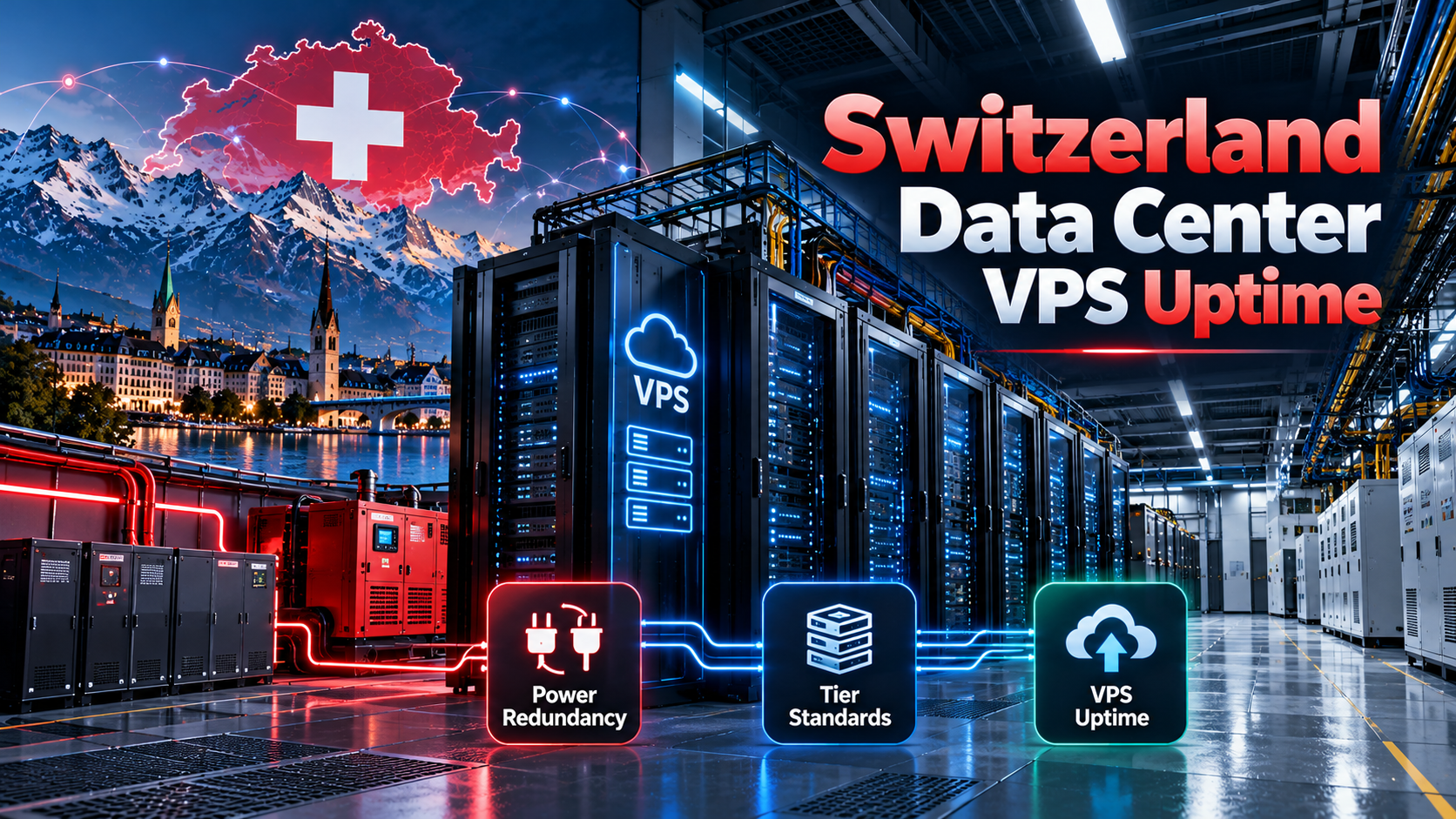
Specifically, when planning an enterprise deployment for switzerland data center vps, a Switzerland datacenter VPS operates within carrier-neutral facilities engineered to Tier III and Tier IV reliability standards in Zurich. Specifically, these facilities feature 2N power distribution, N+1 rotary diesel generator reserves, alpine ambient free-cooling, and multi-layered biometric physical security, guaranteeing 99.99% uptime under the sovereign jurisdiction of the Swiss Federal Constitution.
Furthermore, when evaluating cloud hosting performance, software-level optimizations and hypervisor configurations receive the majority of attention. Yet the most sophisticated KVM kernel tuning and PCIe 4.0 NVMe arrays are utterly dependent on the physical environment that houses them. A single utility power disruption, a failure in cooling distribution, or an unauthorized physical breach can instantly bring enterprise services to a halt. Switzerland has established a worldwide reputation for civil engineering precision, seismic resilience, and infrastructure reliability. By anchoring our cloud virtualization fleet inside carrier-neutral Zurich facilities, Tier-III Swiss datacenter VPS hosting delivers an uncompromising foundation of physical redundancy, environmental efficiency, and sovereign operational security.
Key Technical Takeaways
- Consequently, Tier III and Tier IV Facility Standards: Certified concurrently maintainable architecture ensures that any power or cooling component can be serviced without interrupting virtual server workloads.
- In addition, Dual-Feed 2N Power Distribution: Redundant A+B electrical utility feeds paired with uninterruptible power supply (UPS) batteries eliminate power transients and utility outage risks.
- In particular, Alpine Indirect Free-Cooling: Zurich’s temperate climate enables indirect economizer cooling for over eight months annually, achieving industry-leading PUE ratings below 1.20.
- Therefore, Multi-Zone Biometric Physical Security: Five distinct security perimeters—including anti-tailgating mantraps, iris scanners, and 24/7 armed monitoring—prevent unauthorized physical access.
- Moreover, Sovereign Hydroelectric Grid Resilience: Switzerland’s domestic hydroelectric grid operated by Swissgrid guarantees continuous 99.99% electrical availability, immune to foreign fossil fuel volatility.
- In fact, switzerland data center vps: Why Physical Datacenter Engineering Determines Real VPS Uptime
- Similarly, switzerland data center vps: Understanding Datacenter Tiers: Tier I Through Tier IV Standards
- Meanwhile, Inside the Zurich Facility: Dual Utility Feeds, UPS Systems, and Diesel Reserves
- Additionally, Precision Thermal Management: Cold-Aisle Containment and Alpine Free-Cooling
- As a result, Physical Security Protocols: Biometric Mantraps, CCTV, and Access Control
- Specifically, Technical Datacenter Standards Matrix: Comparing Facility Tiers
- Furthermore, Industry Certifications: ISO 27001, SOC 2 Type II, and FINMA Compliance
- Consequently, Frequently Asked Questions About Swiss Datacenter Standards
- In addition, Deploy in Switzerland’s Premier Tier III Datacenter
switzerland data center vps: Why Physical Datacenter Engineering Determines Real VPS Uptime
In particular, in public cloud marketing, uptime is frequently presented as a software guarantee. Service Level Agreements (SLAs) promising ‘99.99% availability’ abound across budget hosting websites. However, an SLA does not prevent hardware from failing; it merely offers modest billing credits after a catastrophic outage has already damaged your business.
Real uptime is engineered at the physical facility layer. A datacenter is not merely a warehouse with servers; it is a complex, hyper-engineered industrial machine designed to isolate sensitive computer electronics from external environmental disruptions.
In Switzerland, datacenter engineering reflects the nation’s rigorous civil defense standards. Buildings are constructed from reinforced concrete engineered to withstand seismic events, subterranean water penetration, and prolonged external power disruptions. When deploying on a switzerland data center vps, your virtual instances inherit this physical robustness, guaranteeing that production databases and web applications remain accessible regardless of external conditions.
switzerland data center vps: Understanding Datacenter Tiers: Tier I Through Tier IV Standards
Therefore, the Uptime Institute established the globally recognized Tier classification system to benchmark the availability and redundancy of datacenter infrastructure:
Tier I: Basic Capacity
Moreover, a Tier I facility possesses a single non-redundant path for power and cooling, with zero backup generators. Planned maintenance requires shutting down servers completely, and an annual downtime expectation of 28.8 hours (99.671% availability).
Tier II: Redundant Capacity Components
In fact, tier II introduces redundant components (N+1 generators and cooling units) but retains a single distribution path. Unplanned component failure can be absorbed, but maintenance on electrical switchgear requires full system downtime (99.741% availability).
Tier III: Concurrently Maintainable
Similarly, tier III represents the gold standard for enterprise hosting. A Tier III facility features multiple independent distribution paths for power and cooling, with dual-powered equipment (2N) and redundant components (N+1). Any single component—including transformers, switchboards, and chiller loops—can be taken offline for maintenance without impacting active customer workloads. Planned downtime is zero, with an annual availability of 99.982%.
Tier IV: Fault Tolerant
Tier IV adds complete physical fault tolerance (2N+1 throughout all systems), isolating infrastructure into fire-separated compartments so that an explosion, fire, or structural failure in one wing leaves the secondary infrastructure unaffected (99.995% availability). Our Zurich hosting facilities are certified to Tier III and Tier IV standards, ensuring true concurrent maintainability for all hosted virtual machines.
Inside the Zurich Facility: Dual Utility Feeds, UPS Systems, and Diesel Reserves
Meanwhile, electrical power continuity represents the primary lifeline of a virtualized server cluster. Our Zurich facility incorporates industrial-grade electrical redundancy across four coordinated defense stages:
Stage 1: Dual Diverse Substation Feeds (A+B Utility Paths)
Additionally, the facility receives high-voltage electrical power from two independent municipal utility substations operated by the Swiss national grid (Swissgrid). The electrical conduits enter the building through geographically separated subterranean vaults on opposite sides of the structure, ensuring that a street excavation or contractor cable strike cannot sever both feeds simultaneously.
Stage 2: Rotary and Static UPS Battery Arrays
As a result, if a transient voltage spike, frequency fluctuation, or utility blackout occurs, the facility’s Uninterruptible Power Supply (UPS) systems instantly condition power without transfer latency. High-capacity battery banks provide seamless power bridge capacity, absorbing load for up to 30 minutes while downstream backup engines synchronize.
Stage 3: N+1 Diesel Generators with Underground Fuel Reserves
Within 12 seconds of utility power interruption, emergency diesel generators automatically fire, synchronize phase, and assume the complete electrical load of the datacenter. The facility maintains buried underground fuel reserves capable of powering the entire facility at full load for 72 continuous hours without refueling. Long-term priority fuel delivery contracts with Swiss energy distributors ensure indefinite autonomous operation during extended national grid disruptions.
Stage 4: Dual Power Distribution Units (PDUs) to the Rack
Specifically, every server rack receives dual independent electrical feeds (Feed A and Feed B). The enterprise host servers running your virtual machines are equipped with dual hot-swappable power supply units (PSUs). If an internal power supply fails or an entire PDU breaker trips, the secondary unit carries the full load instantly with zero reboot or packet loss.
Precision Thermal Management: Cold-Aisle Containment and Alpine Free-Cooling
Furthermore, high-density cloud compute nodes pack hundreds of CPU cores and NVMe drives into compact rack units, generating intense thermal output. Inefficient cooling creates hot spots that trigger processor thermal throttling, reducing CPU clock speeds and degrading VPS performance.
Consequently, our Zurich datacenters employ precision environmental engineering designed for maximum thermal stability and ecological sustainability:
Cold-Aisle Containment Architecture
In addition, rather than flooding the entire server hall with chilled air, server racks are arranged in cold-aisle containment corridors sealed with physical glass doors and roof panels. Chilled air is delivered under raised floors directly into the server intakes. As the air passes through the chassis and warms, it exhausts into the room and returns directly to computer room air handlers (CRAHs), preventing hot and cold air mixing and maximizing thermodynamic efficiency.
Alpine Indirect Free-Cooling
In particular, switzerland’s cool climate provides a natural competitive advantage. For more than 250 days per year, ambient outdoor temperatures in Zurich remain below 14°C. The facility utilizes indirect air-side economizers, using outdoor air to cool closed-loop chilled water circuits without running energy-intensive mechanical compressors. This reduces facility Power Usage Effectiveness (PUE) to an exceptional 1.15, lowering operational costs and eliminating carbon footprints.
Physical Security Protocols: Biometric Mantraps, CCTV, and Access Control
Therefore, data confidentiality is incomplete without unassailable physical security. An intruder with physical access to a server chassis can insert hardware keyloggers, clone unencrypted boot volumes, or bypass network firewalls via local serial consoles.
Our Zurich facility enforces five concentric perimeters of physical security:
1. Perimeter Defense: K-rated anti-ram fencing, automated vehicle barriers, and infrared motion-detection sensors monitor the property boundary.
2. Access Control Gate: 24/7/365 security personnel verify identification against pre-authorized visitor manifests. Unescorted visitor access is strictly prohibited.
3. Biometric Mantraps: Entry into the secure datacenter core requires passing through anti-tailgating mantraps equipped with weight sensors and dual-factor biometric scanners (fingerprint and iris recognition). If more than one person enters the chamber, the doors lock automatically.
4. Continuous Video Surveillance: High-definition digital CCTV cameras with infrared night vision monitor every aisle, entrance, and meet-me-room. Video logs are encrypted and archived for 90 days.
5. Individually Locked Racks: Server racks are secured with electronic combination locks and tamper sensors, preventing adjacent colocation tenants from accessing neighboring hardware.
Technical Datacenter Standards Matrix: Comparing Facility Tiers
Moreover, the table below outlines the precise technical specifications, redundancy configurations, and uptime guarantees across datacenter tiers:
In fact, by engineering our infrastructure to Tier III concurrently maintainable standards, OnliveServer guarantees that scheduled equipment servicing, transformer upgrades, and generator maintenance never affect your virtual private server.
Industry Certifications: ISO 27001, SOC 2 Type II, and FINMA Compliance
Enterprise compliance mandates third-party verification of datacenter controls. Our Zurich facilities hold the most prestigious international and domestic certifications:
ISO/IEC 27001: Information Security Management
Similarly, the facility operates under an audited Information Security Management System (ISMS) governing physical security, environmental controls, asset management, and operational procedures.
SOC 2 Type II Compliance
Meanwhile, audited by independent international accounting firms, our SOC 2 Type II reports evaluate operational effectiveness across Security, Availability, and Confidentiality over continuous six-month review periods.
FINMA Circular 2018/3 Compliance
Additionally, for Swiss financial institutions, private banks, and wealth management platforms, the facility satisfies the stringent outsourcing criteria established by the Swiss Financial Market Supervisory Authority (FINMA). These standards mandate documented business continuity planning, encrypted physical telemetry, and guaranteed audit access for regulated institutions. Deploying on a Swiss datacenter VPS combines this elite physical foundation with pure KVM virtualization and PCIe 4.0 NVMe performance. For broader infrastructure benchmarks, review our Swiss VPS hosting selection guide and our analysis of the best Swiss VPS hosting providers.
Frequently Asked Questions About Swiss Datacenter Standards
Core Technical Specifications
Deploy in Switzerland’s Premier Tier III Datacenter
As a result, anchor your mission-critical workloads in Zurich’s most advanced carrier-neutral datacenter. Experience dual-feed 2N power redundancy, pure KVM virtualization, PCIe 4.0 NVMe storage, and complete Swiss revDSG privacy.
