

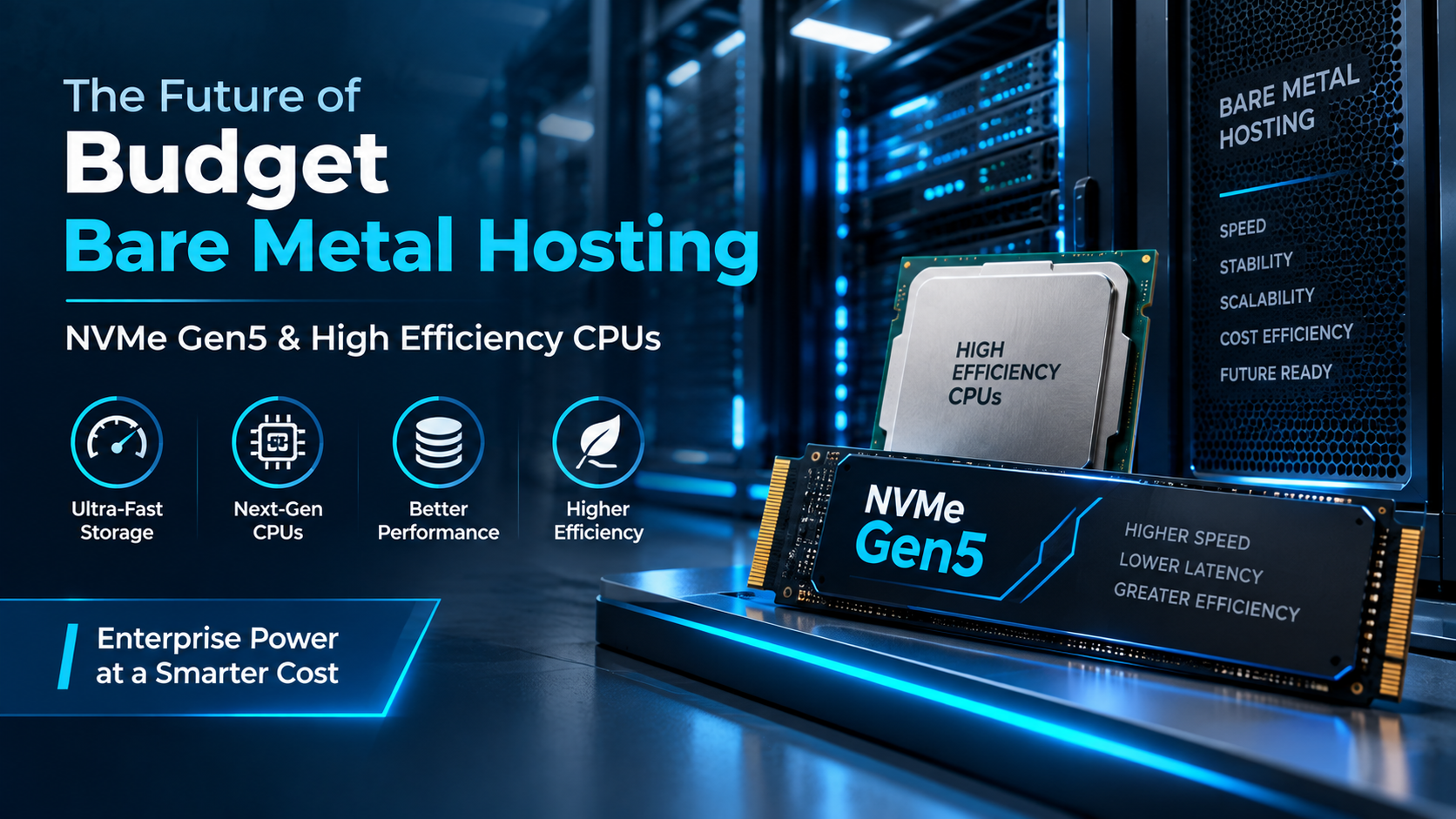
The modern evolution of budget bare-metal hosting leverages PCIe Gen5 NVMe storage and high-efficiency architectures (such as AMD EPYC and Ryzen processors) to deliver workstation-class performance at low operational cost. Unlike legacy budget servers using SATA drives, modern bare metal provides sub-millisecond data access, unshared CPU cores, and massive bandwidth pipelines without monthly cloud virtualization surcharges.
For over a decade, hyper-scale public cloud providers persuaded engineering teams that virtualized instances were the universal answer to compute infrastructure. However, as web applications grow, the hidden costs of virtualization—including 10% to 20% hypervisor CPU steal, erratic shared I/O noise, memory ballooning latencies, and astronomical data egress fees—have sparked a massive cloud repatriation movement. For verified technical specifications and deployment parameters, consult the official Linux Kernel Documentation.
Modern engineering organizations are rediscovering the undeniable performance and predictable cost advantages of dedicated bare-metal servers. While standard virtual workloads thrive on scalable budget VPS hosting servers, high-throughput enterprise pipelines require dedicated silicon. In this guide, we explore how PCIe 5.0 architecture and next-generation CPU efficiency are redefining the total cost of ownership (TCO) for modern infrastructure.
1. The 3 Technological Catalysts Powering Modern Bare Metal
Next-generation budget bare-metal servers outpace legacy hosting through three primary hardware breakthroughs:
2. The Death of the Virtualization Tax in Modern Computing
In virtualized cloud environments, every CPU instruction, memory read, and disk I/O request passes through an abstraction layer managed by a hypervisor (such as KVM, Xen, or ESXi). This architecture introduces inherent bottlenecks:
- CPU Context-Switching & Steal Time: When multiple virtual machines compete for physical core execution time, the hypervisor forces CPU thread scheduling pauses, introducing jitter that cripples real-time financial algorithms and game servers.
- I/O Virtualization Bottlenecks: Emulated storage controllers and virtual network switches add serialization latency to every packet, capping throughput regardless of underlying physical drive capabilities.
- Bare-Metal Determinism: In contrast, dedicated bare-metal servers grant your operating system direct, unmediated control of physical PCIe lanes, DDR5 memory channels, and CPU execution units, delivering 100% predictable low-latency performance. Learn more about compute optimization in our analysis of differences between CPUs and GPUs for performance.
3. The Engineering Physics of PCIe Gen5 NVMe Solid-State Drives
PCI Express 5.0 represents the most significant data transfer leap in modern computing history. Operating at a blistering 32 GT/s (gigatransfers per second) raw bit rate, a PCIe Gen5 x4 M.2 or U.2 drive delivers an unprecedented theoretical bandwidth of up to 15.75 GB/s per channel:
- Sequential Throughput: PCIe Gen5 enterprise drives routinely achieve sustained read speeds exceeding 14,000 MB/s and write speeds of 12,000 MB/s—over 25 times faster than legacy SATA SSDs and double the rate of PCIe Gen4.
- Multi-Million Random 4K IOPS: High-concurrency database queries and vector embeddings require random read/write agility. Gen5 SSD controllers easily handle over 2.5 million IOPS without queuing delays.
- Direct Memory Access (DMA) & DirectStorage: Gen5 architectures facilitate direct data transfers between storage drives and system RAM without CPU mediation, maximizing processing efficiency for AI model parameter loading.
4. High-Efficiency CPU Architecture: Sashing Data Center Power Costs
The primary barrier to budget-friendly bare-metal hosting has historically been data center power consumption and cooling overhead. Next-generation processor architectures have fundamentally solved this challenge:
AMD EPYC Zen 4c (Bergamo / Siena Architecture)
AMD’s compact Zen 4c microarchitecture shrinks core footprint by 35% while maintaining full x86 instruction set compatibility and AVX-512 support. Delivering up to 128 cores and 256 threads per single socket with unmatched performance-per-watt, it enables hosting providers to offer massive multi-threaded density at a fraction of standard power draw.
Intel Xeon Scalable (Emerald Rapids & Sierra Forest)
Intel’s latest enterprise architectures integrate dedicated hardware accelerators including Intel Advanced Matrix Extensions (AMX) for on-chip deep learning inference, Intel QAT (QuickAssist Technology) for wire-speed cryptography, and ultra-dense E-core topologies for massive container hosting.
DDR5 ECC Memory Channels
Operating up to 5,600 MT/s across 8 to 12 memory channels per CPU, DDR5 doubles data bandwidth compared to DDR4, ensuring processors are never starved of data when executing memory-bound workloads.
5. Data Center Thermal Innovations: Liquid Immersion & PUE Reduction
High-performance computing produces intense thermal loads. To sustain budget pricing, next-generation data centers deploy cutting-edge cooling paradigms:
- Direct-to-Chip Liquid Cooling: Circulating dielectric fluid directly over CPU cold plates removes heat 3,000 times more efficiently than air cooling, preventing thermal throttling during sustained 100% CPU loads.
- PUE (Power Usage Effectiveness) Optimization: By reducing auxiliary cooling power from 40% down to under 8% (PUE < 1.1), data centers pass substantial electrical savings directly to bare-metal customers.
- Hardware Root-of-Trust (RoT): Cryptographically signed firmware (TPM 2.0 and Secure Boot) verifies the entire hardware stack before the operating system boots, eliminating rootkit and firmware-level tamper risks.
6. Storage Generations Comparison: SATA SSD vs. PCIe Gen3 vs. Gen4 vs. Gen5 NVMe
Examine how enterprise solid-state drive generations compare across crucial performance dimensions:
| Storage Interface | Max Sequential Read | Random 4K IOPS | Access Latency | Enterprise Workload Match |
|---|---|---|---|---|
| Legacy SATA III SSD | 550 MB/s | ~95,000 IOPS | 50 – 100 μs | Static web files & cold archives |
| PCIe Gen3 x4 NVMe | 3,500 MB/s | ~500,000 IOPS | 20 – 30 μs | Standard web & application servers |
| PCIe Gen4 x4 NVMe | 7,400 MB/s | ~1,000,000 IOPS | 10 – 15 μs | High-traffic e-commerce & medium DBs |
| PCIe Gen5 x4 NVMe | 14,000+ MB/s | 2,500,000+ IOPS | < 8 μs | AI inference, high-frequency FinTech & big data |
7. Linux Bare-Metal Benchmarking: Testing NVMe Gen5 Throughput with FIO
Validate your server’s raw I/O throughput and random IOPS using the industry-standard Flexible I/O Tester (FIO) directly via SSH following our guide on connecting to dedicated servers via SSH:
# 1. Install FIO Benchmark Tool
sudo apt update && sudo apt install -y fio

# 2. Execute Sequential Read Test (Direct DMA, Blocksize 1M, Queue Depth 32)
fio --name=seq_read --ioengine=libaio --iodepth=32 --rw=read --bs=1m \
    --direct=1 --size=10G --numjobs=4 --runtime=60 --group_reporting \
    --filename=/tmp/gen5_test.dat

# 3. Execute Random 4K Read/Write IOPS Test (Simulating Massive Database Load)
fio --name=rand_iops --ioengine=libaio --iodepth=64 --rw=randrw --rwmixread=70 \
    --bs=4k --direct=1 --size=5G --numjobs=8 --runtime=60 --group_reporting \
    --filename=/tmp/gen5_test.dat

# 4. Clean up benchmark test file
rm -f /tmp/gen5_test.dat
8. Real-World Case Studies: Next-Gen Bare Metal in Production
Case Study A: Quantitative Trading Firm Accelerates Risk Modeling
A boutique algorithmic trading group migrated historical backtesting from public cloud virtual instances to an AMD EPYC 96-core server with dual PCIe Gen5 NVMe drives. Nightly simulation runs dropped from 4.2 hours to 34 minutes, while cutting infrastructure costs by 48%.
Case Study B: AI Inference Platform Eliminates API Latency Spikes
A conversational AI startup deployed dedicated bare-metal nodes to serve local LLM embeddings. By leveraging Gen5 NVMe direct model weights loading and DDR5 memory bandwidth, 99th-percentile API response latency plummeted from 680ms to 92ms. Learn more about website launch strategies in our guide on deploying websites on virtual private servers.
9. Top 5 Fatal Budget Bare Metal Selection Mistakes
📌 Frequently Asked Questions (FAQ)
What makes budget bare metal hosting better than traditional hyperscaler cloud instances? +
How does PCIe Gen5 NVMe storage improve database performance? +
Can I run virtual machines and Kubernetes clusters on a bare-metal server? +
How does Onlive Server ensure physical security and uptime for dedicated servers? +
How do PCIe Gen5 NVMe drives benefit budget bare metal hosting?
Are high-efficiency CPUs suitable for continuous 24/7 enterprise workloads?
Conclusion: The Next Generation of Budget Dedicated Hosting
Modern hardware advancements have made budget dedicated servers capable of handling workloads that previously required high-end enterprise hardware. By leveraging modern high-efficiency server processors paired with PCIe Gen5 NVMe storage arrays, organizations can achieve uncompromising compute power at predictable monthly operating costs.
Choosing bare metal over shared virtualized instances ensures 100% hardware dedication, zero noisy-neighbor interference, and full kernel-level customization. Explore Onlive Server budget dedicated hosting to unlock enterprise performance within cost-effective infrastructure budgets.
When processing intensive multi-threaded database transactions or mission-critical enterprise workloads, deploying on enterprise dedicated server hosting provides bare-metal hardware performance, custom RAID arrays, and dedicated unmetered bandwidth.
10. Conclusion: The Bare-Metal Renaissance is Here
The convergence of PCIe Gen5 NVMe storage arrays and ultra-efficient multi-core server processors has inaugurated a new era of enterprise hosting. Organizations no longer need to accept the performance compromises or unpredictable billing models of virtualized public clouds. By deploying modern budget bare-metal infrastructure, you secure dedicated compute dominance, microsecond latency, and dramatic cost savings.
Experience the unyielding power of next-generation bare-metal dedicated servers on Onlive Server today, backed by enterprise-grade SLA guarantees and 24/7 expert infrastructure engineers.
