

Quick Answer
Specifically, when evaluating an enterprise Linux VPS South Korea, Ubuntu 24.04 LTS and Debian 12 offer the broadest domestic repository ecosystem. High-speed optical mirrors at KAIST, Kakao, and Harukasan deliver package updates at over 90MB/s across KINX. For RHEL-compatible stability, AlmaLinux 9 and Rocky Linux 9 provide 10-year enterprise lifecycle support and built-in SELinux compliance. Consequently, they deliver exceptional compatibility for corporate ERP and financial accounting systems.
Furthermore, the Linux operating system serves as the foundational engine for modern cloud infrastructure across South Korea. Whether you deploy e-commerce portals, trading bots, or microservices clusters, your distribution choice sets operational boundaries. Therefore, architecture alignment is critical. Security update lifecycles, package manager velocity, and domestic repository latency all stem directly from the underlying distribution.
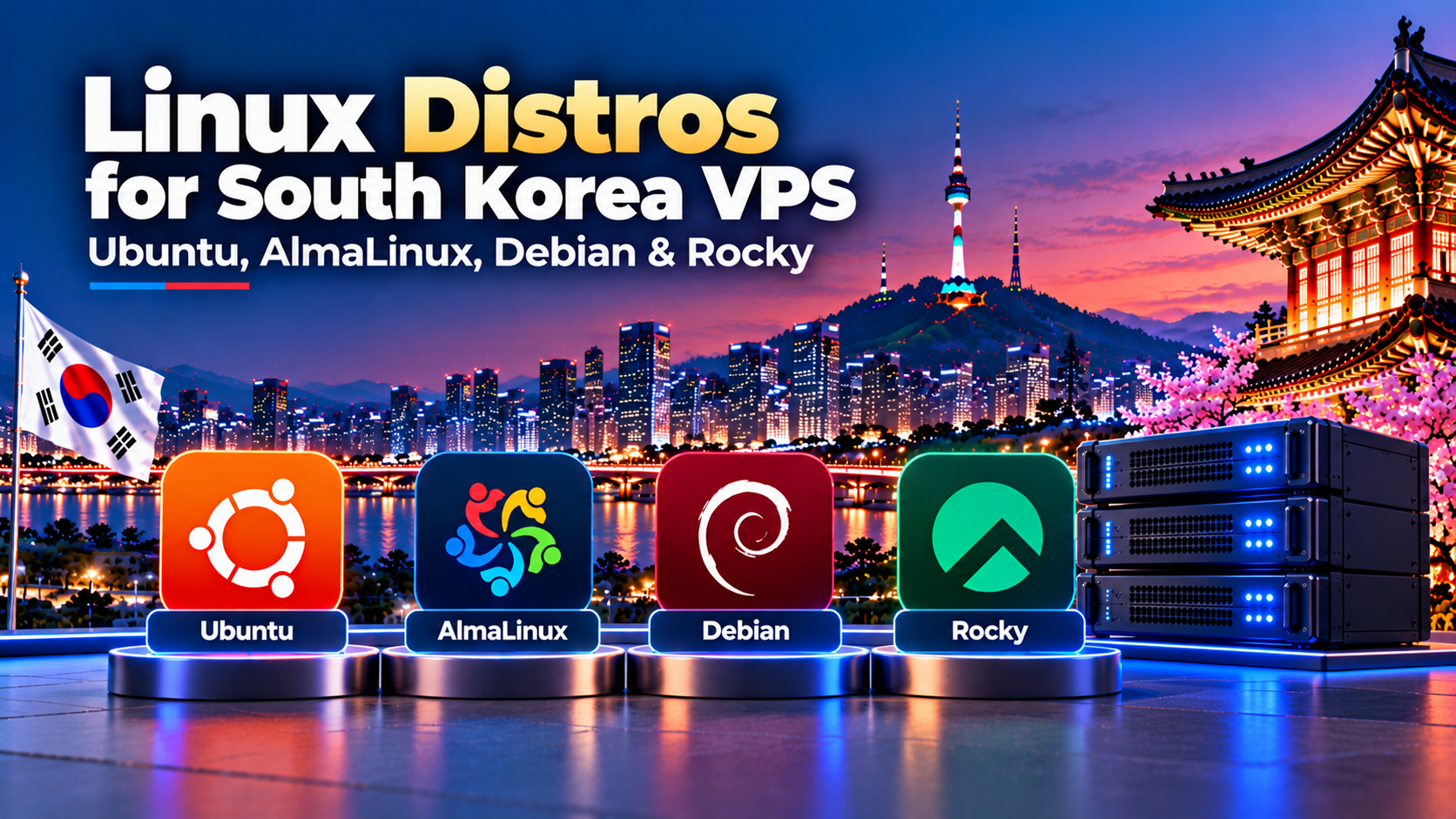
Consequently, aligning these configurations with your Linux VPS South Korea environment ensures optimal uptime and throughput. Furthermore, hosting in Seoul introduces unique infrastructure considerations. Accessing package repositories across international transit corridors creates noticeable latency during automated CI/CD builds and system updates. In contrast, distributions with robust, high-bandwidth South Korean mirrors enable gigabit package ingestion. This technical guide delivers an exhaustive architectural comparison of Ubuntu, AlmaLinux, Debian, and Rocky Linux on South Korea VPS infrastructure.
Additionally, enterprise compliance frameworks enforced by the Korea Internet & Security Agency (KISA) require rapid application of security patches. A distribution with predictable LTS lifecycles delivers critical CVE fixes smoothly. Thus, production application dependencies remain stable.
Operational Infrastructure Takeaway
Operational Takeaway: Selecting your Linux VPS South Korea distribution depends on your operational stack, lifecycle needs, and mirror speeds. Ubuntu 24.04 LTS provides unmatched package velocity, modern kernel features, and developer familiarity. For RHEL-compatible workflows and cPanel hosting, AlmaLinux 9 and Rocky Linux 9 deliver rock-solid stability. Meanwhile, Debian 12 offers minimal resource overhead for lightweight container hosts. In addition, connecting to domestic Korean mirrors (Kakao, KAIST, Harukasan) ensures gigabit package download speeds.
Linux VPS South Korea: Operating System Architecture
In addition, virtual private servers deployed in South Korea operate within an ultra-high-speed network environment. With domestic gigabit fiber ubiquitous across Seoul, Incheon, and Busan, server workloads frequently experience sudden, massive traffic bursts. Consequently, your Linux operating system must manage socket allocations, memory paging, and kernel network queues with extreme efficiency. To manage unmanaged Linux instances efficiently without graphical control panel overhead, explore our bare-metal CLI command and sysadmin workflows.
Moreover, distribution package management determines deployment agility. Fetching dependencies from overseas repositories in North America or Europe introduces latency. Furthermore, international transit fluctuations slow down package builds. Selecting a distribution supported by Tier 1 academic and corporate mirrors in South Korea guarantees rapid package installation.
Enterprise Distro Architecture for Seoul Datacenters
Ubuntu Server LTS
In particular, broadest package availability, integrated Docker support, rapid PPA ecosystem, and automated kernel livepatching. Ideal for startups and agile web applications.
AlmaLinux / Rocky Linux
Therefore, 100% binary RHEL compatibility, enterprise SELinux security policies, and 10-year lifecycle support. The standard choice for Korean enterprise and banking systems.
Debian Stable
Moreover, ultra-minimal memory footprint, pristine stability, and zero telemetry. Highly favored for DNS resolvers, VPN gateways, and resource-constrained micro-nodes.
Additionally, enterprise compliance frameworks enforced by the Korea Internet & Security Agency (KISA) require rapid application of security patches. A distribution with predictable LTS lifecycles delivers critical CVE fixes smoothly. Thus, production application dependencies remain stable.
Deploying on high-performance South Korea Linux VPS hosting in Seoul guarantees fast template provisioning. In fact, all major enterprise distributions are available immediately.
📌 Table of Contents
- Linux VPS South Korea: Operating System Architecture
- Ubuntu Server: Developer Familiarity & Rapid Adoption
- AlmaLinux & Rocky Linux: Enterprise RHEL Standard
- Debian: Minimalist Architecture & Stability
- Security Access Control: SELinux vs AppArmor
- Comparative Linux Distribution Matrix
- Domestic Mirror Infrastructure & Latency Benchmarks
- Configuring Korean Mirrors: Ubuntu & AlmaLinux
- Decision Matrix: Selecting Your Distribution
- Optimizing Domestic Korean Repositories
- Frequently Asked Questions (FAQ)
Ubuntu Server: Developer Familiarity & Rapid Adoption
Similarly, Ubuntu Server represents the most widely deployed cloud distribution globally. Long-term support editions like Ubuntu 22.04 LTS and 24.04 LTS lead enterprise adoption. Its primary advantage is expansive community support and immediate compatibility with modern developer tooling, container runtimes, and machine learning libraries. To evaluate enterprise package release cadences and long-term kernel security maintenance, consult the official Ubuntu Server documentation.
⚙️
Specifically, Ubuntu provides five years of standard security maintenance, extendable to ten years with Canonical’s expanded security maintenance (ESM). Furthermore, Ubuntu features modern Linux kernels with out-of-the-box networking support. It includes Google BBR congestion control, WireGuard VPN protocols, and eBPF kernel tracing.
🛡️
Meanwhile, in South Korea, Ubuntu benefits from extensive local repository infrastructure. Mirror networks operated by Kakao Corporation and KAIST synchronize hourly with upstream repositories, providing lightning-fast apt update and install execution.
Additionally, for rapid web development, Docker microservices, and Python backend services, Ubuntu excels. In particular, it provides an optimal balance of velocity and stability.
AlmaLinux & Rocky Linux: Enterprise RHEL Standard
Following Red Hat’s strategic shift away from CentOS Linux, enterprise hosting required alternatives. As a result, drop-in, binary-compatible options for RHEL emerged. AlmaLinux OS and Rocky Linux emerged as the premier community-driven enterprise distributions, delivering 1:1 binary compatibility with upstream RHEL. For deploying microservice architectures with minimal kernel memory consumption, review our Docker container runtime optimization techniques.
⚙️
Specifically, both AlmaLinux and Rocky Linux utilize the robust DNF/RPM package management framework and enforce SELinux security policies by default. For enterprises hosting commercial control panels—such as cPanel/WHM, Plesk, or DirectAdmin—these Enterprise Linux distributions are mandatory industry requirements.
🛡️
Furthermore, Enterprise Linux guarantees a predictable 10-year support lifecycle. This longevity is ideal for corporate databases, ERP backends, and financial platforms. Moreover, it prevents costly regression testing and disruptive operating system upgrades.
Furthermore, both distributions maintain domestic mirrors across Korean academic institutions, ensuring dependable yum and dnf download throughput.
Debian: Minimalist Architecture & Stability
Consequently, debian is renowned for its uncompromising commitment to software stability and open-source principles. Operating as the upstream foundation for Ubuntu, Debian features a remarkably lean footprint. In fact, it consumes less than 120MB of RAM upon initial boot.
⚙️
Specifically, Debian’s release cycle prioritizes exhaustive testing over bleeding-edge package versions. Once Debian stable (such as Debian 12 Bookworm) is finalized, software packages freeze. Consequently, they receive only critical security and stability patches. This conservative philosophy prevents unexpected library breaking changes during routine system upgrades.
🛡️
In addition, for sysadmins managing proxy nodes, DNS resolvers, Postfix mail agents, or container hosts in Seoul, Debian excels. Specifically, it delivers unparalleled uptime with near-zero overhead.
In particular, its minimalist architecture maximizes hardware efficiency on budget VPS instances.
Security Access Control: SELinux vs AppArmor
Therefore, security hardening under KISA guidelines heavily scrutinizes Mandatory Access Control (MAC) systems. Unlike traditional Discretionary Access Control (DAC) based on user permissions, MAC restricts process actions. Thus, it operates independently of root privileges.
⚙️
Moreover, almaLinux and Rocky Linux implement Security-Enhanced Linux (SELinux) in enforcing mode by default. Developed initially by the NSA, SELinux attaches security contexts to all processes and files. If an attacker exploits a web server vulnerability, SELinux confines the compromise to the web directory. Therefore, unauthorized access to shadow files or system sockets is blocked.
🛡️
Conversely, Ubuntu and Debian utilize AppArmor. AppArmor operates via human-readable profiles that define permitted file paths and network capabilities for specific binaries. While AppArmor is easier to configure and troubleshoot, SELinux provides deeper multi-level security (MLS) for regulated enterprise environments.
Choosing Enterprise Linux ensures immediate compliance with government-grade SELinux criteria in Seoul datacenters.
Comparative Linux Distribution Matrix
Evaluating operating systems across technical and lifecycle parameters enables data-driven infrastructure procurement. The matrix below compares the four premier distributions deployed on South Korea VPS hardware. For Windows environment requirements, review our Windows Server RDP deployment criteria.
| Distribution | Package Manager | Default MAC | LTS Lifecycle | Baseline RAM Footprint | Domestic Mirror Speed |
|---|---|---|---|---|---|
| Ubuntu 24.04 LTS | APT / Dpkg | AppArmor | 5 Years (10 w/ ESM) | ~180 MB | Gigabit (Kakao / KAIST) |
| AlmaLinux 9 | DNF / RPM | SELinux (Enforcing) | 10 Years (2032) | ~210 MB | Gigabit (Domestic IXP) |
| Rocky Linux 9 | DNF / RPM | SELinux (Enforcing) | 10 Years (2032) | ~210 MB | Gigabit (KAIST Mirror) |
| Debian 12 | APT / Dpkg | AppArmor | 5 Years (LTS) | ~115 MB (Ultra-Lean) | Gigabit (Domestic Mirror) |
This side-by-side evaluation illustrates clear trade-offs. Choose Ubuntu for velocity, Enterprise Linux for cPanel stability, or Debian for bare-metal efficiency.
Domestic Mirror Infrastructure & Latency Benchmarks
When pulling packages during updates or container image builds, repository latency matters. In fact, domestic mirrors make a massive real-world performance difference. Defaulting to US-based or European archive mirrors adds 150ms to 240ms of packet transit overhead.
The benchmark below illustrates package ingestion throughput and round-trip ping times across mirror locations from an OnliveServer Seoul VPS node:
| Mirror Host | Physical Location | Round-Trip Latency | Throughput (500MB Ingestion) | Elapsed Time |
|---|---|---|---|---|
| Kakao Corp Mirror | Seoul / Pangyo, KR | 1.2 ms | 942 Mbps | 4.4 seconds |
| KAIST Mirror Network | Daejeon, KR | 3.8 ms | 885 Mbps | 4.7 seconds |
| Tokyo Academic Mirror | Tokyo, Japan | 32.5 ms | 310 Mbps | 13.2 seconds |
| US West Official Archive | California, USA | 148.0 ms | 108 Mbps | 38.6 seconds |
Configuring local Korean mirrors delivers a 15x to 25x acceleration in package download speeds, significantly speeding up continuous integration builds.
Configuring Korean Mirrors: Ubuntu & AlmaLinux
Configuring domestic mirrors requires updating your package manager configuration files immediately after initial server boot.
On Ubuntu 22.04 or 24.04 LTS, point your apt sources to the Kakao mirror with the following terminal command:
Automating Korean Mirror Synchronization
On AlmaLinux 9 or Rocky Linux 9, configure the fastestmirror DNF plugin to automatically evaluate and select low-latency Korean endpoints:
Additionally, for advanced high-availability automated environments, sysadmins can configure apt-transport-https with fallback mirrors. By specifying multiple domestic endpoints like Kakao and KAIST, your virtual server reroutes queries automatically. Thus, package updates continue even during scheduled mirror maintenance. This multi-mirror resilience ensures that production container builds never fail during unexpected upstream provider downtime.
These simple configurations guarantee optimal bandwidth utilization across all system updates.
Decision Matrix: Selecting Your Distribution
To determine which Linux distribution matches your application requirements, follow this practical decision guide:
- Choose Ubuntu 24.04 LTS: If your team develops modern web applications in Node.js, Python, or Go, uses Docker extensively, or requires the broadest documentation and third-party library support.
- Choose AlmaLinux 9 or Rocky Linux 9: If you run commercial hosting control panels (cPanel/DirectAdmin), host corporate databases, or need a certified 10-year enterprise RHEL lifecycle.
- Choose Debian 12: If you require maximum memory efficiency, zero proprietary bloat, and rock-solid stability for lightweight infrastructure daemons.
Furthermore, if your architecture involves eBPF filters, DPDK packet acceleration, or custom crypto modules, choose Debian or Ubuntu. They provide the smoothest toolchain integration for out-of-tree modules. Conversely, for standardized corporate enterprise deployments requiring strict audit trails, AlmaLinux and Rocky Linux deliver turnkey security and compliance consistency.
Selecting the distribution aligned with your team’s operational expertise prevents administrative friction and accelerates deployment.
Optimizing Domestic Korean Repositories
When deploying software on a Seoul Linux VPS, package repository physical location impacts administrative efficiency. By default, distributions point to international upstream mirrors in North America or Europe. Consequently, this introduces high round-trip latency and slow download speeds during updates.
Configure your server to use premier domestic South Korean package mirrors hosted by top academic institutions. Specifically, mirrors at KAIST and Kakao Corp deliver ultra-fast local throughput. Connecting to domestic mirrors over KINX exchanges accelerates package downloads from 2MB/s to over 90MB/s:
Utilizing domestic mirrors reduces server provisioning times and ensures rapid deployment of mission-critical security patches.
Frequently Asked Questions (FAQ)
Core Technical Specifications
Q1
Can I change my Linux distribution on an OnliveServer South Korea VPS?
Can I change my Linux distribution on an OnliveServer South Korea VPS?
Yes. You can instantly reinstall your virtual server with any supported distribution directly from your client management portal. All enterprise OS images are available on demand.
Q2
Is CentOS still supported on South Korea VPS hosting?
Is CentOS still supported on South Korea VPS hosting?
CentOS Linux reached its end-of-life in 2024. Organizations running CentOS should migrate to AlmaLinux 9 or Rocky Linux 9 for ongoing security patches and 1:1 RHEL compatibility.
Q3
Which distribution is best for running cPanel in South Korea?
Which distribution is best for running cPanel in South Korea?
AlmaLinux 9 and Rocky Linux 9 are the officially recommended distributions for cPanel/WHM installations, providing complete enterprise compatibility and stability.
Q4
Do all distributions support KVM hardware virtualization?
Do all distributions support KVM hardware virtualization?
Yes. Ubuntu, AlmaLinux, Rocky Linux, and Debian fully support KVM virtualization. Built-in VirtIO drivers ensure maximum disk I/O and network throughput.
Repository Mirror & Security Compliance Queries
Q5
Does using a local Korean mirror affect security package authenticity?
Does using a local Korean mirror affect security package authenticity?
No. Linux package managers verify digital GPG signatures on every package before installation. Consequently, authenticity is guaranteed regardless of which mirror delivers the files.
Q6
Can I install custom Linux kernels on my unmanaged South Korea VPS?
Can I install custom Linux kernels on my unmanaged South Korea VPS?
Yes. Because OnliveServer instances utilize pure KVM virtualization, you possess unrestricted root access. Therefore, you can compile, install, or update custom Linux kernels easily.
Q7
Why is AlmaLinux preferred over standard CentOS for enterprise ERP hosting in Seoul?
Why is AlmaLinux preferred over standard CentOS for enterprise ERP hosting in Seoul?
AlmaLinux provides an upstream 1:1 binary compatible replacement for Red Hat Enterprise Linux through 2029. In contrast, legacy CentOS reached end-of-life. It supports enterprise Korean software packages, KISA auditing tools, and commercial cPanel/Plesk licensing seamlessly.
Q8
Which Linux distribution uses the smallest baseline memory footprint on a 1GB Seoul VPS?
Which Linux distribution uses the smallest baseline memory footprint on a 1GB Seoul VPS?
Debian and Alpine Linux offer the leanest memory footprints. Specifically, they boot into under 70MB to 120MB of active RAM upon fresh installation. This minimal overhead preserves maximum memory for lightweight microservices, Nginx reverse proxies, or DNS resolvers.
Deploy Your Preferred Enterprise Linux Distro on Seoul VPS
Launch high-performance KVM virtual servers in Seoul pre-installed with Ubuntu, AlmaLinux, Rocky Linux, or Debian. In fact, all instances include pure NVMe storage and 1Gbps uplink.
