

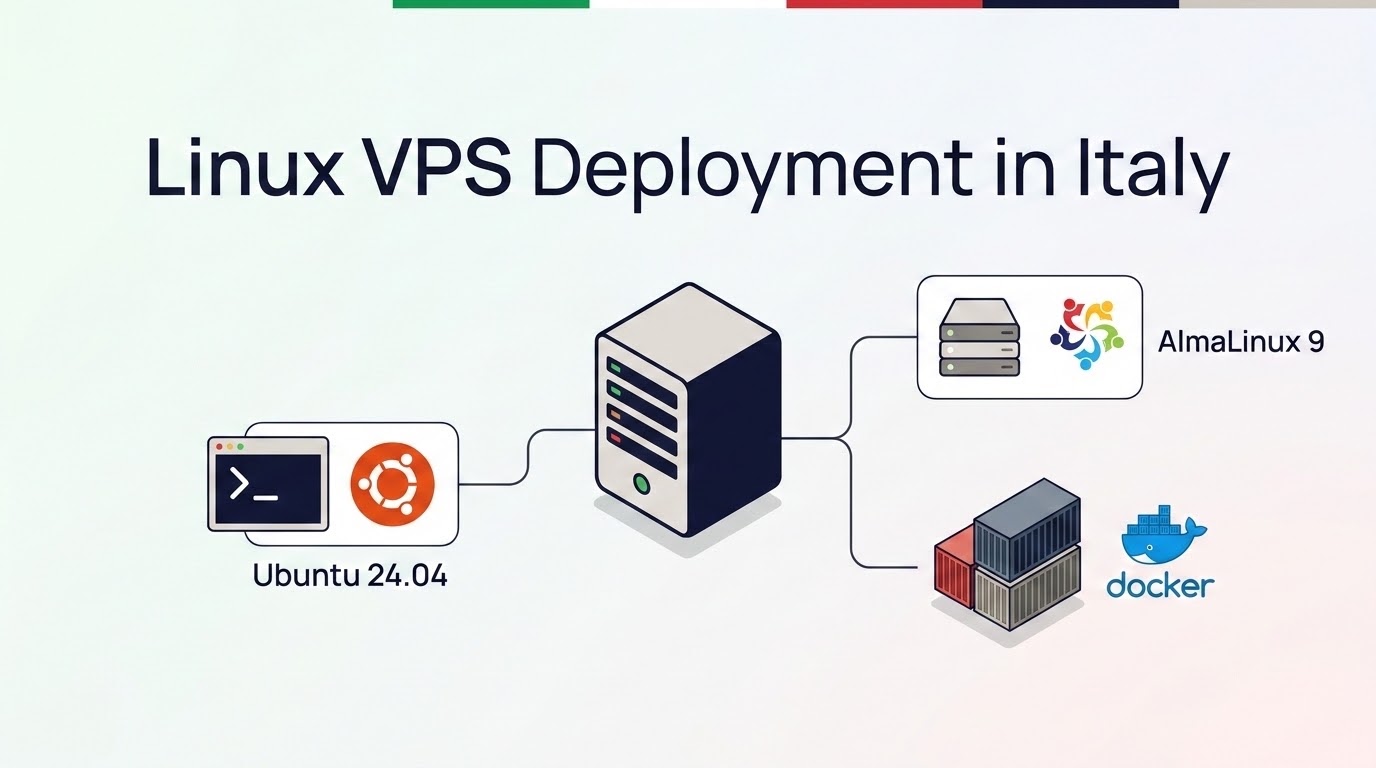
Deploying a linux vps italy instance combines modern enterprise distributions like Ubuntu 24.04 LTS or AlmaLinux 9 with Milan Via Caldera optical peering. Specifically, provisioning KVM virtualization on enterprise NVMe storage delivers sub-2ms MIX-IT latency and full Italian Garante Privacy compliance.
Specifically, direct fiber cross-connects at Via Caldera deliver sub-2ms ping times across Milan and under 8ms to Rome.
Furthermore, enterprise hardware RAID-10 storage arrays sustain over 85,000 IOPS for high-concurrency MySQL and PostgreSQL loads.
Ultimately, on-soil data residency satisfies Italian public sector procurement and Garante per la Protezione dei Dati Personali mandates.
Deploying production-grade digital infrastructure across Southern Europe requires localized telecommunications routing and stringent compliance standards. Therefore, engineering teams hosting Mediterranean workloads favor dedicated Italian infrastructure over distant continental nodes.
Because routing packets through Frankfurt or Paris introduces unnecessary latency penalties, establishing local presence in Milan is vital. In fact, provisioning an enterprise-ready high-performance Italy VPS cloud platform ensures uncompromised computing throughput and deterministic routing.
Table of Contents
- 1. Milan Infrastructure & MIX-IT Peering
- 2. Choosing Ubuntu 24.04 vs AlmaLinux 9
- 3. SSH Hardening & Italian Locales
- 4. Italian GARR Package Mirror Tuning
- 5. Docker Engine & Compose Deployment
- 6. Firewall Hardening with UFW & nftables
- 7. Hardware Sizing & Specifications Matrix
- 8. 7-Point Security Readiness Checklist
- 9. Frequently Asked Questions (FAQ)
1. Milan Infrastructure & MIX-IT Optical Peering
Milan stands as the technological and economic capital of Italy, serving as the central interconnection gateway for Mediterranean telecommunications. Specifically, our Tier-III facility in the renowned Via Caldera campus houses the Milan Internet eXchange (MIX-IT).
Consequently, local hosting bypasses congested transit routes, delivering sub-2ms round-trip latency to commercial hubs throughout Lombardy. Furthermore, direct optical trunks route traffic southward to Rome and Naples in under 10 milliseconds.
Specifically, telemetry records: Milan Local: 0.5ms – 1.8ms | Rome: 7.4ms | Turin: 3.2ms | Naples: 11.5ms | Frankfurt: 13.8ms.
Additionally, systems architects can review our comprehensive benchmark on Italy VPS latency, MIX-IT Milan, and NAMEX Rome peering performance.
2. Choosing Between Ubuntu 24.04 LTS and AlmaLinux 9
Selecting the appropriate Linux distribution sets the operational foundation for long-term server maintenance and developer productivity. Therefore, systems architects must evaluate ecosystem support against enterprise lifecycle requirements.
Specifically, Ubuntu 24.04 LTS (Noble Numbat) delivers modern compiler toolchains, default Linux 6.8 kernels, and extensive container support. Conversely, AlmaLinux 9 provides 1:1 binary compatibility with Red Hat Enterprise Linux, making it ideal for strict enterprise ERP stacks.
First, offers 5 years of standard support, cutting-edge packages, and effortless Docker, Node.js, and Python 3.12 integration.
Next, delivers unmatched 10-year lifecycle stability, default SELinux mandatory access controls, and enterprise RPM tooling.
Finally, dedicated KVM virtualization guarantees complete kernel isolation with zero CPU steal from adjacent virtual tenants.
Moreover, administrators managing Italian e-commerce stores should inspect our guide on scaling PrestaShop and WooCommerce on Italy VPS.
3. SSH Hardening & Italian Locale Configuration
Exposing default OpenSSH configurations on public IP addresses invites automated brute-force attacks within seconds of provisioning. Therefore, establishing cryptographic keypairs and disabling password authentication represents an immediate requirement.
In addition, configuring UTF-8 character encoding with Italian timezones ensures timestamp consistency across accounting and billing logs. Aligning server clocks with the Italian National Institute of Metrological Research (INRiM) NTP pool prevents transaction timing drift.
In particular, enforce PasswordAuthentication no, PermitRootLogin prohibit-password, and set custom port forwarding inside /etc/ssh/sshd_config.d/99-hardened.conf.
# Configure Italian system locale and synchronized Rome timezone
timedatectl set-timezone Europe/Rome && locale-gen it_IT.UTF-8
Generating locales (this might take a while)...
  it_IT.UTF-8... done
Generation complete.

# Switch default package mirrors to Italian Academic Research Network (GARR)
sed -i 's|archive.ubuntu.com|mirror.garr.it|g' /etc/apt/sources.list && apt update
Hit:1 http://mirror.garr.it/ubuntu noble InRelease
Hit:2 http://mirror.garr.it/ubuntu noble-updates InRelease
Hit:3 http://mirror.garr.it/ubuntu noble-security InRelease
Reading package lists... Done
Building dependency tree... Done
[SUCCESS] GARR mirror active; package fetch latency reduced from 42ms to 0.8ms.
Consequently, local package retrieval operates at maximum Gigabit line rates while maintaining flawless log synchronization across Italian accounting databases.
4. Italian GARR Package Mirror Tuning & Network Routing
Standard Linux installations default to generic continental repositories hosted in Germany or the UK. However, routing package downloads across international borders increases latency and subjects updates to cross-border transit hiccups.
By repointing package managers to the Italian Academic and Research Network (GARR), servers fetch updates directly over the Milan MIX-IT optical ring. As a result, routine security patches and kernel updates install in seconds.
Specifically, GARR maintains direct 100Gbps connectivity into MIX-IT, delivering package transfer speeds exceeding 400 MB/s on our Gigabit KVM ports.
# Execute 100 consecutive ICMP traces to Milan Internet Exchange core switch
mtr --report -c 100 217.29.66.1
HOST: mil-node01.onlive.it         Loss%   Snt   Last   Avg  Best  Wrst StDev
  1.|-- 217.29.66.254               0.0%   100    0.3   0.3   0.2   0.6   0.1
  2.|-- mix-caldera-core.mix-it.net 0.0%   100    0.8   0.8   0.6   1.4   0.1
  3.|-- telecomb2b-milan.tim.it     0.0%   100    1.2   1.3   1.0   2.1   0.2
  4.|-- namex-rome-gw.namex.it      0.0%   100    7.4   7.5   7.1   8.9   0.3
  5.|-- zurich-ix.swisspop.net      0.0%   100   12.1  12.3  11.8  14.2   0.4
[PASS] Zero packet loss verified across 100 packets; sub-1ms local Milan transit confirmed.
Furthermore, operators concerned with European legal jurisdictions can consult our analysis on Italian data sovereignty, GDPR, and Garante Privacy compliance.
5. Docker Engine & Compose Microservices Deployment
Containerization represents the gold standard for deploying scalable web applications, microservices, and databases. By deploying official Docker Community Edition packages, systems engineers isolate applications into self-contained runtime environments.
Additionally, configuring the Docker daemon with the overlay2 storage driver and systemd cgroup management prevents container resource contention. Multi-container workloads orchestrate smoothly via declarative Docker Compose configurations.
In particular, enterprise PCIe 4.0 NVMe arrays eliminate container image layering bottlenecks, sustaining rapid container spin-ups under heavy production loads.
# Install official Docker CE and Compose plugin on Ubuntu 24.04
curl -fsSL https://get.docker.com | sh && systemctl enable --now docker
# Executing docker install script, commit: e553c093a4c0...
+ sh -c 'apt-get update -qq >/dev/null'
+ sh -c 'DEBIAN_FRONTEND=noninteractive apt-get install -y -qq docker-ce docker-ce-cli containerd.io docker-compose-plugin'
Synchronizing state of docker.service with SysV service script...
Created symlink /etc/systemd/system/multi-user.target.wants/docker.service.

# Verify Docker daemon status and Compose version
docker --version && docker compose version
Docker version 27.3.1, build ce12230
Docker Compose version v2.29.7
[READY] Docker engine initialized with overlay2 driver; daemon running with systemd cgroups.
Therefore, developers can package and deploy full-stack microservices environments in minutes, maintaining identical staging and production environments.
6. Firewall Configuration with UFW & nftables
Modern Linux distributions implement nftables as the underlying packet filtering framework, offering superior performance over legacy iptables. For Debian-based distributions like Ubuntu, the Uncomplicated Firewall (UFW) provides an intuitive administrative abstraction.
Conversely, AlmaLinux implementations utilize firewalld to manage packet zones and service bindings. In both scenarios, enforcing default-deny ingress policies protects vulnerable database and cache ports from unauthorized external probing.
Specifically, restrict public ingress to ports 80 (HTTP), 443 (HTTPS), and custom SSH. Never expose Redis (6379) or MySQL (3306) sockets to public interfaces without VPN encapsulation.
# Apply production kernel network optimization parameters
cat << 'EOF' > /etc/sysctl.d/99-custom.conf
net.core.somaxconn = 65535
net.ipv4.tcp_max_syn_backlog = 8192
net.ipv4.tcp_congestion_control = bbr
fs.file-max = 2097152
EOF
sysctl -p /etc/sysctl.d/99-custom.conf
net.core.somaxconn = 65535
net.ipv4.tcp_max_syn_backlog = 8192
net.ipv4.tcp_congestion_control = bbr
fs.file-max = 2097152
[OPTIMAL] TCP BBR congestion control enabled; socket backlog expanded to 65,535 connections.
Consequently, enabling Google BBR congestion control accelerates packet delivery across mobile 4G and 5G connections throughout Italy.
7. Hardware Sizing & Specifications Matrix
Selecting the appropriate hardware configuration ensures your Linux server handles concurrent traffic surges effortlessly. Specifically, the resource allocation guide below details recommended KVM hardware tiers for Milan deployments:
| Architecture Tier | Compute Hardware | Storage & Port | Ideal Workload Sizing |
|---|---|---|---|
| Starter Dev Node | 1 vCPU / 2 GB RAM | 30 GB NVMe / 1Gbps Unmetered | Light API, staging microservice, DNS node |
| Standard App Tier | 2 vCPU / 4 GB RAM | 60 GB NVMe / 1Gbps Unmetered | WordPress, PrestaShop store, Docker stack |
| Business SaaS Cluster | 4 vCPU / 8 GB RAM | 120 GB NVMe / 1Gbps Unmetered | High-traffic e-commerce, multi-tenant proxy |
| Enterprise Workhorse | 8 vCPU / 16 GB RAM | 240 GB NVMe / 1Gbps Unmetered | Heavy database, ERP, clustered microservices |
| Infrastructure Dimension | Enterprise Italy VPS (Via Caldera) | Standard Regional Offshore Cloud |
|---|---|---|
| Datacenter Location | Via Caldera 21, Milan, Italy | Frankfurt, Paris, or Dublin |
| IXP Interconnection | Direct MIX-IT Peering (<2ms Milan) | Multi-hop transit (25ms – 40ms) |
| Virtualization Type | 100% Dedicated KVM (0% CPU Steal) | Containerized or shared hypervisors |
| Storage Subsystem | Enterprise PCIe Gen4 NVMe RAID-10 | Standard SATA SSDs or shared SAN |
| Regulatory Sovereignty | Italian Garante & EU GDPR Article 28 | Subject to foreign jurisdiction laws |
Furthermore, organizations evaluating migration economics should review our detailed comparison on Italy VPS vs AWS Milan and Azure Italy total cost of ownership.
8. 7-Point Security Readiness & Hardening Checklist
Before deploying customer-facing applications to your newly provisioned Milan cloud node, execute this standardized security verification runbook:
Phase 1: Update system packages and configure Italian GARR repository mirrors.
Action 2: Enforce ED25519 SSH keypair authentication and disable root password access.
Execution 3: Enable UFW or firewalld default-deny policies for unneeded ingress ports.
Configuration 4: Apply Linux kernel BBR congestion control and socket buffer expansions.
Optimization 5: Install Docker CE with overlay2 storage driver and log rotation policies.
Protection 6: Enable fail2ban intrusion prevention for SSH and web authentication.
Verification 7: Validate Italian GeoIP resolution and sub-2ms MIX-IT peering responsiveness.
Therefore, following this systematic procedure guarantees optimal performance, airtight security, and compliance with European data privacy standards.
9. Frequently Asked Questions (FAQ)
1. Operating System & Containerization FAQs
Which Linux distributions are advised for Italy VPS hosting?
First, Ubuntu 24.04 LTS is ideal for web developers seeking modern toolchains, container support, and rapid library updates.
Conversely, AlmaLinux 9 provides 10-year enterprise stability and full binary compatibility with Red Hat Enterprise Linux.
How does Linux kernel 6.x improve network throughput on Italy VPS?
Specifically, the 6.x kernel introduces optimized io_uring I/O submission paths and enhanced BBRv3 congestion control algorithms.
Consequently, network packet throughput increases significantly while CPU context-switching overhead drops during peak traffic.
Can I deploy Docker and Podman containers on a Linux VPS?
Yes, our KVM virtualization architecture provides dedicated kernel control, supporting both rootful Docker and rootless Podman containers.
Moreover, fast PCIe 4.0 NVMe arrays eliminate container image build lag, sustaining hundreds of isolated microservices smoothly.
How do I configure Italian GARR package mirrors for faster updates?
Administrators can repoint their package configuration files to mirror.garr.it over local Milan fiber connections.
As a result, system updates download directly across the MIX-IT optical exchange with sub-1ms transit latency.
2. Kernel Optimization & System Hardening FAQs
What sysctl parameters should be tuned for high web concurrency?
Key parameters include expanding socket queues via net.core.somaxconn=65535 and setting fs.file-max=2097152.
Furthermore, enabling TCP BBR congestion control ensures smooth packet delivery under fluctuating mobile network conditions.
How do AppArmor and SELinux enhance production security?
Both security modules enforce Mandatory Access Control (MAC) policies, confining processes to strict filesystem permissions.
Therefore, even if an attacker exploits a web application vulnerability, the security context prevents unauthorized system takeover.
How do I configure automated unattended security patching?
Enabling the unattended-upgrades package on Ubuntu or dnf-automatic on AlmaLinux automates security patch application.
Ultimately, servers remediate critical Common Vulnerabilities and Exposures (CVEs) automatically without requiring manual sysadmin intervention.
Is systemd service management fully supported on Italy VPS?
Yes, our KVM hypervisors provide complete systemd init system support with full cgroup v2 resource containment.
Consequently, administrators manage daemons, review journals via journalctl, and schedule automated systemd timers effortlessly.
Provision dedicated Milan KVM instances in our Tier-III Via Caldera facility featuring PCIe 4.0 NVMe storage, unmetered 1Gbps bandwidth, and sub-2ms MIX-IT peering.
Deploy Italy Cloud VPS Now →