

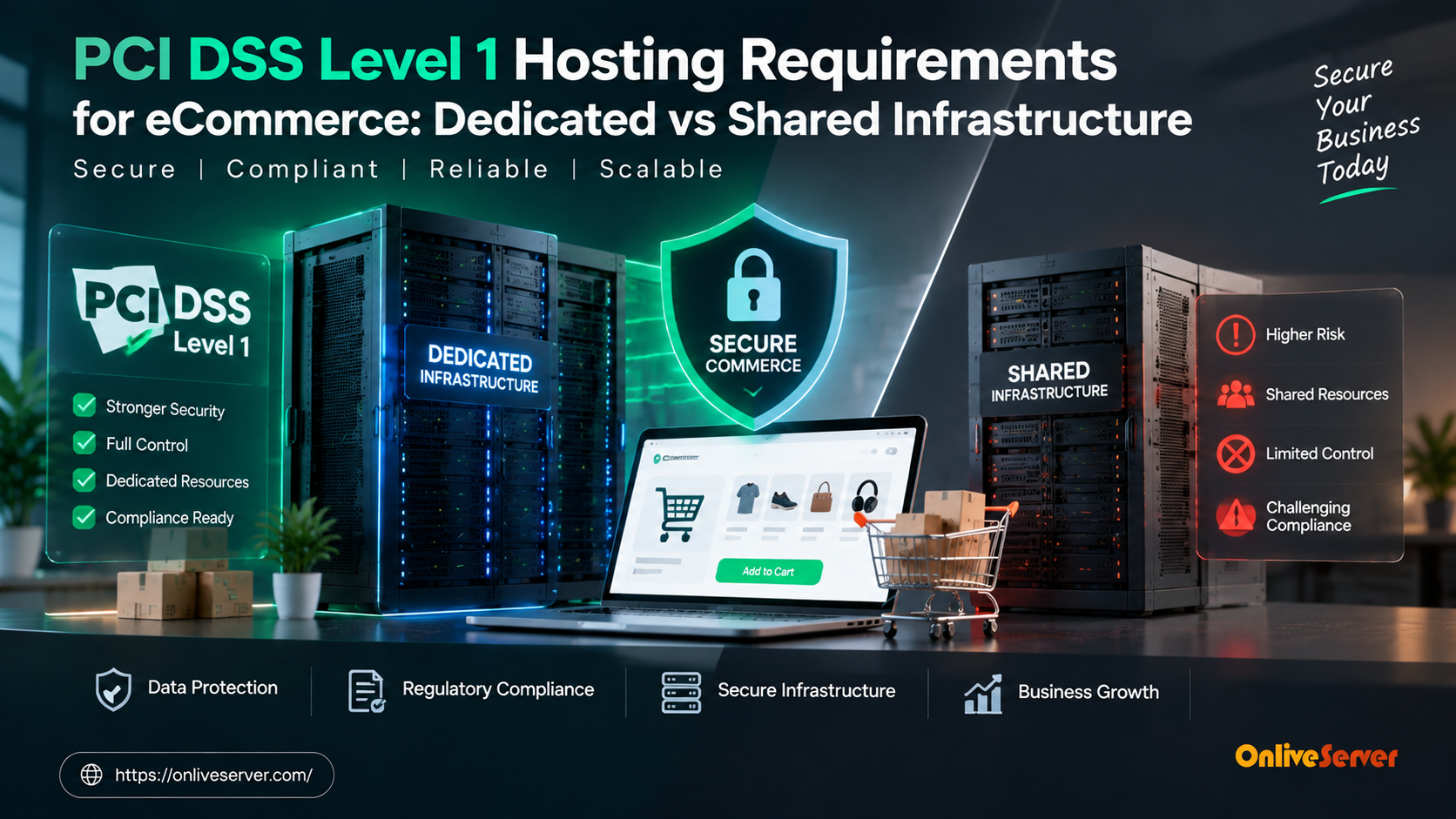
PCI DSS Level 1 compliance mandates physical or hypervisor-level isolation (bare-metal dedicated servers or dedicated single-tenant private cloud), explicitly prohibiting shared public hosting where adjacent tenants share physical memory or kernels. Mandatory controls include two-factor authentication (2FA) on all management endpoints, end-to-end AES-256 encryption for cardholder data at rest and TLS 1.3 in transit, and quarterly external ASV vulnerability scans.
What Are PCI DSS Hosting Requirements for eCommerce?
PCI DSS hosting requirements focus on protecting the systems and infrastructure that store, process, transmit, or can impact the security of cardholder data. For eCommerce, this includes secure access, network protection, vulnerability management, logging, monitoring, and appropriate isolation. Shared hosting can be used only when the required controls and responsibilities are properly addressed. For verified technical specifications and deployment parameters, consult the official Linux Kernel Documentation.
Your hosting environment should also have clearly defined security responsibilities between the merchant and hosting provider. A dedicated environment can provide greater control over server configuration and resource isolation, but a enterprise bare-metal server infrastructure option is not automatically PCI DSS compliant. The actual compliance scope depends on your payment architecture, cardholder-data environment, provider responsibilities, and applicable PCI DSS requirements.
Why Does Hosting Infrastructure Matter for PCI DSS Compliance?
Hosting infrastructure matters for PCI DSS because servers, networks, applications, and access controls can store, process, transmit, or affect the security of cardholder data. The infrastructure must support appropriate isolation, access control, monitoring, vulnerability management, and other applicable security controls. The exact requirements depend on the environment and PCI DSS scope.
For eCommerce businesses, the hosting environment is part of the broader security architecture. Shared or multi-tenant infrastructure requires appropriate controls to separate customer environments and data. PCI DSS specifically includes additional requirements for multi-tenant service providers, including protecting and separating customer environments and restricting access to each customer’s resources.
A dedicated server can provide greater control over the operating environment, but it doesn’t automatically make a system PCI DSS compliant. The merchant and its service providers still need to understand their respective responsibilities, maintain appropriate controls, and determine the applicable PCI DSS requirements based on the actual cardholder-data environment.
What Does PCI DSS Level 1 Mean for eCommerce Businesses?
PCI DSS Level 1 generally refers to a higher level of compliance validation defined by the applicable payment brand or acquirer. For an eCommerce business, it can involve more formal assessment and reporting requirements. The exact criteria depend on the payment brand, acquirer, transaction environment, and the merchant’s cardholder-data environment.
For eCommerce businesses, the important consideration is understanding which systems and payment processes are within PCI DSS scope. PCI DSS applies to entities that store, process, or transmit cardholder data, as well as systems that can impact the security of the cardholder-data environment. The required validation method can also depend on how payment processing is outsourced and how the checkout is implemented.
If payment processing is fully outsourced to a PCI DSS-compliant third-party provider, the merchant may have a different validation path than a business whose website or systems handle account data directly. Merchants should confirm their specific requirements with their acquirer or applicable payment brand rather than assuming that a particular hosting model automatically determines PCI DSS Level 1 status.
PCI DSS Dedicated vs Shared Hosting: What’s the Difference?
The main difference between dedicated and shared hosting is the level of infrastructure isolation and control available to the merchant. In a shared environment, multiple customers may use shared physical or virtual resources, so the provider must address appropriate tenant isolation and security controls. A dedicated server assigns the server to one customer, which can simplify infrastructure separation, but it does not automatically make the customer environment PCI DSS compliant.
| Factor | Shared / Multi-Tenant Hosting | Dedicated Hosting |
|---|---|---|
| Infrastructure | Physical or virtual resources may be shared with other customers. | Server resources are dedicated to one customer. |
| Tenant Isolation | Providers must implement appropriate controls to protect and separate customer environments. | Physical server separation reduces multi-tenant considerations for that server. |
| Configuration Control | Often more limited because the provider manages shared infrastructure. | Greater control over server configuration and security settings. |
| Access Management | Depends on the architecture, payment setup, and applicable controls. | Depends on the merchant’s environment and payment architecture; dedicated hosting alone doesn’t determine scope. |
| Best Evaluation Approach | Verify tenant isolation, provider controls, compliance evidence, and shared responsibilities. | Verify server security, provider responsibilities, configuration, monitoring, and the overall PCI DSS scope. |
What Are the Key PCI Compliant Dedicated Server Requirements?
A PCI-compliant dedicated server should support access control, secure configuration, vulnerability management, logging, monitoring, and network protection. However, dedicated hosting alone doesn’t make an eCommerce environment PCI DSS compliant.
Can a Dedicated Server Make PCI DSS Compliance Easier?
A dedicated server can make PCI DSS compliance easier to manage by providing greater control over server configuration, access, network rules, and resource isolation. It can also support faster infrastructure performance and explain how dedicated servers improve page load speed through dedicated CPU, RAM, and storage resources. However, dedicated hosting alone doesn’t make an eCommerce environment PCI DSS compliant; all applicable controls and responsibilities still need to be addressed.
What Should You Ask a Hosting Provider About PCI DSS?
Before choosing a hosting provider, verify how its infrastructure supports PCI DSS compliance for eCommerce hosting. Ask about its current compliance documentation, security controls, access management, vulnerability management, logging, monitoring, and responsibilities. Confirm whether the provider can supply an applicable Attestation of Compliance and clearly explain which PCI DSS requirements are managed by the provider and which remain your responsibility.
Ready to Strengthen Your eCommerce Hosting Infrastructure?
Don’t let limited server control or unclear security responsibilities create unnecessary PCI DSS challenges. Choose an infrastructure that gives your eCommerce environment the control, isolation, and configuration flexibility it needs. Explore our Dedicated Server Cheap Hosting Options and evaluate the resources required for your workload.
Frequently Asked Questions
What are the main PCI DSS hosting requirements for eCommerce?
PCI DSS hosting requirements include appropriate access control, secure configuration, vulnerability management, network protection, logging, monitoring, and protection of cardholder data. The exact controls depend on the systems in scope and how payment data is stored, processed, or transmitted.
Is a dedicated server automatically PCI DSS compliant?
No. A dedicated server provides greater control and infrastructure isolation, but it doesn’t automatically make an eCommerce environment PCI DSS compliant. The merchant must still implement and maintain all applicable security controls and address its responsibilities within the cardholder data environment.
Can shared hosting be PCI DSS compliant?
Shared or multi-tenant hosting can be used in environments subject to PCI DSS when the required security controls are properly implemented. Providers may need to address additional requirements for protecting and separating customer environments. Merchants should verify the provider’s applicable compliance documentation and responsibilities.
What is a PCI compliant dedicated server?
A PCI compliant dedicated server is part of a hosting environment designed to support applicable PCI DSS security requirements. It should provide appropriate access controls, secure configuration, vulnerability management, monitoring, and network protection. However, the server itself doesn’t determine the merchant’s overall PCI DSS compliance.
Does PCI DSS apply if payment processing is outsourced?
PCI DSS responsibilities can still apply when payment processing is outsourced. The merchant’s scope depends on its payment architecture and how cardholder data interacts with its systems. Outsourcing payment processing doesn’t automatically remove all PCI DSS responsibilities, so merchants should confirm their specific scope with their acquirer and applicable payment providers.
What should I check before choosing PCI DSS eCommerce hosting?
Check the provider’s current PCI DSS compliance documentation, applicable Attestation of Compliance, security controls, access management, vulnerability management, logging, monitoring, and responsibility boundaries. Confirm that the documentation and services apply to the specific hosting environment you’re purchasing.
Does dedicated hosting reduce PCI DSS compliance scope?
Not necessarily. Dedicated hosting can provide greater infrastructure control and isolation, but it doesn’t automatically reduce PCI DSS scope. Scope depends on the complete payment architecture, systems involved, data flows, and applicable requirements. A qualified PCI DSS assessor or your acquiring bank can help determine the appropriate scope.
Conclusion: Strategic Architecture & Performance Summary
Implementing these technical optimizations for pci dss level 1 hosting requirements for ecommerce: dedicated vs shared infrastructure ensures robust throughput, predictable latency, and maximum system reliability across production environments. Rigorous benchmarking and proactive parameter tuning eliminate latent resource bottlenecks before they impact end users.
Pairing disciplined operating system administration with reliable compute foundations is essential for mission-critical operations. Deploying workloads on enterprise dedicated server hosting provides the dedicated resources, network resilience, and hardware acceleration necessary to sustain high availability under heavy production load.
Wrapping Up
PCI DSS hosting requirements go beyond simply choosing a dedicated or shared server. eCommerce businesses need to consider infrastructure isolation, access controls, secure configuration, vulnerability management, monitoring, and clearly defined provider responsibilities. A dedicated server can provide greater control over the hosting environment, but it doesn’t automatically make a business PCI DSS compliant. Reviewing the hosting architecture and applicable PCI DSS responsibilities helps create a more secure and manageable eCommerce environment.
