

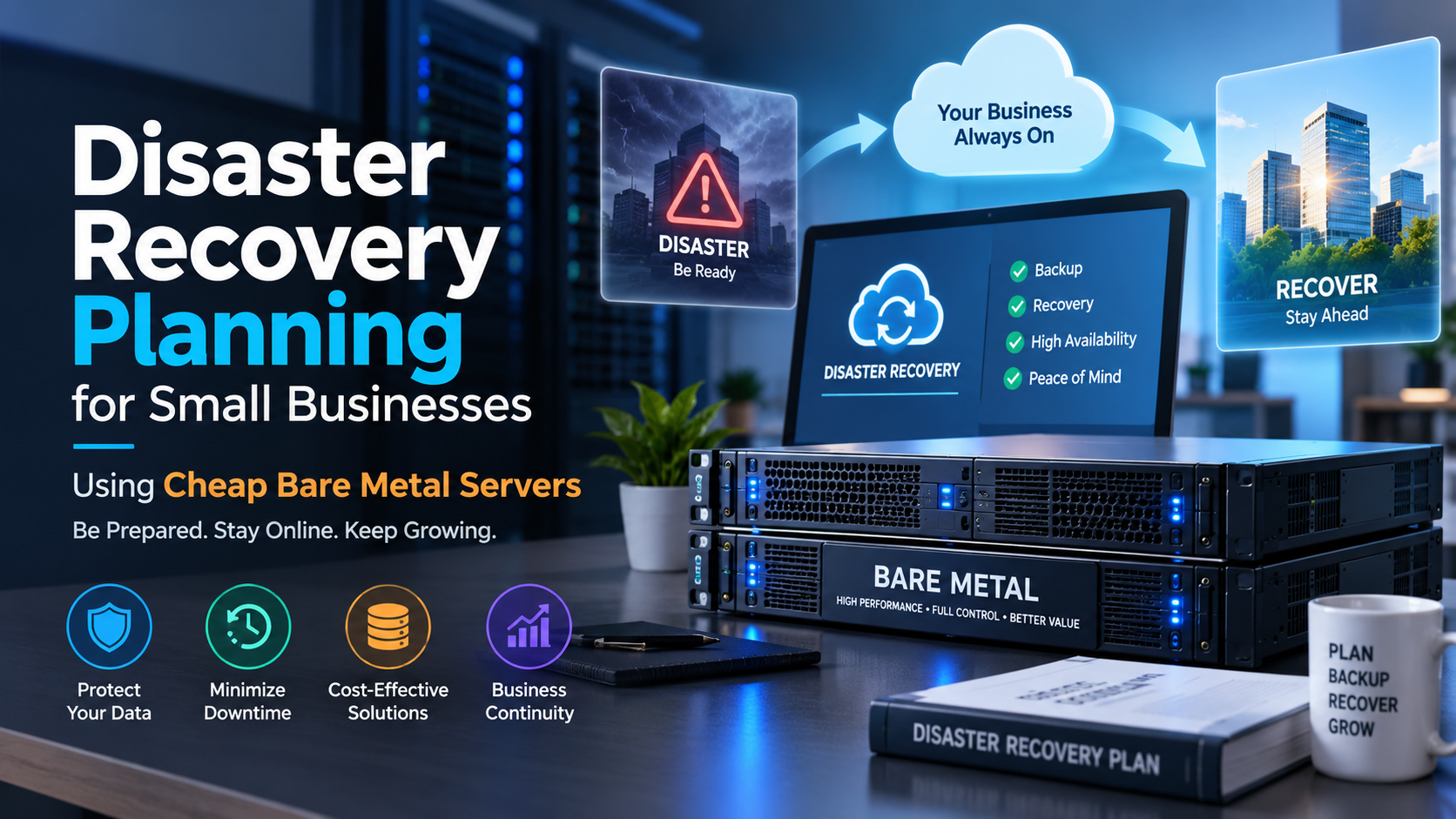
Small businesses can implement resilient disaster recovery by utilizing a budget bare-metal dedicated server as an isolated, offsite backup and replication target. Adopting the 3-2-1 backup strategy (3 copies of data, 2 different media formats, 1 offsite copy), configure automated daily encrypted snapshot replication using BorgBackup, Restic, or ZFS send/receive to ensure rapid recovery during ransomware attacks or primary site failures.
Historically, robust multi-site disaster recovery (DR) was reserved exclusively for Fortune 500 enterprises with multimillion-dollar IT budgets. Public cloud hyperscalers charge prohibitive data egress fees and hourly compute premiums for standing reserve instances. However, the emergence of high-throughput dedicated hardware has transformed the economics of business continuity. For verified technical specifications and deployment parameters, consult the official Linux Kernel Documentation.
By leveraging an affordable, unmetered cheap 1gbps dedicated server as an off-site replication target, growing businesses can maintain synchronized database replicas, automated ZFS snapshots, and instant containerized failover environments. While primary applications may run across production clusters or scalable budget VPS hosting server deployments, a dedicated bare-metal DR target provides unconstrained compute power when disaster strikes.
1. The 3 Core Pillars of Cost-Effective Bare-Metal Disaster Recovery
Building a resilient disaster recovery strategy on budget bare metal relies on three foundational engineering principles:
2. Establishing Your Business DR Metrics: RPO, RTO & MTD
Before selecting hardware or writing backup automation scripts, define your organization’s critical recovery thresholds:
- Recovery Point Objective (RPO): The maximum acceptable age of files or transactions that must be recovered from backup storage for normal operations to resume. For transactional e-commerce, an RPO of 15 minutes or less prevents unrecoverable order loss.
- Recovery Time Objective (RTO): The maximum acceptable duration of time that a system can remain offline after a disaster strikes before causing irreparable operational damage.
- Maximum Tolerable Downtime (MTD): The total cumulative time your business can survive without its core digital infrastructure before facing bankruptcy or severe regulatory noncompliance.
3. The 3 Architectural Standby Models on Cheap Bare Metal
Depending on your budget and recovery objectives, configure your dedicated bare-metal server using one of three proven continuity topologies:
A. Cold Standby (Off-Site Immutable Vault)
The bare-metal server acts as an encrypted storage repository receiving nightly disk images and database dumps. In a crisis, sysadmins manually spin up virtual machines or containers. Cost: Lowest | RTO: 4 to 8 Hours | RPO: 12 to 24 Hours.
B. Warm Standby (Continuous Replica with Scaled Containers)
The dedicated server runs live read-only database replicas receiving continuous binary log streams, with container orchestration templates (Docker Compose / Kubernetes) pre-configured. Upon primary failure, a DNS switch activates full traffic. Cost: Highly Affordable | RTO: 15 to 30 Minutes | RPO: < 5 Minutes.
C. Hot Standby (Active-Passive Automated Failover)
A fully redundant bare-metal mirror running in an independent geographic region, utilizing BGP Anycast or Cloudflare Geo-DNS health routing for instantaneous zero-touch traffic failover. Cost: Moderate | RTO: < 60 Seconds | RPO: Near-Zero. Explore hardware performance dynamics in our analysis of the future of budget bare metal hosting.
4. The 7-Step Small Business Disaster Recovery Action Blueprint
Follow this systematic engineering workflow to establish an end-to-end bare-metal business continuity pipeline:
- Business Impact Analysis (BIA): Catalog all revenue-generating digital assets, identifying core database schemas, static asset stores, and API gateway endpoints.
- Dedicated DR Target Provisioning: Commission an off-site bare-metal node with hardware-level RAID-1/10 NVMe storage in a geographically remote data center.
- Encrypted WireGuard / IPsec Tunneling: Interconnect primary production infrastructure with the secondary DR node over a dedicated, hardware-encrypted VPN tunnel.
- Continuous Transaction Log Shipping: Configure MySQL/MariaDB binlog replication or PostgreSQL WAL archiving to stream transactions in real time.
- ZFS Snapshot Automation: Schedule hourly incremental filesystem snapshots retained under immutable WORM policies for 30 days.
- Automated Health Monitoring & DNS Failover: Configure third-party synthetic health probes (e.g., Cloudflare Load Balancing / Route 53) to trigger failover routing automatically.
- Bi-Annual Tabletop Fire Drills: Execute unannounced simulated outages to validate team runbooks, measure actual RTO recovery speeds, and eliminate operational bottlenecks.
5. Implementing the Modern 3-2-1-1-0 Resilience Rule
Enhance the traditional backup paradigm into the modern enterprise standard for complete ransomware immunity:
- 3 Copies of Data: Maintain one primary production copy and two distinct backup sets.
- 2 Different Media Types: Store snapshots across local NVMe storage and remote bare-metal object stores.
- 1 Off-Site Location: Host your dedicated DR server in a distinct geographic availability zone separated by at least 300 miles.
- 1 Immutable / Air-Gapped Copy: Utilize WORM (Write Once, Read Many) or ZFS snapshot holds with restricted SSH keys that prevent ransomware from deleting backup history.
- 0 Errors After Automated Verification: Conduct automated daily restoration verification scripts to guarantee archive integrity.
6. Disaster Recovery Architecture Models Comparison
Compare how different disaster recovery strategies align with organizational budgets and operational risk profiles:
| DR Architecture Model | Target RPO Window | Target RTO Window | Infrastructure Cost | Recommended SMB Use Case |
|---|---|---|---|---|
| Cold Bare-Metal Vault | 12 – 24 Hours | 4 – 8 Hours | Lowest ($28 – $50/mo) | Static websites & non-critical internal tools |
| Warm Bare-Metal Standby | < 5 Minutes | 15 – 30 Minutes | Affordable ($60 – $120/mo) | Growing E-Commerce, SaaS & Digital Agencies |
| Hot Active-Passive Mirror | Near-Zero (< 1s) | < 60 Seconds | Moderate ($150 – $300/mo) | FinTech, Healthcare & High-Frequency DBs |
7. Automated 1 Gbps Off-Site ZFS & MySQL Replication Shell
Automate incremental snapshot synchronization directly over secure SSH using your dedicated 1 Gbps uplink after connecting to backup servers via SSH:
8. Real-World Case Studies: Small Businesses Saved by Bare-Metal DR
Case Study A: Logistics Firm Defeats Ransomware in 22 Minutes
A regional trucking logistics company was hit by ransomware that encrypted their local SAN. By leveraging an immutable off-site bare-metal server with hourly ZFS snapshots, the team rolled back their entire 12TB database in just 22 minutes with zero ransom paid. Protect your perimeter by protecting your systems from unauthorized access.
Case Study B: FinTech SaaS Maintains Uptime During Datacenter Flood
When a municipal water main break disabled a primary European data facility, a payment SaaS executed automated Cloudflare DNS failover to an Onlive Server bare-metal node in Frankfurt. API services resumed in 45 seconds. Discover optimal deployment blueprints in our guide on launching websites with virtual private servers.
9. Top 5 Fatal Disaster Recovery Planning Mistakes
📌 Frequently Asked Questions (FAQ)
Q Why use a cheap 1Gbps dedicated server instead of public cloud storage for DR?
Q How frequently should a small business conduct disaster recovery drills?
Q Can I host my production database and DR target in different countries?
Q What network bandwidth is required for continuous off-site replication?
Conclusion: Architecting a Bulletproof Small Business Disaster Recovery Plan
Disaster recovery readiness is not an afterthought but a fundamental business continuity requirement. Establishing automated, encrypted data replication to an independent secondary server guarantees business operations can resume within minutes of a catastrophic incident.
Leveraging budget-friendly dedicated hardware for hot-standby or cold-backup recovery environments offers enterprise-grade data protection without enterprise pricing. Secure your business data with Onlive Server automated backup and disaster recovery solutions.
When processing intensive multi-threaded database transactions or mission-critical enterprise workloads, deploying on enterprise dedicated server hosting provides bare-metal hardware performance, custom RAID arrays, and dedicated unmetered bandwidth.
10. Conclusion: Fortify Your Small Business Continuity
Disaster recovery planning is no longer an optional luxury—it is the ultimate insurance policy for your digital enterprise. By deploying an affordable, unmetered cheap 1Gbps dedicated bare-metal server as your off-site recovery node, you achieve sub-15-minute RPO/RTO resilience, ransomware immunity, and 100% infrastructure sovereignty.
Safeguard your mission-critical operations with Onlive Server’s global fleet of high-performance dedicated bare-metal servers, offering unmetered 1 Gbps connectivity, enterprise NVMe storage arrays, and 24/7 expert Linux systems engineering support.
