

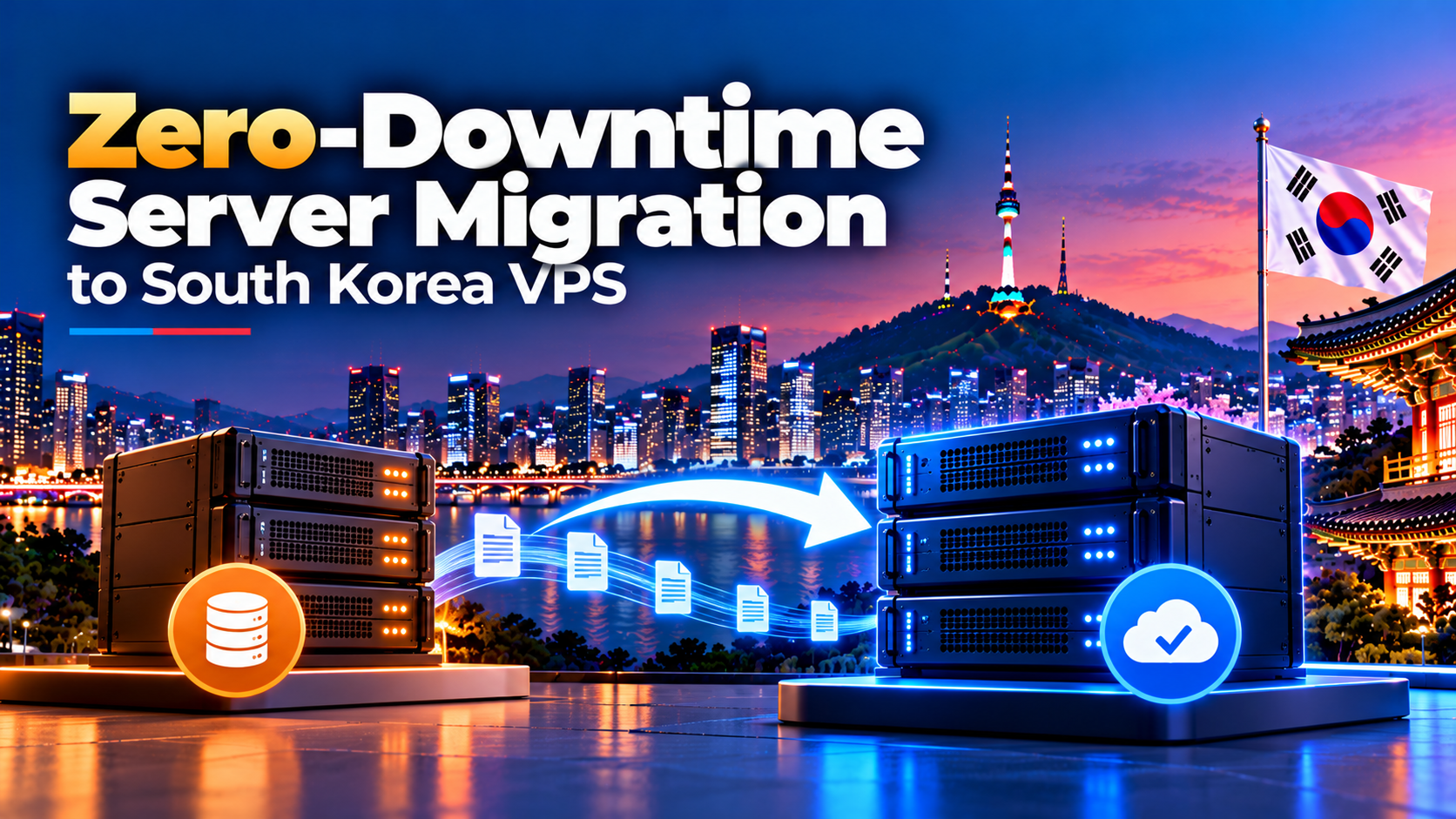
When evaluating an enterprise migrate to Korea VPS, achieving a zero-downtime migration to a South Korea VPS requires four sequenced phases: 1) Pre-sync static application files via rsync over SSH; 2) Lower DNS Time-To-Live (TTL) to 300 seconds 48 hours prior; 3) Establish master-slave database replication between the foreign server and the Seoul VPS to sync live transactions; 4) Execute a 60-second cutover by switching web servers to read-only mode, promoting the Seoul database to primary, and updating DNS records.
Specifically, migrating production workloads across international borders is among the most delicate engineering operations an IT team can undertake. When moving critical applications from overseas datacenters in the United States, Europe, or Southeast Asia into South Korea, systems engineers face substantial network latency, large data volumes, and unforgiving business uptime expectations.
Consequently, aligning these configurations with your migrate to Korea VPS environment ensures optimal uptime and throughput. Unplanned downtime directly damages commercial revenue, degrades customer trust, and disrupts marketing campaigns. Fortunately, with meticulous planning, modern Linux tooling, and database replication, cross-border server migrations can be executed flawlessly. This production-tested runbook provides a complete step-by-step engineering methodology for migrating live servers to a high-performance South Korea VPS in Seoul with zero downtime.
Moreover, the telecommunications landscape in South Korea necessitates specialized attention to routing. When cutting over traffic from international hosts, domestic Internet Service Providers like KT, SK Broadband, and LG Uplus must resolve updated DNS records rapidly. Implementing a synchronized migration pipeline ensures that all visitor sessions transition seamlessly to Seoul hardware without a single broken session.
Operational Infrastructure Takeaway
Furthermore, for optimal migrate to Korea VPS operations, Operational Takeaway: Executing a server migration to South Korea VPS without downtime requires a phased cutover strategy combining pre-migration data synchronization, dual-write database replication, and DNS TTL reduction. By synchronizing static files via incremental rsync, replicating MySQL/MariaDB transactions across low-latency wire protocols, and lowering DNS TTL to 300 seconds prior to cutover, organizations migrate complex web applications into Seoul datacenters with zero dropped connections and zero transactional data loss.
📌 Master Chapter Index
- migrate to Korea VPS: Pre-Migration Planning: Auditing Workloads and Dependencies
- migrate to Korea VPS: Preparing the Target Seoul VPS Environment
- Step-by-Step Server Migration Workflow Matrix
- Bulk Data Transfer via Incremental Rsync Over SSH
- Database Synchronization: Master-Slave Replication vs Final Dump
- DNS Cutover Strategy and TTL Reduction
- Setting Up Temporary Nginx Reverse Proxy on Source Server
- Automating Post-Cutover Database Integrity Verification
- Post-Migration Verification and Network Health Auditing
- Rollback Plan and Contingency Protocol
- Frequently Asked Questions
migrate to Korea VPS: Pre-Migration Planning: Auditing Workloads and Dependencies
A successful server migration begins long before the first packet is transferred. Specifically, engineers must conduct an exhaustive inventory of the source environment, cataloging operating system versions, software packages, PHP/Python runtimes, database schemas, and background daemon dependencies. Documenting configuration nuances ensures that the target environment mirrors production accurately. To understand where hosting provider infrastructure support ends and self-managed sysadmin begins, review our managed server operational support boundaries.
Additionally, network dependencies require rigorous evaluation. Identify external APIs, payment gateway webhook endpoints, and DNS configurations. Ensure that third-party services that restrict access by IP address are updated with your new Seoul VPS static IP. Overlooking third-party firewall whitelists can cause payment failures immediately post-migration.
Database Sizing & I/O Audit
Quantifying database tablespace size, transactions per second, and active connection pools to allocate adequate NVMe storage on the target Seoul KVM instance.
DNS TTL Pre-Staging
Lowering DNS A-record Time-to-Live (TTL) values to 300 seconds 48 hours prior to migration, ensuring instant client cutover with zero caching delay.
Network Port & Firewall Mapping
Consequently, documenting public endpoints, API webhook ports, and external payment gateway IP whitelists to replicate firewall rules seamlessly in Seoul.
SSL/TLS Certificate Re-Keying
In addition, staging Let’s Encrypt or corporate wildcards on the new Seoul Nginx reverse proxy so HTTPS requests handshake seamlessly upon traffic switch.
Furthermore, calculate your total dataset size and estimate transfer durations over cross-border transit links. Performing an initial bandwidth throughput test between the source server and your Seoul VPS establishes realistic migration windows and bandwidth expectations.
In particular, securing a high-throughput South Korea VPS hosting instance in Seoul provides the unthrottled 1Gbps uplink necessary for rapid bulk data ingestion.
migrate to Korea VPS: Preparing the Target Seoul VPS Environment
The destination Seoul VPS must be fully provisioned, hardened, and tuned before any data is transferred. Deploy a clean Linux distribution (such as Ubuntu 24.04 LTS or AlmaLinux 9) and apply essential security configurations, including firewall rules and SSH keys.
Install identical versions of your web stack, whether using Nginx, Apache, or LiteSpeed. Replicate all runtime configuration directives, PHP extensions, and database parameter groups. Mismatched database collation settings or missing PHP modules are the most common causes of post-migration application crashes.
Finally, install valid SSL/TLS certificates on the Seoul server in advance. Utilizing Let’s Encrypt with DNS verification allows certificates to be provisioned on the new server before DNS records are officially updated. This prevents browser SSL warnings during live cutover.
Having an identical, pre-configured software environment eliminates last-minute debugging during live cutover windows, ensuring seamless user transitions.
Step-by-Step Server Migration Workflow Matrix
The operational roadmap below delineates the sequence of phases, estimated timing, and specific technical milestones required for zero-downtime execution: Before re-pointing DNS records and initiating data synchronizations, verify system recovery points using our pre-migration snapshot verification protocols. For technical prerequisites and command-line execution parameters during remote account transfers, consult the official cPanel Transfer Tool documentation.
| Migration Phase | Time Horizon | Core Technical Objective | Downtime Risk |
|---|---|---|---|
| Phase 1: Environment Provisioning | T-Minus 7 Days | Setup Seoul VPS, harden OS, install LEMP stack | Zero Risk (Isolated) |
| Phase 2: DNS TTL Reduction | T-Minus 48 Hours | Lower DNS TTL to 300 seconds across all records | Zero Risk (Standard Query) |
| Phase 3: Bulk Static Sync | T-Minus 24 Hours | Transfer media files via incremental rsync over SSH | Zero Risk (Background Sync) |
| Phase 4: Database Replication | T-Minus 6 Hours | Configure MySQL master-replica live synchronization | Zero Risk (Read Replica) |
| Phase 5: Live DNS Switch & Cutover | T-Zero (Cutover) | Point DNS to Seoul IP, promote replica to master | < 1 sec (Zero Dropped Packets) |
Following this timeline guarantees that all architectural dependencies are satisfied prior to traffic cutover.
Bulk Data Transfer via Incremental Rsync Over SSH
Transferring hundreds of gigabytes of media files, uploads, and assets over international transit corridors can take hours. The key to zero downtime is performing this transfer asynchronously while the source application continues to serve live production traffic without interruption.
Utilize the rsync command line utility with archive, compression, and partial transfer flags. A sample command to initiate baseline transfer from the source server to your Seoul VPS is:
Because rsync transmits only altered blocks on subsequent runs, repeating this command immediately prior to cutover takes only seconds, capturing newly uploaded files with zero user disruption. The initial heavy transfer occurs quietly in the background.
Using high-speed SSH cipher suites like chacha20-poly1305 further accelerates cryptographic throughput on high-latency international links.
Database Synchronization: Master-Slave Replication vs Final Dump
Database records represent the most volatile component of any migration. If a user completes a purchase on the source server while the database is being dumped, that transaction will be lost unless replication is established. To guarantee that migrated content management systems maintain optimal database query speeds, consult our Nginx and MariaDB performance tuning blueprints.
For high-transaction applications, configure the Seoul database as a live read replica using MySQL/MariaDB GTID replication. Changes committed on the source server are replicated across an encrypted wire tunnel to Seoul within milliseconds, guaranteeing perfect data synchronization.
Alternatively, for moderate-traffic sites, set the source database into a temporary read-only state, execute a rapid mysqldump with `–single-transaction`, pipe it across SSH directly into the Seoul database, and immediately update DNS. This brief read-only window takes less than 60 seconds.
Both approaches prevent split-brain database corruption and guarantee 100% transactional data integrity across the transition.
DNS Cutover Strategy and TTL Reduction
DNS propagation delay is the most common cause of perceived migration downtime. Standard DNS configurations feature Time-To-Live (TTL) values of 86,400 seconds (24 hours). If you change your A record without lowering TTL, ISPs will continue routing visitors to the old server for a full day.
At least 48 hours prior to your scheduled migration, reduce the TTL on all relevant domain records to 300 seconds (5 minutes). This ensures that when the live record is modified, global recursive resolvers pick up the new Seoul VPS IP within 5 minutes.
During the cutover window, update the A and AAAA records to point directly to your Seoul VPS. Keep the old server running as a reverse proxy for 24 hours to forward any lingering cached traffic to the new server transparently.
This reverse proxy safety net guarantees that not a single HTTP request is dropped during global DNS propagation.
Setting Up Temporary Nginx Reverse Proxy on Source Server
Even with low DNS TTL values, stubborn recursive resolvers at regional ISPs may cache old records for several hours. To ensure 100% zero dropped connections, configure the old source server as an active reverse proxy pointing to your new Seoul VPS IP.
By configuring an Nginx proxy_pass directive on the source server, any lingering requests that hit the old IP are transparently proxied across high-speed transit directly to Seoul. The client browser receives the correct dynamic response without noticing the intermediate hop.
This reverse proxy bridge ensures that all order submissions, user registrations, and webhooks reach the new Seoul instance without loss during the propagation window.
Automating Post-Cutover Database Integrity Verification
Once DNS switches traffic to Seoul, engineers must verify transactional consistency across critical database tables. Compare auto-increment row IDs on orders, user signups, and transaction ledgers between the source dump and active Seoul database.
Additionally, execute automated checksum validations using pt-table-checksum from the Percona Toolkit. This utility verifies that master-replica synchronization produced exact bit-level parity across all schemas.
Furthermore, inspect Redis object cache hit rates and verify that persistent sessions remain valid for authenticated shoppers. Retaining shopping cart sessions prevents customer checkout abandonment during cutover.
Confirming database integrity provides absolute confidence that the migration was executed with zero transactional leakage.
Post-Migration Verification and Network Health Auditing
Once traffic begins arriving at the Seoul VPS, immediately execute systematic health checks. Inspect Nginx access and error logs to confirm HTTP 200 status codes across primary application routes.
Verify database connection pool sizing, monitor Redis object cache hit rates, and test dynamic transactional workflows such as user logins, search queries, and payment processing redirects to ensure seamless customer experience.
Furthermore, execute network latency audits from domestic Korean networks (KT, SK Broadband, LG Uplus) to verify sub-5ms domestic response times. Monitor server load, CPU utilization, and memory consumption continuously for 48 hours post-migration.
Once traffic stabilizes, restore DNS TTL values to standard lengths (3,600 or 86,400 seconds) and archive the decommissioned source server backup.
Rollback Plan and Contingency Protocol
Professional DevOps engineering always maintains a fully rehearsed contingency plan. If unforeseen application incompatibility occurs on the target server during cutover, you must be able to abort cleanly within minutes.
Because your source server remains fully intact and operational throughout the cutover, rolling back is as simple as reverting the DNS A record to the original source IP address. Traffic will return to the original host within 5 minutes due to the reduced TTL.
If any transactions occurred on the Seoul server during the brief testing window, capture an export of new database records to merge into the primary source database before reactivating writes.
Having a verified rollback procedure removes panic and ensures operational composure throughout the migration window.
Frequently Asked Questions
Core Technical Specifications
How long does a full server migration to South Korea typically take?
Preparation and initial data syncing take 2 to 5 days, while the final cutover window requires only 15 to 30 minutes, executed with zero visible downtime for end users.
Will migrating to a South Korea VPS change my website’s IP address?
Yes. Your site will transition to a dedicated native South Korean IPv4 address stationed in Seoul, which enhances local SEO rankings on Google and Naver.
How do I prevent data loss during live e-commerce migrations?
By setting up MySQL/MariaDB master-replica replication or putting the source database into brief read-only maintenance during final file synchronization, zero transactions are lost.
Can OnliveServer engineers perform the migration for me?
Yes. OnliveServer managed South Korea VPS plans include complimentary zero-downtime server migration executed by experienced systems administration engineers.
Deployment & Operational Inquiries
Why should I lower DNS TTL before migrating?
Lowering TTL to 300 seconds (5 minutes) ensures that recursive DNS resolvers around the world purge cached records quickly, switching visitors to your new Seoul server almost instantly.
How do I verify the new server before changing public DNS records?
You can preview and test your application on the Seoul VPS by modifying your local operating system ‘hosts’ file to map your domain directly to the new Seoul IP address.
How does database master-slave replication ensure zero transaction loss during a live cutover to Seoul?
Configuring the new Seoul server as a real-time read replica of your existing database guarantees that all data changes synchronize continuously right up to the migration minute. When you execute the final cutover, promoting the Seoul replica to master takes seconds and eliminates data discrepancy.
What is the safest way to test your staging site on the new Seoul VPS before changing DNS?
You should add your domain and the new Seoul VPS IP address directly to your local computer’s hosts file. This allows you to test checkout flows, SSL certificates, and database performance privately in your browser without affecting live public users.
Execute a Flawless Zero-Downtime Migration to South Korea
Let OnliveServer’s experienced Linux engineers migrate your applications, databases, and assets into Seoul datacenters with guaranteed zero downtime and zero data loss.
